


TL;DR:
- Adequate hydration is essential for core bodily functions like temperature regulation, waste removal, and tissue protection. Drinking 1.5 to 2 liters daily, with adjustments for activity or health, helps maintain balance and prevent conditions like dehydration and kidney stones. Small habits like carrying water and monitoring urine color support long-term health and well-being.
Adequate hydration supports every core function your body performs, from regulating temperature to clearing waste, and it reduces the risk of common conditions including urinary tract infections, kidney stones, and constipation. Both the NHS and the British Dietetic Association are clear on this: most adults need an adequate amount of fluid daily, and falling short even mildly has measurable effects on mood, concentration, and physical performance. Two things you can do right now: keep a glass or bottle within arm’s reach, and check your urine colour. Pale straw is what you are aiming for.
Table of Contents
- What does water actually do inside your body?
- How much should you drink each day?
- How do you recognise dehydration?
- What health conditions does poor hydration raise the risk of?
- Which drinks and foods actually count towards hydration?
- How quickly does water actually hydrate you?
- What does the research say about long-term disease risk?
- How to make staying hydrated a daily habit
- When should you seek help for dehydration?
- Key takeaways
- A perspective on hydration from the Naturessoulshop wellness team
- Useful sources and further reading
What does water actually do inside your body?
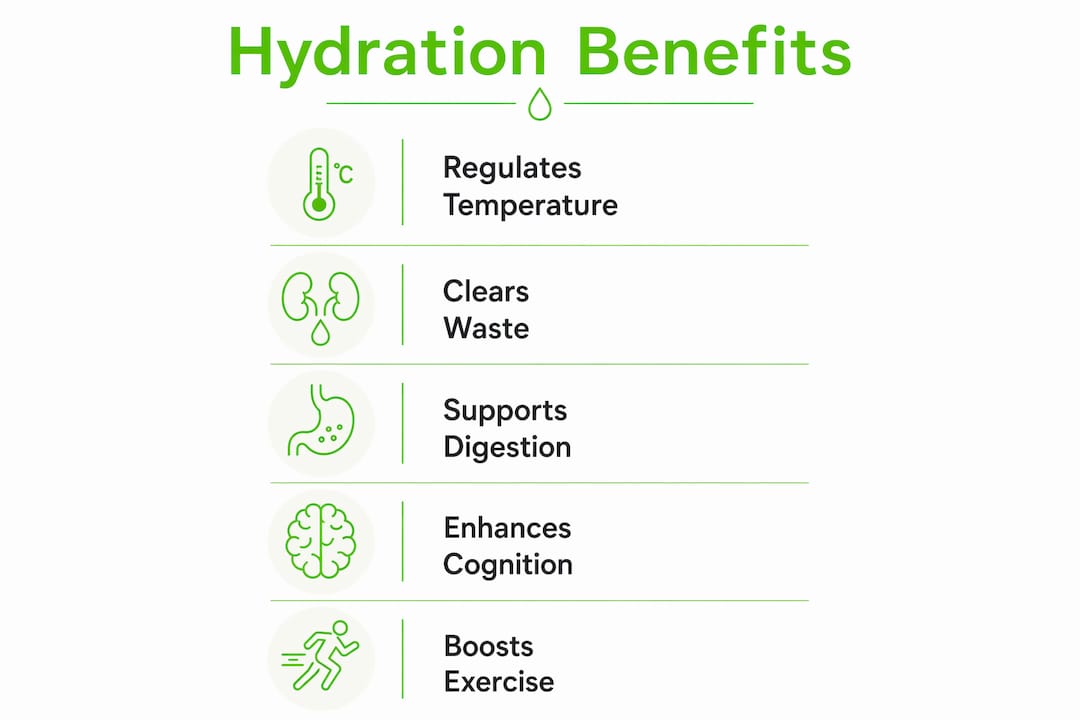
Water makes up approximately 50–66% of total body weight, which gives you a sense of how central it is to almost every physiological process. Strip it back and there are five functions that matter most:
- Temperature regulation: Sweat is your body’s cooling system. Without adequate fluid, that system fails and core temperature rises.
- Waste removal: The kidneys need water to filter blood and produce urine; the bowel needs it to move waste along without hardening.
- Joint lubrication: Synovial fluid, which cushions cartilage in every joint, is largely water. Low fluid intake means less cushioning.
- Nutrient and oxygen transport: Blood plasma is mostly water. It carries glucose, vitamins, minerals, and oxygen to cells and removes carbon dioxide on the return journey.
- Tissue protection: Water acts as a shock absorber around the brain, spinal cord, and foetus during pregnancy.
The NHS and BDA both reference these functions when explaining why staying hydrated matters for everyday health, not just athletic performance. Most people associate dehydration with thirst on a hot day. The reality is that the body is managing fluid balance every minute, and even small deficits start to show.

How much should you drink each day?
The NHS recommends at least 6–8 mugs of fluid daily, which aligns closely with the BDA’s figure of 1.5–2 litres. The famous “8 glasses of water” rule is a reasonable approximation of the same target, though it was never a precise clinical threshold. What matters more than hitting an exact number is understanding that roughly 20–30% of your daily fluid comes from food, so your drink targets are not the whole picture.
| Group | Approximate daily fluid target | Notes |
|---|---|---|
| Adults (general) | 1.5–2 litres (6–8 mugs) | More in heat, illness, or activity |
| Children (4–8 years) | — | From drinks and food combined |
| Children | Around 1.5 litres | Increase with sport and warm weather |
| Pregnant women | — | Supports increased blood volume and amniotic fluid |
| Breastfeeding women | Around 2 litres or more | Fluid is lost through milk production |
| Older adults | 1.5–2 litres (scheduled) | Thirst sensation diminishes with age — drink by the clock |
Several factors push your needs higher: sustained physical activity, hot or humid weather, fever, vomiting, diarrhoea, and certain medications. Older adults deserve a specific mention because the thirst mechanism becomes less reliable with age, meaning they can be significantly dehydrated before they feel it. Scheduling drinks rather than waiting for thirst is a practical fix.
Pro Tip: If you struggle to track litres, use urine colour as your guide. Pale straw means you are well hydrated; anything darker than apple juice is a signal to drink more.
How do you recognise dehydration?
Dehydration follows a predictable progression, and catching it early is straightforward once you know what to look for.
- Mild: Thirst, dry or sticky mouth, darker urine, slight headache, reduced concentration.
- Moderate: Dizziness, low energy, noticeably reduced urine output, muscle cramps, irritability.
- Severe: Confusion or disorientation, inability to urinate, rapid heartbeat, sunken eyes, cold or blotchy skin.
The NHS lists these warning signs and notes that severe dehydration can be life-threatening, particularly in older people. If someone shows signs of severe dehydration — confusion, very low urine output, or a rapid pulse — that is a medical emergency.
When to call for help: Ring NHS 111 if symptoms are moderate and not improving with fluids. Call 999 or go to A&E immediately if the person is confused, unconscious, or unable to keep fluids down.
Fluid loss of just 1.6% of body weight has been shown to impair working memory and increase fatigue. That is a smaller deficit than most people imagine, roughly equivalent to skipping fluids for a couple of hours on a warm day.
What health conditions does poor hydration raise the risk of?
Urinary tract infections
Low fluid intake reduces urine volume and frequency, which allows bacteria to multiply in the bladder and urethra. Drinking enough to produce regular, pale urine is one of the simplest ways to reduce UTI risk, particularly for women who are already more susceptible.
Kidney stones
Concentrated urine is the primary driver of kidney stone formation. Minerals that would normally stay dissolved begin to crystallise when there is not enough water to dilute them. Increasing fluid intake is the first line of advice from most urologists and GPs for anyone with a history of stones.
Constipation
The colon draws water from stool as it passes through. Inadequate fluid intake produces harder, drier stools that are more difficult to pass. Fluid intake works alongside digestive health and fibre to keep bowel movements regular.
Cognitive effects
Research shows that even mild dehydration, defined as 1–3% body weight loss, impairs mood, working memory, and concentration. For anyone doing knowledge work or studying, this is a practical reason to keep fluids topped up throughout the day.
Exercise performance
Hydration maintains blood volume, which means the heart pumps more efficiently and muscles receive oxygen more readily. Even modest fluid deficits during exercise increase perceived effort and reduce endurance. The effect is more pronounced in heat.
Which drinks and foods actually count towards hydration?
Not everything you drink contributes equally, and some drinks actively work against you.
| Drink / food | Hydration value | Practical note |
|---|---|---|
| Plain water | Excellent | Best primary source; no calories or additives |
| Tea and coffee | Good | Mild diuretic effect is offset by fluid content for most people; counts towards daily total |
| Milk (dairy and plant-based) | Good | Provides fluid plus nutrients; useful for children and older adults |
| Fruit juice | Moderate | Contributes fluid but also sugar; limit quantity |
| Sugar-sweetened drinks | Poor | Replacing water with sugary drinks harms metabolic health; avoid as a primary source |
| Alcohol | Negative | Diuretic; increases fluid loss rather than replacing it |
| Sports drinks (isotonic) | Good for athletes | Appropriate for sustained intense exercise; unnecessary for casual activity |
| High-water foods | Moderate | Cucumber, melon, courgette, tomatoes, strawberries contribute meaningfully |
Tea and coffee are worth addressing directly because the advice has shifted. The mild diuretic effect of caffeine does not outweigh the fluid content for most people drinking moderate amounts, so your morning cup counts. That said, neither is a substitute for plain water as your primary source.
High-water fruits and vegetables deserve more credit than they typically get. Organic fruits such as watermelon, strawberries, and oranges can be over 90% water by weight, contributing meaningfully to your daily total. The BDA notes that 20–30% of daily fluid intake comes from food, so a diet rich in fresh produce genuinely reduces how much you need to drink.
For those interested in smoothies as a way to combine hydration with nutrient-dense foods, healthy smoothie recipes can be a practical way to increase both fluid and micronutrient intake in one go.
Sports drinks are appropriate when exercise lasts longer than 60–90 minutes at high intensity, because sweat losses include sodium and other electrolytes that water alone does not replace.
For a casual gym session or a 30-minute run, water is sufficient.
How quickly does water actually hydrate you?
Fluids begin to be absorbed in the small intestine within roughly 15 minutes of drinking, though full rehydration after a significant deficit takes longer, typically 45 minutes to a few hours depending on how much fluid has been lost and whether food is involved. Drinking a large volume all at once is less effective than sipping steadily, because the body can only absorb fluid at a certain rate.
For exercise, the practical approach is to drink before you start, sip during activity rather than waiting until thirsty, and continue drinking afterwards. Urine colour is a reliable post-exercise check: if it remains dark after you have cooled down, keep sipping.
During illness involving vomiting or diarrhoea, small frequent sips are more effective than large quantities, which can trigger further vomiting. Oral rehydration solutions, available from any UK pharmacy, are formulated to replace both fluid and electrolytes efficiently and are particularly useful for children and older adults.
What does the research say about long-term disease risk?
The short-term effects of dehydration on cognition and kidney function are well established. The longer-term picture is more nuanced but worth taking seriously.
NIH coverage of these studies is careful to note that observational data cannot establish causation. People who drink more water may also have healthier diets, exercise more, and smoke less. What the evidence does support is that maintaining adequate fluid intake is a low-cost, low-risk habit that sits alongside other protective behaviours.
The American Heart Association highlights hydration’s role in reducing cardiac workload by maintaining blood volume, which is particularly relevant during exercise and hot weather. A heart that does not have to work harder to compensate for low blood volume is under less strain over time.
The practical implication is straightforward: you do not need to wait for definitive causal evidence to act. Drinking enough fluid each day is one of the simplest health habits available, and the downside risk of doing so is essentially zero.
How to make staying hydrated a daily habit
Knowing you should drink more and actually doing it are different problems. These habits work in practice:
- Carry a reusable bottle. A 500ml bottle refilled three to four times covers most adults’ daily target without any tracking.
- Set reminders. A phone alert at 10am, 1pm, and 4pm catches the gaps when work absorbs attention.
- Flavour water simply. A slice of lemon, cucumber, or fresh mint makes plain water more appealing without adding sugar.
- Eat your fluids. Build meals around high-water vegetables and fruits. Home-cooked meals using fresh produce naturally increase fluid intake.
- Adapt for cold weather. Thirst is suppressed in cold conditions, but respiratory and urinary losses continue. Warm herbal teas count towards your total and are easier to drink in winter.
- Workplace habits. Keep a glass on your desk rather than relying on trips to the kitchen. Refill stations in many UK offices make this straightforward.
- Children and older adults. Neither group reliably signals thirst. Offer drinks at regular intervals rather than waiting to be asked.
The CDC recommends choosing water over sugary drinks and serving it during meals as a default. These are small structural changes that add up across a week.
When should you seek help for dehydration?
Mild dehydration resolves with steady fluid intake over a few hours. Increase your fluid intake, rest in a cool place if heat is a factor, and use an oral rehydration solution if you have been vomiting or have diarrhoea. These are available over the counter at Boots, Lloyds Pharmacy, and most supermarkets.
Contact NHS 111 if:
- Symptoms are not improving after a few hours of increased fluid intake.
- You are caring for a child or older adult who is refusing fluids or showing signs of confusion.
- You have an underlying condition such as kidney disease or diabetes that complicates rehydration.
Call 999 or go to A&E immediately if there is:
- Confusion or loss of consciousness.
- No urine output for eight or more hours.
- A rapid or irregular heartbeat.
- Fainting or inability to stand.
In hospital, severe dehydration is treated with intravenous fluids, which restore blood volume and electrolyte balance faster than oral intake can manage. This is not a home remedy situation. If someone is at the severe end of the scale described earlier, do not wait.
This article is general health information, not medical advice. Always confirm guidance with your GP or a qualified healthcare professional for your own situation.
Key takeaways
Staying adequately hydrated is one of the most effective and accessible things you can do for your long-term health, and the NHS and BDA guidance makes the daily target clear and achievable.
| Point | Details |
|---|---|
| Daily fluid target | Adults need 1.5–2 litres (6–8 mugs) daily; pale straw urine confirms good hydration. |
| Who needs extra fluid | Older adults, pregnant and breastfeeding women, children, and anyone active or unwell need more. |
| Mild dehydration has real effects | A fluid loss of just 1.6% of body weight impairs working memory and increases fatigue. |
| Water is the best primary source | Sugary drinks harm metabolic health; plain water, tea, coffee, and high-water foods all count. |
| When to seek help | Call NHS 111 for moderate symptoms not improving; call 999 for confusion, no urine, or rapid pulse. |
A perspective on hydration from the Naturessoulshop wellness team
Most hydration advice focuses on volume, and that is useful as far as it goes. What gets less attention is the quality of what people are drinking. At Naturessoulshop, working across organic food and wellness products, the pattern we see repeatedly is that people who struggle with hydration are often reaching for the wrong things: sugary drinks that spike and crash, or nothing at all because plain water feels unappealing.
The habit that makes the biggest practical difference is not counting millilitres. It is making water the default by removing friction. A bottle on the desk, a jug on the table at meals, a piece of fruit at mid-morning. These are not dramatic interventions. They align with what the NHS and BDA recommend, and they are supported by the emerging research on long-term disease prevention. For anyone exploring organic wellness products that complement a hydration-first approach to health, the principle is the same: simple, clean, consistent habits compound over time.
Useful sources and further reading
The following sources underpin the guidance in this article and are worth bookmarking if you want to go deeper.
NHS and UK public health
- NHS Inform: Hydration — Practical daily targets, warning signs of dehydration, and advice for specific groups including older adults. Clear and accessible.
- NHS: Water, drinks and hydration — The main NHS England guidance on fluid intake, covering what counts and what does not.
- British Dietetic Association: The importance of hydration — Detailed BDA resource covering daily targets, urine colour monitoring, sports drinks, and elderly-specific advice.
International research and public health
- NIH News in Health: Hydrating for health — Accessible summary of observational research linking chronic under-hydration with long-term disease risk, with appropriate caveats on causation.
- American Heart Association: Staying hydrated, staying healthy — Focuses on hydration’s role in cardiac health and physical activity.
- Harvard T.H. Chan School of Public Health: The importance of hydration — Commentary on sugary drink substitution and its metabolic consequences.
- Mayo Clinic: Water — how much should you drink every day? — Covers body water proportion, individual variation, and practical guidance.
- CDC: About water and healthier drinks — US public health guidance on water intake, drink substitution, and practical tips applicable to any context.


