


Mindful movement is any physical activity practised with present-moment attention to sensation and breath, from walking to yoga to tai chi. It works by anchoring focus in the body rather than in thought, and research links it to better mood, sharper focus and more enjoyment of exercise itself. The practices below take between two and fifteen minutes.
TL;DR:
- Mindful movement practices are accessible in short sessions and can be integrated into daily routines through cues like the kettle or desk time.
- Consistent, brief practice, especially when attached to existing habits, fosters better adherence and long-term benefits.
- Guided sequences reduce effort and help maintain focus, increasing enjoyment and likelihood of sustained practice.
- Mindful movement improves how exercise feels, which significantly increases the motivation to continue over time.
- Adjustments like using props, reducing movement range, and slowing tempo enhance safety for those with injuries or limited mobility.
Table of Contents
- What is mindful movement, and how does it differ from exercise?
- What are examples of mindful movement?
- How do you practise mindful movement in 2, 10 or 15 minutes?
- How do you build a lasting mindful movement habit?
- What does the research say about mindful movement benefits?
- How do you adapt mindful movement safely?
- Who’s behind this guidance, and where does it come from?
- A short editorial nudge: keep practice curious, not performative
- Support your movement practice with gentle everyday rituals
- Where to go deeper: research and guided resources
- Sources
- FAQ
What is mindful movement, and how does it differ from exercise?
Mindful movement practices ask you to pay attention to what is happening in your body as it moves, not just to reps, distance or calories. The attention has a particular quality: you notice sensation (the pull of a muscle, the give of the floor under your feet), you let breath set the pace rather than a stopwatch, and you drop judgement about whether you’re doing it “right”.
Ordinary exercise is usually goal-driven. You run to hit a pace, lift to hit a number, or class-hop to burn a certain figure of calories. Mindful movement flips the priority: the outcome still matters, but the point of the session is the noticing. A think-aloud study that tracked adults through treadmill sessions found that mindfulness instructions actually shifted people’s attention inward, toward interoceptive monitoring and adaptive self-regulation, compared with sessions where they were distracted or given no instruction at all. That inward shift is the mechanism doing the work.
This is where the science of embodied learning comes in. The body becomes an anchor for attention, which helps integrate physical sensation with emotional and cognitive processing, a link that seems to explain why movement practised this way supports stress regulation as well as clearer decision-making. In practice, that means three things distinguish mindful movement from a normal workout:
- Breath leads, not follows. Movement is paced to inhalation and exhalation rather than fitted around breath as an afterthought.
- Sensation is the target, not the side effect. You’re tracking what a stretch, step or shift actually feels like, moment to moment.
- Judgement is optional and usually skipped. There’s no “good” or “bad” session, only what you noticed.
You can apply this quality of attention to almost any movement, which is exactly why it’s more accessible than most people assume.
What are examples of mindful movement?
You don’t need a studio or an hour spare. Mindful movement practices come in enough shapes that almost anybody, schedule or space can find one that fits.
- Walking meditation. Slow, deliberate steps with attention on foot contact, weight shift and breath. Works in a hallway, a garden, or a car park during a lunch break.
- Yoga. Breath-linked postures with holds long enough to notice sensation change. Best for an evening wind-down, though a slower Hatha-style practice suits mornings too.
- Tai chi. Continuous, circular movement performed slowly, prized for balance and joint mobility, particularly useful for older adults or anyone rebuilding confidence after injury.
- Qigong. Simpler and often more static than tai chi, built around breath and gentle repetition, a good entry point if tai chi’s sequences feel like too much to learn at once.
- Somatic movement. Small, exploratory movements (a slow spinal roll, a gentle shoulder circle) aimed at releasing tension rather than building strength, useful for chronic pain or stiffness.
- Intuitive or free-form dance. Unstructured movement to music, following impulse rather than choreography, which suits people who find rigid instruction harder to settle into than pure sensation.
Every one of these adapts down. Tai chi and qigong sequences translate well to a chair. Yoga has seated and wall-supported variants for most postures. Walking meditation needs only a few metres of floor, not a park. The point isn’t to find the “correct” practice; it’s to have two or three in rotation so you’re never stuck because the one you know doesn’t fit today’s body, mood or five minutes. Mixing forms also keeps the practice interesting, which matters more for adherence than most people expect.
How do you practise mindful movement in 2, 10 or 15 minutes?
Guided sequences work because they tell you exactly where to put your attention and what to do when it wanders, which is the part people usually get stuck on when they try this alone. Research on guided mindful walking backs this up: a small within-subjects study found that walking with guided mindfulness instructions felt less effortful than the same walk done unguided, even at matched intensity. Lower perceived effort is one of the more practical reasons a habit sticks.
A 2-minute grounding practice
- Stand with feet hip-width apart. Take one slow breath in through the nose, and let the exhale be slightly longer than the inhale.
- Notice where your feet meet the floor. Shift weight slowly from heels to toes, then side to side, feeling the pressure change.
- Add a small, slow movement, perhaps rolling your shoulders back or tilting your chin gently, staying with the sensation rather than the shape of the movement.
- When a thought pulls you away, name it silently (“thinking”), then return attention to your feet or your breath.
- Close with one more full breath before returning to whatever you were doing.
A 5 to 10 minute walking or seated sequence
- Begin seated or standing. Take three breaths, letting each exhale settle your shoulders slightly further down.
- Start walking slowly, or if seated, begin small foot taps or ankle circles. Match the pace to your breath rather than the reverse.
- For the first two minutes, anchor attention on foot contact: heel, then ball, then toe, if walking; or the point of contact with the floor if seated.
- For the next few minutes, widen attention to include the ribs expanding on the inhale and releasing on the exhale.
- If your mind drifts to a task list or a conversation, that’s expected. Note it, then return to the physical anchor, foot or breath, without frustration.
- In the final minute, slow further still. Let the last few steps or movements be almost imperceptibly small, then stand or sit still for one breath before finishing.
A 12 to 15 minute gentle flow
This borrows structure from MBSR-style movement sequences, which tend to link slow postures directly to breath pacing and tempo rather than treating breath as background.
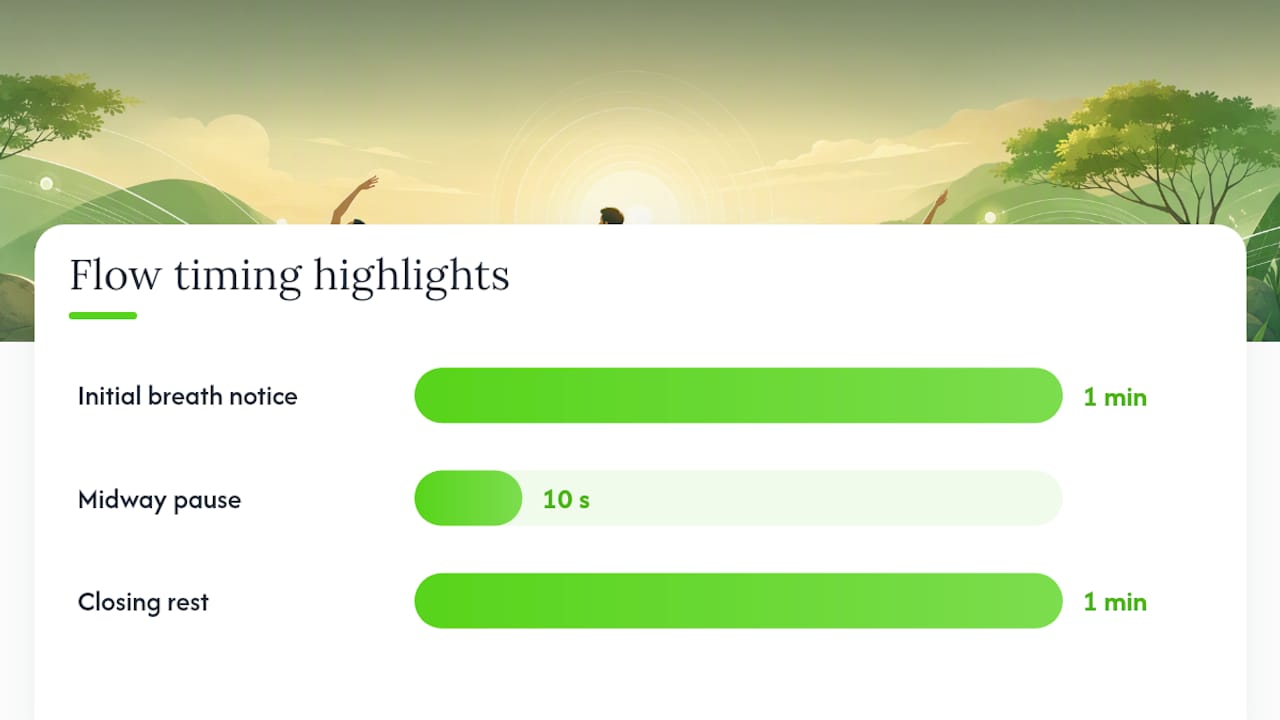
- Start lying down or seated. Spend one minute simply noticing the breath without trying to change it.
- Move into a slow sequence: gentle spinal rolls, seated forward folds, or standing side stretches, one breath per transition.
- Hold each position for three to five breaths, scanning for where tension sits, jaw, shoulders, lower back, and softening slightly on each exhale.
- Midway, pause completely for ten seconds. Ask silently: “What do I notice now that I didn’t notice at the start?”
- Continue with two or three more postures, keeping the same unhurried pace.
- Close lying or sitting still, hands resting, for one full minute before you get up.
Pro Tip: When attention wanders, and it will, use a three-word internal cue: “name, release, return.” Name the distraction, release the grip on it, return to the physical sensation you were tracking. This is the exact prompt structure that MBSR practitioner scripts recommend, and it works better than simply telling yourself to “focus”.
If you’d rather follow a voice than your own instructions, a body scan script gives a reliable, step-by-step template you can adapt into any of the sequences above, particularly the seated or lying versions.
How do you build a lasting mindful movement habit?
Motivation fades within days for most people, so the practices that survive are the ones stitched onto something you already do, not the ones that need a fresh decision every morning.
Habit stacking is the most reliable lever. Tie your two-minute grounding practice to an existing cue, the kettle boiling, the moment you sit down at your desk, or the walk from car to front door. You’re not adding a new slot to your day; you’re changing what happens during a slot that already exists. This mirrors the same logic used to build other healthy habits naturally, where the cue matters more than willpower.
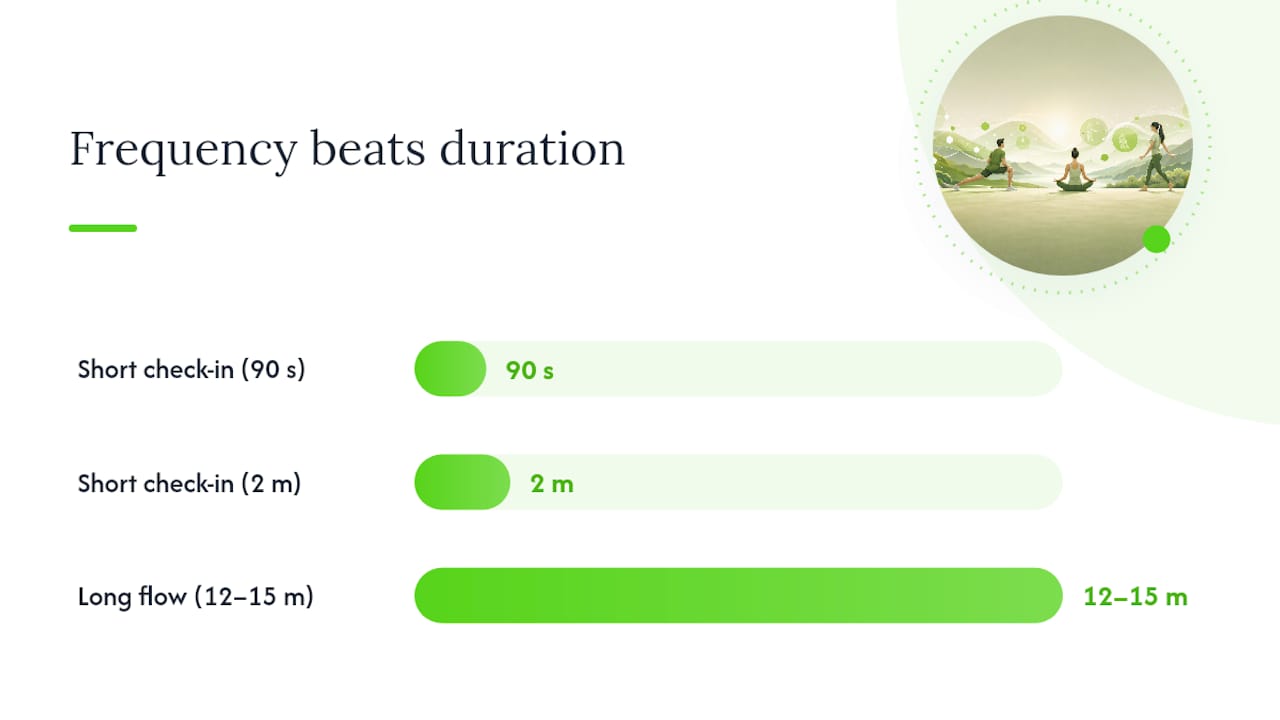
Frequency beats duration, at least at first. A short daily check-in, even ninety seconds, does more for building the skill than one long weekly session. Save the twelve to fifteen-minute flow for once or twice a week, and treat the two-minute version as the daily non-negotiable.
Environment does some of the work for you. A rolled mat left visible, a five-minute audio saved to your phone home screen, or a note on the kettle are all small nudges that lower the activation energy needed to start. Experienced teachers note that slowing down an already-familiar action, a slow walk to the kettle, deliberate stair steps, is often a more reliable gateway into the habit than committing to formal classes from day one.
Common obstacles and fixes worth knowing before they trip you up:
- “I forget.” Attach the practice to a cue you cannot skip, brushing teeth, boiling the kettle, rather than to a time on a clock.
- “I get bored or restless.” Rotate between two or three forms (walking one day, seated the next) so no single practice grows stale.
- “I don’t have the energy for a full session.” Do the two-minute version. It counts. Consistency at low intensity beats sporadic effort at high intensity.
- “My mind won’t settle.” That’s normal, not failure. The skill being trained is noticing the wander and returning, not preventing the wander in the first place.
Pro Tip: Pair your movement practice with a mindful pause around food, even something as small as noticing the first bite of breakfast, following tips for eating healthy on holiday to maintain mindful nutrition while travelling. The two reinforce each other, and a practical guide to mindful eating offers a similar cue-based structure you can copy directly.
What does the research say about mindful movement benefits?
The clearest finding across the evidence is that mindful movement changes how exercise feels, more reliably than it changes how much of it you do. A meta-analysis pooling 13 studies found a moderate positive effect of mindfulness-based exercise on affective response, with an effect size of g = 0.41. In plain terms, people consistently report feeling better during and after movement when it’s practised mindfully, and that improved feeling is one of the strongest known predictors of whether someone keeps exercising at all.
A randomised controlled trial of previously inactive adults found that a mindful exercise intervention significantly increased both enjoyment and intention to continue exercising, compared with a distraction-based control group.
That’s the encouraging half. The less encouraging half: the same trial found behaviour gains had faded by the one-month follow-up once the structured programme ended, unless people kept using some maintenance strategy, a reminder, a habit stack, a check-in. Enjoyment rose reliably; sustained behaviour change did not follow automatically.
A few honest caveats worth holding onto:
- Sample sizes across this research tend to be small, often under 100 participants, and the intervention formats vary a lot between studies.
- Follow-up periods are typically short, weeks rather than months, so long-term claims outrun the current evidence.
- A systematic review covering this area notes that positive affect during exercise does predict continued participation, but methodological inconsistency between studies means the field still needs longer, better-controlled trials.
None of that undercuts the practical takeaway. Feeling better during movement is a genuine, measurable effect, and it’s the affective boost, not sheer willpower, that keeps most people coming back.
How do you adapt mindful movement safely?
Most mindful movement practices are gentle by design, which makes them unusually forgiving for injuries, chronic pain and limited mobility, but a few sensible adjustments matter.
- Reduce range before you reduce the practice. A smaller stretch or a shorter hold still delivers the attention-training benefit; you don’t need full range of motion to get value.
- Slow the tempo further if balance is a concern. Tai chi and qigong both adapt well to a chair or a wall for support.
- Use props generously. A cushion under the knees, a wall for balance, a chair for seated yoga, none of these dilute the practice.
- Stop immediately for sharp pain, dizziness or breathlessness beyond mild exertion, and rest before deciding whether to continue.
- See a clinician or a qualified teacher before starting if you have a cardiovascular condition, a recent injury, or a diagnosed balance disorder, particularly before attempting standing sequences unsupervised.
Who’s behind this guidance, and where does it come from?
This guide draws on published trials and meta-analyses on mindful exercise, body-scan literature, and practitioner-level scripts used in MBSR-style teaching, alongside broader guides to gentle self-care. Naturessoulshop has covered adjacent ground before, including mindful eating practices and family-focused wellness habits, and the same underlying principle runs through both: attention, applied gently and consistently, changes how the body and mind respond to daily life.
The connection to this topic includes supporting the after of practice, not replacing the practice itself, with products aimed at rest, recovery and gentle ritual rather than performance.
A short editorial nudge: keep practice curious, not performative
You’re allowed to skip a session, shorten it, or do it badly. None of that undoes the value of the two minutes you did manage. The point of mindful movement was never to hit a target; it was to notice something you’d otherwise have missed, a tight shoulder, a held breath, a moment of actual calm.
Treat curiosity as the metric, not consistency streaks or perfect posture. A single mindful minute folded into brushing your teeth counts exactly as much as a full session on a mat.
— Arjit
Support your movement practice with gentle everyday rituals
Support what comes after the mat is rolled up. A warm shower with a product like the Honeysuckle Luxury Bath Soap turns the close of a mindful movement session into a small ritual of its own, a sensory cue that the practice has ended and rest has begun.

None of this replaces the practice itself, and nothing here treats or cures anything. These are lifestyle supports, not medical products, and they sit alongside movement rather than instead of it. If you’re building a broader wellbeing routine around slow, attentive living, browse the health and wellness range for products designed to complement recovery and rest. Start with one product tied to your existing wind-down cue, and let it become part of your habit routine.
Where to go deeper: research and guided resources
For the research underpinning this guide, the randomised controlled trial on mindful exercise and behaviour and the meta-analysis on affective responses are the strongest starting points. The think-aloud study on internal orientation is worth reading if you want the mechanism explained in more depth.
For guided practice, the body scan script from the University of Pennsylvania is a dependable place to start, and Verywell Mind’s overview of body scan benefits covers sleep and stress applications in more detail than fits here.
Sources
- Mindful exercise intervention on exercise affect and behavior: A randomized controlled trial
- Meta-analysis on mindfulness-based exercise interventions (MAIA meta-analysis)
- Think‑aloud evidence of internal orientation during mindful exercise
- Moderate walking with guided mindfulness reduces perceived exertion
- Body scan progressive awareness practice — University of Pennsylvania
FAQ
What are the five basics of mindfulness practice?
Most frameworks centre on attention to the present moment, non-judgement, acceptance, patience and a beginner’s mind, approaching each session as if experiencing it for the first time. In movement, these translate into noticing sensation, dropping the urge to judge form, and returning attention gently when it wanders.
What are examples of mindful movement?
Walking meditation, yoga, tai chi, qigong, somatic movement and intuitive dance all count, along with slowed-down everyday actions like a deliberate walk to the kettle or mindful stair climbing.
What are examples of mindfulness practice more broadly?
Beyond movement, common examples include seated breath awareness, body scans, mindful eating, and brief pauses built into daily transitions, such as noticing three breaths before opening your laptop.
What are the seven principles of mindfulness?
Definitions vary depending on the source, but a widely cited version includes non-judging, patience, beginner’s mind, trust, non-striving, acceptance and letting go. These apply as much to movement practice as to seated meditation.
How is mindful movement different from regular exercise?
Regular exercise is typically outcome-focused, measured in reps, pace or calories, while mindful movement prioritises the quality of attention during the movement itself, using breath and sensation as the main anchors rather than performance metrics.


