


TL;DR:
- Mindful eating involves paying full attention to hunger, fullness, taste, and emotional cues, promoting healthier habits. It reduces calorie intake, emotional eating, and digestive issues by replacing automatic behavior with present-moment awareness. Starting gradually with one distraction-free meal enhances sustainability and fosters internal signals’ recognition.
Mindful eating is defined by Health Canada as awareness of how, why, what, when, where, and how much you eat, connecting it firmly to healthy living rather than dieting. The importance of mindful eating lies in its ability to shift your relationship with food from one driven by habit and distraction to one guided by genuine internal signals. Unlike calorie counting or restrictive plans, this practice asks you to pay full attention during meals, noticing hunger, fullness, flavour, and emotional state. Harvard Health, the University of Washington, and Health Canada all point to the same conclusion: awareness at the table produces measurable, lasting change.
How does mindful eating influence physical health and eating behaviours?
Mindful eating produces direct, measurable changes in what and how much you consume. A 2026 systematic review found that mindful eating interventions reduced calorie intake by a mean difference of 174.63 calories among youth, even when self-reported mindfulness scores did not rise. That finding matters because it shows behaviour changes before conscious awareness catches up, meaning the physical benefits arrive early in the practice.

Slowing down a meal is one of the most reliable techniques for eating less without feeling deprived. Harvard Health recommends pacing meals over 20 minutes, putting your fork down between bites, and chewing slowly to give fullness signals time to reach the brain. The stomach takes roughly 20 minutes to communicate satiety, so eating faster than that almost guarantees overeating.
Distracted eating compounds the problem significantly. When you eat while watching a screen or scrolling your phone, your brain processes the meal as background noise rather than a primary experience. The table below illustrates the contrast clearly.
| Factor | Distracted eating | Mindful eating |
|---|---|---|
| Calorie awareness | Low; intake often underestimated | High; portions feel more satisfying |
| Fullness recognition | Delayed or missed | Recognised in real time |
| Digestion | Rushed; less saliva and enzyme activity | Supported by slower, thorough chewing |
| Meal satisfaction | Often low; cravings return quickly | Higher; sensory engagement increases fulfilment |
Improved digestion is a direct physical benefit that rarely gets enough attention. Chewing food thoroughly increases saliva production and enzyme activity, which eases the digestive process and reduces bloating. Mindful eating naturally encourages this because you are paying attention to texture and flavour rather than rushing to the next bite.
- Recognise hunger before you sit down, not mid-plate
- Pause halfway through a meal to assess fullness on a scale of one to ten
- Chew each mouthful until the texture changes noticeably
- Put utensils down between bites to slow the pace naturally
Pro Tip: Set a kitchen timer for 20 minutes when you begin a meal. If you finish before it rings, pause and drink a glass of water before deciding whether you need more food.
What are the mental and emotional benefits of mindful eating?
Mindful eating reduces emotional eating by inserting awareness between a trigger and the automatic response of reaching for food. A clinical trial combining mindfulness with scuba diving found emotional eating scores dropped by 0.82 points in the intervention group versus 0.27 in the control group, with effects lasting up to eight months. That durability is significant because most dietary interventions show rapid relapse within weeks.
The psychological benefits extend well beyond controlling portions. When you eat with attention, you begin to notice the difference between physical hunger and emotional hunger. Physical hunger builds gradually and responds to most foods. Emotional hunger arrives suddenly, craves specific comfort foods, and often brings guilt afterwards. Recognising that distinction is one of the most powerful shifts mindful eating produces.
Mindfulness as a low-risk approach to stress regulation and reward processing is now supported by nutritional psychiatry research. Present-moment awareness during meals reduces the stress response associated with eating, which in turn lowers the likelihood of using food to self-soothe. This is particularly relevant for anyone who notices they eat more when anxious, bored, or tired.
“Mindful eating fosters curiosity and self-compassion rather than guilt, helping individuals recognise emotional cues without judgement.”
The shift from self-criticism to self-compassion is not a soft benefit. It directly reduces the shame cycle that drives binge eating and restrictive behaviour. When you observe your eating patterns without labelling them as failures, you create the psychological space needed to make different choices next time.
- Identify three common emotional triggers that lead you to eat without hunger
- Practise a two-minute breathing exercise before meals to lower cortisol and increase presence
- After eating, note your emotional state without judgement, simply as information
- Use mindfulness for stress techniques to build the same present-moment awareness outside mealtimes
What practical mindful eating strategies can you start today?
The University of Washington’s guide recommends three structured check-ins: one before the meal to assess hunger, one midway through to gauge fullness, and one after to reflect on satisfaction. This simple framework turns an ordinary meal into a brief, intentional practice without requiring meditation experience or extra time.
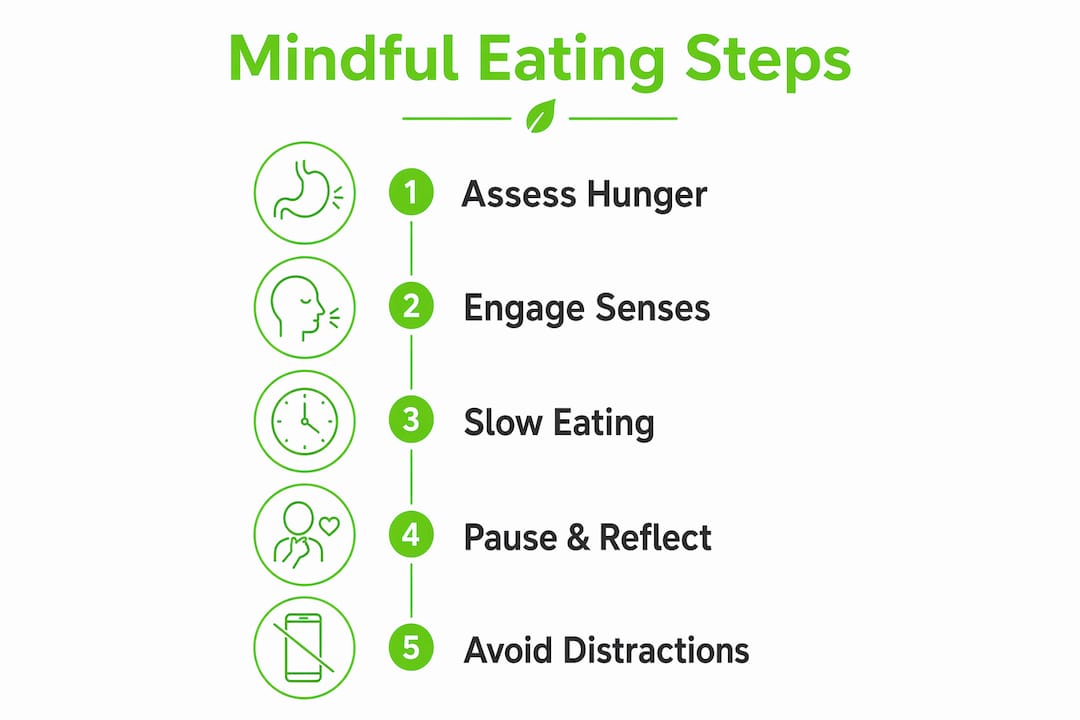
Starting small is the most reliable path to sustained change. Attempting perfect mindfulness at every meal immediately sets an unrealistic standard. Practitioners recommend beginning with one distraction-free meal per day and building from there, which allows attention to develop gradually rather than feeling like another obligation.
Here is a practical sequence for building mindful eating habits from scratch:
- Choose one meal each day to eat without screens, books, or background noise.
- Before sitting down, pause for 30 seconds and rate your hunger from one to ten.
- Take three slow breaths before your first bite to shift your nervous system into a calmer state.
- Eat slowly, placing your utensils down between each bite and noticing flavour, texture, and temperature.
- Halfway through, pause and re-rate your hunger. Decide consciously whether to continue.
- After the meal, note how you feel physically and emotionally without judgement.
- Gradually extend this practice to a second meal once the first feels natural.
Sensory engagement deepens the practice considerably. The University of Washington encourages appreciating the origins of food, noticing its colour, aroma, and texture before eating. This is not a ritual for its own sake. Engaging the senses before the first bite activates the cephalic phase digestive response, which primes the stomach with acid and enzymes before food even arrives.
Removing screens is non-negotiable for beginners. Research consistently shows that screen use during meals increases total intake and reduces meal satisfaction. For practical guidance on mindful grocery shopping, choosing foods with intention before they reach your plate also reinforces the same awareness you practise at the table.
Pro Tip: Keep a small notebook near your dining area for one week. After each meal, write one sentence about how hungry you were when you started and one about how you felt when you finished. Patterns emerge within days.
How does mindful eating differ from conventional dieting?
Mindful eating is a behaviour-based practice, not a rule-based restriction system. Health Canada’s framework positions it as a way of reconnecting with internal signals rather than following external guidelines about what to eat or avoid. This distinction matters because diets create compliance and failure cycles, while mindful eating builds self-knowledge that persists regardless of what is on the plate.
The 2026 systematic review confirmed that calorie reduction occurred through mindful eating interventions without strict food limits being imposed. Participants ate less because they paid attention, not because certain foods were forbidden. That mechanism is fundamentally different from dieting and produces a very different psychological relationship with food.
| Dimension | Mindful eating | Conventional dieting |
|---|---|---|
| Core mechanism | Internal awareness of hunger and fullness | External rules about food types and quantities |
| Emotional relationship | Curiosity and self-compassion | Compliance, guilt, and restriction |
| Sustainability | Builds over time through habit | Often abandoned within weeks |
| Food restriction | None required | Central to the approach |
| Outcome focus | Satisfaction and wellbeing | Weight loss as primary goal |
Mindful eating also supports healthier food choices without forbidding anything. When you eat slowly and attentively, ultra-processed foods often become less appealing because their artificial flavours and textures become more noticeable. This is not a rule imposed from outside. It is a natural consequence of paying attention.
Key takeaways
Mindful eating reduces calorie intake, emotional eating, and digestive discomfort by replacing automatic food behaviour with deliberate, present-moment awareness at every meal.
| Point | Details |
|---|---|
| Behaviour changes first | Calorie intake drops before subjective mindfulness scores improve, so start practising before you feel mindful. |
| Emotional eating responds well | Clinical evidence shows emotional eating scores drop significantly and durably with consistent mindful practice. |
| Distraction is the main obstacle | Removing screens during meals is the single highest-impact change for most people starting out. |
| Mindful eating is not a diet | It works through internal awareness, not food restriction, making it more sustainable than conventional dieting. |
| Start with one meal | Building the habit at one daily meal before extending it prevents overwhelm and supports lasting change. |
Why I think most people misunderstand what mindful eating actually requires
Most people hear “mindful eating” and picture slow, ceremonial meals with no distractions, which immediately feels impractical. That framing is the main reason people dismiss the practice before trying it. What I have found, both personally and through the research, is that the real work is much smaller and more forgiving than that image suggests.
The single most useful shift I made was treating the pause before a meal as non-negotiable. Thirty seconds of stillness before picking up a fork does more to interrupt autopilot eating than any elaborate technique. It is not glamorous, but mindfulness tips for stress consistently point to brief, repeated pauses as the mechanism behind lasting behavioural change.
The pitfall I see most often is people trying to be perfectly mindful at every meal simultaneously. That approach collapses within a week. The research from the University of Washington and Harvard Health both point to the same practical wisdom: start with one manageable, distraction-free meal and monitor two things, how hungry you were when you started and how full you felt when you stopped. Everything else follows from that.
Patience is not optional here. Behavioural changes in eating patterns precede subjective shifts in awareness, which means you will be eating differently before you feel different. Trust the process and resist the urge to measure progress by how “mindful” you feel.
— Arjit
Eat with intention: how Naturessoulshop supports your mindful eating practice
Mindful eating works best when the food on your plate is worth paying attention to. Naturessoulshop stocks organic fruits, vegetables, dry grocery staples, dairy, and vegan and gluten-free options, all sourced with clean ingredients that make sensory engagement genuinely rewarding.

When you slow down and actually taste what you are eating, the quality of your ingredients becomes far more noticeable. Naturessoulshop makes it straightforward to fill your kitchen with wholesome, minimally processed foods that complement the awareness you are building at the table. Browse the full range at the Naturessoulshop online store or explore the health-focused product range to find options aligned with your nutritional goals.
FAQ
What is mindful eating?
Mindful eating is the practice of paying full attention to the experience of eating, including hunger signals, emotional triggers, flavour, and fullness cues. Health Canada defines it as awareness of how, why, what, when, where, and how much you eat.
Does mindful eating actually reduce how much you eat?
A 2026 systematic review found mindful eating interventions reduced calorie intake by a mean difference of 174.63 calories in youth, even without strict food restrictions. Behaviour changes occur before subjective mindfulness scores improve.
How long does it take to see results from mindful eating?
Clinical trial evidence shows emotional eating scores drop within weeks of consistent practice, with effects lasting up to eight months. Physical changes such as reduced intake tend to appear before you consciously feel more mindful.
Can mindful eating help with emotional eating?
A randomised controlled trial found emotional eating scores dropped by 0.82 points in participants who combined mindfulness with structured activities, compared to 0.27 in the control group. Recognising the difference between physical and emotional hunger is the core mechanism.
Do I need to change what I eat to practise mindful eating?
No food restrictions are required. Mindful eating works through internal awareness rather than external rules, and research confirms calorie reduction occurs without forbidding specific foods. Choosing higher-quality, organic ingredients can deepen the sensory experience, but it is not a prerequisite.


