


To sell a product as USDA organic, an operation must be certified under federal standards set out in 7 CFR Part 205, administered by the National Organic Program (NOP). Certification hinges on three things: a documented Organic System Plan (OSP), annual on-site inspections (plus unannounced checks and occasional residue testing), and strict adherence to the production and handling rules built around the National List of Allowed and Prohibited Substances.
Labelling then determines what you can actually print on the pack. Products that are labeled as “100 percent organic” or “organic” products containing the majority of organic ingredients may carry the USDA organic seal. Products labeled “made with organic” can name several organic ingredients or categories on the front panel but may not use the seal. Products with less organic content may list specific organic ingredients only in the ingredient statement and cannot make organic claims on the front panel.
- Federal legal basis: 7 CFR Part 205, enforced by USDA’s NOP.
- Core operational trio: OSP, accredited certifier, annual inspection.
- Labelling tiers: 100% organic, organic (95%+), made with organic (70%+), under 70% (ingredient-only listing).
- Seal eligibility: only the top two tiers may display the USDA organic seal.
A useful number to hold onto: land must go three years without prohibited substances before its first organic harvest, and dairy animals need twelve months of organic management before their milk qualifies, according to USDA’s own standards summary. Miss either threshold and the certification clock resets.
Key Takeaways
USDA organic certification requires a documented Organic System Plan, an accredited certifier, annual inspections, and precise adherence to labelling thresholds that determine seal eligibility.
| Point | Details |
|---|---|
| OSP is non-negotiable | Every certified operation needs a documented Organic System Plan naming inputs, monitoring and controls. |
| Certifiers, not USDA, certify | Work directly with a USDA-accredited certifying agent for application, inspection and sign-off. |
| Labelling tiers are fixed | Only 100% organic and 95%+ organic products may carry the USDA organic seal. |
| Transition timelines are strict | Land needs 3 years clean; dairy needs 12 months; poultry from day 2 of life. |
| Records decide inspections | Reconciled purchase, production and sales records are what inspectors actually check first. |
Certification under 7 CFR Part 205 isn’t a formality bolted onto good farming practice. It’s the framework that determines whether “organic” on a label means anything at all.
Where to read the official USDA organic rules in full
- eCFR :: 7 CFR Part 205 for the current, legally binding regulatory text.
- Labeling Organic Products (AMS) for detailed front-panel and information-panel wording rules.
- Organic standards summary (AMS) for production and livestock transition requirements.
- Organic certification (AMS) to find and compare accredited certifying agents.
- Organic 101 (USDA) for a plain-language explanation of inspection scope and traceability.
Table of Contents
- Which laws and agencies actually set USDA organic requirements?
- USDA organic labelling categories and what each one allows
- How do you get USDA organic certified, step by step?
- What production and handling rules do organic operations follow?
- What records and traceability do inspectors expect?
- A pre-application checklist for USDA organic certification
- What actually separates operations that pass inspection from those that struggle?
- Sources
Which laws and agencies actually set USDA organic requirements?
Everything traces back to one regulation: 7 CFR Part 205, the section of the Code of Federal Regulations that created and governs the National Organic Program. It covers production standards, handling rules, the National List, labelling requirements and the OSP rule in one continuous body of text. If you want the authoritative, current wording rather than someone’s summary of it, the eCFR version of Part 205 is kept up to date and is the version certifiers and inspectors actually work from.
Three bodies sit around that regulation, and it helps to know what each one does. USDA’s Agricultural Marketing Service (AMS) houses the NOP, which writes and enforces the rules day to day. The National Organic Standards Board (NOSB), a citizen advisory panel, recommends changes to the National List and reviews proposed rule amendments before AMS finalises them. Between them, they maintain the NOP Handbook, the policy guidance document that fills in the practical detail the regulation itself doesn’t spell out, plus a process for temporary variances when disasters or research needs require a departure from standard practice.
The organic label only means something if every business behind it. From farm to processor to retailer, follows the same documented rules and can prove it under inspection. That’s the entire logic of the NOP: one federal standard, one seal, enforced through accredited third parties rather than USDA itself inspecting every farm.
The most recent structural change is the Strengthening Organic Enforcement (SOE) rule, which expanded which businesses in the supply chain need certification and gave the NOP sharper tools for traceability and fraud detection. If you handle, broker or import organic product without touching a farm, SOE is likely the reason you now need paperwork you didn’t need a few years ago.
USDA organic labelling categories and what each one allows
Getting the label wording wrong is the single most common reason a product gets flagged during certifier review, so it’s worth treating these four tiers as fixed categories rather than a sliding scale.
| Category | Organic content | Seal use | Front panel wording |
|---|---|---|---|
| 100% organic | All ingredients organic (excluding water/salt) | Yes | “100% Organic” |
| Organic | At least 95% organic ingredients | Yes | “Organic” |
| Made with organic | At least 70% organic ingredients | No | “Made with organic [up to 3 ingredients/categories]” |
| Specific ingredients | Under 70% organic | No | No front claim; organic ingredients may be named only in the ingredient list |
The distinction between the principal display panel and the information panel matters more than most first-time applicants expect. According to AMS labelling guidance, a “made with organic” product can only name up to three organic ingredients or ingredient categories on the front of the pack, even if more than three qualify, and it must never carry the seal regardless of how close to 95% it gets.
- Only certified operations may use the USDA organic seal only on 100% organic or organic (95%+) products.
- “Made with organic” products can reference up to three organic ingredients or categories on the front panel.
- Products under 70% organic content may name specific organic ingredients only in the ingredient statement, never on the front.
- Multi-ingredient processed foods must source any permitted nonorganic ingredients from the National List.
Some categories carry extra layers on top of the core NOP rules. Organic wine, for example, intersects with Alcohol and Tobacco Tax and Trade Bureau (TTB) labelling requirements around sulphite disclosure, so a wine label has to satisfy both agencies simultaneously. If your product doesn’t fit neatly into food, checking which framework actually governs your category before you design the pack saves a reprint later.
How do you get USDA organic certified, step by step?
Certification follows a fixed sequence, and skipping ahead rarely works because each step depends on documentation from the one before it.
- Draft your Organic System Plan (OSP). This is the foundation document describing every input, monitoring practice, recordkeeping system and contamination-prevention control you use.
- Choose a USDA-accredited certifying agent. USDA doesn’t certify operations directly. It accredits private, state and foreign certifying bodies who do the actual certification and inspection work, so your relationship is with the certifier, not a federal office.
- Submit your application and fees. Certifiers set their own fee structures, typically scaled to farm size, revenue or complexity, so costs vary meaningfully between certifiers for the same operation.
- Undergo an on-site inspection. An inspector reviews fields, facilities, storage, labelling and your paper trail against what your OSP claims.
- Receive your certification decision. Approved operations get a certificate listing exactly which products and activities are covered.
- Renew annually. Certification isn’t a one-time event. Every certified operation goes through a fresh annual inspection to keep its certificate current.
A solid OSP needs to name specific approved inputs (not just “organic fertiliser” but the actual product and its National List status), set a monitoring schedule, define how you’ll prevent commingling with non-organic stock, and, for group or multi-site operations, describe internal control systems that verify every member complies.
- Operations grossing under $5,000 annually in organic sales are exempt from certification, though they still must follow production standards if they use the word “organic”.
- Certain retail operations that only handle already-certified packaged products, without further processing, typically don’t need their own certification.
- Unannounced inspections tend to target operations with prior non-conformities, complex supply chains, or random selection as part of USDA’s oversight programme.
Pro Tip: Build your OSP around your actual supplier list, not a generic template. Certifiers reject more applications for vague or copy-pasted input lists than for almost any other single reason.
If you’re weighing whether full certification is worth it against staying under the exemption threshold, it’s worth reading how the certified organic label works from the buyer’s side, since that shapes what your customers will actually expect to see on the pack.
What production and handling rules do organic operations follow?
Before a single organic crop can be harvested, the land it grows on needs a three-year clean record. Fields must go three years without prohibited substances before the first organic harvest counts, and that clock doesn’t restart just because ownership changes hands. Livestock have their own timelines: dairy animals need twelve months of continuous organic management before their milk qualifies, animals raised for slaughter must be under organic management from the last third of gestation, and poultry must enter organic management no later than their second day of life, according to USDA’s organic standards.
| Category | Transition requirement |
|---|---|
| Cropland | 3 years free of prohibited substances before first organic harvest |
| Dairy animals | one year of continuous organic management before milk qualifies |
| Slaughter livestock | Organic management from the last third of gestation |
| Poultry | Organic management from no later than day 2 of life |
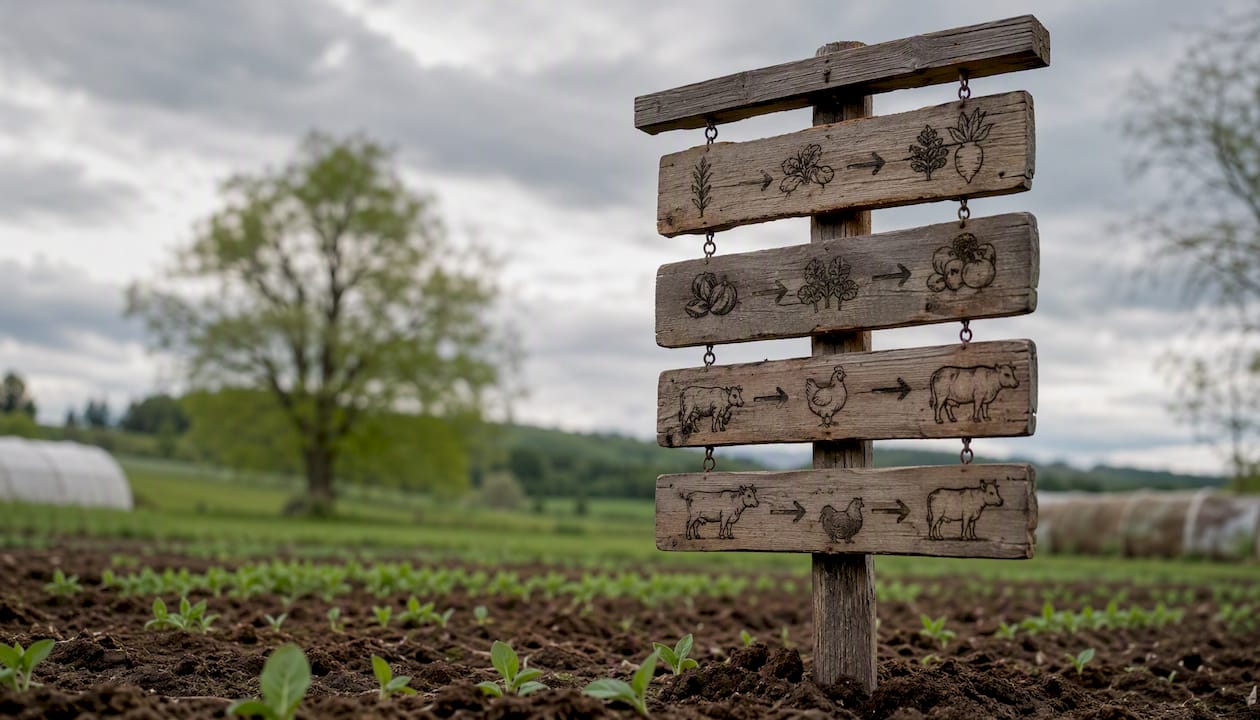
Certain methods are off the table entirely, regardless of how the rest of the operation is run. Genetic engineering, ionising radiation and sewage sludge are all prohibited outright under the National List framework, as is routine antibiotic use or synthetic growth hormone administration in livestock. These aren’t grey areas open to interpretation by individual certifiers. They’re flat exclusions written into the regulation.
Where the rules do allow flexibility is the National List itself, the mechanism that names specific synthetic substances permitted in organic production (certain pest controls, for instance) alongside natural substances that are actually prohibited because of how they’re processed. Producers are also expected to prefer organic seeds and planting stock wherever commercially available, only sourcing conventional seed when an organic equivalent genuinely can’t be found. Anyone converting land or a herd should think hard about the difference between organic and conventional production before committing, since the input and recordkeeping burden increases substantially the moment you start the transition clock.
Soil fertility management sits at the centre of crop certification, not as an afterthought. Operations are expected to actively build soil organic matter and biological activity through crop rotation, cover cropping and approved amendments, rather than simply substituting a National-List-approved input for a synthetic one and calling the job done. Livestock welfare standards follow a parallel logic: animals need access to the outdoors, pasture where applicable, and living conditions that accommodate natural behaviour, not just an organic feed ration inside a conventional confinement system.
What records and traceability do inspectors expect?
Traceability from farm to shelf is the whole point of the organic promise. Without a paper trail that reconciles every batch from input to sale, a certificate is just a piece of paper, and inspectors know it.
The records that matter most in practice are the ones that let an inspector reconcile quantities at every stage: OSP documentation, input purchase receipts (matched against National List approval), production and harvest logs, sales and transfer records, and processing batch records that show exactly which organic ingredients went into which finished lot. For handlers, supplier documentation proving upstream certification status is just as important as your own records.
Verification usually works backwards. An inspector picks a finished batch, then works down through your processing records, input purchases and harvest logs to confirm the volumes reconcile at every step. Any gap, more finished product than the organic inputs could plausibly account for, is exactly what triggers deeper scrutiny or product testing. Residue testing exists as a backstop against fraud rather than a routine checkpoint, but operations with unexplained record gaps are far more likely to be selected for it.

Pro Tip: Keep a running reconciliation spreadsheet that ties input purchases to output volumes month by month. It takes an afternoon to set up and turns a stressful inspection day into a fifteen-minute conversation.
Enforcement escalates in stages: denial of certification, suspension, revocation, and civil penalties for the most serious or repeated violations. It’s also worth knowing that the USDA organic seal is a registered trademark, which means fraudulent use can trigger trademark enforcement on top of the standard administrative penalties. That dual exposure is part of why USDA treats seal misuse so aggressively compared with ordinary labelling disputes. Good supplier verification practices, of the kind covered in traceability explainers from the specialty food and coffee sectors, translate directly into the kind of documentation organic inspectors want to see.
A pre-application checklist for USDA organic certification
Most delays and inspection non-conformities trace back to gaps that could have been closed before the application ever went in. Work through this roughly in order:
- Map your operation. Draw a site map showing fields, storage, processing areas and buffer zones from neighbouring conventional land.
- Verify every supplier’s certification status. Collect current organic certificates for every input supplier before you list their product in your OSP.
- Cross-check inputs against the National List. Don’t assume a product is approved because the label says “organic-friendly”. Confirm it against the actual list.
- Document your commingling and contamination controls. Cleaning logs for shared equipment, separate storage areas, dedicated totes, whatever applies to your operation.
- Draft sample OSP entries with real specificity. For example: “Input: OMRI-listed fish emulsion, applied monthly April to September, corrective action if application exceeds label rate is documented in the field log.”
- Build your recordkeeping templates before you need them. Harvest logs, batch records and sales reconciliation sheets should exist and be in use before your first inspection, not assembled retroactively.
- Submit final label art to your certifier for review. Do this before printing, not after.
- Common pitfall: listing an input by brand name without confirming its current National List status, which can lapse.
- Common pitfall: treating the OSP as a one-time document rather than updating it whenever a supplier or input changes.
- Common pitfall: printing labels before certifier sign-off, which risks an expensive reprint if wording doesn’t clear review.
Pro Tip: Always submit final label art to your certifier early and get written sign-off before printing. A verbal “that should be fine” from a certifier representative isn’t documentation, and inspectors will ask for the paper trail.
Readers building out a livestock operation specifically should also look at how organic meat standards and welfare rules interact with the conversion timelines above, since livestock certification tends to trip up more first-time applicants than crop certification does.
If you’re sourcing certified organic ingredients rather than producing them yourself, Naturessoulshop’s range across fresh produce, dry grocery, dairy and skin care gives a working example of how the labelling tiers show up on real products. Browse the Nature’s Soul Fresh range to see certified organic produce labelling in practice, or explore the full Naturessoulshop catalogue if you’re comparing certified suppliers for your own supply chain.
What actually separates operations that pass inspection from those that struggle?
It’s rarely the farming or processing itself. Most operations that stumble during certification aren’t running poor practices. They’re running good practices badly documented, and inspectors can only certify what they can verify on paper. The businesses that sail through year after year tend to share a specific habit: someone on the team owns the OSP as an active document, not a file that gets dusted off once a year before renewal.
Assigning that ownership explicitly matters more than it sounds. When no one is clearly responsible for updating input lists, logging corrective actions or chasing supplier certificates as they lapse, small gaps accumulate quietly until an inspector finds three of them in one afternoon. A basic internal audit run a month or two before the scheduled inspection, essentially rehearsing what the inspector will ask, catches most of these gaps while there’s still time to fix them.
Supplier evidence deserves more attention than most first-time applicants give it, particularly for multi-ingredient products pulling from several certified sources. A processed product with eight organic ingredients from five suppliers needs current certificates from all five on file, not just the two largest by volume. Certifiers have seen enough fraud cases involving a single uncertified ingredient hiding among certified ones that they check this specifically, and it’s one of the easiest things to have ready in advance.
The three-year rule around recordkeeping isn’t arbitrary either. Certifiers and inspectors can and do request historical records going back that far, so treating documentation as disposable after the current season is a genuine risk, not just tidiness advice.
This article is general information, not a substitute for advice from a qualified lawyer. Consult a qualified legal professional about your own circumstances before acting on anything here.
Sources
- eCFR :: 7 CFR Part 205 – National Organic Program
- Labeling Organic Products | Agricultural Marketing Service
- Organic | Agricultural Marketing Service
- Organic 101: What the USDA organic label means
- Organic certification | Agricultural Marketing Service


