


Gluten-free bread is any loaf made without wheat, barley or rye, typically built from rice, buckwheat, sorghum, millet, tapioca or legume flours instead. That’s the whole test: no wheat, no barley, no rye, and no hidden derivatives of them (malt extract and some starches sneak these in). Beyond that ingredient line, though, quality varies enormously between loaves labelled “gluten free.”
The most common gluten-free loaf types you’ll come across:
- Rice-based loaves – often white or brown rice flour blended with starches for a soft, sandwich-friendly crumb
- Buckwheat and sorghum loaves – denser, more flavourful, closer to a wholegrain wheat loaf in fibre
- Millet-based breads – light, slightly sweet, popular in artisan bakeries
- Legume-based loaves – made from chickpea or lentil flour, higher in protein
- Gluten-free sourdough – fermented using gluten-free flours rather than wheat starter
- Certified commercial loaves – mass-produced breads carrying a formal gluten-free certification mark
Gluten-free bread commonly relies on alternative flours and starches such as rice, tapioca and sorghum, with eggs, psyllium husk or xanthan gum stepping in to replace the elastic structure gluten normally provides. Look for a recognised certification mark on the pack, such as GFCO in the US or the Coeliac UK crossed-grain symbol, as your quickest trust signal when scanning a shelf.
Key Takeaways
Gluten-free bread works when it avoids wheat, barley and rye entirely, replaces gluten’s structure with binders like psyllium husk or xanthan gum, and carries genuine certification rather than a self-reported label claim.
| Point | Details |
|---|---|
| Definition first | Gluten-free bread contains no wheat, barley or rye, and relies on flours like rice, sorghum, buckwheat or millet instead. |
| Sourdough needs checking | Most sourdough is not gluten free; only loaves made from a genuinely gluten-free starter qualify. |
| Certification beats label claims | A recognised mark like GFCO or Coeliac UK’s Crossed Grain symbol is more reliable than front-of-pack wording alone. |
| Fibre is the quality signal | Aim for around 2 to 3 grams of fibre per slice rather than judging a loaf by “gluten free” alone. |
| Clean-ingredient options exist ready-made | Nature’s Soul Shop’s rice and buckwheat loaves skip preservatives and dough improvers for shoppers who’d rather not bake their own. |
Table of Contents
- Which breads are naturally gluten free and which never can be
- What gluten-free bread is made from: flours, starches and binders
- Is sourdough bread gluten free?
- How store-bought gluten-free loaves differ by category
- How to choose the best gluten-free bread for your needs
- Making gluten-free bread at home
- Reading labels and certification for coeliac-safe choices
- Coeliac disease versus non-coeliac gluten sensitivity: different priorities
- Practical bread substitutes and how to use them
- Examples of store-bought gluten-free loaves worth knowing
- Author perspective: a buyer’s honest take
- Ready-made clean-ingredient gluten-free loaves, no baking required
- Sources
Which breads are naturally gluten free and which never can be
Some breads are gluten free by nature of their traditional recipe, no reformulation required. Corn tortillas, most cornbread, socca (a French chickpea flatbread), and certain rice-based flatbreads have never contained wheat, barley or rye in their classic form. These are worth knowing because they give you options that don’t rely on a manufacturer’s substitution recipe at all.
Others are permanently off the table unless entirely rebuilt from different flours:
- Never naturally gluten free: standard wheat bread, rye bread, barley bread, spelt bread, most traditional sourdough, brioche, ciabatta, focaccia
- Naturally gluten free: corn tortillas, socca, certain rice flatbreads, some traditional cornbread recipes, injera (when made purely from teff)
- Gluten free only when reformulated: bagels, pizza bases, baguettes, sandwich loaves sold under a “gluten-free” label
Here’s where confusion creeps in. A loaf can be made entirely from gluten-free ingredients and still carry gluten from cross-contamination on shared equipment, in a shared oven, or via airborne wheat flour dust in a mixed bakery. That’s the gap between “naturally gluten free by ingredient” and “genuinely safe to eat if you have coeliac disease.” The first is a recipe fact. The second is a production and handling fact, and only certification or a dedicated facility tells you which one you’re getting.
Pro Tip: If you have coeliac disease rather than a general sensitivity, treat any uncertified loaf from a mixed bakery as a risk, even if every listed ingredient is gluten free. Ask directly whether wheat flour is used anywhere on site that day.
What gluten-free bread is made from: flours, starches and binders
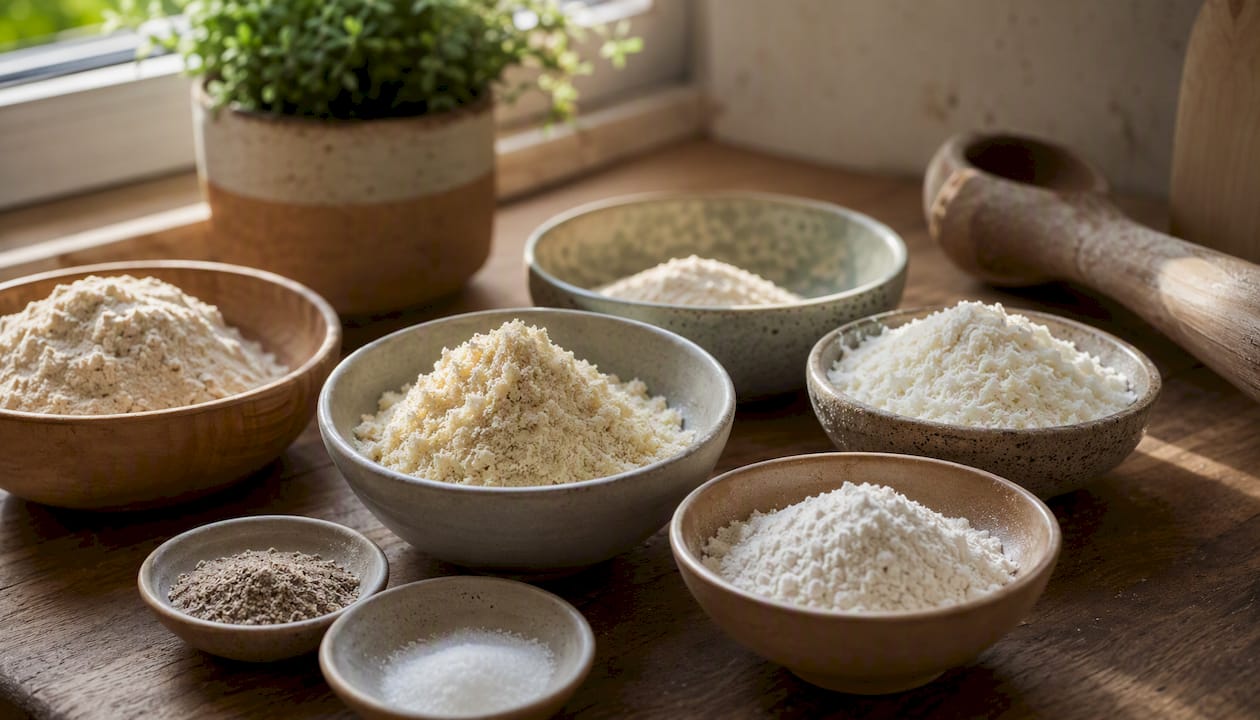
Take away gluten and you take away the protein network that gives wheat bread its stretch and chew, so gluten-free bakers rebuild that structure from a different toolkit. Rice flour and tapioca starch form the backbone of most commercial loaves, contributing softness and a neutral flavour that doesn’t fight with sandwich fillings. Potato starch does similar work, adding moisture retention. Sorghum, millet and buckwheat bring more flavour and considerably more fibre, which is why the denser, darker loaves in the gluten-free aisle tend to taste more like real bread and less like sweetened cardboard.
Binders are the unsung part of the recipe. Without something to mimic gluten’s elasticity, a loaf made purely from rice flour and water would crumble the moment you tried to slice it. That’s the job of:
- Psyllium husk – a soluble fibre that gels with water, giving artisan-style loaves their chew
- Xanthan gum – a common commercial binder, typically under 2% of a loaf’s total weight
- Eggs – add structure and moisture in many home recipes, though they rule the loaf out for vegans
- Guar gum – functions similarly to xanthan, often used in combination
Practitioner-tested recipes consistently treat psyllium husk or xanthan gum as essential rather than optional: skip the binder and you usually end up with a dry, crumbly result no matter how good the flour blend is. Worth checking allergen flags too. Almond flour rules out loaves for nut allergies, egg-bound recipes rule out strict vegans, and some starch-heavy commercial loaves use dairy-derived additives that aren’t obvious from the front of the pack.
Is sourdough bread gluten free?
Most sourdough is not gluten free, because it’s still made with wheat flour. Fermenting wheat, even for 24 or 48 hours, breaks down some gluten but nowhere near enough to make it safe for coeliac disease.
This is one of the most persistent myths in the gluten-free world, largely because long fermentation genuinely does reduce gluten content and can ease digestion for people with mild sensitivity. Coeliac disease is an autoimmune reaction, though, and the threshold for triggering it is tiny. Traditional wheat sourdough, however long it’s fermented, isn’t a reliable option if you have coeliac disease or a diagnosed wheat allergy.
Genuine gluten-free sourdough exists, but it’s built from a completely different starter: one cultivated using rice flour, sorghum, or a gluten-free flour blend from day one, never wheat. To check whether a sourdough loaf on a shelf or in a bakery is actually gluten free:
- Read the full ingredient list, not just the front label claim
- Check for a certification mark rather than trusting “sourdough” as an implicit health claim
- Ask the bakery directly whether the starter has ever contained wheat flour
- Look for a stated production environment (dedicated gluten-free facility vs shared kitchen)
Pro Tip: Some bakeries run dedicated gluten-free baking days or use a separate oven entirely for gluten-free sourdough. That’s a stronger safety signal than any label wording, since it removes the shared-equipment risk at the source rather than just controlling ingredients.
How store-bought gluten-free loaves differ by category
Commercial gluten-free bread splits into a handful of practical categories, and the differences between them explain almost everything about why one loaf tastes better and another lasts longer on the shelf. Names like Canyon Bakehouse, Schär, Warburtons’ gluten-free range, Genius, Promise, Rudi’s, Udi’s, Glutino, Three Bakers and BFree all sit somewhere in this landscape, and knowing the category tells you more than the brand name does.
Mass-market packaged loaves, the kind sold pre-sliced and frozen for shelf stability, lean heavily on starches and gums to survive weeks in transit and storage. Artisan and bakery-style loaves take the opposite approach: fewer additives, simpler flour blends, shorter shelf life, and noticeably more flavour. Some 2025 testing of commercial gluten-free breads found several mass-market lines are dairy-free, nut-free and soy-free and lean on wholegrains such as brown rice and sorghum, though texture and taste still varied widely between them.
| Category | Best for | Texture | Ingredient/allergen profile | Availability |
|---|---|---|---|---|
| Artisan bakery loaf | Toast, standalone eating | Chewy, dense crust | Fewer additives, often egg or dairy present | Fresh, limited shelf life |
| Mass-market packaged | Sandwiches, everyday use | Soft, sometimes gummy | Starch and gum heavy, often allergen-free variants | Frozen or shelf-stable, widely available |
| Frozen shelf-stable | Batch buying, backup loaves | Softens on toasting | Similar to mass-market, longer preservative use | Freezer aisle, long shelf life |
| In-store fresh (bakery counter) | Same-day eating | Varies by recipe | Depends on bakery, cross-contamination risk higher | Local, day-fresh only |
A comparison of artisan and supermarket gluten-free loaves found the same pattern repeatedly: bakery-style loaves aim for fewer additives and stronger flavour but trade away shelf life, while mass-market loaves optimise for softness and durability using starch-heavy formulas.
To spot a cleaner ingredient list on pack:
- Check whether whole grains (brown rice, sorghum, millet) rank above refined starches in the ingredient list
- Count the gums and stabilisers; more than two or three is a sign of a heavily processed loaf
- Look for a fibre count per slice rather than relying on “gluten free” as a proxy for healthy
- Check for added sugars disguised under names like dextrose, tapioca syrup or maltodextrin
How to choose the best gluten-free bread for your needs
Choose by use-case first, priority second. If you’re after sandwich bread, softness and slice size matter most. If it’s toast, crumb structure and how it holds a spread matter more than sliceability. If you’re baking with it, structural integrity under heat is the deciding factor.
A quick checklist to run through, whether you’re standing in a shop aisle or browsing online:
- Scan the ingredient list top to bottom, not just the “gluten free” badge on the front
- Check fibre content; nutrition-focused sources recommend aiming for 2 to 3 grams of fibre per slice where possible, since refined starch-heavy loaves often fall well short of that
- Look at the allergen table for nut, dairy, egg and soy flags relevant to your household
- Confirm certification status if coeliac disease is a factor
- Note the format: fresh loaves need faster use, frozen loaves buy you flexibility
Nutrition experts are consistent on one point: gluten free doesn’t automatically mean healthier. A loaf built from refined rice starch with minimal fibre can be nutritionally weaker than a wholegrain wheat loaf, for anyone who can tolerate gluten in the first place. The healthiest choice within gluten-free options is the one built from whole-food flours rather than the one with the flashiest “gluten free” branding. This nutrition guidance on avoiding gluten while eating well makes a similar point about prioritising food quality over the absence of a single ingredient.
Pro Tip: Buy a single loaf before committing to a multi-pack of anything new. Toast a slice, then freeze another and toast it again a week later. Texture on second toasting reveals a lot about how a loaf actually holds up in daily use, not just fresh from the bag.
Making gluten-free bread at home
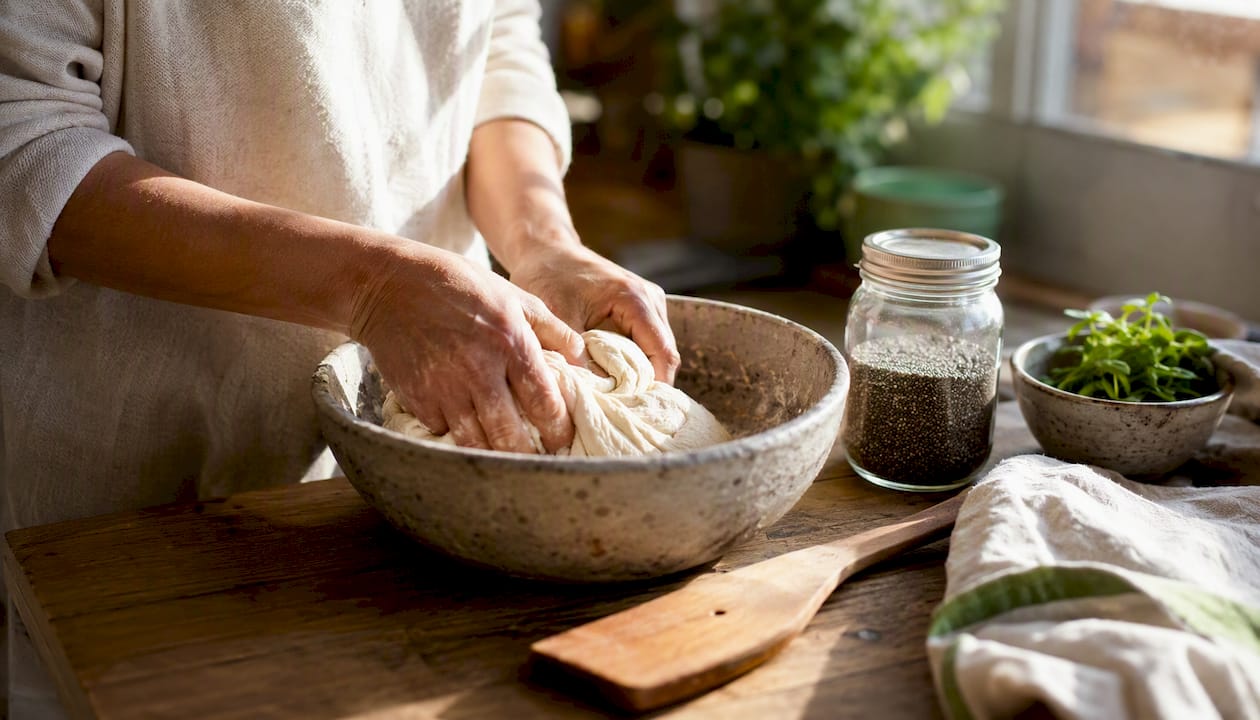
Home baking hands you control over every ingredient, which solves the two biggest complaints people have about store-bought loaves: blandness and dryness. You decide the flour blend, the binder, and exactly how much fibre goes in, and that control usually produces a better-tasting, more nutritionally solid loaf than most mass-market alternatives.
A reliable method leans on a handful of fundamentals. Blend a base flour (often rice or a specialised gluten-free flour mix) with a starch for softness, add a binder such as psyllium husk or xanthan gum, and get the hydration right, since gluten-free dough behaves more like a thick batter than a kneadable dough. Minimalist Baker’s crusty artisan gluten-free loaf proves the point neatly: a handful of ingredients, psyllium husk doing the structural heavy lifting, and a genuinely chewy crust as the result.
Three things separate a good home loaf from a gummy disappointment:
- Measure by weight, not volume. A digital scale removes the guesswork that ruins hydration ratios, especially when swapping starches like potato starch for potato flour.
- Check internal temperature before pulling it from the oven. King Arthur Baking recommends around 206 to 210°F as the target for a fully set gluten-free loaf.
- Cool completely before slicing, often two hours or more, since the starch structure keeps setting as the loaf loses moisture. Cut too soon and you get a gummy crumb, even if the bake itself was perfect.
Pro Tip: If your loaf keeps coming out gummy in the middle despite following a recipe exactly, the fault is almost always slicing too early or under-baking by a few degrees, not the recipe itself. For more on ingredient swaps and technique, Nature’s Soul Shop’s guide to baking without gluten covers common substitutions in more depth.
Reading labels and certification for coeliac-safe choices
The single most reliable safety signal on any gluten-free loaf is a recognised third-party certification mark, not the words “gluten free” printed on the front. Manufacturer claims are self-reported. Certification programmes test products independently against a defined threshold.
Certification schemes worth knowing:
- GFCO (Gluten-Free Certification Organization) – widely recognised in the US, tests to a strict parts-per-million threshold
- Coeliac UK’s Crossed Grain symbol – the UK’s leading certification, licensed to products meeting a defined gluten limit
- National certification bodies – many countries run their own equivalent schemes, worth checking for locally.
Label language matters just as much as the certification mark itself. “Gluten free” on the front typically means the product meets a regulatory threshold for gluten content. “May contain traces of wheat” is a precautionary allergen statement, usually meaning the product was made in a facility that also processes wheat, even if the recipe itself contains none. “Made in a facility that also handles wheat” is the most cautious wording and the one coeliac readers should treat most seriously.
Trust signal: A certified product has been independently tested against a numeric gluten threshold. A manufacturer’s own “gluten free” label claim, without a certification mark, relies entirely on that company’s internal quality control. Both can be genuinely accurate, but only one has been checked by someone outside the company.
For non-coeliac sensitivity, “may contain” warnings matter far less. For coeliac disease, they’re often the deciding factor between a safe loaf and one to skip entirely. Nature’s Soul Shop’s guide to choosing organic gluten-free foods runs through similar label checks in more detail.
Coeliac disease versus non-coeliac gluten sensitivity: different priorities
Coeliac disease requires certified gluten-free products, full stop. The autoimmune reaction that coeliac disease triggers doesn’t scale with dose in a forgiving way, so even trace cross-contamination can cause gut damage over time, whether or not it causes an immediate symptom. Non-coeliac gluten sensitivity operates differently: many people in this group can tolerate a wider range of products and don’t need certified loaves specifically, though favouring lower cross-contamination production is still sensible practice.
The practical difference in shopping priorities:
- Coeliac disease: certification mark, dedicated production facility, careful reading of “may contain” statements, willingness to contact manufacturers directly with questions
- Non-coeliac sensitivity: ingredient simplicity, digestive tolerance testing (introduce new loaves gradually), less strict need for facility-level certification
Nutritionally, both groups face the same trap: assuming gluten free equals healthy. Look at added sugars, which sneak into many commercial loaves as a flavour fix for the blandness plain rice flour can produce. Check for whole-food ingredients rather than a wall of starches and gums. And, again, fibre content per slice is one of the most useful single numbers on the pack, since it correlates strongly with whether a loaf will actually keep you full or leave you hungry an hour later.
Practical bread substitutes and how to use them
When a gluten-free loaf isn’t the right fit, or you just want variety, several substitutes cover most bread use-cases without any wheat, barley or rye involved at all: rice cakes, corn tortillas, gluten-free wraps, cloud bread, lettuce wraps and polenta slices.
Matching substitute to use-case makes the swap painless:
- Corn tortillas – wraps, tacos, quick flatbread substitute for sandwiches
- Rice cakes – toast replacement for spreads, though notably lower in fibre than a wholegrain loaf
- Cloud bread (an egg and cream cheese based “bread”) – low-carb sandwich base, very different texture to grain bread
- Lettuce wraps – burger and sandwich base for a lighter, carb-free option
- Polenta slices – firm enough to grill or toast, works well as a pizza base alternative
- Gluten-free wraps – closest like-for-like swap for standard wraps, check the ingredient list for the same starch-and-gum pattern seen in packaged loaves
Nutritional trade-offs are worth knowing before you swap wholesale. Rice cakes and cloud bread tend to be considerably lower in fibre than a genuine wholegrain gluten-free loaf, so if you’re relying on bread for fibre intake day to day, these aren’t a direct swap. Nature’s Soul Shop’s guide to gluten-free pizza crust options covers polenta and other base alternatives in more depth for anyone building meals around these substitutes regularly.
Examples of store-bought gluten-free loaves worth knowing
Walk down any well-stocked gluten-free aisle and you’ll see a fairly consistent cast of names: Canyon Bakehouse, Schär, Warburtons’ gluten-free line, Genius, Promise, Rudi’s, Udi’s, Glutino, Three Bakers and BFree. Each occupies a slightly different niche rather than competing head-on for the exact same shopper.
Some focus on soft, sandwich-style loaves designed to mimic conventional white bread as closely as possible, prioritising texture over ingredient minimalism. Others lean into wholegrain formulations with visibly more seeds and darker crumb, aimed at shoppers who want fibre alongside the gluten-free label. A few specialise narrowly, offering bagels, rolls or English muffin formats rather than standard sliced loaves, which matters if your household eats more breakfast bread than sandwich bread. Availability also varies significantly by region. What sits on a shelf in one country’s supermarkets may be entirely absent in another, which is exactly why understanding the ingredient and category differences covered earlier matters more than memorising any single name. The category tells you what to expect; the specific loaf on your local shelf is the one you actually need to read the label on.
Author perspective: a buyer’s honest take
If you eat gluten-free bread for a health reason rather than a preference, buy for the ingredient list first and worry about brand loyalty later. That’s the single change I’d make to how most people shop this category. Too many buyers treat “gluten free” as a finish line when it’s really just an entry requirement, one that says nothing about fibre, additive load or how the loaf will actually taste on day three out of the freezer.
My practical split: for sandwiches, prioritise a loaf with a shorter ingredient list and visible whole grains, even if it’s slightly denser than the softest packaged option. For toast, texture matters less than flavour, so this is where an artisan-style loaf earns its higher price and shorter shelf life. For baking (stuffing, breadcrumbs, croutons), almost anything works, so buy whatever’s cheapest and don’t overthink it. The mistake I see most often is buying the same soft sandwich loaf for all three uses and wondering why it’s underwhelming at two of them.
Clean ingredients aren’t a marketing gimmick, they’re a genuinely useful filter. A loaf built from rice or buckwheat flour with minimal gums, no artificial preservatives, and a certification mark you recognise is doing almost everything right before you’ve even tasted it. That filter won’t tell you if you’ll personally like the flavour, but it will reliably rule out the loaves most likely to disappoint you nutritionally.
Ready-made clean-ingredient gluten-free loaves, no baking required
Not everyone wants to weigh flour and check internal temperatures on a Tuesday evening, and that’s exactly the gap Nature’s Soul Shop’s gluten-free bread range fills. These loaves are built from rice and buckwheat flours with no dough improvers and no preservatives, so the ingredient list stays short enough to actually read in the shop aisle.
That matters most if you’re the kind of shopper this article has been describing: someone who checks fibre content, counts the gums on a label, and would rather pay slightly more for a loaf built from whole-food flours than save a little and end up with a starch-heavy compromise. It also suits vegan households and anyone avoiding egg-bound recipes, since the formulation skips animal-derived binders entirely. If you’ve read this far and decided your priority is ingredient simplicity over the softest possible sandwich texture, Nature’s Soul Shop’s organic gluten-free bread range is worth a look, and you can browse the full gluten-free and vegan selection to see what’s currently in stock.
Sources
- Gluten‑Free Vs. Regular Bread: Experts Share Which Is Healthier
- Store‑Bought Gluten‑Free Breads, Ranked Worst To Best
- Easy Gluten‑Free Bread
- Crusty gluten‑free artisan bread — Minimalist Baker
- The ultimate gluten‑free bread (artisan style) — The Loopy Whisk
This article is general information, not a substitute for advice from a qualified doctor. Consult a qualified healthcare professional about your own circumstances before acting on anything here.


