


Require USDA National Organic Program (NOP) certification for food and agricultural goods sold into the US, GOTS for textiles, and COSMOS Standard, NATRUE, or NSF/ANSI 305 for cosmetics and personal care, depending on your market. Household items fall back on the EU Organic Regulation where they contain agricultural ingredients, or a private health and beauty scheme otherwise.
Before you accept any supplier as “organic,” get these on file:
- A current certificate in PDF form, not a screenshot or a logo on an invoice
- The certifying agent’s name and accreditation status
- The exact scope: which ingredients or finished products the certificate covers
- Certificate issue and expiry dates
- A clear percentage organic statement
- Recent batch or lot evidence tied to an audit date
For cross-border sourcing, insist on either a government organic regime recognised in your market (NOP, EU Organic Regulation) or a widely accepted private scheme (COSMOS, NATRUE, NSF/ANSI 305, GOTS) backed by traceable documentation.
Key Takeaways
Matching the right certification to the right product category, and verifying it annually against a public register, is the single most reliable safeguard against mislabelled organic goods.
| Point | Details |
|---|---|
| Match certification to product type | Use USDA NOP for US food, GOTS for textiles, COSMOS/NATRUE/NSF‑ANSI 305 for cosmetics, EU Organic Regulation for EU food sourcing. |
| Check the label threshold | “100% organic,” “organic” (≥95%), and “made with organic” (≥70%) carry different legal meanings and label rights. |
| Government seals carry legal weight | NOP and EU Organic Regulation violations can be reported and enforced; private schemes rely on contract and reputation. |
| Re-verify certificates every year | Certificates expire and scopes change, so annual checks against a certifier’s register matter as much as the first check. |
| Naturessoulshop lists certification details | Product pages show certification information upfront, though buyers should still request certifier PDFs directly. |
Table of Contents
- Organic farming certification and label thresholds you need to know
- How do international organic standards compare for sourcing?
- Should you trust a private label certification or a government seal?
- How long does organic certification actually take?
- A sourcing manager’s take on verifying certificates
- Frequently asked questions
- Sources
Organic farming certification and label thresholds you need to know
Organic farming certification isn’t one label. It’s a family of thresholds that determine what a supplier is legally allowed to print on a package, and buyers who don’t know the tiers end up accepting products that are far less “organic” than they assume.
“Organic” allows a small amount of non-organic content, provided those ingredients aren’t available in organic form. Below that is a “made with organic ingredients]” category, which requires a higher proportion of organic content and can name up to three qualifying ingredients on the front label. Products with less organic content cannot use the term “organic” on the principal display panel, though specific certified ingredients may be listed in the statement of ingredients. The [Agricultural Marketing Service’s labelling rules require a USDA-accredited certifier to approve the label before it ships, which is your first checkpoint as a buyer.
Cosmetics work differently because there’s no single government organic definition for them. The FDA is explicit that “organic” isn’t defined in cosmetic law; NOP only governs agricultural ingredients, and cosmetic products still need to meet separate FDA safety and labelling rules regardless of any organic claim. That gap is exactly why private cosmetic standards exist, and why an organic ingredient claim on a lotion doesn’t carry the same legal weight as it does on a bag of rice.
How do international organic standards compare for sourcing?
No single certification is recognised everywhere, so cross-border buyers need to think in terms of equivalence, not universality. The USDA NOP governs food and agricultural products for the US market and lists every accredited operation in the Organic INTEGRITY Database. The EU Organic Regulation does the equivalent job across the European Union, with its own logo and its own set of accredited control bodies. Neither automatically covers the other’s market, though trade equivalency arrangements between the US and EU mean many operators hold recognised status under both without duplicating every inspection.
Cosmetics have no such government-to-government bridge. COSMOS Standard, run by a consortium of European certifying bodies, sets its own thresholds and calculation method for organic percentage by product category, with the COSMOS technical guide spelling out labelling elements including certifier name and stated percentage. NATRUE runs a stricter organic tier, requiring at least 95% of natural substances from controlled organic farming for that level. NSF/ANSI 305 fills a similar role in the US, certifying personal care items as “containing organic ingredients” against thresholds documented on NSF’s own certification page.
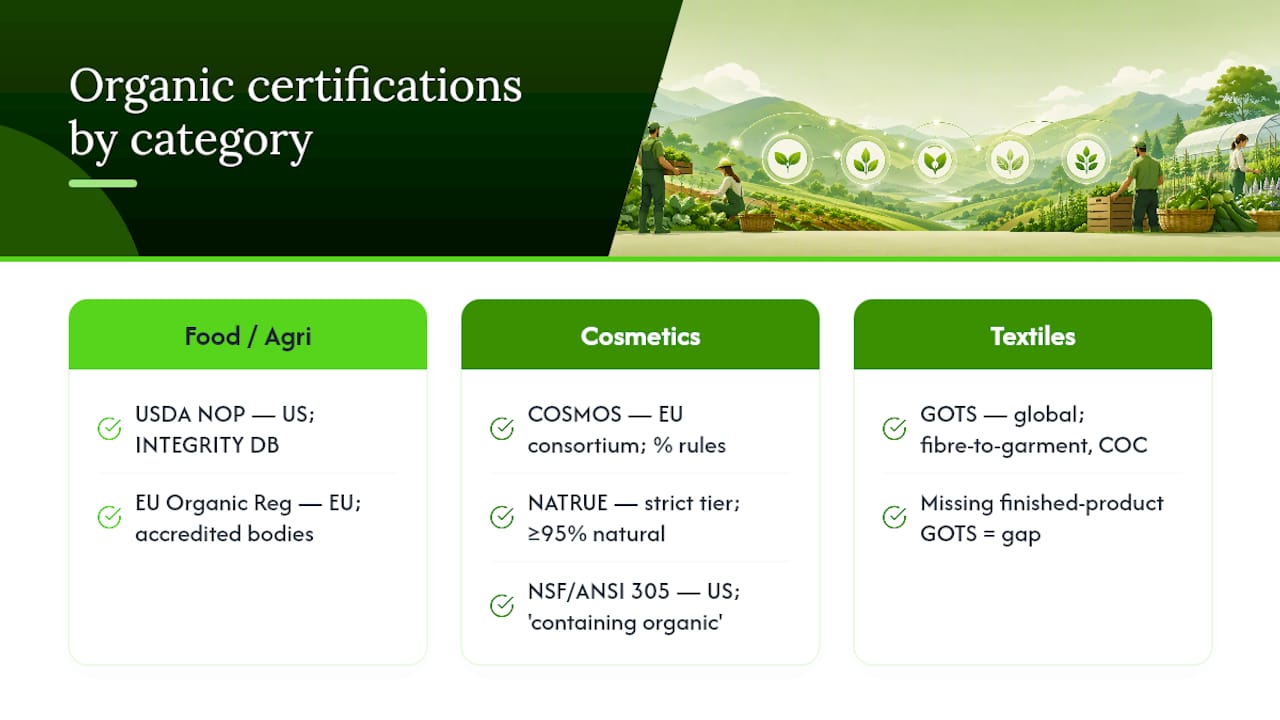
For textiles, GOTS is the closest thing to a global default, covering fibre origin through to finished garment with chain-of-custody rules baked in. If a supplier can’t produce a GOTS certificate scoped to the finished product, rather than just the raw cotton, treat that as a gap, not a technicality.
Should you trust a private label certification or a government seal?
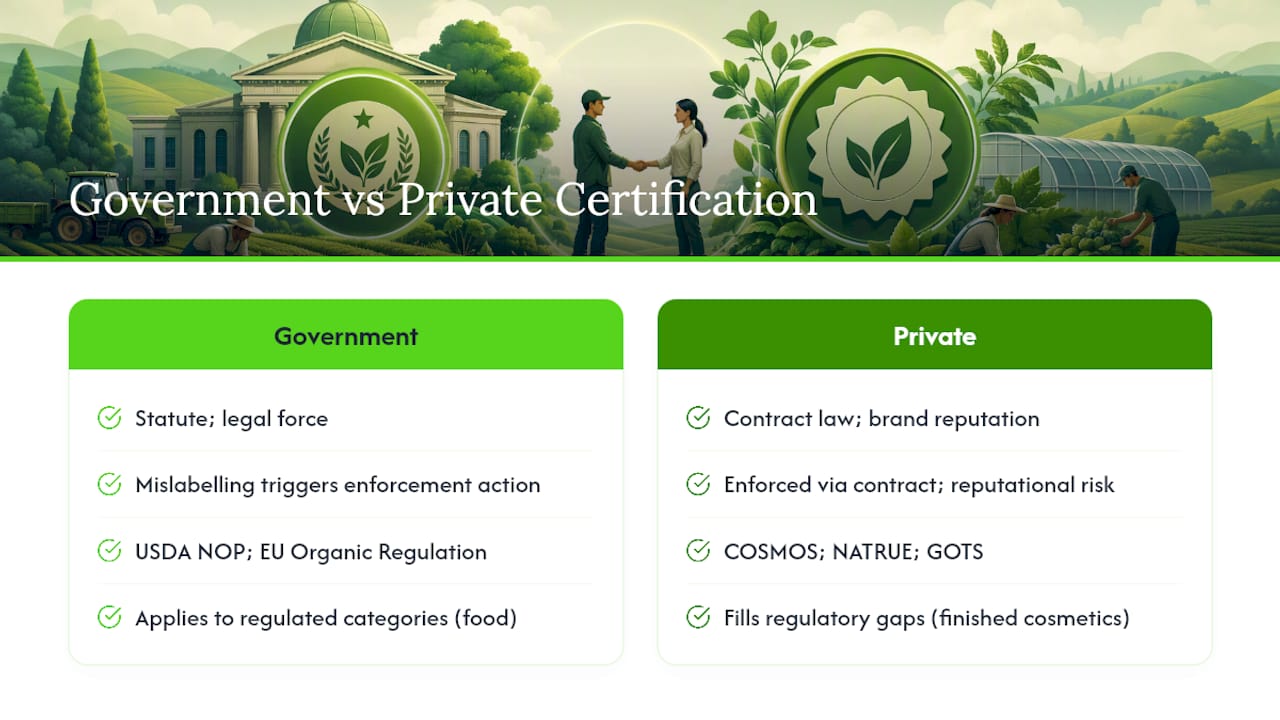
Both are legitimate, but they answer different questions. A government certification like USDA NOP or the EU Organic Regulation carries legal force: mislabelling triggers enforcement action, and the NOP Online Complaint Portal exists specifically for buyers and consumers to report suspected violations. That legal backbone is why food buyers should treat NOP or EU Organic Regulation compliance as close to non-negotiable for products sold into those markets.
Private schemes like COSMOS, NATRUE, and GOTS operate on contract law and brand reputation rather than statute. That doesn’t make them weaker in practice. COSMOS and NATRUE have filled a real regulatory vacuum, since neither the FDA nor USDA defines “organic” for finished cosmetics. Without a private standard, a cosmetics brand could print “organic” on a bottle with almost no verification behind it.
The catch with private schemes is fragmentation. A textile certified GOTS in Europe carries real weight globally, but a “natural” claim without COSMOS or NATRUE backing means nothing enforceable. Some countries also run their own national private schemes, such as Ireland’s health and beauty standards for products outside government organic scope, which buyers in those markets should check for separately.
The practical rule: government certification where it exists and applies to your product category; a recognised, named private standard everywhere else. Never accept an unnamed “eco-certified” or “organic-inspired” claim as a substitute for either.
How long does organic certification actually take?
Most first-time food operations take six to twelve months to move from application to certificate, largely because land and inputs need a transition period before harvests qualify; for more on mandatory inspections and annual certification, see quality food service explained. Renewal is far faster once a supplier is established, typically running alongside the mandatory annual inspection rather than as a separate process.
Costs vary enormously by certifier, operation size, and country, so there’s no single figure a buyer can rely on across the board. What matters more for sourcing decisions is the pattern: initial certification costs more than renewal, and small operations under $5,000 in annual organic sales may qualify for an NOP exemption from certification altogether, though they still can’t use the USDA seal. If a “small” supplier claims exemption, ask to see the sales threshold documentation, not just take the claim at face value.
Cosmetics certification under COSMOS or NATRUE tends to run on similar annual audit cycles once initial approval is granted. GOTS renewal follows the same logic: annual, unannounced-inspection-eligible, and tied to a scope that should list the finished product, not just the raw fibre. Whatever the certification, budget for it to be a recurring line item, not a one-off cost a supplier pays once and forgets.
A sourcing manager’s take on verifying certificates
Re-check every supplier certificate annually and keep the paperwork on file. Cross-check names against the Organic INTEGRITY Database or the certifier’s own register. Watch for certificates scoped only to raw ingredients, not the finished product you’re actually buying.
Frequently asked questions
Do I need different certifications for the same brand’s food and cosmetic lines? Yes. A brand selling both organic snacks and organic skincare needs USDA NOP (or the EU Organic Regulation) certification for the food line and a separate scheme like COSMOS, NATRUE, or NSF/ANSI 305 for cosmetics, since no single certification covers both categories.
Is a supplier exempt from certification if they’re small? Under NOP rules, operations with under $5,000 in annual organic sales can be exempt from certification, but they still cannot use the USDA organic seal. Ask for sales documentation before accepting an exemption claim at face value.
Can a product be “made with organic ingredients” without full organic certification? Yes, provided the product contains at least 70% organic content and names no more than three qualifying ingredients on the label. This is a separate labelling tier from “organic” (95%+) or “100% organic.”
How often should I re-check a supplier’s certificate? At minimum, annually, timed to the supplier’s own inspection cycle. Certificates carry validity dates, and a scope or status can change between renewals, so treat last year’s PDF as outdated evidence.
What’s the biggest red flag in a supplier’s certification paperwork? A certificate scoped only to raw ingredients rather than the finished product you’re buying. An organic cotton certificate doesn’t automatically extend to the dyed, finished garment unless GOTS chain-of-custody covers that stage too.
Sources
Naturessoulshop is the alternative to guessing whether a supplier’s organic claim is real: every product listing carries the certification details behind it, so you’re not chasing a PDF before you can trust the label. We stock certified organic groceries, personal care, and household items across our range of organic groceries and care products, from fresh produce to items like Namak Para Jowar and Honeysuckle Luxury Bath Soap.
That said, our listing certification details are a starting point, not a substitute for your own checks. Pull the certifier’s PDF and confirm the scope yourself before you commit to bulk sourcing. If you’re a retailer or brand looking at recurring supply, browse the shop’s organic range or get in touch about bulk enquiries, and check our health and wellness category if you’re sourcing certified nutraceuticals specifically.
- Labeling organic products | Agricultural Marketing Service
- Organic cosmetics | FDA
- NATRUE label requirements (v3.9) | NATRUE
- COSMOS‑standard technical guide v3.2
Recommended
- Certified organic explained: UK labelling and verification – naturessoulshop
- How to Identify Organic Products Effortlessly – naturessoulshop
- USDA organic requirements for businesses: what producers need to do – naturessoulshop
- Organic Certification in India: Your Guide to Healthy Choices – naturessoulshop


