


Certified organic means a product has met legally required production and handling standards and been independently verified by an approved control body. In the UK, that is not a marketing claim — it is a regulated status, and using the word “organic” without valid certification is a regulatory offence. Three signals tell you immediately whether a product is genuinely certified:
- The certifier code printed on pack (format: GB-ORG-XX for Great Britain, XI for Northern Ireland)
- The certifier’s logo or mark from a body such as the Soil Association, Organic Farmers & Growers (OF&G), or the Organic Food Federation
- Evidence of annual inspection — every certified operation is audited at least once a year by its control body
The UK’s framework is overseen by the Department for Environment, Food & Rural Affairs (Defra), which approves and monitors the control bodies. The Organic Research Centre provides independent research underpinning the standards. Between them, these organisations give the term “certified organic” a legal backbone that words like “natural” or “sustainable” simply do not have.
Table of Contents
- What “certified organic” legally means in the UK
- Who can hold organic certification in the UK?
- What auditors actually check during certification
- How to become certified organic: steps, timelines, and costs
- How to check whether a product is genuinely certified organic
- How imported organic products are labelled and recognised
- What the research says about certified organic benefits
- Key takeaways
- Why the certification label matters more than most people realise
- Naturessoulshop: certified organic products with provenance you can check
- Useful sources and further reading
What “certified organic” legally means in the UK
The statutory basis is clear: you may only use “organic” on food, feed, or seed if the product and its suppliers comply with organic regulations and an approved control body has inspected and certified them. This applies to labelling, advertising, and commercial documents alike.
The rules for food products centre on a 95% threshold:
- At least 95% of a product’s agricultural ingredients must be organic
- For processed animal feed, the same 95% threshold applies by dry matter
- Ingredients below that 95% must be specifically permitted within organic regulations — they cannot simply be any non-organic ingredient the producer chooses
- Permitted non-organic ingredients, additives, and processing aids are listed explicitly in the regulations; nothing outside that list is allowed
Misuse carries real consequences. Labelling or advertising a product as organic without valid certification is an offence under UK organic regulations. Certifier codes on packaging communicate both the certifier and the jurisdiction: GB-ORG-XX covers Great Britain, XI covers Northern Ireland, and non-UK goods carry different three-letter country codes. The agricultural statement and the certifier code must appear in the same visual field as any organic logo used on the label.
Key figure: 95% of agricultural ingredients must be organic for a food product to carry the organic label — a threshold that applies across the UK.
Who can hold organic certification in the UK?
Certification is not limited to farms. Any operator in the supply chain where organic integrity is maintained can — and often must — register with an approved control body. The main operator types are:
- Producers (arable and livestock farmers, horticulturalists, smallholders)
- Processors and manufacturers (bakeries, dairies, meat processors, ready-meal producers)
- Packers and re-packers (co-operative packing facilities, contract packers)
- Importers bringing certified organic goods into the UK
- Traders and distributors who handle organic products in bulk
- Some retailers that process or repack foods under their own brand
The chain-of-custody principle is what makes this work. Every link in the chain where organic product changes hands or is processed must be certified, so that integrity is maintained from field to shelf. A small farm growing certified organic carrots, a co-operative that washes and bags them, and a retailer that sells them under a private-label organic brand each need their own certification. An importer bringing in certified organic pulses from abroad must also hold UK certification to sell them as organic here.
This is why the certifier code on a finished product reflects the UK certifier responsible for that specific operator, not necessarily the farm of origin.

What auditors actually check during certification
Certification is not a one-off approval. Every certified operation undergoes at least one annual inspection, and auditors work through a structured checklist. Understanding what they examine helps explain why the standard carries weight.
- Prohibited inputs — auditors verify that no synthetic pesticides, mineral nitrogen fertilisers, or genetically modified organisms have been used. Input purchase records and invoices are cross-checked against field histories.
- Approved inputs and records — any input used must appear on the approved list. Auditors check product labels, supplier documentation, and application records.
- Crop rotations and soil management — rotation plans, cover-crop records, and soil health indicators are reviewed to confirm the system is genuinely building soil fertility rather than depleting it.
- Animal welfare and feed rules — livestock operations must demonstrate appropriate stocking densities, access to pasture, and that feed rations meet organic requirements. Feed invoices are checked.
- Seed and planting stock — organic seed must be used where available; any use of non-organic seed requires justification and, in some cases, derogation approval.
- Processing and handling — for food manufacturers, auditors check physical separation of organic and non-organic lines, cleaning logs, permitted additives, and labelling proofs.
- Traceability and mass balance — processors must demonstrate that the quantity of organic raw material in matches the quantity of certified organic product out, accounting for processing losses.
- Documentation and record-keeping — field maps, input records, sales invoices, and cleaning schedules must all be current and consistent.
Pro Tip: Keep a simple traceability file — a folder (physical or digital) holding supplier invoices, input product labels, and a basic field or batch history. Auditors spend less time on paperwork queries, and you reduce the risk of corrective actions that delay your certificate.
For a deeper look at organic standards criteria, the Naturessoulshop guide covers the specific requirements in plain language.

How to become certified organic: steps, timelines, and costs
The path to certification follows a clear sequence, though the timeline varies by operator type.
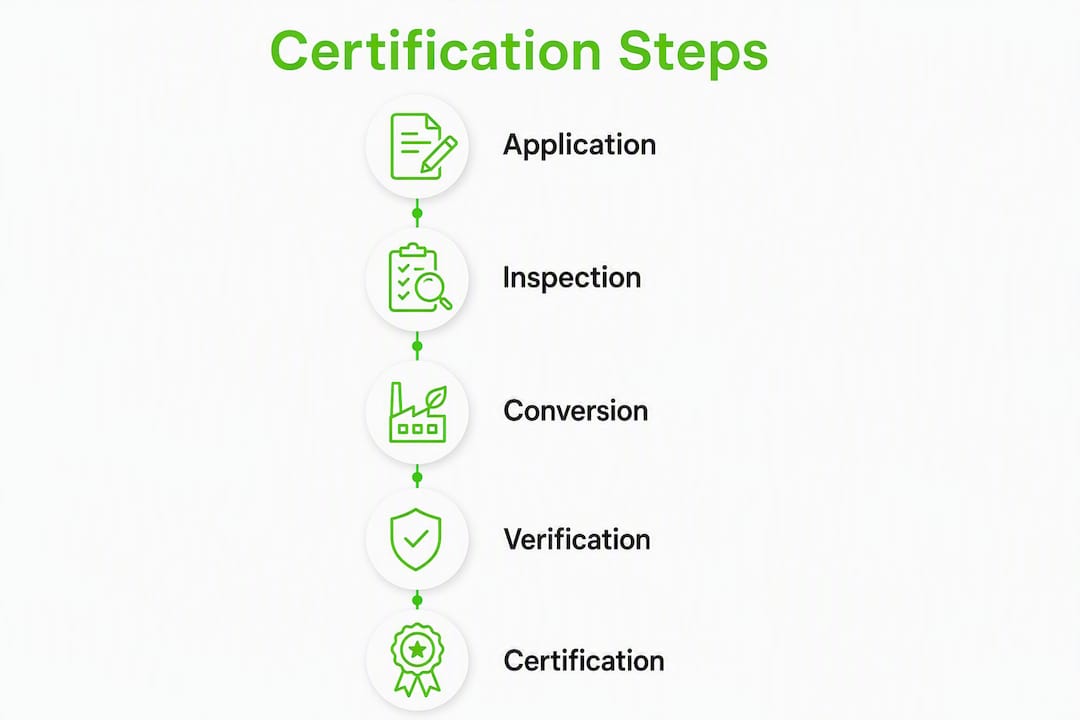
- Choose an approved control body. Defra publishes the list of approved UK control bodies. Soil Association, OF&G, and the Organic Food Federation are the largest, but others exist. Compare their fee structures and sector expertise before applying.
- Submit an application and organic system plan. This document describes your operation: what you produce, how you manage inputs, your record-keeping system, and your conversion history.
- Initial inspection. An inspector visits your farm, facility, or premises to verify that your system plan matches reality. This inspection is thorough — expect a full day on a working farm.
- Conversion period (where applicable). For land, a two-year conversion period applies before annual crops can be sold as organic; perennial crops require three years. During conversion, you follow organic standards but cannot yet market produce at an organic premium. For processors with no land, conversion periods are shorter or may not apply.
- Certification decision and certificate issuance. If the inspection is satisfactory, the control body issues a certificate of organic operation. Your certifier code (GB-ORG-XX) is assigned at this point.
- Annual inspections. Every certified operation is re-inspected at least once per year. Additional unannounced inspections can occur.
Cost factors to plan for:
- Annual certification fees (vary by control body and operation size)
- Inspection travel and time costs
- Administrative time for record-keeping
- Possible productivity adjustments during conversion (lower yields, no premium income)
- Testing costs where residue checks are required
The conversion period is where the financial pressure is sharpest. As one practitioner account notes, conversion imposes cashflow and administrative burdens, and small producers often face proportionally higher per-unit costs during transition. Defra and individual certifiers publish guidance on available support schemes; check GOV.UK and your chosen control body’s website for current grant information before you apply.
How to check whether a product is genuinely certified organic
Verifying an organic claim takes about thirty seconds once you know what to look for. Here is a practical checklist for in-store or online shopping:
- Find the certifier code. Look for a code in the format GB-ORG-XX (Great Britain) or XI-ORG-XX (Northern Ireland) somewhere on the packaging, usually near the ingredient list or on the back panel.
- Check for the certifier’s logo. The Soil Association’s symbol, OF&G’s logo, or the Organic Food Federation mark are the most common in the UK. The logo should appear in the same visual field as the organic claim.
- Read the agricultural statement. Certified products must state the percentage of organic agricultural ingredients and identify the certifier. If neither appears, the claim is unverified.
- Cross-reference the certifier’s register. Each approved control body maintains a public register of certified operators. Search by business name or product to confirm the certificate is current.
- Use GOV.UK guidance. The approved control bodies list on GOV.UK lets you identify which body issued a code and find their register.
If something looks wrong — a product claiming to be organic with no code, no certifier logo, or an unrecognised code — report it to the control body named on the label, or to Defra’s enforcement channels. The offence of misusing the term “organic” is taken seriously, and control bodies investigate complaints.
Pro Tip: Screenshot the certifier code and search the control body’s online register before buying an unfamiliar brand online. Most registers are searchable by operator name and show the scope of certification, so you can confirm the specific product category is covered.
How imported organic products are labelled and recognised
Buying imported organic goods adds a layer of complexity, but the code system makes it manageable.
- Non-UK certifier codes use a different three-letter country prefix instead of “GB” or “XI.” An EU-certified product might carry a code beginning with the relevant EU member state’s identifier, alongside the EU organic logo (the green leaf).
- Equivalence agreements allow the UK to recognise some foreign organic schemes as meeting standards broadly equivalent to UK regulations. Where equivalence applies, the product can be sold as organic in the UK without re-certification. Where it does not, additional checks or UK certification may be required.
- Practical differences in permitted inputs exist between jurisdictions. The UK, EU, and US (USDA) organic programmes share the same broad philosophy but differ on specific permitted substances. A product certified under a foreign scheme may have been produced with an input that UK regulations do not permit, even if both carry an “organic” label.
- The certifier code resolves most uncertainty. If you see an unfamiliar code, search the certifier’s website or the GOV.UK guidance pages to identify the scheme and its scope.
For context on how organic certification works in other markets, the Naturessoulshop guide on organic certification in India illustrates how different national frameworks approach the same core principles.
Pro Tip: When buying imported certified organic products, note the three-letter country code and look up the certifier’s public register. Check that the product’s declared scope matches what you are buying — a certifier may cover a business’s grain products but not its processed foods.
What the research says about certified organic benefits
The environmental case for certified organic is not just marketing. A Defra-commissioned review synthesised by the Organic Research Centre found that certified organic systems provide strong evidence of benefits for biodiversity, soil health, and reduced pesticide use compared with other assurance schemes. The review drew on peer-reviewed literature, farm-scale data, and standards assessments — it is not a promotional summary.
An independent summary by Agricology of the same review reinforces the finding: organic farming delivers consistently strong outcomes across biodiversity and soil health indicators, and the evidence base is described as robust.
The scale of UK organic farming reflects growing confidence in the system:
| Metric | 2025 figure |
|---|---|
| Fully organic land | 461,000 hectares |
| Land in conversion | 79,000 hectares |
| — | a 63% increase from 2024 |
That 63% rise in land entering conversion is a meaningful signal. Farmers do not take on the administrative and financial burden of conversion without a reason, and the data suggests confidence in the market is growing.
The legal backbone of certification also matters for consumer trust. Because “organic” is a regulated term subject to mandatory independent inspection, it is far harder to misuse than loosely defined marketing language such as “natural” or “regenerative.” Those terms carry no statutory definition and require no third-party audit. Certified organic does. For readers wanting to understand the environmental impact of organic food in more depth, the evidence is well-documented.
The difference between certified organic and conventional production is also worth understanding directly — the Naturessoulshop organic vs conventional guide covers the practical contrasts.
Key takeaways
Certified organic is a legally regulated status in the UK, verified by annual independent inspection and identifiable by a certifier code (GB-ORG-XX) on every genuine product.
| Point | Details |
|---|---|
| The 95% rule | At least 95% of agricultural ingredients must be organic for a food product to carry the organic label in the UK. |
| Certifier code on pack | Look for GB-ORG-XX (Great Britain) or XI-ORG-XX (Northern Ireland) to confirm the product is certified. |
| Annual inspections | Every certified operation is audited at least once a year; unannounced inspections are also permitted. |
| Organic land growing | UK organic land reached 461,000 hectares fully certified in 2025, with 79,000 hectares in conversion, up 63% from 2024. |
| Naturessoulshop sourcing | Naturessoulshop stocks certified organic products across fresh produce, dry grocery, and other categories, with provenance details available on product pages. |
Why the certification label matters more than most people realise
The most common mistake consumers make is treating “organic” as a spectrum — assuming that a product described as “natural,” “free-range,” or “sustainably sourced” is roughly equivalent to certified organic. It is not, and the gap is structural, not just semantic.
Certified organic is the only food claim in the UK that requires mandatory, independent, annual inspection by an approved third party. Every other positive-sounding label — “natural,” “clean,” “regenerative,” “eco-friendly” — can be applied by a brand to its own products without any external verification whatsoever. There is no auditor, no certifier code, no register entry. The brand simply decides the word fits.
This matters because the inspection process is genuinely rigorous. Auditors do not just review paperwork; they cross-check input invoices against field histories, verify mass-balance calculations for processors, and can trigger unannounced visits. A producer who slips a prohibited input into their system faces losing their certificate, not just a reputational risk. That accountability is what gives the label its value.
The counterargument — that certification is expensive and therefore excludes small, genuinely ethical producers — has some truth to it. Conversion costs are real, and the per-unit burden falls hardest on smaller operations. But the answer to that problem is better support for small producers during conversion, not weakening the standard. A label that means something only because it is hard to get is precisely the kind of signal consumers can rely on.
For shoppers, the practical implication is simple: if a product does not carry a certifier code and a recognisable certification mark, the organic claim is unverified. That does not make the product bad — but it does mean you are taking the producer’s word for it rather than an independent auditor’s.
Naturessoulshop: certified organic products with provenance you can check
Knowing what certified organic means is one thing. Finding products that actually meet the standard, with the certifier details to prove it, is where most shoppers hit a wall.
Naturessoulshop stocks certified organic products across fresh fruit and vegetables, dry grocery, dairy, and more — sourced from suppliers whose certification we verify before listing. Product pages include origin details so you can see where your food comes from, not just a vague “organic” claim. If you want the certifier code or certification scope for a specific product, the customer services team can provide it.
Browse the certified organic range or head to Nature’s Soul Fresh for fresh produce with full provenance. For certification queries on any product, contact customer services directly.
Useful sources and further reading
The following primary sources and independent reviews are the most authoritative references for certified organic in the UK:
- Organic food: labelling and advertising rules (GOV.UK) — the primary statutory guidance covering the 95% rule, certifier codes, labelling requirements, and the offence of misusing the term “organic.” Start here for any compliance question.
- Organic food: UK approved control bodies (GOV.UK) — the official list of approved certifiers including Soil Association, OF&G, and the Organic Food Federation, with links to their registers. Use this to verify a certifier code or find a control body for certification.
- Organic farming statistics 2025: United Kingdom (GOV.UK) — official headline figures on UK organic land area and conversion trends. Useful for understanding the scale and direction of the sector.
- Organic Research Centre — independent research body that produced the Defra-commissioned review comparing certified organic with other assurance schemes. Consult for peer-reviewed evidence on environmental outcomes.
- Agricology summary of the Defra/ORC review — an accessible plain-language summary of the ORC findings, useful if you want the key conclusions without reading the full technical review.
- Explaining food quality standards (Wild Foodz) — a practical guide to how food quality standards work and how to read labels, useful for consumers wanting broader context on verification.


