


TL;DR:
- Prioritize buying organic for high-residue produce such as berries, leafy greens, and stone fruits to reduce pesticide exposure. Buy conventional for thick-skinned items like bananas and avocados, where the outer layer limits residue transfer, saving costs. Focus on organic dairy and eggs to minimize antibiotic and hormone exposure, while using simple washing methods to reduce surface residues on low-risk produce.
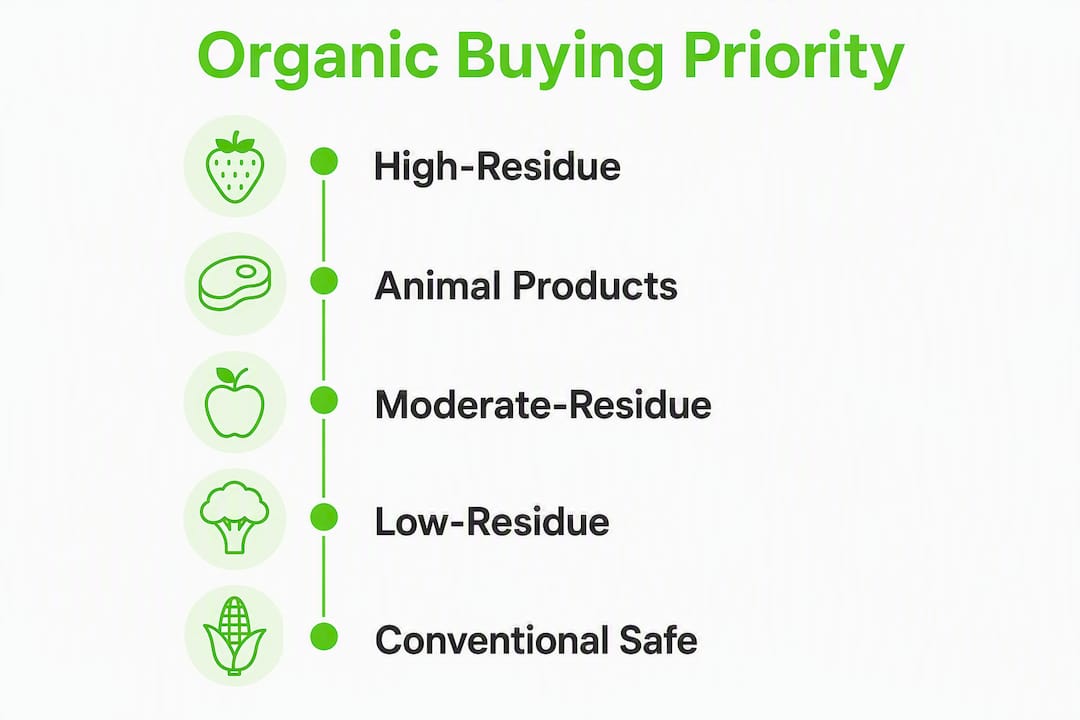
Prioritise organic for thin-skinned fruit, leafy greens, and all animal products. Buy conventional for thick-peeled produce. That one rule will cover most of the health benefit at a fraction of the cost of going fully organic.
Three shopping rules to use right now:
- High-residue produce first: berries, leafy greens, stone fruit, grapes, and apples carry the most pesticide residues. These are your priority swaps.
- Organic animal products when possible: milk, eggs, and meat are where antibiotic and hormone concerns are most relevant in the UK.
- Use the Clean Fifteen as your safety net: avocados, bananas, onions, and pineapples are consistently low in residues. Buy these conventional and spend the saving elsewhere.
The shopping checklist later in this guide pulls all of this together into a single printable list.
Table of Contents
- Which produce is worth buying organic first?
- Which produce can you safely buy conventional?
- Why organic meat, dairy, and eggs deserve a place on your list
- How to eat more organic food without overspending
- Where to buy organic in the UK
- What does the evidence actually say?
- Your organic shopping checklist for one shop
- Key takeaways
- The organic priority question most guides get wrong
- Naturessoulshop: organic groceries without the supermarket compromise
- Useful sources and further reading
Which produce is worth buying organic first?
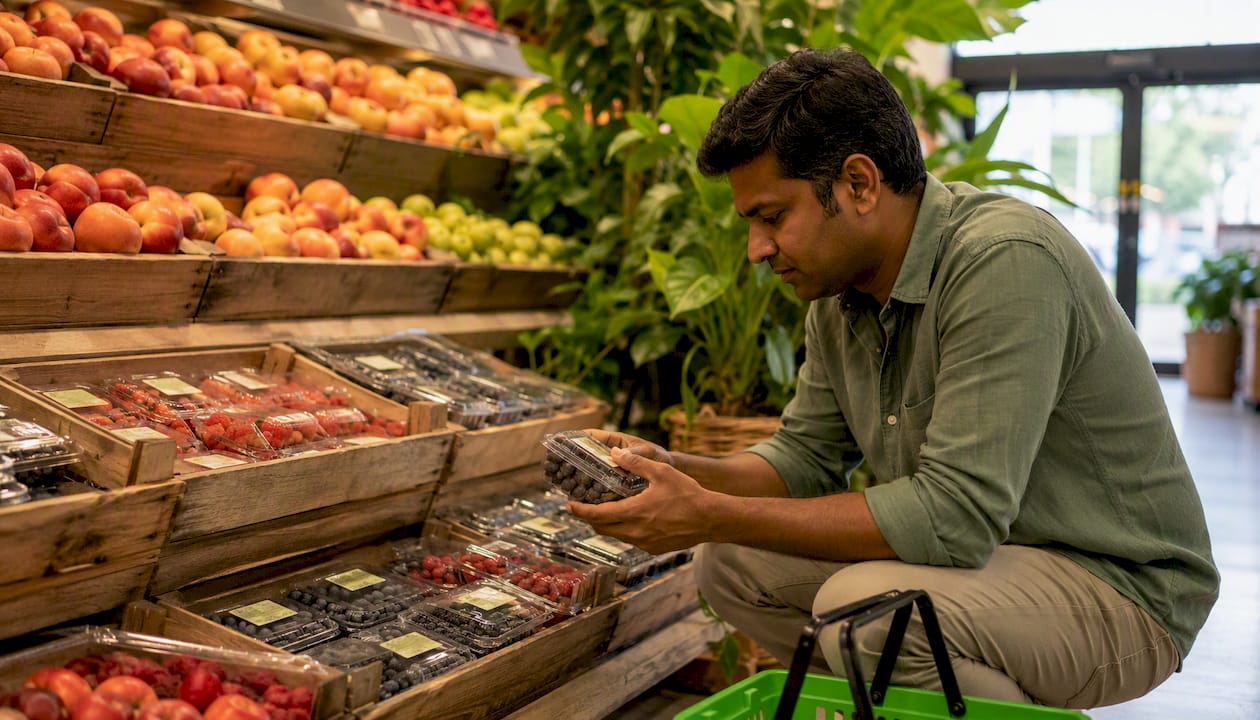
The case for prioritising certain items is not abstract. PAN UK testing found that 85% of peaches and nectarines, 84% of grapes, and 83% of strawberries tested positive for multiple pesticide residues. These are not trace findings on a handful of samples; they are the norm for conventionally grown soft fruit in the UK market.
High-priority items to buy organic:
- Strawberries and soft berries (blueberries, raspberries): thin skin, no peeling, eaten whole
- Leafy greens (spinach, kale, chard): high surface area, often eaten raw
- Peaches and nectarines: 85% multiple-residue rate in PAN UK data
- Grapes: 84% multiple-residue rate; eaten whole with skin
- Apples: commonly eaten unpeeled; consistently high in residue surveys
- Celery and bell peppers: thin-skinned, difficult to wash effectively
- Tomatoes: frequently eaten in volume; residues concentrate in skin
The logic behind this list is straightforward. Cumulative exposure matters more than any single meal. If you eat spinach in a salad four times a week, the residue load from conventional spinach adds up in a way that a single conventional avocado simply does not.
Pro Tip: Prioritise the organic swap for whichever item you eat most often. If your household goes through a bag of spinach every few days, that is your highest-value swap, not an occasional punnet of grapes.
The Dirty Dozen samples consistently show a very high rate of detectable pesticides, with PFAS pesticides present on many samples and multiple different pesticides on each.
Which produce can you safely buy conventional?
Thick peel is a genuine barrier. Avocados, bananas, and pineapples have outer layers that block pesticide penetration, so the edible flesh carries very little residue regardless of how the crop was grown. Spending the organic premium here is largely wasted.
The Clean Fifteen includes produce items that are consistently low in pesticide residues, making them safer choices for conventional purchases.
- Avocados (cost saving: high — organic avocados can cost twice as much)
- Sweet corn (cost saving: medium)
- Pineapple (cost saving: high)
- Onions (cost saving: medium)
- Papaya (cost saving: medium)
- Frozen sweet peas (cost saving: low)
- Asparagus (cost saving: medium)
- Cabbage (cost saving: high)
- Watermelon (cost saving: high)
- Bananas (cost saving: high)
- Mushrooms (cost saving: medium)
- Carrots (cost saving: medium)
- Kiwi (cost saving: medium)
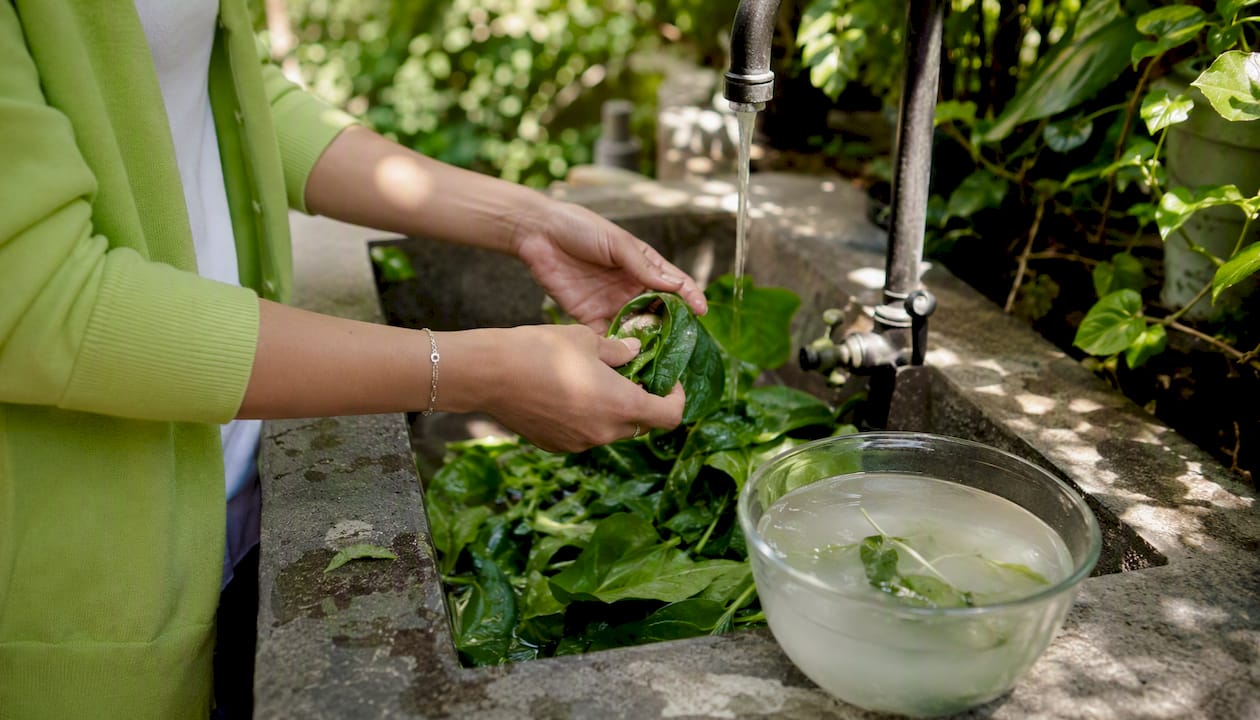
For any conventional item you are concerned about, a simple wash in dilute baking-soda solution (one teaspoon to two cups of water) removes surface residues more effectively than water alone, according to published research. It will not eliminate systemic residues that have penetrated the flesh, but for low-residue items it is a practical extra step.
Why organic meat, dairy, and eggs deserve a place on your list
Residue data drives the produce priority list. For animal products, the concern shifts to antibiotics and feed standards. Under UK organic regulations, certified organic animals must be fed organic feed, cannot be given routine antibiotics or synthetic growth hormones, and must have outdoor access. These are legally enforced requirements, not marketing claims.
Routine antibiotic use in conventional livestock is a genuine public-health concern. When animals receive antibiotics prophylactically, resistant bacteria can develop and enter the food chain. Choosing organic farming practices removes that route of exposure.
What to look for on the label:
- Soil Association certification: the most rigorous UK standard, covering feed, welfare, and antibiotic use
- OF&G (Organic Farmers & Growers): another UK-accredited certifier; look for the logo
- “Organic” alone is not enough: the word must be backed by a named certifier on the packaging
- Avoid “natural” or “free-range” as organic proxies: neither term carries the same regulatory weight
Pro Tip: Organic milk and eggs are usually the most affordable entry points into organic animal products. A four-pint organic milk from a supermarket own-brand often costs only slightly more than its conventional equivalent. Start there before tackling organic mince or chicken.
How to eat more organic food without overspending
Organic prices have risen faster than conventional prices in recent years, which makes a selective approach more important than ever. Going fully organic overnight is neither necessary nor cost-effective. The goal is targeted spending on the items where it genuinely matters.
Practical tactics that work in the UK:
- Buy frozen organic berries: frozen organic strawberries and blueberries cost significantly less than fresh organic equivalents and retain their nutritional value well. This is the single easiest swap on the high-priority list.
- Shop seasonally: organic strawberries in June cost far less than in January. Seasonal buying, guided by what’s in season, cuts the premium substantially.
- Use box schemes: Abel & Cole and Riverford both offer weekly organic vegetable boxes that work out cheaper per item than buying organic loose in a supermarket. Both allow you to customise the contents so you can prioritise your high-residue items.
- Choose supermarket own-brand organic: Sainsbury’s SO Organic range, for example, covers staples like organic milk, eggs, and tinned tomatoes at prices that undercut branded organic lines.
- Bulk-buy pantry staples: organic oats, lentils, and rice bought in larger quantities from online retailers cost less per 100g than supermarket shelf prices.
- Farmers’ markets: small growers who follow organic practices but lack certification often sell at lower prices than certified organic retailers. Ask directly about their growing methods.
One practical habit worth building: check the price per 100g rather than the pack price. Organic own-brand pasta at a supermarket sometimes undercuts branded conventional pasta on a unit-price basis, particularly during promotions.
Where to buy organic in the UK
Mainstream supermarkets are the most convenient starting point. Sainsbury’s, Waitrose, and Ocado carry broad organic ranges, including own-brand lines that keep costs down. Tesco and Morrisons have narrower organic selections but cover the essentials. Certification logos appear on packaging, so it is straightforward to verify what you are buying.
Box schemes suit households that want a regular supply without hunting for individual items. Abel & Cole and Riverford deliver directly to the door, and both are certified by the Soil Association. The weekly commitment can feel restrictive, but both allow skipping weeks and adjusting box contents online.
Farmers’ markets are worth visiting for fresh produce, particularly in summer. Not every stall will be certified organic, but many small growers use organic methods without the cost of formal certification. Ask about pesticide use directly. The Soil Association’s website explains what certification actually involves, which helps you ask the right questions.
Online retailers, including Naturessoulshop, offer organic pantry staples, dairy alternatives, and specialist items that mainstream supermarkets do not stock. Online shopping also makes it easier to compare unit prices across categories before you commit.
One important note on labelling: the word “natural” carries no legal definition in the UK. Only products carrying a named certification body (Soil Association, OF&G, Biodynamic Association) on the label are genuinely regulated. Learning to identify genuine organic labels takes about five minutes and saves you from paying an organic premium for a product that does not meet organic standards.
What does the evidence actually say?
The science on organic food is more nuanced than either side of the debate tends to admit. Mayo Clinic and Harvard Health both note that organic foods expose consumers to fewer pesticide residues, but the evidence for a major nutritional advantage over conventional food remains limited. Eating more fruit and vegetables, organic or not, is the more important priority.
| Source | Key finding |
|---|---|
| PAN UK | 85% of peaches/nectarines, 84% of grapes, 83% of strawberries had multiple residues |
| EWG 2026 | 96% of Dirty Dozen samples contained pesticides; 63% had PFAS pesticides |
| EWG 2026 | Average of four or more pesticides per sample on most Dirty Dozen items |
| PubMed (baking soda study) | Sodium bicarbonate solution removes more surface residues than water alone |
| Mayo Clinic / Harvard Health | No clear evidence of major nutritional advantage; eating more produce is the priority |
“The overall health benefit of eating plenty of fruit and vegetables is more important than whether those items are organic.” — Mayo Clinic and Harvard Health, summarising the current evidence base.
The nutritional value of organic foods is a separate question from residue reduction. For most shoppers, the practical case for selective organic buying rests on reducing pesticide exposure, not on expecting dramatically higher nutrient levels.
Your organic shopping checklist for one shop
Use this list on your phone at the checkout. Tick the organic column when the organic version is available and affordable; default to conventional for everything else.
Buy organic (high priority):
- Strawberries or soft berries (fresh or frozen)
- Spinach or kale
- Apples
- Grapes
- Peaches or nectarines
- Milk (own-brand organic is fine)
- Eggs (Soil Association certified)
- Celery or bell peppers
Quick swaps that save money without sacrificing much:
- Swap fresh organic berries for frozen organic berries (same residue benefit, lower cost)
- Choose organic milk and eggs but conventional bananas and onions
- Buy own-brand organic oats instead of branded conventional granola
- Pick organic tinned tomatoes over fresh conventional tomatoes when cooking
For a deeper step-by-step approach to switching to organic across your whole shop, the Naturessoulshop guide covers the transition in practical stages.
Key takeaways
Prioritising organic for high-residue produce and animal products, while buying conventional for Clean Fifteen items, gives you most of the health benefit at a fraction of the cost of going fully organic.
| Point | Details |
|---|---|
| High-residue produce first | Berries, leafy greens, stone fruit, and grapes carry the heaviest pesticide loads; these are your priority swaps. |
| Clean Fifteen saves money | Avocados, bananas, onions, and pineapples are consistently low in residues; buy these conventional. |
| Animal products matter | UK organic certification bans routine antibiotics and synthetic growth hormones; prioritise organic milk and eggs first. |
| Frozen and own-brand cut costs | Frozen organic berries and supermarket own-brand organic lines reduce the premium without reducing the benefit. |
| Naturessoulshop for pantry and specialist items | Naturessoulshop stocks organic staples, dairy alternatives, and specialist items that mainstream supermarkets often do not carry. |
The organic priority question most guides get wrong
Most organic shopping guides treat this as a binary: either you go organic or you do not. That framing misses the point entirely. The real question is not whether organic is worth it in the abstract. It is which specific items, eaten at what frequency, create the most meaningful reduction in your cumulative pesticide exposure.
The PAN UK data on soft fruit is striking precisely because it is not about a single bad batch, but reflects the baseline condition of conventionally grown strawberries and grapes in the UK market. When 83–85% of samples carry multiple residues, that is a structural feature of how those crops are grown, not an anomaly.
What I find underappreciated in most coverage is the frequency argument. A household that eats spinach daily and swaps to organic spinach has done more for its long-term exposure profile than one that buys organic everything once a month. The checklist above reflects that logic: it is built around what people actually eat regularly, not around what sounds most dramatic.
The processed-food angle is also worth flagging. Dietitians consistently advise scepticism about paying organic premiums for biscuits, crisps, or breakfast cereals. An organic label on a heavily processed snack does not neutralise the sugar or the refined flour. Spend the premium on whole foods where the residue reduction is direct and meaningful.
Naturessoulshop: organic groceries without the supermarket compromise
Supermarkets cover the basics, but their organic ranges are narrow and the unit prices rarely reward you for shopping carefully. Naturessoulshop stocks organic produce, dairy alternatives, pantry staples, and specialist items across every category, from fresh organic fruit and vegetables to vegan and gluten-free lines, all with clean ingredients and no filler.
The range is built around the same priority logic this guide uses: whole foods first, clean ingredients throughout, and a selection that covers the high-residue swaps the checklist above recommends. Browse the full organic grocery range to compare products, check ingredients, and use the checklist from this guide while you shop.
Useful sources and further reading
- PAN UK: PFAS and pesticides in UK food — UK-specific residue testing data on soft fruit and stone fruit; the source for the 83–85% multiple-residue figures used in this guide.
- EWG 2026 Shopper’s Guide to Pesticides in Produce — Annual US-based guide covering the Dirty Dozen and Clean Fifteen; methodology is broadly applicable to UK shoppers.
- GOV.UK: Organic produce tests and inspections — The UK government’s official guidance on organic certification requirements for animal products.
- Mayo Clinic: Organic foods — are they safer or more nutritious? — Balanced evidence summary from a major clinical institution.
- Harvard Health: Understanding organic foods — Dietitian-informed guidance on prioritising organic purchases.
- PubMed: Baking-soda washing study — Peer-reviewed research on the effectiveness of sodium bicarbonate solution for removing surface pesticide residues.


