


Many Delhi NCR parents assume that buying organic automatically means zero pesticides and superior nutrition across the board. The reality is more nuanced, and understanding it can save you money, reduce genuine health risks, and help you make smarter choices for your family. As the organic food market grows rapidly across India, so does the confusion around what labels actually mean. This guide cuts through the noise with evidence-based clarity, so you can shop with confidence rather than guesswork.
Table of Contents
- What does ‘organic produce’ really mean?
- How does organic differ from conventional produce?
- Health implications for families and children
- How to buy organic in Delhi NCR: Practical tips for parents
- Making organic work for your family: Smart strategies
- Ready to start your organic journey?
- Frequently asked questions
Key Takeaways
| Point | Details |
|---|---|
| Certification matters | Look for trusted labels like Jaivik Bharat and NPOP to ensure produce is genuinely organic. |
| Lower pesticide residues | Organic produce consistently contains fewer pesticide residues than conventional, though not zero. |
| Health benefits add up | Switching to organic offers modest but meaningful benefits, especially for pregnant women and children over time. |
| Focus your budget | Prioritise buying organic for foods most likely to carry high pesticide loads. |
| Smart shopping | Use certification checks, apps, and trusted shops to avoid fraud and get the healthiest options. |
What does ‘organic produce’ really mean?
The word ‘organic’ gets used loosely, but in a legal and regulatory sense, it carries very specific meaning. Certified organic produce must meet standards that prohibit synthetic pesticides, chemical fertilisers, and genetically modified organisms. Farms must also go through a 2-3 year conversion period before their soil qualifies, during which they build soil health through crop rotations, composting, and natural inputs. Third-party audits verify compliance, and group certification schemes make this process more affordable for smaller farmers.
In India, the key certification bodies are NPOP (National Programme for Organic Production, administered by APEDA), FSSAI, and the Jaivik Bharat label for domestic consumers. India’s NPOP standards are recognised as equivalent to EU and US standards for exports, and over 4.7 million farmers are now certified under these frameworks. Understanding organic certification in India is the first step to shopping wisely.
Here is a quick summary of what organic does and does not allow:
| Feature | Organic | Conventional |
|---|---|---|
| Synthetic pesticides | Not permitted | Permitted |
| Chemical fertilisers | Not permitted | Permitted |
| GMO seeds | Not permitted | Permitted |
| Soil health practices | Mandatory | Optional |
| Third-party audit | Required | Not required |
| Pesticide residues | Substantially lower | Higher |
When shopping, look for the Jaivik Bharat labelling logo or NPOP certification number on the packaging. Batch numbers and certifier details should be visible. If they are not, treat the product with caution.
Pro Tip: When in doubt at the market, photograph the certification logo and search the certifier’s name on the APEDA or FSSAI database before purchasing.
How does organic differ from conventional produce?
With a clearer definition of organic, let’s see how it measures up next to conventional produce in practical terms for your family.
The most significant difference is pesticide residue. Organic produce carries 30 to 70% lower pesticide residues compared to conventional produce. Crucially, this does not mean zero residues. Legacy contamination from soil or water can still appear, and some approved organic pesticides do exist. The risk is substantially lower, not eliminated.

On nutrition, the picture is more modest. Organic foods often show 10 to 50% higher antioxidant levels and slightly elevated vitamin C and omega-3 content. However, researchers note these differences are generally small and not clinically significant for most people. Organic produce also tends to have lower nitrate levels, which matters particularly for infants.
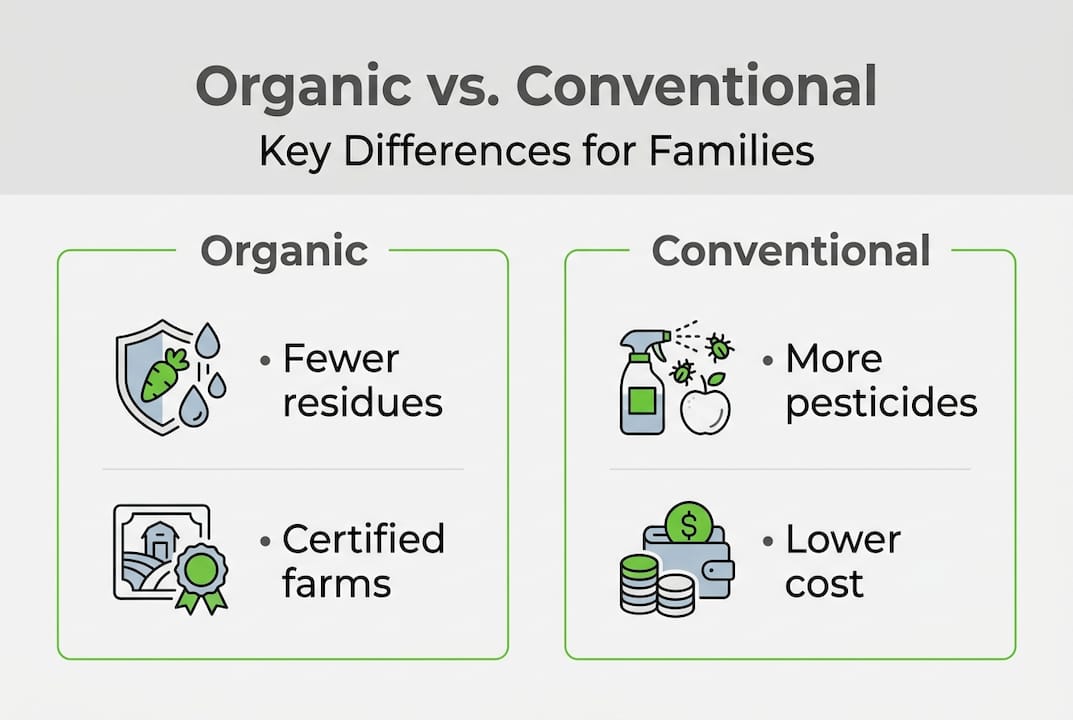
| Factor | Organic | Conventional |
|---|---|---|
| Pesticide residues | 30-70% lower | Higher |
| Antioxidants | 10-50% higher | Lower |
| Nitrate levels | Lower | Higher |
| Cost | Higher | Lower |
| Availability in Delhi NCR | Growing | Widely available |
For a deeper look at how farming methods shape these outcomes, explore our guide on organic vs conventional farming and the key organic vs conventional differences that matter most for families.
Pro Tip: Focus your organic budget on high-pesticide-risk foods. In the Indian context, leafy greens, strawberries, grapes, apples, and bell peppers tend to carry the highest residue loads. These are your priority purchases.
Health implications for families and children
Understanding the differences leads naturally to the central concern for parents: how organic produce can affect family health, especially for the young and expecting.
The health benefits of organic eating are most meaningful for pregnant women, babies, and young children. Their bodies are smaller, their detoxification systems are still developing, and their exposure relative to body weight is proportionally higher. Studies measuring pesticide metabolites in urine consistently show lower levels in children eating organic diets.
Research links lower pesticide exposure from organic diets to:
- Reduced risk of obesity and type 2 diabetes
- Lower likelihood of metabolic syndrome
- Possible protection against allergy sensitisation
- Reduced risk of coeliac disease in some studies
- No definitive link to lower cancer risk has been established
These are associations, not certainties. Science does not yet confirm that organic eating alone prevents specific diseases. What it does show is that cumulative, small reductions in chemical exposure over years of childhood development add up. Think of it less as a cure and more as a consistent, low-level protective habit.
For practical guidance on feeding children well, our resources on healthy organic eating for children and balanced meals for families offer actionable starting points. You can also explore key nutrients in organic foods to understand what your child actually needs at each stage.
How to buy organic in Delhi NCR: Practical tips for parents
To put this knowledge into practice, here is how you can buy genuine organic produce in Delhi NCR, safely, smartly, and affordably.
India’s organic market carries a real fraud risk. Label verification is essential because not every product claiming to be organic has been independently audited. Here is a step-by-step approach:
- Look for the Jaivik Bharat logo or NPOP certification number on the packaging. These are your primary trust signals.
- Check the certifier’s name and verify it against the APEDA or FSSAI online database.
- Download verification apps such as the APEDA Organic Integrity platform to cross-check batch and farm details.
- Buy from trusted sources including certified farmers’ markets, reputable organic shops, and verified online stores.
- Ask questions. A genuine organic seller will know their certifier, their farm, and their audit history.
- If something looks suspicious, such as unusually low prices or missing certification details, walk away.
For a curated list of reliable options, our guide to best organic food brands in India is a useful reference. If you are just getting started, our switching to organic guide walks you through the transition at a manageable pace. You might also find it helpful to read about organising your kitchen for organic living to set yourself up for success from day one.
Pro Tip: Group certification schemes allow smaller farms to share audit costs, making their produce more affordable. Buying from group-certified cooperatives is often a smart way to access genuine organic produce at lower prices.
Making organic work for your family: Smart strategies
Next, let’s bring all these insights home with workable strategies for Delhi NCR families aiming to eat better and live well.
You do not need to replace every item in your kitchen overnight. Prioritising certified organic for children and pregnant women, and focusing on high-residue foods first, gives you the greatest health return for your budget.
Here are strategies that work in real Delhi NCR households:
- Start with the high-risk list. Prioritise organic for leafy greens, apples, grapes, and bell peppers before worrying about onions or bananas, which carry lower residue loads.
- Batch cook with organic produce. Cooking in larger quantities on weekends reduces both cost per meal and the temptation to reach for processed alternatives during busy weekdays.
- Involve your children in shopping. Children who choose their own vegetables at the market are far more likely to eat them. Let them pick the organic tomatoes or spinach.
- Vary the diet broadly. A varied diet rich in fruits, vegetables, whole grains, and pulses delivers more nutritional benefit than an all-organic but narrow diet. Organic is one layer of a healthy food strategy, not the whole picture.
- Track your spending. Set a monthly organic budget and review it quarterly. As you identify which swaps matter most, you can redirect spending more efficiently.
- Think long-term. Choosing organic, even partially, reduces your family’s cumulative pesticide load over years. It is also a small but meaningful contribution to soil health and environmental sustainability for future generations.
For more ideas on getting children engaged with healthy food, visit our guide on tips for picky eaters.
Ready to start your organic journey?
If you are motivated to take the next step, here is how you can access reliable organic produce without the guesswork. At Nature’s Soul Shop, every product is sourced with clean ingredients and verified quality in mind, from fresh fruits and vegetables to dairy, dry grocery, and beyond.
Our Nature’s Soul Fresh range brings certified organic produce directly to Delhi NCR families, with full transparency on sourcing and certification. Whether you are building your first organic basket or looking to expand into organic health essentials across categories, we make it straightforward to shop with confidence. You can also explore our certified organic tomatoes as a simple, high-impact starting point for your family’s organic journey.
Frequently asked questions
Is organic produce really pesticide-free?
No. Organic produce carries 30 to 70% lower pesticide residues than conventional produce, but legacy residues from soil or water can still be present. It is substantially safer, not completely free.
Are there proven health benefits for children eating organic?
Studies link organic diets to lower pesticide exposure and possible reductions in obesity, allergy sensitisation, and coeliac risk, though the overall nutritional difference is modest.
How can I tell if organic food in Delhi NCR is genuine?
Look for the Jaivik Bharat or NPOP logo, check the certification number on the APEDA or FSSAI database, and use government-backed verification apps to confirm authenticity.
Is it expensive to switch to organic food?
Organic produce does cost more, but focusing on high-residue foods, buying from group-certified farms, and planning meals in batches can make the transition genuinely affordable for most families.
Recommended
- Switching to Organic: Step-by-Step Guide for Healthier Living – naturessoulshop
- Tips for picky eaters: encourage healthy organic eating – naturessoulshop
- Organic Certification in India: Your Guide to Healthy Choices – naturessoulshop
- Organic vs Conventional Farming: Complete Guide – naturessoulshop
- Elevate Your Kitchen With Eco-Friendly Baking - The Vanilla Valley
- Cozee Bay - Compostable kitchen organizing guide for sustainable homes


