


Non-GMO foods are foods produced without the use of modern laboratory genetic engineering techniques such as recombinant DNA technology, transgenesis, or gene splicing. In plain terms: the plants or animals involved have not had their DNA deliberately altered in a laboratory setting. For UK shoppers, the most practical implication is that common processed ingredients, particularly those derived from soy, maize, canola, and sugar beet, are the ones most likely to come from genetically modified crops.
A few things worth knowing before you read further:
- Non-GMO labels in the UK are voluntary, not government-mandated, and rely on private certification schemes and supply-chain audits rather than a single official standard.
- Third-party verification seals (such as the Non-GMO Project Verified mark) indicate supply-chain review and, where applicable, product testing, but they do not guarantee absolute zero GM presence.
- Certified organic products from bodies such as the Soil Association normally prohibit GMOs as part of a broader set of farming standards, making organic a stricter label in scope.
Table of Contents
- What non-GMO foods actually are
- How non-GMO differs from organic
- How non-GMO labels and verification actually work
- Testing, contamination, and what “adventitious presence” means
- What regulators and scientists say about GMO safety
- Which crops and ingredients are most likely to be GMO
- How to shop for non-GMO foods in the UK
- Common myths about non-GMO foods
- Key takeaways
- The label is only part of the story
- Find non-GMO and organic products at Naturessoulshop
- Useful sources
What non-GMO foods actually are
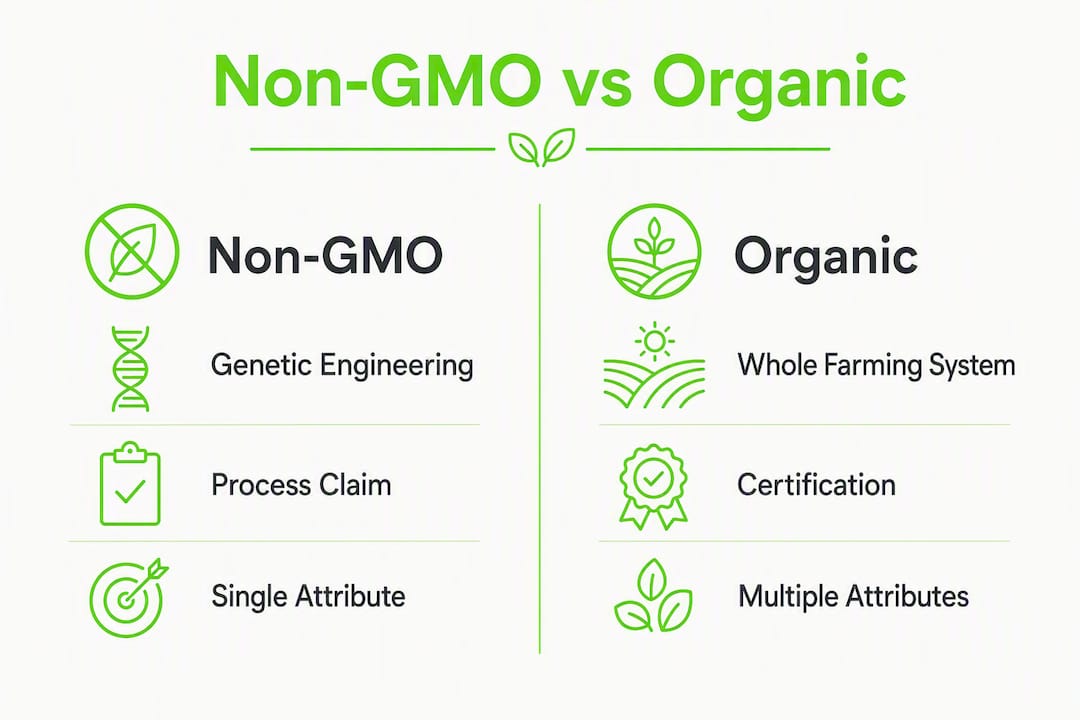
The Food Standards Agency defines non-GMO foods as products not intentionally altered using modern laboratory genetic engineering. The techniques excluded are specific: recombinant DNA methods, transgenic modification, and gene splicing. Traditional plant breeding, cross-pollination, and marker-assisted selection are not classified as genetic engineering and are therefore permitted under non-GMO claims.
Non-GMO is a process claim, not a nutrition claim. It tells you something about how a food was produced, not whether it is more nutritious, lower in calories, or free from pesticides. A bag of non-GMO crisps is still a bag of crisps.
Where this distinction matters most is in processed foods. Fresh, whole produce, most British apples, carrots, potatoes, and leafy greens, is rarely engineered. The risk sits in processed ingredients. Soya lecithin (found in chocolate and baked goods), cornstarch (in sauces and soups), canola oil (in cooking sprays and margarines), and high-fructose corn syrup all commonly derive from GM commodity crops. For a deeper look at genetic modification and what it means for allergenicity and nutrition, the Naturessoulshop guide on what is non-GMO covers the basics clearly.
How non-GMO differs from organic
These two labels are frequently confused, and the confusion costs shoppers money or leaves them with weaker assurances than they wanted.
| Feature | Non-GMO | Certified Organic |
|---|---|---|
| Scope | Genetic engineering only | Whole farming system (soil, inputs, welfare) |
| Pesticide restriction | None (non-GMO crops can be sprayed) | Synthetic pesticides largely prohibited |
| GMO prohibition | Yes | Yes, as part of broader standards |
| UK certification body | Private schemes (no single government standard) | Soil Association, OF&G, others |
| Testing and verification | Supply-chain audits; product testing where applicable | Annual farm inspection plus input approval |
| Price premium | Moderate | Higher |
Certified organic in the UK, governed by bodies such as the Soil Association, prohibits GMOs as one condition among many. It also restricts synthetic pesticides, requires soil management practices, and involves annual farm inspections. Non-GMO labels, by contrast, address only the genetic engineering question. A product can carry a non-GMO seal and still be grown with synthetic herbicides, in depleted soil, on an industrial farm.
The Non-GMO Project notes that many consumers choose non-GMO for environmental and systemic reasons, including biodiversity and corporate food-system concerns, not purely for personal health. That motivation often aligns better with organic certification, which addresses the farming system as a whole.
Pro Tip: If your main concern is pesticide residues, non-GMO alone is not enough. Reach for certified organic, particularly for the produce your family eats most often. If your concern is specifically about genetic engineering and budget is tight, non-GMO verification on processed pantry staples is a reasonable, lower-cost middle ground.
How non-GMO labels and verification actually work
There is no single UK government standard for voluntary “non-GMO” or “GMO-free” claims. What exists instead is a patchwork of private certification schemes and supply-chain protocols. Understanding what sits behind a seal helps you judge how much weight to give it.
The most widely recognised international scheme is the Non-GMO Project Verified programme. Its verification process covers:
- Supply-chain documentation: tracing ingredients back to source and reviewing supplier declarations.
- Ingredient risk assessment: categorising inputs by their likelihood of GMO contamination.
- Product testing: required for high-risk ingredients above a certain threshold, using PCR-based laboratory analysis.
- Annual renewal: brands must re-verify each year; the seal does not carry forward automatically.
In the UK, the Soil Association’s organic certification implicitly covers the GMO question as part of its broader standards. For food labelling guidance more broadly, the Naturessoulshop article on food labelling for healthier choices is a practical starting point.
Labels a UK shopper might encounter include:
- Non-GMO Project Verified (US-origin scheme, increasingly visible on UK-stocked imported products)
- Soil Association Organic (UK; GMO prohibition built into organic standard)
- OF&G Organic (UK; equivalent organic certification)
- EU Organic logo (still found on products imported from EU member states)
Retailer own-label claims such as “made without genetically modified ingredients” are self-declared and rely on supplier contracts rather than independent third-party auditing. They are not meaningless, but they carry less verification weight than a third-party seal.
Testing, contamination, and what “adventitious presence” means
Absolute zero GMO presence is not a realistic standard for global food supply chains. Cross-pollination in fields, shared transport, and complex multi-ingredient sourcing all create opportunities for trace amounts of GM material to appear in products that were never intended to contain it. This is called adventitious presence, meaning accidental or technically unavoidable contamination.
To handle this practically, regulators and certifiers use action thresholds rather than zero-tolerance rules. Under UK and EU food labelling law, foods containing more than a minimal threshold of approved GM ingredients must be labelled accordingly. Below that threshold, adventitious presence does not trigger a mandatory labelling requirement, provided the operator can demonstrate the presence was unintentional and technically unavoidable.
0.9% is the UK/EU labelling threshold for approved GM ingredients in food. Products below this level are not required to carry a GM label if contamination was adventitious.
Testing uses PCR (polymerase chain reaction) analysis, a method that detects specific DNA sequences associated with genetic modifications. Laboratories can identify GM material at very low concentrations. When a verified supply chain detects an unexpected result above its internal action threshold, the standard response is to quarantine the batch, investigate the source, and notify the certifier before the product reaches retail.
What regulators and scientists say about GMO safety
The short answer: approved GMO foods are not considered inherently less safe or less nutritious than their non-GMO counterparts by any major regulatory body.
The National Academies of Sciences reviewed over 900 studies and found no validated evidence that foods made with GMOs pose special health risks. Safety assessments before approval examine toxicity, allergenicity, and compositional equivalence, comparing the GMO crop’s nutrient profile against its conventional counterpart. The FDA’s position is consistent: currently approved genetically engineered crops are not associated with unique human health risks.
The World Health Organization’s guidance on genetically modified food draws the same conclusion for approved products, while noting that each new GM crop must be assessed individually before it reaches the market.
What regulators assess is product safety. What they do not fully resolve are the broader systemic questions: long-term ecological impacts, effects on biodiversity, and the concentration of seed ownership in global agriculture. These are legitimate concerns, and they are the reason many thoughtful consumers choose non-GMO or organic even when they accept the safety science. The environmental impact of organic farming is worth reading if those systemic questions matter to you.
Which crops and ingredients are most likely to be GMO
Most fresh fruit and vegetables sold in UK supermarkets are not genetically engineered. The real exposure comes from commodity crops processed into ingredients. The highest-risk crops globally are:
- Soy: appears as soya lecithin, soybean oil, soy protein isolate, and textured vegetable protein in snacks, chocolate, baby formula, and meat alternatives.
- Maize (corn): cornstarch, corn syrup, corn flour, and dextrose show up in breakfast cereals, crisps, baked goods, and sauces.
- Canola (rapeseed): canola oil and rapeseed oil are used in cooking sprays, margarines, and salad dressings.
- Sugar beet: a significant proportion of refined white sugar in processed foods derives from GM sugar beet, particularly in US supply chains.
- Papaya: certain Hawaiian varieties were engineered to resist ringspot virus; less relevant to UK retail but worth noting for imported tropical products.
- Some potato and apple varieties: Arctic Apples and Innate potatoes exist commercially, though their UK presence is limited.
Consumer guidance from Down to Earth and UPMC HealthBeat both flag soy, corn, canola, and sugar beet as the four ingredients most worth scrutinising on an ingredient panel. In UK supply chains, the risk from sugar beet is lower than in the US because European sugar beet cultivation operates under stricter EU-derived rules, but imported processed foods remain a variable.
For non-GMO pantry alternatives and produce examples, the Naturessoulshop guide to top non-GMO foods offers a useful reference list.
How to shop for non-GMO foods in the UK
A practical routine makes this much less overwhelming than it sounds.
- Start with whole produce. Fresh vegetables, fruit, meat, fish, eggs, and dairy are rarely engineered. Building meals around these reduces GMO exposure without reading a single label.
- Read ingredient panels on processed foods. Look for soya lecithin, cornstarch, corn syrup, rapeseed oil, and “vegetable oil” (often canola-based) in the ingredients list. These are your highest-risk entries.
- Choose certified organic when pesticide reduction also matters. Organic certification prohibits GMOs and restricts synthetic pesticides. For produce your household eats daily, organic is the stronger assurance. The Naturessoulshop piece on why choose organic vegetables explains this for families specifically.
- Look for trusted verification marks. The Soil Association logo, OF&G Organic, and the Non-GMO Project Verified seal all indicate third-party review. Retailer self-declarations are a weaker but still useful signal.
- Ask your supplier. Independent health food shops, farm shops, and online retailers with transparent sourcing policies can often tell you exactly where an ingredient originates. Farmers’ market stallholders frequently know their seed sources.
- Swap processed staples for whole-food alternatives. Replace cornstarch-thickened sauces with arrowroot or potato starch. Swap soya lecithin-containing chocolate for brands that use sunflower lecithin. These swaps reduce incidental exposure and often improve diet quality at the same time.
Pro Tip: The single most effective swap for reducing GMO exposure is replacing cooking oils. Switching from generic “vegetable oil” or rapeseed oil to cold-pressed extra virgin olive oil or coconut oil removes one of the most common GMO-derived ingredients from your kitchen immediately.
Gastronomy professionals are increasingly applying similar sourcing logic, and the gastronomy trends coverage from Wild Foodz illustrates how non-GMO and heritage breeding methods are shaping menus and ingredient sourcing in 2026.
Common myths about non-GMO foods
Myth: Non-GMO automatically means healthier. Not necessarily. A non-GMO biscuit is still a biscuit. Dietitians consistently point out that the GMO label says nothing about sugar content, saturated fat, or overall nutritional quality. As The Paleo Diet’s analysis notes, prioritising minimally processed, plant-forward foods matters far more for health outcomes than the GMO status of an ingredient. The Naturessoulshop guide to minimally processed foods covers this well.
Myth: Non-GMO means pesticide-free. It does not. Non-GMO crops can be and often are grown with synthetic pesticides and herbicides. Only certified organic certification restricts synthetic agrochemical use.
Myth: Organic and non-GMO are the same thing. Organic certification includes a GMO prohibition, but non-GMO certification does not include organic farming requirements. Organic is the broader standard; non-GMO is a narrower, single-issue claim.
Myth: Non-GMO products contain zero GM material. Due to adventitious presence in global supply chains, trace amounts below the 0.9% UK/EU labelling threshold can appear in verified non-GMO products. Certification reduces the risk; it does not guarantee absolute zero.
Key takeaways
Non-GMO foods are a process claim about genetic engineering, not a guarantee of superior nutrition, and organic certification remains the stronger assurance for shoppers concerned about pesticides and farming practices.
| Point | Details |
|---|---|
| Non-GMO definition | Foods not produced using laboratory genetic engineering such as recombinant DNA or transgenesis. |
| Safety consensus | Major reviews (National Academies, FSA, WHO) find approved GMO foods pose no unique health risks. |
| Non-GMO vs organic | Organic prohibits GMOs and restricts pesticides; non-GMO addresses genetic engineering only. |
| Highest-risk ingredients | Soy, maize, canola, and sugar beet derivatives appear most often in processed foods. |
| Naturessoulshop | Stocks certified organic and non-GMO products across fresh produce, pantry staples, and health foods for UK shoppers. |
The label is only part of the story
The non-GMO conversation tends to get stuck in a binary: either GMOs are dangerous and must be avoided, or the science is settled and the label is meaningless. Neither position is particularly useful.
The scientific consensus on approved GMO food safety is genuinely robust. The National Academies reviewed hundreds of studies and found no validated health risk. Accepting that does not mean the non-GMO label has no value. It means the value lies somewhere other than personal toxicology.
Where non-GMO and organic choices genuinely matter is in the systemic picture: seed diversity, soil health, the concentration of agricultural intellectual property in a handful of corporations, and the long-term resilience of food supply chains. These are not fringe concerns. They are the reasons that chefs, agronomists, and food-system researchers take non-GMO breeding seriously as a tool for sustainable agriculture, even when they are relaxed about the safety of currently approved GM crops.
The practical upshot for a UK shopper is this: do not choose non-GMO because you believe it will make you healthier in a direct, measurable way. Choose it, or choose organic, because you care about how food is produced and what kind of food system you want to support. That is a legitimate, well-grounded reason, and it does not require you to dispute the safety science.
Find non-GMO and organic products at Naturessoulshop
Knowing what to look for is one thing. Finding it reliably is another. Naturessoulshop stocks a curated range of organic and non-GMO products across fresh produce, dry grocery, dairy, vegan and gluten-free lines, and health supplements, all with clean ingredient lists and transparent sourcing.
The shopping checklist in this article maps directly to what the store carries: whole produce, verified pantry staples, and processed alternatives made without the high-risk derivatives (soya lecithin, corn syrup, generic vegetable oils) that appear in conventional supermarket lines. Whether you are starting with a single swap, such as a clean cooking oil or a non-GMO snack, or building a full organic weekly shop, the range covers both entry points.
Browse the full organic and non-GMO range at Naturessoulshop or head directly to the fresh produce section to start with whole foods, the single most effective step the shopping checklist recommends.
Useful sources
- Food Standards Agency: UK regulator covering GMO food definitions, labelling requirements, and safety oversight.
- World Health Organization: Food, genetically modified: International guidance on GMO definitions, safety assessment principles, and approved crop categories.
- National Academies of Sciences: Foods made with GMOs do not pose special health risks: Comprehensive review of over 900 studies on GMO food safety.
- FDA: GMO crops, animal food and beyond: US regulatory position on safety assessments and compositional equivalence.
- Non-GMO Project: What do you need to know about GMOs?: Consumer-facing explanation of verification, motivations, and label meaning.
- Non-GMO Project: 6 benefits to going non-GMO: Environmental and biodiversity arguments for non-GMO supply chains.
- Down to Earth: Avoiding GMO foods: Practical consumer guide to high-risk crops and ingredient substitutions.
- UPMC HealthBeat: Decoding food labels: Dietitian guidance on reading ingredient panels and reducing processed food exposure.
- Journal of Healthcare and Life-Science Research: Comparative study: Academic review comparing non-GMO breeding methods and their nutritional and ecological outcomes.


