In the UK, a product can only be labelled organic if it is certified by an approved organic control body and, for most processed foods, the vast majority of its agricultural ingredients meet organic standards. That is the legal test. Everything else, the farming methods, the animal-welfare rules, the traceability requirements, flows from those two requirements.
Here is what that looks like on the pack:
- A control body code number (e.g. GB-ORG-05 for Soil Association Certification)
- A statement of agricultural origin such as “UK Agriculture” or “Non-UK Agriculture”
- An organic certification logo (common but not always present on every product)
One thing the label does not guarantee: superior nutrition or absolute safety. Organic certifies how something was produced, not that it is nutritionally better than its conventional equivalent.
Table of Contents
- What ‘organic’ legally means in the UK
- How organic farming actually works in practice
- What different on-pack organic claims actually mean
- Who certifies organic products in the UK and how inspections work
- How to verify an organic claim and avoid greenwashing
- Key takeaways
- Useful sources
What ‘organic’ legally means in the UK
The word “organic” is legally protected in the UK. Certification by an approved organic control body is a legal requirement before any business can label, market, or advertise food, feed, or seed as organic. There is no grey area here: without that certification, using the word is a criminal offence enforced by Trading Standards.
For processed foods, the core threshold is the 95% rule: at least 95% of the agricultural ingredients must be organic. The remaining 5% may only come from a pre-approved list of permitted non-organic ingredients and processing aids. You cannot simply swap in any conventional ingredient to fill that gap.
Labels on organic pre-packed food produced in Great Britain must carry the control body code and a statement of agricultural origin in the same visual field as the organic logo. Northern Ireland follows slightly different wording requirements, reflecting its distinct post-Brexit regulatory position.
Statutory note: UK organic regulations are built on retained EU organic law, adapted post-Brexit. Defra is the competent authority. The current framework is set out on GOV.UK’s organic food labelling guidance.
| Requirement | Detail |
|---|---|
| Minimum organic agricultural ingredients | At least 95% of agricultural ingredients must be organic for processed foods |
| Mandatory on-pack elements (GB) | Control body code + statement of agricultural origin |
| Annual inspection | Required for all certified operators |
| Conversion period (annual crops) | a typical multi-year period before fully organic status |
| Competent authority | Defra (Great Britain) |
How organic farming actually works in practice
Understanding what the label certifies means looking at what happens on the farm and in the processing facility, not just what the packaging says.
Organic is an audited production system built on four principles: health, ecology, fairness, and care. That framing matters because it explains why the rules go well beyond simply banning a few chemicals.
On the land, organic standards require:
- Soil health managed through crop rotation, green manures, and compost rather than synthetic fertilisers
- No synthetic pesticides; only a restricted list of naturally derived substances is permitted
- No genetically modified organisms (GMOs) at any point in production
- No irradiation of produce or ingredients
For livestock, the requirements are equally specific. Animals must have meaningful outdoor access, be fed certified organic (non-GM) feed, and must not receive routine antibiotics or growth hormones. Preventive medication is restricted; treating a sick animal is still permitted, but that animal’s products may lose organic status depending on the circumstances.
Supply-chain integrity is where many shoppers are surprised. Operators must maintain an organic system plan and keep records covering production, processing, storage, and transport. Physical segregation of organic and non-organic goods throughout the chain is mandatory. A single instance of commingling, where organic grain mixes with conventional grain in a shared silo, can trigger decertification.
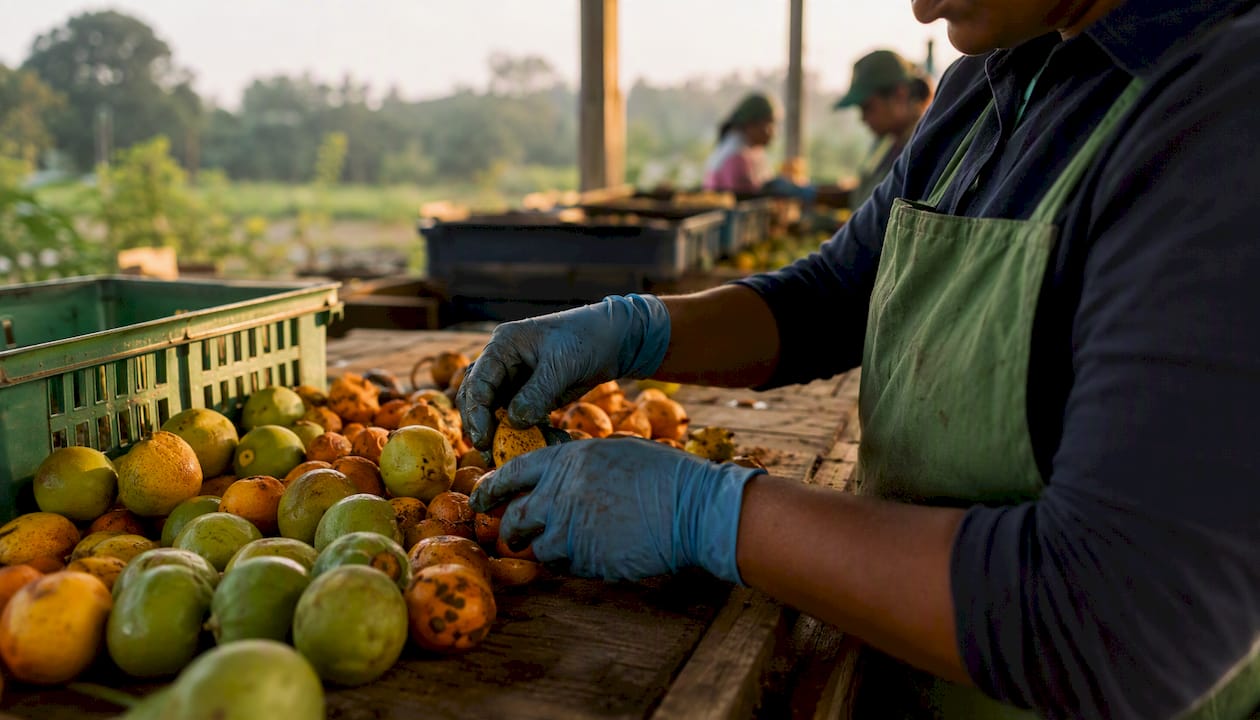
What about in-conversion produce? When a farm switches from conventional to organic, it enters a conversion period. For annual crops, that period is typically around two years, during which the land is managed to organic standards but the produce cannot yet be sold as fully organic. You may see “in-conversion” labelling on some products; that is honest, but it is not the same as certified organic. The farm is doing the right thing; it just has not completed the clock yet.
Pro Tip: When buying from a farmers’ market or farm shop, ask whether the producer is in conversion or fully certified. A reputable grower will know exactly which status applies and can show you their certificate number.
For a deeper look at how organic and conventional farming compare on soil health and crop management, Naturessoulshop has a detailed guide worth reading alongside this one.
What different on-pack organic claims actually mean
Not every product that says “organic” on the front is making the same claim. The label tier matters.
| Label claim | What it means | Non-organic ingredients permitted? |
|---|---|---|
| 100% organic | Every agricultural ingredient is organic | No |
| Organic | ≥95% of agricultural ingredients are organic | Yes, from approved list only |
| Made with organic [ingredient] | Lower threshold; only named ingredients are organic | Yes, broadly |
The “100% organic” claim is rare on complex processed foods for a straightforward reason: there is no simple 100% organic claim for products with multiple agricultural inputs unless every single one is certified organic. A biscuit with organic wheat, organic butter, and organic sugar can carry it; one that also contains conventional vanilla extract cannot.
The “made with organic” tier exists in some jurisdictions but carries far less weight. In the UK, the primary tiers shoppers encounter are “organic” (the 95% threshold) and “100% organic.”
Shopper checklist for reading the label:
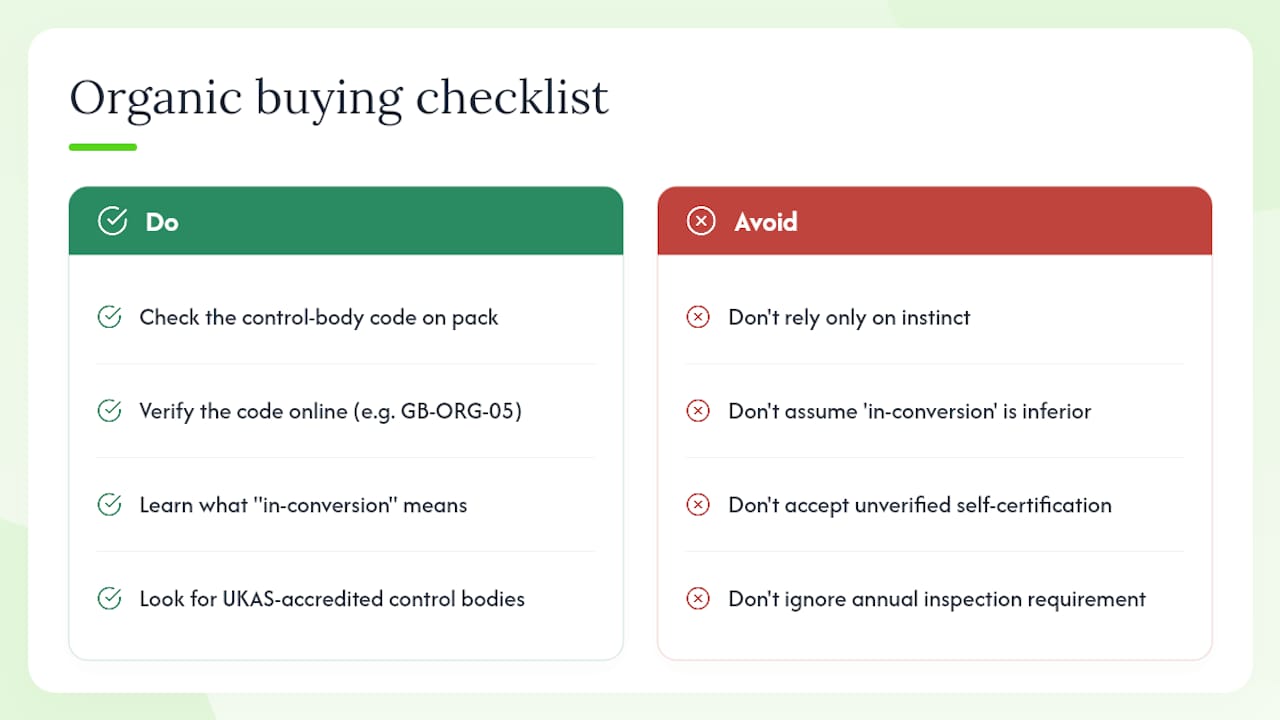
- Look for the control body code (format: GB-ORG-XX) on the front or back of pack
- Check for the statement of agricultural origin near the organic logo
- If a logo is present, confirm it belongs to a recognised UK certifier (Soil Association, Organic Farmers & Growers, and others)
- For multi-ingredient products, scan the ingredient list: organic ingredients are usually flagged with an asterisk and a footnote
Small producers sometimes display only the certifier code without a logo. That is perfectly legal and does not make the product less legitimate. The code is what matters for verification.
For practical examples of how these rules apply to processed goods, Naturessoulshop’s guide to food labelling and healthier choices walks through real label scenarios.
Who certifies organic products in the UK and how inspections work
The governance chain runs in one direction: Defra sets the rules, approved organic control bodies carry out certification and inspection, and UKAS assesses those control bodies against ISO/IEC 17065 to confirm their independence and technical competence. No control body can operate without that UKAS accreditation.
The two most widely recognised UK control bodies are Soil Association Certification and Organic Farmers & Growers (OF&G), though several others appear on the Defra-approved list. Each issues its own code, which is why you will see different GB-ORG numbers on different products.
“Certification bodies such as OF&G provide tailored guidance and issue certificates after inspection; non-compliance may lead to removal of labelling rights and enforcement by Trading Standards.” — OF&G organic certification guidance
What does an inspection actually cover? Certification requires an organic system plan, annual inspections, and supply-chain controls covering the full operation: seed sources, soil records, pest management, storage, processing, and transport. Inspectors check physical segregation controls and cross-reference them against the operator’s records. A paper trail that does not match the physical reality is grounds for suspension.
| Stage | Timing / Frequency |
|---|---|
| Initial certification inspection | Before any organic claims are made |
| Annual renewal inspection | Annual |
| Conversion period (annual crops) | ~2 years before fully organic status |
| Unannounced spot inspections | At control body’s discretion |
| UKAS accreditation review | Periodic, per ISO/IEC 17065 schedule |
For readers who want to understand what organic certification means in full procedural detail, Naturessoulshop’s explainer covers the process step by step.
How to verify an organic claim and avoid greenwashing
Greenwashing in the organic sector tends to be subtle: vague language (“natural”, “eco-friendly”, “grown without chemicals”), missing code numbers, or a logo that looks official but belongs to no recognised body. Here is how to check before you buy.
- Verify the control body on GOV.UK — The GOV.UK organic food guidance lists approved control bodies. Cross-reference the code on the pack against that list.
Pro Tip: On a supermarket shelf, flip the pack and look for the GB-ORG code before the logo. Logos can be mimicked; a valid code tied to a real control body cannot.
Understanding food quality standards more broadly can also help you spot when a product’s claims do not quite hold together, whether organic or otherwise.
Key takeaways
A product is legally organic in the UK only when it is certified by an approved control body and, for processed foods, contains at least 95% organic agricultural ingredients.
| Point | Details |
|---|---|
| Certification is mandatory | No approved control body certification means no legal right to use the word “organic.” |
| The 95% rule applies to processed foods | At least 95% of agricultural ingredients must be organic; up to 5% non-organic ingredients are allowed, but only from a pre-approved list. |
| Check the control body code | The GB-ORG-XX code on-pack is the most reliable verification tool available to shoppers. |
| Organic certifies method, not nutrition | The label guarantees production standards; it does not mean the product is nutritionally superior. |
| Conversion ≠ certified organic | In-conversion produce meets organic standards but cannot be sold as fully organic until the period ends. |
The legal detail is the point
Most people who buy organic do so on instinct: it feels cleaner, more considered, more trustworthy. That instinct is not wrong, but it is incomplete without the legal layer underneath it.
What strikes me about the UK framework is how much accountability it actually builds in. Annual inspections, UKAS-accredited control bodies, mandatory code numbers on pack: this is not a voluntary scheme where brands self-certify and hope nobody checks. When the system works as designed, the control body code on a packet of organic fresh produce represents a documented chain of custody from soil to shelf.
The part shoppers underestimate is the conversion period. A farm that has been managed organically for 18 months is doing almost everything right, but its produce still cannot carry the full organic label. That distinction protects the integrity of the claim for everyone else. It is worth remembering when you see “in-conversion” on a label: it is not a lesser product, it is an honest one.
Where I think the system falls short is consumer awareness. Most shoppers have no idea what GB-ORG-05 means, or that they can look it up in under a minute. Closing that gap, knowing what to look for and where to check, is what separates confident organic buying from expensive guesswork.
Useful sources
Official and authoritative references for readers who want to go further:
- Organic food: labelling and advertising rules — GOV.UK — The primary UK legal reference. Covers the 95% rule, mandatory label elements, approved control bodies, and the certification requirement.
- CIS 17: Organic control bodies — UKAS — Sets out how UKAS accredits organic control bodies against ISO/IEC 17065; useful for understanding the oversight structure.
- Four principles of organic — IFOAM — The philosophical and practical framework (health, ecology, fairness, care) that underpins organic standards globally.
This article provides general information about UK organic standards and is not legal or regulatory advice. For the current approved list of control bodies and the latest labelling requirements, check GOV.UK or consult a qualified food-law professional.
If you are ready to shop with confidence, Naturessoulshop stocks certified organic products across fresh produce, dry grocery, dairy, vegan and gluten-free ranges, home care, and skin care, all with clean ingredients you can trace.