


TL;DR:
- Easy yoga stretches are simple, beginner-friendly poses that enhance flexibility and reduce stress without equipment. Short daily sessions of 10 to 15 minutes are effective for improving mobility and building a sustainable practice. Consistency and breath awareness are essential for gaining maximum benefits and injury prevention.
Easy yoga stretches are beginner-friendly poses that improve flexibility, reduce stress, and support overall wellness without prior experience or equipment. Known formally as foundational asanas in the Hatha yoga tradition, these poses work for any fitness level. Sessions of 10–15 minutes are effective for reducing tension and building a sustainable practice. Postures like Mountain Pose, Child’s Pose, and Cat-Cow are recommended by medical institutions including the Cleveland Clinic as starting points for spinal mobility and alignment. Naturessoulshop supports this kind of accessible wellness, pairing clean organic nutrition with movement practices that genuinely work.
1. Child’s Pose (Balasana)
Child’s Pose is the most accessible resting posture in yoga. Kneel on the floor, sit back towards your heels, and stretch your arms forward along the mat. Your forehead rests on the ground, and your spine lengthens with each exhale. This pose releases tension in the lower back, hips, and shoulders in under a minute.
If your hips do not reach your heels, place a folded blanket between your thighs and calves. That small adjustment removes the strain entirely.
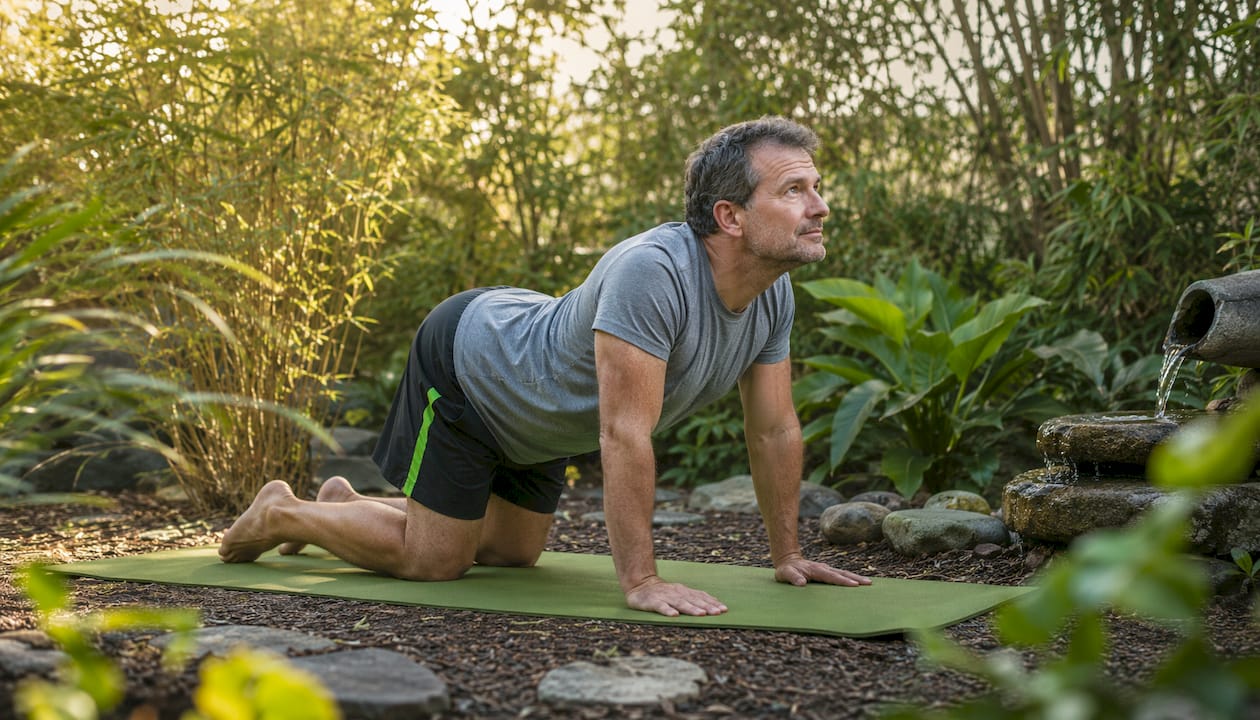
2. Cat-Cow (Marjaryasana-Bitilasana)
Cat-Cow is a two-part spinal movement performed on all fours. On an inhale, drop your belly, lift your chest, and look slightly upward (Cow). On an exhale, round your spine toward the ceiling and tuck your chin (Cat). Cleveland Clinic recommends this sequence as a foundational pose for spinal mobility. Repeating it 5–8 times warms the entire spine and eases morning stiffness.
Move slowly and let the breath lead the movement. Rushing this pose removes most of its benefit.
3. Mountain Pose (Tadasana)
Mountain Pose looks like simply standing, but it teaches full-body alignment. Stand with feet hip-width apart, press all four corners of each foot into the floor, and lengthen through the crown of your head. Engage your thighs gently and let your arms hang at your sides with palms facing forward. This pose builds body awareness and is the foundation for nearly every standing posture in yoga.
Pro Tip: Hold Mountain Pose for 5 slow breaths and notice where your weight sits. Most beginners discover they lean forward onto their toes without realising it.
4. Downward-Facing Dog (Adho Mukha Svanasana)
Downward-Facing Dog stretches the hamstrings, calves, and spine simultaneously. Start on all fours, tuck your toes, and press your hips up and back to form an inverted V shape. Keep a slight bend in your knees if your hamstrings feel tight. This is one of the most recognised yoga poses globally and appears in nearly every beginner sequence.
Bend your knees generously at first. Straight legs are not the goal; a long spine is.
5. Low Lunge (Anjaneyasana)
Low Lunge opens the hip flexors, which tighten from prolonged sitting. Step one foot forward between your hands, lower the back knee to the mat, and sink your hips gently toward the floor. Keep your front knee directly above your ankle. Hold for 5 breaths, then switch sides.
This pose is particularly useful for people who sit at a desk for long periods. The hip flexor release is immediate and noticeable.
6. Seated Forward Fold (Paschimottanasana)
Sit on the floor with legs extended straight in front of you. Inhale to lengthen your spine, then exhale and hinge forward from your hips, reaching toward your feet. Do not round your back aggressively. Reach only as far as feels comfortable, and hold a strap or towel around your feet if needed.
Yoga success is measured by comfort and consistency, not by how far you can reach. That principle applies directly here.
7. Supine Twist (Supta Matsyendrasana)
Lie on your back, draw one knee to your chest, and let it fall across your body while you extend that arm out to the side. Keep both shoulders on the mat. This reclined twist releases the lower back and outer hip without requiring any balance. It is one of the safest and most satisfying stretches in any beginner sequence.
Practising low to the mat removes balance barriers entirely, allowing full focus on alignment and breath.
8. Legs-Up-the-Wall (Viparita Karani)
Sit sideways next to a wall, then swing your legs up as you lie back. Your legs rest vertically against the wall, and your back is flat on the floor. This gentle inversion reduces swelling in the legs, calms the nervous system, and requires zero flexibility. Stay here for 2–5 minutes with eyes closed.
This is the one pose that almost every beginner underestimates. Its calming effect on the body is disproportionate to its effort.
9. Seated Spinal Twist (Ardha Matsyendrasana)
Sit with legs extended, bend one knee, and place that foot on the outside of the opposite thigh. Inhale to grow tall, then exhale and twist toward the bent knee. Use your opposite elbow as a gentle lever against the knee. This pose improves spinal rotation and aids digestion.
Switch sides after 5 breaths. The twist should feel like a gentle wringing, not a forced crank.
10. Corpse Pose (Savasana)
Savasana is the final resting pose in every yoga session. Lie flat on your back, let your feet fall open, and rest your arms slightly away from your body with palms facing up. Close your eyes and breathe naturally for 3–5 minutes. This pose allows the nervous system to absorb the benefits of the session.
Skipping Savasana is the most common beginner mistake. The rest is not optional. It is where the practice consolidates.
How to practise yoga stretches at home safely
Home yoga practice costs nothing and requires very little space. No specialised equipment is needed beyond a non-slip mat, and even that is optional on carpet. Comfortable, non-restrictive clothing is the only real requirement.
Practical setup tips for home practice:
- Clear a mat-sized space. You need roughly 2 metres by 60 centimetres of floor space.
- Use household props. Pillows and blankets provide effective support and elevation during seated or reclined poses.
- A sturdy chair works as a prop. Use it for balance support in standing poses or as a raised surface for seated stretches.
- Wear non-slip socks or go barefoot. Socks with grip prevent sliding on smooth floors.
- Keep water nearby. Hydration supports muscle function even during gentle sessions.
Pro Tip: If you feel any sharp or shooting pain during a pose, stop immediately. Mild discomfort from a stretch is normal. Pain is not.
Beginners should avoid forcing their bodies into painful shapes. Gentle muscle engagement and breath awareness build stability far more effectively than pushing to a visual ideal. Seated and reclined postures are the safest entry point because they remove the challenge of balance entirely.
What role does breath play in gentle yoga poses?
Breath is not a background detail in yoga. It is the mechanism that makes the practice work.
Mindful breath and slow movement are the most effective techniques for transitioning the nervous system from tension to calm. That shift is the primary reason people feel noticeably different after even a short session. When you synchronise your movement with your inhale and exhale, you give the nervous system a clear signal to downregulate. Rushing through poses without breath awareness removes this effect almost entirely.
“Setting a simple, single-word intention before your session, such as ‘calm’ or ‘space,’ simplifies mental focus and prevents beginners from feeling scattered. The intention does not need to be profound. It just needs to be yours.”
Setting a simple intention before practice helps beginners maintain mental focus throughout the session. This technique is particularly useful when the mind is busy or resistant to slowing down. A single word anchors attention without adding complexity.
Breath synchronisation also prevents injury. When you exhale into a stretch, the muscles release more readily than when you hold your breath or breathe shallowly. This is not a metaphor. It is a physiological response. Slow, deliberate breathing during yoga stretches for flexibility produces deeper, safer results than any amount of forcing.
How to build a daily yoga routine that actually sticks
Consistency produces results in yoga. Intensity does not.
Sessions of 10–15 minutes are effective for beginners and far easier to maintain than hour-long commitments. The goal is to make the practice so manageable that skipping it feels stranger than doing it. A short daily session beats an occasional long one every time.
A practical approach to building the habit:
- Choose a fixed time. Morning sessions ease stiffness from sleep. Bedtime sessions signal the body to wind down. Both work. Pick one and repeat it.
- Start with just three poses. Child’s Pose, Cat-Cow, and Savasana form a complete three-minute sequence. That is enough to begin.
- Add one new pose per week. Gradual progression keeps the practice interesting without creating pressure.
- Track how you feel, not how you look. Note your energy, mood, and sleep quality rather than flexibility milestones.
- Pair yoga with a complementary habit. Practising after a consistent trigger, such as after brushing your teeth or before your morning tea, makes the habit automatic.
Nutrition supports the practice. Anti-inflammatory foods reduce muscle soreness and support recovery between sessions. Pairing a simple yoga routine with clean, whole-food nutrition compounds the wellness benefits significantly. For post-session recovery, recovery-focused foods support muscle repair and energy replenishment even after gentle movement.
Key takeaways
Easy yoga stretches deliver the greatest benefit when breath awareness, consistency, and accessible modifications are prioritised over flexibility or intensity.
| Point | Details |
|---|---|
| Short sessions work | 10–15 minute sessions reduce tension and improve flexibility for beginners. |
| No equipment needed | A non-slip mat is optional; household items like blankets serve as effective props. |
| Breath leads movement | Synchronising breath with poses calms the nervous system and prevents injury. |
| Consistency beats intensity | Daily short sessions produce more lasting results than occasional long ones. |
| Low-to-mat poses are safest | Seated and reclined postures remove balance barriers and reduce injury risk. |
Why I think most beginners approach yoga completely backwards
The first mistake I see consistently is people treating yoga as a flexibility test. They scroll through images of advanced poses, decide they are not flexible enough, and never start. That logic is circular and wrong. Yoga builds flexibility. You do not need it to begin.
The second mistake is equating effort with progress. I have watched people strain through poses with held breath and tense jaws, convinced they are working harder and therefore improving faster. They are not. Yoga prioritises breath awareness and gentle muscle activation over extreme flexibility. The person breathing slowly in a modified Child’s Pose is getting more from the practice than the person grimacing in a full forward fold.
What actually works is embarrassingly simple. Ten minutes on the floor, three poses, slow breathing. Done daily, that routine changes how your body feels within a fortnight. The props matter too. A folded jumper under your hips in a seated pose is not cheating. It is good practice. Accessibility is the point, not the compromise.
The most sustainable yoga practice is the one you will actually do tomorrow. Start there.
— Arjit
Naturessoulshop and your wellness routine
Yoga and nutrition work together. The physical benefits of a consistent stretching practice deepen when your body has the right fuel to support recovery and reduce inflammation.

Naturessoulshop stocks a wide range of organic wellness products to complement your movement practice, from fresh fruits and vegetables to vegan and gluten-free groceries with clean ingredients. Whether you are looking for a post-session snack or a wholesome meal to support your recovery, the range covers it. For those pairing yoga with a broader health focus, the health supplements range includes organic options that support the body from the inside out. Good movement and good nutrition are not separate habits. They are the same habit, approached from two directions.
FAQ
How long should a beginner yoga session last?
Sessions of 10–15 minutes are effective for beginners and sufficient to reduce tension and improve flexibility. Consistency matters more than duration.
Do I need to be flexible to start yoga stretches?
No flexibility is required to begin yoga. Yoga builds flexibility over time through consistent practice, and all poses can be modified to suit your current range of motion.
What equipment do I need for home yoga practice?
Home yoga practice requires no specialist equipment. A non-slip mat is helpful but optional, and household items like blankets or pillows substitute effectively for yoga props.
Which poses are best for stress relief?
Child’s Pose, Legs-Up-the-Wall, and Supine Twist are the most effective poses for stress relief. These reclined and restorative postures calm the nervous system quickly and require no prior experience.
How often should beginners practise yoga stretches?
Daily practice, even for just 10 minutes, produces the best results. Short, frequent sessions build the habit and deliver more consistent benefit than longer sessions done occasionally.


