


TL;DR:
- Fair trade is a structured trading partnership focusing on fairness, transparency, and respect, not charity. It guarantees fair prices, safe working conditions, and community investments through premiums, supporting sustainable and equitable development. Consumer awareness and certification accountability are key to ensuring fair trade’s ongoing positive impact on producers and communities worldwide.
Fair trade is defined as a trading partnership built on dialogue, transparency, respect, and equity in international trade. It is not charity. It is a structured model designed to ensure producers in developing countries receive fair payment, work under safe conditions, and retain a share of the value their labour creates. Organisations including Fairtrade International, the World Fair Trade Organization, and the FINE association have shaped the movement into a globally recognised framework. Key commodities such as coffee, tea, cocoa, and bananas sit at its core, and the market continues to grow as consumer awareness rises. Understanding the fair trade definition matters because it shapes how you spend, what you support, and who benefits from your choices.
What are the main principles and goals of fair trade?
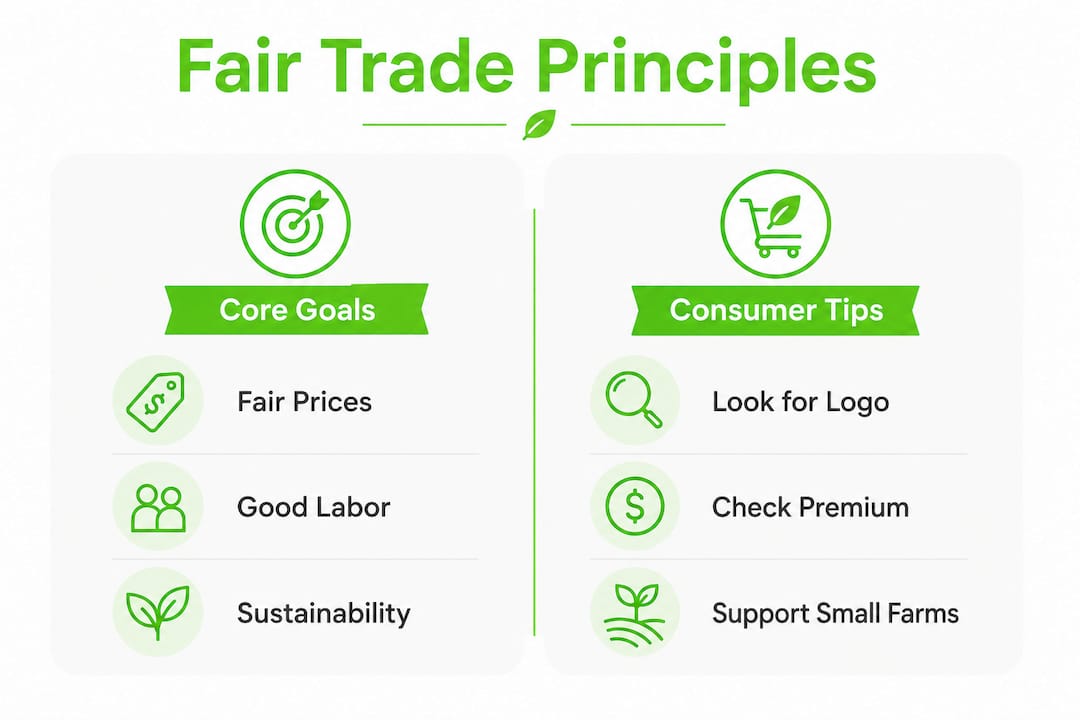
Fair trade rests on five core principles: fair prices, safe working conditions, environmental sustainability, democratic organisation, and long-term trading relationships. Each principle addresses a specific failure in conventional global trade, where price pressure on producers often forces wages down and environmental standards out.
The most concrete mechanism is the Fairtrade Minimum Price. This is a guaranteed floor price that producers receive regardless of how low global commodity markets fall. Fair trade’s minimum price acts as a financial safety net, protecting farmers from extreme commodity price swings that can wipe out an entire harvest’s income overnight. When market prices rise above the minimum, producers receive the higher rate.
On top of the minimum price, Fairtrade International certification includes an additional Fairtrade Premium. This is a sum of money paid into a communal fund that producer groups control democratically. The Fairtrade Premium is allocated by producer communities themselves, funding collective investments rather than individual payouts. Communities choose what to build: schools, health clinics, clean water systems, or agricultural equipment.
Environmental sustainability is not optional under fair trade standards. Fair trade agriculture promotes soil conservation, biodiversity protection, and responsible resource management. These practices build environmental resilience over time, which matters enormously for farming communities whose livelihoods depend on healthy land.
- Fair prices above the cost of production
- Safe and dignified working conditions
- No forced or child labour
- Environmental standards covering soil, water, and biodiversity
- Democratic decision-making within producer organisations
- Long-term trading relationships that allow producers to plan ahead
Pro Tip: When buying fair trade products, look for the Fairtrade Premium on pack descriptions. It tells you that a portion of your purchase funds community projects chosen by the producers themselves, not by a distant corporate board.
How does fair trade impact producers and communities?
The impact of fair trade on producers is real but nuanced. Direct income gains are often modest, particularly in the short term. The deeper value lies in institutional change.
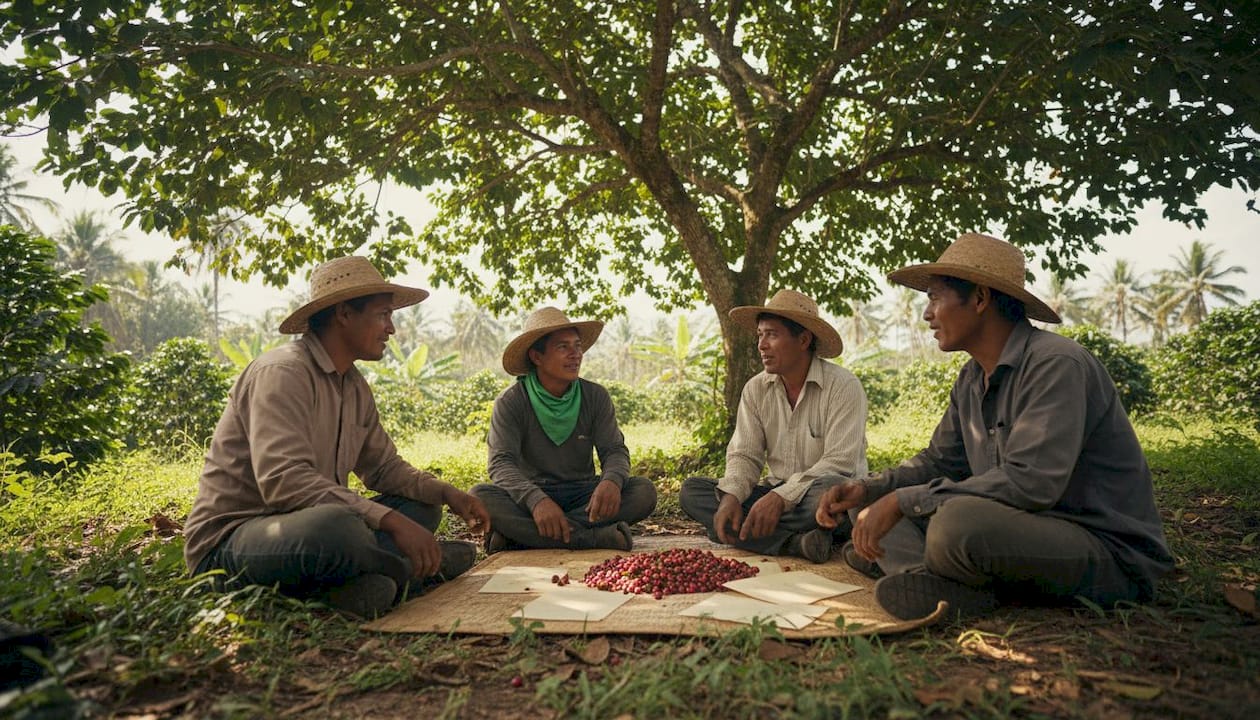
Fair trade provides significant institutional benefits including improved access to credit, stronger farming co-operatives, and better long-term capital stocks. These structural gains matter more than a single season’s price premium. A farmer with access to credit can invest in better seed, weather a drought, or expand production. A strong co-operative can negotiate better terms with buyers and reduce dependence on exploitative middlemen.
The Fairtrade Premium funds tell a clear story about community development. Producer groups across Latin America, Africa, and South Asia have used Premium funds to build the following:
- Primary schools and adult literacy programmes
- Health clinics and maternal care facilities
- Clean water infrastructure and sanitation systems
- Agricultural training centres and storage facilities
- Roads connecting remote farms to markets
“Fair trade’s greatest contribution is not the price premium alone. It is the creation of organised, financially literate producer communities that can advocate for themselves in global markets. That institutional strength outlasts any single trading season.”
Environmental benefits compound over time as well. Fair trade farming practices reduce chemical inputs, protect forest cover, and maintain soil health. These are not abstract gains. They directly protect the long-term productivity of the land that farming families depend on for survival.
What distinguishes Fairtrade certification from the broader fair trade movement?
The distinction between “Fairtrade” and “fair trade” is one of the most misunderstood points in ethical consumerism. Getting it wrong costs consumers both money and moral clarity.
“Fairtrade” refers specifically to independently audited certification governed by international standards. The lowercase “fair trade” is a broader, unregulated term that any brand can use without formal verification. This gap is where marketing claims can mislead well-intentioned shoppers.
Fair trade is best understood as an ecosystem. It includes formal certifications like Fairtrade International, direct trade relationships between roasters and farms, and informal ethical partnerships. All of these work toward economic justice, but they carry very different levels of accountability.
| Feature | Fairtrade certification | Unverified “fair trade” claim |
|---|---|---|
| Independent audits | Yes, regular third-party audits | No requirement |
| Minimum price guarantee | Yes, legally defined floor price | Not guaranteed |
| Premium fund | Yes, democratically allocated | Not applicable |
| Traceability | Yes, often backed by blockchain | Varies widely |
| Consumer trust | High, regulated standard | Depends on brand integrity |
Fair trade certification programmes often involve rigorous traceability systems backed by audits and modern technologies like blockchain to confirm compliance at every stage of the supply chain. That level of verification is what separates a certified label from a marketing phrase.
Pro Tip: When a product claims to be “fairly traded” or “ethically sourced” without a recognised certification logo, ask the brand directly for their audit reports. Legitimate ethical sourcing programmes welcome that question.
Which products dominate the fair trade market?
Coffee, tea, cocoa, and bananas account for 60% of the total fair trade market. These four commodities share a common profile: they are grown predominantly in developing countries, consumed heavily in wealthy nations, and historically subject to extreme price volatility that harms producers.
Coffee is the flagship fair trade product. The global coffee trade is worth hundreds of billions of pounds annually, yet smallholder farmers in Ethiopia, Colombia, and Vietnam have historically received a fraction of the retail price. Fair trade certification changes that equation by guaranteeing a floor price and adding a Premium on top.
Fair trade products represent about 0.01% of the total US market as of 2026. That figure sounds small, but it reflects rapid growth driven by rising consumer awareness. The niche status also signals significant room for expansion as ethical consumerism moves from the margins to the mainstream.
Consumer awareness is the single biggest driver of fair trade demand. When shoppers understand what the certification means and what it funds, purchasing behaviour shifts. That is why education about the fair trade definition is not just academic. It has direct commercial consequences for producers in developing countries.
- Coffee: the largest single fair trade commodity by volume
- Bananas: a major fair trade success story in European supermarkets
- Cocoa: critical given widespread labour concerns in West African production
- Tea: strong fair trade presence in South Asian and East African supply chains
- Cotton and flowers: growing fair trade categories beyond food
Naturessoulshop stocks direct-from-farm coffee and organically grown bananas, two of the most significant fair trade commodities, sourced with clean ingredient standards at the centre of every decision.
Key takeaways
Fair trade is a certified trading model that guarantees minimum prices, funds community development through Fairtrade Premiums, and requires environmental and labour standards that conventional supply chains routinely ignore.
| Point | Details |
|---|---|
| Core definition | Fair trade is a structured partnership based on transparency, equity, and respect, not charity. |
| Fairtrade Premium | Producers control a communal fund democratically, investing in schools, clinics, and infrastructure. |
| Certification distinction | “Fairtrade” is audited and regulated; “fair trade” is an unverified claim any brand can make. |
| Market composition | Coffee, tea, cocoa, and bananas make up 60% of the fair trade market globally. |
| Institutional impact | The strongest benefits are structural: better credit access, stronger co-operatives, and long-term capital. |
Fair trade’s future depends on what consumers do next
I have spent years watching the fair trade movement grow from a niche concern into a genuine commercial force, and the pattern I keep seeing is this: the certification works, but consumer education consistently lags behind it.
Most shoppers who buy a fair trade coffee or banana have no idea what the Fairtrade Premium is, who controls it, or what it has built. That knowledge gap is the movement’s biggest vulnerability. When consumers cannot distinguish a certified label from a marketing claim, brands that invest in genuine certification lose their competitive advantage. That erodes the incentive to certify at all.
The certification complexity is also a real barrier for producers. Smaller farming co-operatives in remote regions often struggle to meet audit requirements, not because their practices are poor, but because the paperwork and cost of certification are prohibitive. The movement needs to address this honestly rather than treating certification as a solved problem.
What gives me genuine optimism is the institutional strength fair trade builds over time. A co-operative that has operated under fair trade standards for a decade has better governance, better financial literacy, and better market access than one that has not. That compound effect is where the real development story lives, well beyond any single price premium.
For ethical consumers and businesses alike, the most useful thing you can do is learn to read labels critically. Support brands that publish their audit reports. Ask where your food comes from. Read about ethical sourcing and family wellness to understand how supply chain transparency affects the food on your table. Fair trade is not perfect, but it is the most rigorous framework we currently have for making global trade less exploitative.
— Arjit
Naturessoulshop and ethical sourcing: what you will find in the shop
Naturessoulshop was built on the belief that clean ingredients and ethical sourcing are not optional extras. They are the baseline.
Every product category at Naturessoulshop, from organic fruits and vegetables to skin care and home care, is selected with supply chain transparency in mind. The shop carries products that align with fair trade principles: no harmful additives, no exploitative sourcing, and no compromise on ingredient integrity. Whether you are looking for organic grocery staples or clean skin care, the Naturessoulshop store brings together ethically sourced products that reflect the values this article has outlined. Choosing products with clean, traceable origins is one of the most direct ways to put fair trade principles into practice in your daily life.
FAQ
What is the fair trade definition in simple terms?
Fair trade is a trading model that guarantees producers in developing countries fair prices, safe conditions, and a share of profits to invest in their communities. It is based on transparency, respect, and equity rather than charity.
How does the Fairtrade Premium work?
The Fairtrade Premium is an additional sum paid on top of the product price, controlled democratically by the producer community. Producers vote on how to spend it, typically on schools, health clinics, or agricultural infrastructure.
What is the difference between “Fairtrade” and “fair trade”?
“Fairtrade” refers to independently audited certification with guaranteed minimum prices and standards. “Fair trade” is a broader, unregulated term that any brand can use without formal verification or accountability.
Which products are most commonly fair trade certified?
Coffee, tea, cocoa, and bananas account for 60% of the global fair trade market. Cotton, flowers, and sugar are also significant fair trade categories with growing consumer demand.
Does fair trade actually help producers?
Fair trade delivers modest direct income gains but significant institutional benefits, including better access to credit, stronger co-operatives, and community infrastructure funded by the Fairtrade Premium. The long-term structural impact is where the evidence is strongest.


