


TL;DR:
- Cruelty-free products have never been tested on animals throughout their development process. Most brands lack third-party certification, making many claims unverified and easy to mislead consumers. Certification from Leaping Bunny or PETA remains the most reliable way to confirm cruelty-free status.
Cruelty-free is defined as a product and all its ingredients having undergone no animal testing at any stage of development, from raw material sourcing through to the finished item. The term is widely used across cosmetics, food, and household goods, but it carries no single legal definition in most countries. Organisations such as Leaping Bunny, Cruelty Free International, and PETA operate the most recognised certification programmes, yet only about 15% of cosmetic brands globally meet their high-standard requirements. That figure tells you how much ground the industry still has to cover.
What is cruelty free and why does the definition matter?
Cruelty-free means no animal was used to test a product or any of its ingredients at any point during development. The definition sounds straightforward, but its practical application is far more complicated. Because no government has enshrined a universal legal standard, brands can print “cruelty-free” on packaging without meeting any verified criteria.

This gap matters enormously for conscious shoppers. A brand can self-declare cruelty-free status while its contract manufacturer tests ingredients on animals in another country. Cruelty-free is not legally protected in many countries, which means audit-based third-party certifications are the only reliable way to verify a claim.
The cruelty-free meaning also extends beyond finished products. A true cruelty-free certification requires companies to confirm that no new animal testing has been conducted anywhere in their supply chain, including raw ingredient suppliers and contract manufacturers. That is a much higher bar than most people realise.
How is cruelty-free regulated across the globe?
Regulation varies sharply by region, and those differences directly affect what you see on a label.
The European Union banned animal testing for cosmetic ingredients in 2004 and for finished products in 2009. Selling cosmetics tested on animals within the EU is prohibited. That makes EU-sold cosmetics broadly safer to trust on this point, though it does not cover supply chains outside the bloc.
China has historically required animal testing for imported cosmetics sold in physical retail. This created a significant loophole: brands could claim cruelty-free in Western markets while submitting to mandatory testing to access Chinese shelves. China has relaxed some of these rules for certain product categories since 2021, but the situation remains complex and brand-specific.
Canada and the United States have no federal bans on cosmetic animal testing, though several US states have passed their own legislation. Canada’s regulations are similarly patchwork.
- The EU ban covers finished products and ingredients sold within its borders.
- China’s rules vary by product category and distribution channel.
- The US and Canada rely on voluntary brand commitments rather than federal law.
- No international treaty governs cruelty-free standards across all product types.
Pro Tip: When shopping for imported products, check whether the brand sells in mainland China through physical retail. If it does, its cruelty-free claim deserves extra scrutiny regardless of what the label says.
What certifications and standards verify cruelty-free claims?
Third-party certification is the most reliable way to confirm a cruelty-free claim. Two programmes dominate the field.
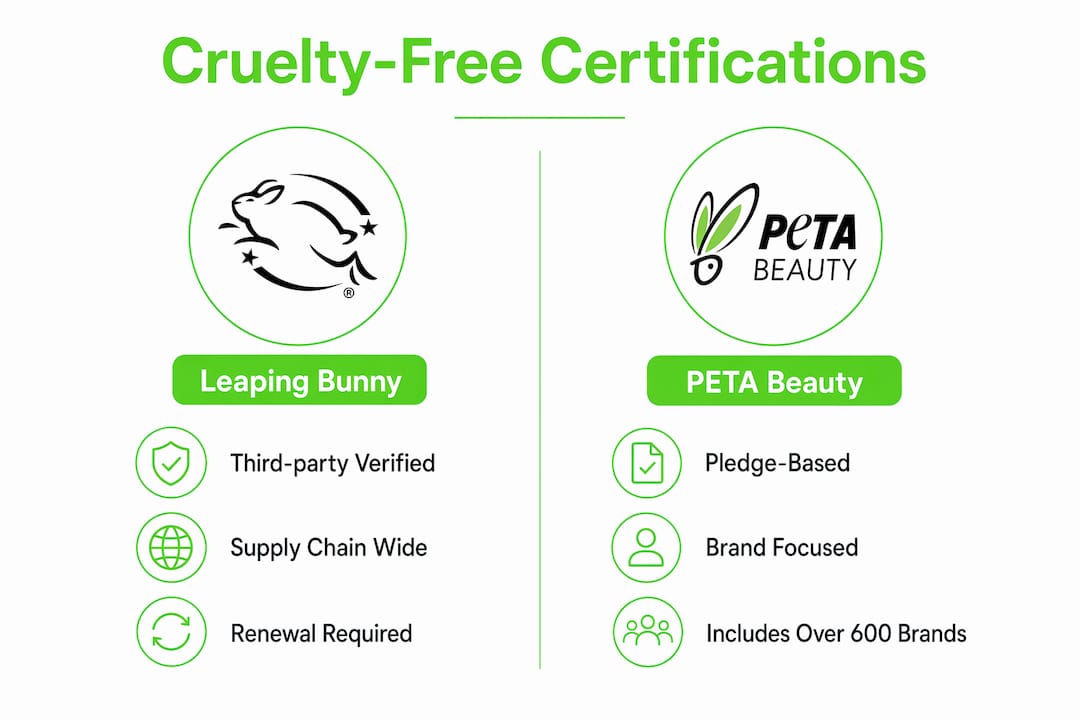
Leaping Bunny is administered by Cruelty Free International and is widely regarded as the gold standard. Leaping Bunny certification requires comprehensive supplier audits, confirming no animal testing occurs at any development stage across the entire supply chain. Brands must recommit annually and open themselves to independent verification.
PETA’s Beauty Without Bunnies programme takes a pledge-based approach. PETA’s Ultimate Cruelty-Free List includes over 6,300 companies committed to no animal testing anywhere in their supply chains as of march 2026. The list is extensive, but PETA’s verification relies more on brand declarations than on the physical audits Leaping Bunny requires.
The gap between these two approaches matters. 78% of beauty brands lack third-party certification to verify their cruelty-free claims, relying instead on self-declared marketing. That means the vast majority of “cruelty-free” labels you encounter in shops carry no independent backing.
| Certification | Verification method | Supply chain scope | Renewal required |
|---|---|---|---|
| Leaping Bunny | Independent supplier audits | Full supply chain | Annual recommitment |
| PETA Beauty Without Bunnies | Brand pledge and declaration | Brand-level commitment | Ongoing pledge |
| Self-declared label | None | Unverified | None |
Pro Tip: Look for the Leaping Bunny logo when you want the strongest available guarantee. PETA’s list is a useful starting point, but treat it as a first filter rather than a final answer.
How does cruelty-free differ from vegan and other related terms?
Cruelty-free and vegan are not the same thing. Confusing them is one of the most common mistakes conscious shoppers make.
Cruelty-free and vegan labels differ in a fundamental way: a product can be cruelty-free but still contain animal-derived ingredients such as beeswax, lanolin, or carmine. Equally, a product can be vegan, containing no animal-derived ingredients, yet have been tested on animals at some stage of development.
Here is how the distinctions break down in practice:
- Cruelty-free addresses testing only. It says nothing about what is inside the product.
- Vegan addresses ingredients only. It says nothing about how those ingredients were tested.
- A lipstick containing beeswax but never tested on animals is cruelty-free but not vegan.
- A synthetic moisturiser with no animal ingredients but tested on mice is vegan but not cruelty-free.
- Only products that are both certified cruelty-free and certified vegan satisfy both criteria simultaneously.
The clean beauty movement has helped raise awareness of these distinctions, but marketing language still blurs the lines regularly. A product labelled “natural” or “ethical” carries no guaranteed cruelty-free or vegan status unless a recognised certification backs it up.
For shoppers who want to understand the difference between plant-based and vegan labelling more broadly, these distinctions extend well beyond cosmetics into food and grocery categories too.
How to choose cruelty-free products: practical steps
Knowing what cruelty-free means is one thing. Finding genuinely cruelty-free products on a shop shelf is another. These steps make the process reliable.
-
Check the Leaping Bunny database first. The Leaping Bunny website holds a searchable list of certified brands. If a brand appears there, its supply chain has been audited. Start here before reading any label.
-
Cross-reference with PETA’s list. PETA’s database covers a wider range of brands. Use it alongside Leaping Bunny to broaden your options, but treat brands that appear only on PETA’s list as requiring a second look.
-
Read labelling language carefully. Phrases such as “we don’t test on animals” or “not tested on animals where not required by law” are red flags. The second phrase is a direct reference to the China loophole. Certified brands do not need that qualifier.
-
Check market availability. Some brands claim cruelty-free but still sell in markets requiring animal tests, which undermines their claims entirely. A quick search for a brand’s China retail presence takes under a minute.
-
Look beyond the finished product. Ethical shopping requires evaluating both animal testing policies and ingredient sourcing. Ask whether the brand’s ingredient suppliers are also covered by the certification.
Pro Tip: Bookmark the Leaping Bunny brand search page on your phone. Checking a brand takes less than 30 seconds at the point of purchase, and it removes all guesswork.
What are the benefits and limitations of choosing cruelty-free products?
Choosing cruelty-free products delivers real benefits, but it also comes with limitations that honest shoppers should understand.
The benefits are clear:
- Every certified purchase reduces commercial demand for animal testing, which puts direct financial pressure on brands to adopt alternatives.
- Meaningful progress depends on industry-wide adoption of non-animal testing methods such as in vitro models and computational toxicology. Consumer demand accelerates that shift.
- Cruelty-free purchasing signals to the market that ethical standards matter, influencing corporate behaviour over time.
- For shoppers who care about ethical sourcing in food and beverage, cruelty-free principles extend naturally into grocery and household categories.
The limitations are equally real:
- Cruelty-free status is unrelated to product efficacy. A certified product is not automatically gentler, safer, or more effective than a non-certified one.
- Cruelty-free does not mean sustainable. A product can avoid animal testing while still relying on environmentally damaging ingredients or packaging.
- Without regulation, the term remains open to misuse. Industry transparency and rigorous certification are the only real defences against widespread marketing abuse of the label.
“Consumers should use cruelty-free certifications as ethical proxies but also assess product formulation for individual suitability.” — The Clean Skin Lab
The most grounded approach is to treat cruelty-free certification as one filter among several, not as a complete guarantee of a product’s overall ethics or quality.
Key takeaways
Cruelty-free certification from Leaping Bunny or PETA is the only reliable way to verify that no animal testing occurred across a product’s full supply chain.
| Point | Details |
|---|---|
| Definition scope | Cruelty-free covers testing only, not ingredients or sustainability practices. |
| Certification matters | Only 15% of cosmetic brands meet recognised high-standard cruelty-free requirements. |
| Vegan is separate | A product can be cruelty-free but contain animal-derived ingredients, or vegan but animal-tested. |
| Leaping Bunny leads | Leaping Bunny requires annual supplier audits, making it the most rigorous available standard. |
| China loophole | Brands selling in mainland China physical retail may be subject to mandatory animal testing despite cruelty-free claims. |
Why I think the cruelty-free label deserves more scepticism, not less
The cruelty-free conversation has matured considerably over the past decade, but I find that most shoppers still give labels far too much benefit of the doubt. The statistic that 78% of brands carry no third-party certification is not a minor footnote. It means the majority of cruelty-free claims you encounter in a pharmacy or supermarket are, at best, unverified promises.
What I have come to believe is that the label’s value lies entirely in the certification behind it, not the words themselves. A Leaping Bunny logo represents real audits, real supplier checks, and real accountability. A self-declared “cruelty-free” sticker represents a marketing decision. Treating these two things as equivalent is the central mistake most guides on this topic fail to address directly.
The optimistic side of this picture is genuinely exciting. In vitro testing, organ-on-a-chip technology, and computational modelling are advancing fast enough that animal testing is becoming scientifically unnecessary in many categories. The brands investing in these methods now are not just ethical. They are ahead of where regulation is heading.
My practical advice is this: use the Leaping Bunny database as your primary filter, treat PETA’s list as a secondary check, and be especially sceptical of any brand that sells in mainland China physical retail while claiming cruelty-free status. Vigilance here is not cynicism. It is the only thing that keeps the standard meaningful.
— Arjit
Cruelty-free and ethical products at Naturessoulshop
Naturessoulshop stocks a carefully selected range of organic, natural, and ethically sourced products across skin care, food, and household categories. Every product in the range is chosen with clean ingredients and transparent sourcing in mind, making it easier to shop with confidence rather than having to decode every label yourself.
Whether you are looking for certified skin care, vegan grocery staples, or gluten-free snacks that align with your values, the Naturessoulshop online store brings them together in one place. The range includes products such as organic skin creams, health-focused supplements, and plant-based food options that meet the standards conscious shoppers are looking for. Ethical sourcing is not an afterthought here. It is the starting point.
FAQ
What does cruelty free mean for cosmetics?
Cruelty-free means neither the finished cosmetic product nor any of its ingredients were tested on animals at any stage of development. The term covers the entire supply chain, not just the final formula.
Is a product cruelty free if it has no certification?
Not reliably. Without third-party certification from a body such as Leaping Bunny or PETA, a cruelty-free claim is self-declared and unverified. 78% of beauty brands carry no independent certification.
Can a product be cruelty free but not vegan?
Yes. Cruelty-free refers to testing practices only, so a product can avoid animal testing while still containing animal-derived ingredients such as beeswax or lanolin. Always check both statuses separately.
How do I know if a brand is genuinely cruelty free?
Search the Leaping Bunny database or PETA’s Ultimate Cruelty-Free List, and check whether the brand sells in mainland China through physical retail, which can require mandatory animal testing.
Does cruelty free mean the product is safer or more effective?
No. Cruelty-free status is unrelated to product efficacy or gentleness. It is an ethical commitment about testing methods, not a measure of formula quality or safety.


