


Simple and effective methods to balance your macronutrients
Balancing your macros means hitting practical daily targets for protein, carbohydrates, and fat that match your body, your goals, and your lifestyle. The most reliable approach, recommended by nutrition experts, is to set targets in grams rather than percentages, start with protein, then distribute the remaining calories between carbs and fats based on how active you are and how full each makes you feel.
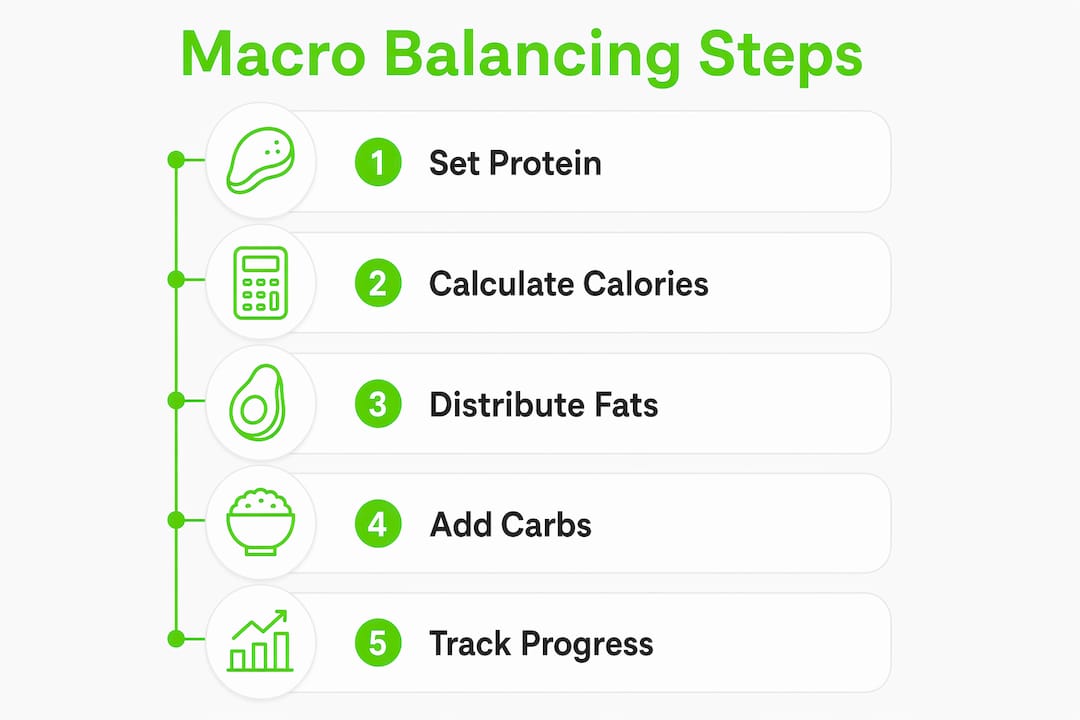
Here is the core framework at a glance:
- Set your calorie target first based on your goal (fat loss, maintenance, or muscle gain).
- Prioritise protein by setting a gram target relative to your bodyweight.
- Distribute remaining calories between carbohydrates and fats according to your activity level and personal satiety.
- Use gram targets, not percentages, to avoid confusion and make daily logging straightforward.
- Allow yourself a range, not a fixed number, for carbs and fats to keep things sustainable.
That last point matters more than most beginners expect. Registered dietitians consistently recommend ranges over rigid daily numbers because they reduce stress and improve long-term adherence.
What are macronutrients and why do they matter?
Macronutrients are the three main nutrients your body uses for energy: protein, carbohydrates, and fat. Each one serves distinct physiological functions that are genuinely irreplaceable.
- Protein (4 kcal per gram): repairs muscle tissue, supports immune function, and is the most satiating macro gram for gram.
- Carbohydrates (4 kcal per gram): the body’s preferred fuel source for the brain and working muscles, particularly during moderate to high-intensity exercise.
- Fat (9 kcal per gram): supports hormone production, aids absorption of fat-soluble vitamins (A, D, E, and K), and contributes to sustained energy between meals.
Because fat delivers more than twice the calories per gram compared to protein or carbs, small inaccuracies in measuring it have a bigger impact on your total calorie count. A tablespoon of olive oil is roughly 120 kcal; a tablespoon of chicken breast is closer to 10 kcal. That gap is why food quality and accurate portioning both matter.
General UK nutritionist guidance places carbohydrates at roughly 45–65% of total calories, protein at 10–35%, and fat at 20–35%, though these ranges shift considerably depending on your goal. A person training for a marathon sits at the higher end of carbohydrates; someone focused on fat loss with minimal cardio may lean towards the higher end of protein.
How to calculate your personalised macro targets
Getting your macro targets right starts with one number: your Total Daily Energy Expenditure (TDEE). This is the total calories your body burns in a day, accounting for both your resting metabolism and your activity level.
Step 1: Calculate your Basal Metabolic Rate (BMR) using the Mifflin-St Jeor formula
- Men: (10 × weight in kg) + (6.25 × height in cm) − (5 × age) + 5
- Women: (10 × weight in kg) + (6.25 × height in cm) − (5 × age) − 161
Step 2: Multiply your BMR by an activity factor
- Sedentary (desk job, little exercise): BMR × 1.2
- Lightly active (light exercise 1–3 days per week): BMR × 1.375
- Moderately active (exercise 3–5 days per week): BMR × 1.55
- Very active (hard training 6–7 days per week): BMR × 1.725
Step 3: Adjust for your goal
- Fat loss: subtract 300–500 kcal from your TDEE
- Maintenance: eat at TDEE
- Muscle gain: add 200–300 kcal to your TDEE
Step 4: Set your protein target first
Aim for 1.6–2.2g of protein per kilogram of bodyweight if you train regularly. For a sedentary person focused on weight loss, 1.2–1.6g per kg is a reasonable starting point.
Step 5: Distribute remaining calories between carbs and fats

Multiply your protein grams by 4 to find protein calories, then subtract from your total. Split what remains between carbs and fat based on preference. If you feel better with more carbs around training, skew that way. If you prefer fewer carbs and find fat more satiating, adjust accordingly. Tracking protein in grams while allowing flexibility with carbs and fats is more sustainable than trying to hit three precise numbers every single day.
Which foods help you hit your macro targets?
Choosing the right foods makes hitting your targets far less effortful. Here are practical, UK-relevant options across each macro category.
Protein sources
- Animal: chicken breast, turkey mince, eggs, Greek yoghurt, cottage cheese, tinned tuna, salmon, lean beef mince
- Plant-based: lentils, chickpeas, black beans, tofu, tempeh, edamame, natural protein sources such as hemp seeds and pumpkin seeds
Carbohydrate sources
- Whole grains: oats, brown rice, wholemeal bread, quinoa, barley
- Vegetables and legumes: sweet potato, butternut squash, peas, lentils
- Fruit: bananas, berries, apples (useful pre-workout for quick energy)
- Red lentil pasta is a particularly useful option, delivering both carbohydrates and a solid hit of protein in one ingredient
Healthy fats
- Unsaturated: olive oil, avocado, almonds, walnuts, flaxseed, oily fish (mackerel, sardines, salmon)
- Quality of fats matters more than quantity: prioritise unsaturated sources and limit saturated fats from processed meats and full-fat dairy
One area beginners consistently underestimate is hidden calories in oils, sauces, and dressings. Two tablespoons of a standard shop-bought Caesar dressing can add a significant number of kilocalories, almost entirely from fat, without feeling like a meaningful part of the meal. Weigh or measure these carefully.
What are the health benefits of balancing your macros?
Balancing macronutrients supports far more than weight management. Protein supports muscle repair and satiety, carbohydrates fuel the brain and working muscles, and fats aid hormone production and vitamin absorption. Together, a balanced intake supports blood sugar regulation and metabolic health.
“Consistent macro ratios at each meal help regulate blood sugar, support metabolism, and maintain satiety throughout the day, rather than just hitting overall daily targets.” This means spreading your macros across meals, rather than eating most of your protein at dinner, tends to produce better energy and appetite control.
Muscle preservation during fat loss is one of the clearest evidence-based benefits. When protein intake is adequate, the body preferentially burns fat rather than lean tissue during a calorie deficit. For anyone over 40, where muscle loss accelerates naturally, this becomes particularly relevant.
Appetite control is another practical benefit. Higher protein intakes are consistently associated with reduced hunger, which makes sticking to a calorie target considerably easier without relying on willpower alone.
Practical tips for flexible, sustainable macro balancing
Pro Tip: Build a staple food list of 15–20 foods you eat regularly and log them once in your tracking app. Memory-based food logging can be inaccurate by up to 45%; a saved list removes the guesswork and cuts daily logging time dramatically.
Sustainability comes from reducing friction, not from being perfect every day. These habits make a real difference:
- Weigh food raw whenever possible. Cooked weights vary depending on water loss during cooking, so raw weights give you a consistent baseline.
- Use a digital kitchen scale rather than cups or spoons for anything calorie-dense. Eyeballing portions is one of the most common sources of tracking error.
- Log soon after preparing food, not at the end of the day. Recall-based logging is far less accurate.
- Meal prep two or three times a week to reduce daily decisions. Batch cooking and saving meals in your tracking app dramatically cut the daily burden of logging.
- Review weekly averages, not daily totals. Small daily deviations are inevitable; weekly trends reveal the patterns that actually need adjusting.
- Adjust based on hunger and training signals, not just the numbers. If you are consistently hungry on rest days, a small increase in protein or fat often resolves it without needing to overhaul your whole plan.
Common macro ratios and what each one is designed for
There is no single best macro ratio. Fat loss outcomes are similar across different carb-to-fat splits when total calories and protein are matched, which means the “best” ratio is largely the one you can maintain.
| Goal | Approximate ratio (protein / carbs / fat) | Notes |
|---|---|---|
| General health and maintenance | 20% / 50% / 30% | Aligns with standard UK dietary guidelines |
| Fat loss | 30–35% / 35–40% / 25–30% | Higher protein preserves muscle in a deficit |
| Muscle gain | 25–30% / 45–50% / 20–25% | More carbs to fuel training and recovery |
| Low-carb or ketogenic | 25–30% / 5–10% / 60–70% | Carbs minimised; fat becomes primary fuel |
| Endurance sport | 15–20% / 45–65% / 20–25% | Carbohydrate demands are high for sustained output |
These are starting points, not rules. A 70kg woman training four times a week for fat loss will likely do better with a protein target of around 112–154g per day and carbs and fat adjusted around that, rather than trying to hit a percentage split to the decimal.
Is macro balancing suitable for everyone?
For most healthy adults, tracking macros is a practical and evidence-based approach to improving diet quality and managing body composition. That said, it is not universally appropriate.
Individuals with a history of eating disorders should approach numeric tracking with caution and ideally work with a registered dietitian or therapist before starting. The focus on numbers can reinforce disordered thinking patterns for some people, and non-numeric approaches based on hunger cues and food quality may be more suitable.
Pregnant and breastfeeding women, people managing chronic conditions such as type 2 diabetes or kidney disease, and children and teenagers all have specific nutritional needs that standard macro calculators do not account for. A GP or registered dietitian can provide guidance tailored to those circumstances.
For the majority of beginners, the risk is not harm but burnout. Starting with protein tracking alone, before adding carbs and fats, is a gentler entry point that still delivers most of the benefit.
How to track your macros without it taking over your life
The most widely used tracking tools available in the UK include MyFitnessPal, Cronometer, and Nutracheck, the latter being particularly popular with UK users because its food database is built around British supermarket products and portion sizes. All three allow you to scan barcodes, save meals, and log recipes.
A few practical habits make tracking far less time-consuming:
- Scan barcodes at the point of purchase, not at the point of eating. You can pre-log a meal while you are still in the supermarket.
- Use the recipe builder for home-cooked meals. Enter all ingredients once, save the recipe, and log it in seconds every subsequent time.
- Pre-log the next day’s meals the evening before. This takes around five minutes and removes the need to make decisions when you are hungry.
- Spot-check rather than track continuously once you have a good feel for your regular meals. Logging for two weeks every few months is enough for many people to stay on track without daily effort.
For family meal planning, tracking shared recipes by portion is the most efficient approach. Divide total recipe macros by the number of servings and log one serving per person.
A sample day of meals that demonstrates macro balance
This example is built around a 2,000 kcal target with roughly 150g protein, 200g carbohydrates, and 65g fat. It is not a prescription, but it shows how the numbers translate into actual food.
Breakfast: Porridge made with 80g rolled oats, 300ml semi-skimmed milk, and a handful of blueberries. Two scrambled eggs on the side. Approx: 550 kcal, 35g protein, 65g carbs, 15g fat
Lunch: Large salad with 150g grilled chicken breast, 100g cooked quinoa, half an avocado, cherry tomatoes, cucumber, and a drizzle of olive oil and lemon. Approx: 550 kcal, 45g protein, 45g carbs, 20g fat

Snack: 200g low-fat Greek yoghurt with a tablespoon of mixed seeds and a banana. Approx: 300 kcal, 20g protein, 40g carbs, 8g fat
Dinner: 150g salmon fillet, 200g roasted sweet potato, and a large portion of steamed broccoli and green beans with a teaspoon of olive oil. Approx: 550 kcal, 45g protein, 50g carbs, 20g fat
Total: approx 1,950 kcal, 145g protein, 200g carbs, 63g fat
This is a balanced meal structure that works for most beginners. Swap ingredients to suit your preferences; the structure matters more than the specific foods.
Common mistakes in macro balancing and how to fix them
Tracking cooked weights instead of raw. Chicken breast loses roughly 25% of its weight when cooked. If you log 200g of cooked chicken, you are actually logging closer to 150g raw, which means you are underestimating your protein. Weigh raw, always.
Ignoring liquid calories. A large glass of orange juice, a flat white, and a protein shake can add 400–500 kcal to a day without feeling like food. Log drinks the same way you log meals.
Setting targets too aggressively. A 1,000 kcal daily deficit is not twice as effective as a 500 kcal deficit. It typically leads to muscle loss, fatigue, and abandonment within a few weeks. A moderate deficit is more productive over a 12-week period.
Giving up after one bad day. One day over your targets does not undo a week of good tracking. The weekly average is what matters, and a single outlier rarely shifts it meaningfully.
Not adjusting as you lose weight. As your bodyweight drops, your TDEE decreases. Recalculate your targets every 4–6 weeks to avoid a plateau that is actually just a maths problem.
How to read UK nutrition labels for macro tracking
UK food labels follow a standardised format regulated by the Food Standards Agency. Every packaged food must display energy (in both kJ and kcal), fat, saturates, carbohydrates, sugars, protein, and salt per 100g, and usually per serving.
The “per 100g” column is the most useful for macro tracking because it lets you calculate any portion size accurately. If a product shows 20g protein per 100g and you eat 150g, you are getting 30g protein. Simple multiplication, no guesswork.
Watch out for serving sizes that do not match how you actually eat. A cereal box might list a 30g serving, but most people pour closer to 60–80g. Weigh your portion rather than trusting the suggested serving.
The traffic light system on the front of UK packaging (red, amber, green) is a useful at-a-glance guide for fat, saturates, sugars, and salt, but it does not tell you about protein content. For macro tracking, always go to the back-of-pack table.
Key takeaways
Balancing macros effectively requires setting protein targets first in grams, distributing remaining calories between carbs and fats based on your activity and satiety, and reviewing weekly trends rather than chasing daily perfection.
| Point | Details |
|---|---|
| Protein first | Set protein at 1.6–2.2g per kg of bodyweight before calculating carbs and fat. |
| Gram targets beat percentages | Tracking in grams is more practical and reduces daily confusion for beginners. |
| Weigh food raw | Raw weights avoid cooking distortions and keep your macro logs accurate over time. |
| Weekly trends matter most | Small daily deviations are inevitable; consistent weekly patterns are what drive results. |
| Not suitable for everyone | Those with a history of eating disorders should seek professional guidance before tracking numerically. |
Stock your kitchen with foods that make macro balancing easy

Getting your macros right starts with having the right ingredients to hand. Naturessoulshop stocks a wide range of organic, clean-ingredient foods that fit naturally into a macro-balanced diet, from vegan and gluten-free options to wholesome snacks and dry grocery staples. Browse the full range at Naturessoulshop and build a kitchen that works with your goals, not against them.


