


TL;DR:
- Whole grains keep all parts of the kernel, while refined grains have the bran and germ removed during milling. Refining reduces fiber, vitamins, and minerals, which cannot be fully restored through enrichment. Including whole grains most of the time supports better health, but refined grains can be practical in specific situations when paired with fiber-rich foods.
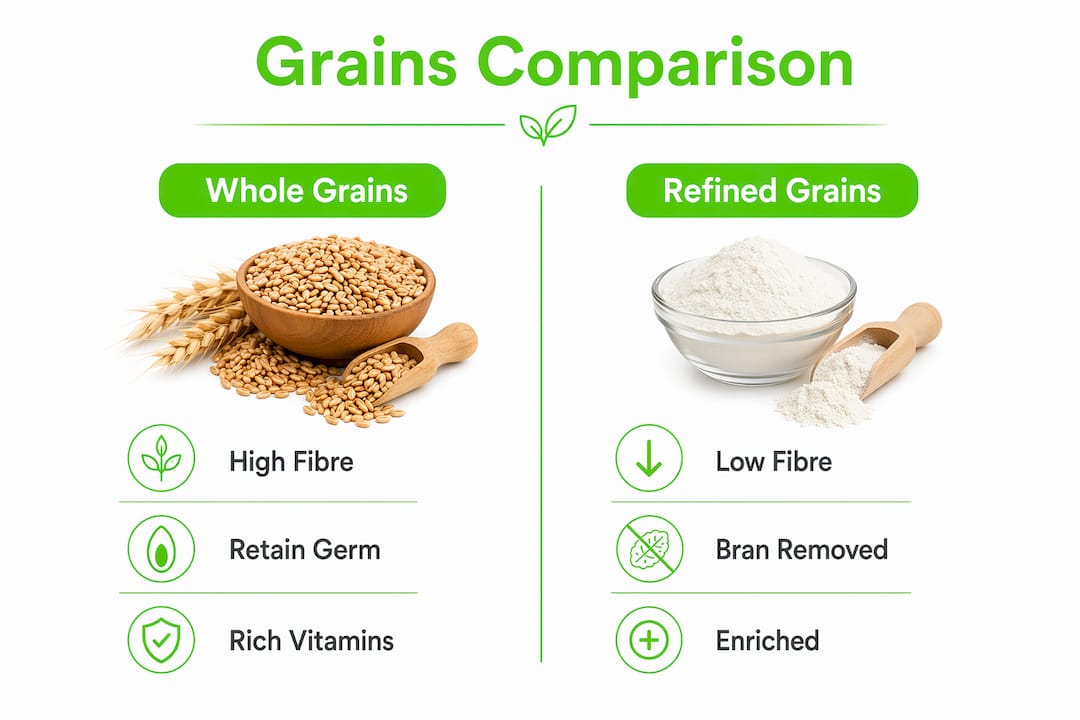
Whole grains are defined as grains that retain all three parts of the kernel: the bran, the germ, and the endosperm. Refined grains, by contrast, have had the bran and germ removed during milling, leaving only the starchy endosperm. The Whole Grains Council recognises this structural difference as the single most important factor in comparing whole grains vs refined grains nutritionally. That one processing step strips away fibre, B vitamins, magnesium, zinc, and dozens of other compounds your body relies on daily. Understanding what is lost, and what is not, is the foundation of every smart grain choice you make.
What are the nutritional differences between whole and refined grains?
Refined grains lose bran and germ during milling, which removes most dietary fibre and key micronutrients including magnesium, zinc, and Vitamin B6. Enrichment programmes restore only a fraction of what is lost, typically adding back iron and folate but not the full spectrum of minerals and antioxidants originally present. The result is a grain that delivers calories efficiently but falls short on nutritional depth.
The fibre gap is the most significant refined grain difference. Dietary fibre from the bran layer slows digestion, stabilises blood sugar, and feeds beneficial gut bacteria. When the bran is removed, that function disappears almost entirely. A slice of white bread, for example, contains a fraction of the fibre found in a slice of 100% whole wheat bread made from the same quantity of grain.
B vitamins tell a similar story. The germ is rich in B6, folate, and thiamine. Refining strips these out. Enrichment adds synthetic folate back, which matters for neural tube defect prevention, but B6 and many other compounds are not replaced. Whole grains nutritional value therefore extends well beyond what enrichment can replicate.
| Nutrient | Whole grain | Refined grain |
|---|---|---|
| Dietary fibre | High (bran intact) | Low (bran removed) |
| Magnesium | Good source | Significantly reduced |
| Zinc | Present | Largely removed |
| Vitamin B6 | Present in germ | Largely removed |
| Folate | Natural form present | Synthetic form added back |
| Antioxidants | Present in bran and germ | Mostly absent |
Pro Tip: When comparing bread labels, look at the fibre per 100g figure rather than per slice. Whole grain breads typically show 6g or more of fibre per 100g, while refined white breads often show 2–3g.
How do whole grains affect health compared to refined grains?
Regular whole grain consumption correlates with lower risk of colorectal cancer, cardiovascular disease, stroke, and type 2 diabetes. These are not marginal associations. They appear consistently across large population studies spanning decades. The mechanism involves fibre, antioxidants, and phytochemicals working together in ways that no single enriched nutrient can replicate.

The benefits of whole grains on heart health are particularly well documented. Soluble fibre from oats, for instance, binds to cholesterol in the digestive tract and removes it before absorption. Whole grain barley contains beta-glucan, a fibre type that the European Food Safety Authority has formally linked to reduced blood cholesterol. These are specific, named compounds with specific, measurable effects.
The whole grains benefits for blood sugar control are equally clear. The intact bran and germ slow the rate at which glucose enters the bloodstream. Refined grains, stripped of this buffering structure, cause faster glucose spikes. Over time, repeated glucose spikes contribute to insulin resistance, which is a key driver of type 2 diabetes.
Key health benefits backed by current research include:
- Reduced colorectal cancer risk from fibre’s role in speeding transit time through the colon
- Lower cardiovascular disease risk through cholesterol reduction and anti-inflammatory compounds
- Better blood sugar regulation due to slower glucose absorption
- Improved gut microbiome diversity from prebiotic fibre feeding beneficial bacteria
- Reduced stroke risk associated with consistent whole grain intake in long-term studies
Refined grains are not without nutritional merit. Refined grains contribute nearly 40% of dietary fibre in the US diet and remain a significant source of folic acid. That figure reflects how much refined grain the average person eats, not that refined grains are fibre-rich per serving. The public health contribution of enriched refined grains, particularly folic acid for women of childbearing age, is real and should not be dismissed.
About 83% of grain servings in the typical diet are refined grains, despite guidelines recommending at least half be whole grains. That gap between guidance and reality explains why chronic disease rates linked to poor fibre intake remain stubbornly high.
When might refined grains be a reasonable choice?
Refined grains are a practical choice in specific, real-world situations. Dismissing them entirely ignores how people actually cook and eat. The goal is informed choice, not rigid elimination.
Brown rice takes 40–50 minutes to cook compared to 18–20 minutes for white rice. On a weeknight with limited time, that difference is significant. Quick-cooking whole grain options like bulgur wheat, rolled oats, and pre-cooked grain pouches reduce this friction considerably. But when those options are not available, white rice paired with vegetables and legumes still constitutes a nutritious meal.
Here are four practical scenarios where refined grains make sense:
- Time constraints. White rice, white pasta, and plain couscous cook quickly. Pairing them with fibre-rich vegan foods like lentils, chickpeas, or leafy greens compensates for the lower fibre content.
- Children with high energy needs. Refined grains are calorie-dense and easy to digest. For young children who struggle to eat large volumes, white rice or white bread can help meet energy requirements without digestive discomfort.
- Athletes during training. Fast-digesting refined carbohydrates before or during intense exercise provide rapid fuel. Whole grains, with their slower digestion, are less suited to this specific use case.
- Budget constraints. Refined grains are almost always cheaper than their whole grain equivalents. When cost is a barrier, choosing refined grains and adding fibre through vegetables, pulses, and fruit is a sound nutritional strategy.
Consistency matters more than perfection. If switching entirely to whole grains creates friction that causes you to abandon healthy eating habits altogether, a mixed approach is far more sustainable.
Pro Tip: Add a tin of lentils or a handful of frozen peas to white rice dishes. You recover much of the fibre you lose from choosing refined grain, and the meal takes no extra preparation time.
How do you identify genuine whole grain products?
‘Whole wheat’ and ‘multi-grain’ labels can be misleading. Neither term guarantees that the product contains predominantly whole grain. Multi-grain simply means more than one type of grain is present. Those grains may all be refined.
Colour is equally unreliable. Brown bread can be coloured with molasses or caramel. Dark colour does not confirm whole grain content. The only reliable check is the ingredient list.
Watch for these labelling pitfalls:
- “Wheat flour” without “whole” means refined flour. The word “whole” must appear directly before the grain name.
- “Made with whole grains” can mean the product contains a token amount. Check whether whole grain flour appears first in the ingredient list.
- “Multigrain”, “seven-grain”, or “harvest grain” are marketing terms with no regulatory definition for whole grain content.
- “Enriched flour” always means refined. Enrichment is a sign that nutrients were removed and partially replaced.
Label claims like ‘whole wheat’ do not necessarily mean whole grain. The ingredient list is your best verification tool. Look for “whole wheat flour”, “whole oat flour”, or “whole rye” as the first ingredient. If you see “enriched wheat flour” at the top, the product is primarily refined regardless of what the front of the packet claims.
58% of whole grain intake comes from breads and breakfast cereals. That means commonly available, processed whole grain products do confer genuine health benefits. You do not need to seek out obscure ancient grains to benefit. A genuine whole grain loaf from a supermarket shelf delivers the same fibre and micronutrient advantages as a more artisan option.
Key takeaways
Whole grains are nutritionally superior to refined grains because they retain fibre, vitamins, and minerals that refining removes and enrichment cannot fully restore.
| Point | Details |
|---|---|
| Structural difference matters | Whole grains keep bran, germ, and endosperm; refined grains lose bran and germ during milling. |
| Fibre is the critical gap | Whole grains deliver significantly more dietary fibre, supporting gut health, blood sugar, and heart health. |
| Enrichment has limits | Refined grain enrichment restores iron and folate but not magnesium, zinc, B6, or antioxidants. |
| Refined grains have a role | Time, cost, and specific dietary needs make refined grains a practical choice when paired with fibre-rich foods. |
| Labels require scrutiny | Only “whole” before the grain name in the ingredient list confirms genuine whole grain content. |
Grains, balance, and what I have actually learnt
I spent years treating whole grains as an all-or-nothing commitment. Brown rice or nothing. Whole wheat pasta or nothing. That approach made cooking feel like a chore and, honestly, made me less consistent than I should have been.
What shifted my thinking was accepting that the research on whole grains’ environmental efficiency and health benefits does not require perfection. It requires consistency. A diet that includes whole grains most of the time, with refined grains filling practical gaps, is far better than a rigid plan that collapses under real-life pressure.
The labelling issue is the part I wish more people understood. I have picked up products in health food shops that were marketed as whole grain but had enriched wheat flour as the first ingredient. Reading the ingredient list takes ten seconds. It is the single most useful habit you can build around grain choices. Pair that with a few genuinely whole grain staples, rolled oats, whole wheat bread, brown rice when time allows, and you cover the nutritional bases without overthinking every meal.
— Arjit
Whole grain options at Naturessoulshop
Naturessoulshop stocks a range of organic dry grocery products built around clean, natural ingredients, including whole grain options that make the switch from refined grains straightforward.

Whether you are looking for gluten-free whole grain alternatives or simply want to stock your kitchen with better-quality staples, the organic food store at Naturessoulshop covers the full range. Products like the Namak Para Jowar, a vegan and gluten-free whole grain snack, show how whole grain eating can be both practical and satisfying. Every product is selected with clean ingredients and nutritional integrity in mind, so you spend less time decoding labels and more time eating well.
FAQ
What is the main difference between whole and refined grains?
Whole grains retain the bran, germ, and endosperm of the kernel, while refined grains have the bran and germ removed during milling. This removal significantly reduces fibre, vitamins, and mineral content.
Are whole grains always the healthier grain option?
Whole grains are nutritionally superior in most contexts due to higher fibre and micronutrient content. Refined grains enriched with folic acid still serve a public health role, particularly for women of childbearing age.
How do I know if a product is genuinely whole grain?
Check the ingredient list for the word “whole” directly before the grain name, such as “whole wheat flour” or “whole oat flour”. Terms like “multigrain” or “enriched flour” do not confirm whole grain content.
Does brown bread always mean whole grain?
No. Brown bread can be coloured with molasses or caramel and still contain primarily refined flour. Colour is not a reliable indicator of whole grain content.
Can I get enough fibre from refined grains alone?
Refined grains contribute to overall fibre intake, but whole grains deliver significantly more fibre per serving. Pairing refined grains with vegetables, pulses, and fruit is the most practical way to meet fibre targets when whole grains are not available.


