


TL;DR:
- Cruelty free means a product has not been tested on animals at any development stage, but certification standards vary widely. The Leaping Bunny offers the most rigorous independent verification, while PETA relies on self-declarations. Consumers should check brand policies and trusted databases to confirm genuine cruelty-free status.
Cruelty free is defined as a product and its ingredients having undergone no animal testing at any stage of development or production. The term appears on everything from moisturisers to washing-up liquid, yet no single global legal definition exists to govern it. Certifications such as Leaping Bunny and PETA’s Beauty Without Bunnies programme set the most rigorous standards, but brands can still print “cruelty free” on packaging without meeting either. Understanding what the label actually guarantees, and when it guarantees nothing, is the first step to shopping with genuine confidence.
What does cruelty free mean legally and commercially?
The cruelty free meaning shifts depending on which country you are in and which brand you are reading. The US government does not regulate cruelty-free claims, so brands may self-define the term and use it even when suppliers or overseas partners have tested ingredients on animals. That is not a loophole most shoppers expect to find.

The EU bans animal testing for cosmetics under most circumstances, but specific REACH chemical safety exceptions still apply. China has historically required animal testing for imported cosmetics, though regulations have shifted for certain product categories in recent years. A brand that sells in China and claims to be cruelty free in the UK is operating in a grey area that deserves scrutiny.
The practical result is that “cruelty free” on a label can mean very different things:
- No animal testing on the finished product only, with no restriction on ingredient testing
- No animal testing by the brand itself, but no requirement placed on ingredient suppliers
- No animal testing anywhere in the supply chain, including third-party manufacturers
- No animal testing unless required by law in a specific market
Pro Tip: When a brand claims to be cruelty free, search for its animal testing policy on its own website. A genuine policy names its suppliers and states explicitly that no animal testing is conducted anywhere in the supply chain.
What certifications actually guarantee cruelty-free standards?
Certification programmes exist precisely because self-declared claims are unreliable. Two names dominate: Leaping Bunny and PETA’s Beauty Without Bunnies.
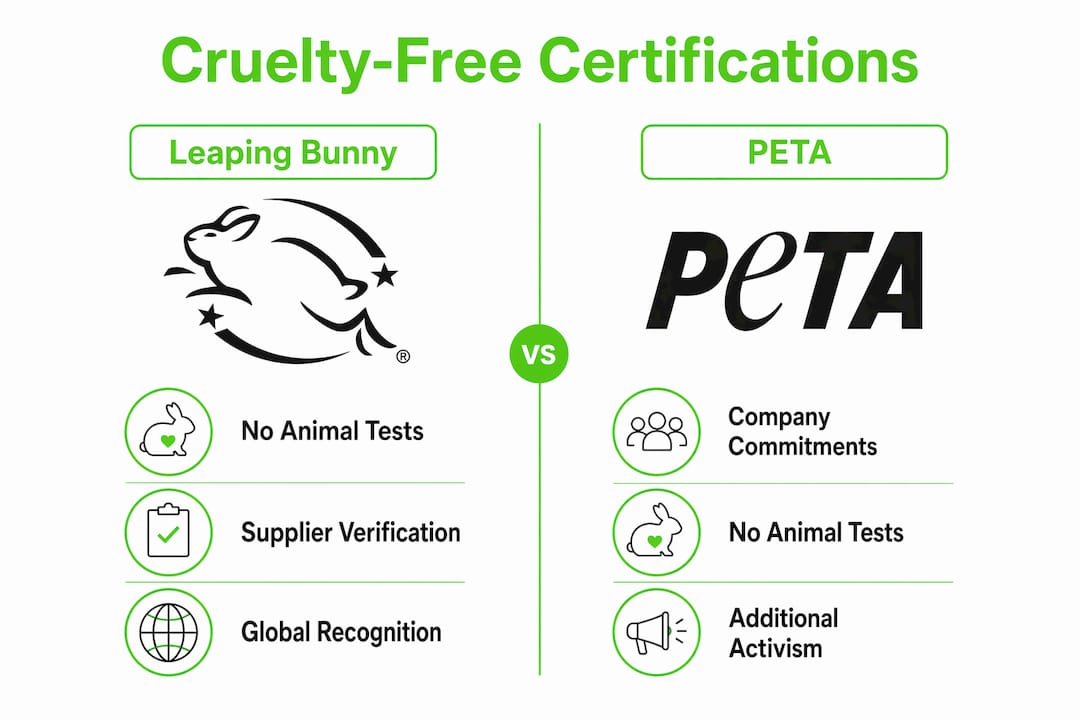
The Leaping Bunny Programme is the only widely accepted standard that requires no animal testing on products or ingredients after a fixed cut-off date, combined with mandatory supplier audits. Licensed companies pledge that neither they nor their ingredient suppliers conduct animal testing during product development. On-site audits verify those pledges. That combination of supplier commitment and independent verification makes Leaping Bunny the most rigorous standard available to consumers.
PETA’s cruelty-free standard takes a different approach. PETA defines cruelty free as a company refusing all animal testing anywhere in its supply chain, with no exceptions for legal requirements in any market. PETA relies on a signed statement of compliance from the brand rather than on-site audits, which makes entry easier but verification less thorough than Leaping Bunny.
| Certification | Scope | Verification method | Supplier requirement |
|---|---|---|---|
| Leaping Bunny | Products and ingredients post cut-off date | On-site supplier audits | Yes, mandatory |
| PETA Beauty Without Bunnies | Full supply chain, no legal exceptions | Signed brand statement | Yes, but self-declared |
One technical detail matters more than most shoppers realise. Cut-off date language in certifications means a brand commits to no animal testing after a specific date, not necessarily that no ingredient in the product was ever tested on animals historically. “No testing after 2018” is a different promise from “no testing ever.” Reading the certification terms, not just the logo, gives you the clearest picture.
Pro Tip: The Leaping Bunny website hosts a searchable database of certified brands. Cross-referencing a product there takes under a minute and removes all guesswork about whether a logo is genuine.
How does cruelty free differ from vegan?
Cruelty free and vegan are not the same thing. Cruelty free focuses on animal testing; vegan focuses on animal-derived ingredients. A product can be both, either, or neither.
Confusing the two is one of the most common mistakes ethical shoppers make. The Vegetarian Society notes that cruelty free is not a regulated term and varies by brand, whereas vegan certification specifically excludes animal-derived ingredients such as beeswax, lanolin, carmine, and collagen. A lipstick certified cruelty free may still contain beeswax. A vegan shampoo may have been tested on animals if the brand has no cruelty-free policy.
The distinctions matter in practice:
- A product is cruelty free but not vegan if it contains animal-derived ingredients such as honey or silk proteins but was never tested on animals
- A product is vegan but not cruelty free if it contains no animal-derived ingredients but was tested on animals during development
- A product is both when it carries certifications covering testing and ingredients separately
- A product is neither when it contains animal-derived ingredients and was tested on animals
Beyond these two labels, ethical shoppers increasingly consider fair trade sourcing, environmental impact, and animal welfare in ingredient sourcing. Cruelty free and vegan are starting points, not the full picture. For a deeper look at how plant-based and vegan labels compare, the plant-based vs vegan guide at Naturessoulshop unpacks those distinctions clearly.
How to identify truly cruelty-free products
Identifying genuinely cruelty-free products requires more than reading the front of the packaging. The back of the box, the brand’s website, and independent databases all tell a more complete story.
-
Look for recognised certification logos. The Leaping Bunny logo and PETA’s cruelty-free bunny are the two most reliable signals. Certification logos provide reliable assurance that self-declared claims cannot match.
-
Read the brand’s animal testing policy directly. A credible policy states that neither the brand nor its suppliers test on animals, and that the brand does not sell in markets where animal testing is legally required for cosmetics.
-
Check whether the brand sells in markets with mandatory animal testing. Brands that sell in markets requiring animal testing for imported cosmetics cannot credibly claim full cruelty-free status for those product lines.
-
Use independent verification databases. Leaping Bunny’s searchable database and PETA’s online brand list are free to use and regularly updated. Apps such as Cruelty-Cutter allow you to scan barcodes in-store.
-
Examine supplier commitments, not just brand pledges. Independent audits and supply-chain documentation distinguish credible certifications from self-declared promises. Ask whether the brand requires written no-testing commitments from ingredient suppliers.
Pro Tip: If a brand’s animal testing policy uses phrases like “we do not conduct animal testing unless required by law,” that is not a cruelty-free policy. It is a conditional policy. Genuine cruelty-free brands state no exceptions.
Why is cruelty-free labelling still inconsistent?
The inconsistency in cruelty-free labelling comes from a structural gap. No international body governs the term, so regulatory and certification scope differences affect what the label means and what consumers can reasonably expect.
Several factors keep the situation complicated:
- Regional legal gaps. The EU bans most cosmetic animal testing, but the US has no equivalent federal ban, and other major markets maintain testing requirements for certain product categories.
- Corporate self-regulation. Many brands rely on internal policies rather than third-party audits. Self-declared no-testing pledges vary widely in scope and are rarely verified externally.
- Emerging alternatives. Scientific methods such as in vitro cell testing, organ-on-a-chip technology, and computer modelling are replacing animal tests in research. Wider adoption reduces the practical need for animal testing, but regulatory acceptance of these methods varies by country.
- Consumer pressure and legislation. Advocacy groups and legislative campaigns in the US, UK, and Australia are pushing for formal bans on cosmetic animal testing. Progress is real but uneven.
The most honest summary is this: the label alone tells you very little. The certification behind it tells you almost everything.
Key takeaways
Cruelty free means no animal testing at any stage of production, but without recognised certification, the claim carries no legal weight and no guaranteed scope.
| Point | Details |
|---|---|
| No global legal definition | Brands can self-declare cruelty free without meeting any external standard. |
| Leaping Bunny is the gold standard | It requires supplier audits and a post-cut-off-date no-testing commitment. |
| Cruelty free is not the same as vegan | Cruelty free covers testing; vegan covers ingredients. They require separate certifications. |
| Cut-off dates matter | “No testing after a specific date” is not the same as “never tested on animals.” |
| Certification logos beat label claims | Leaping Bunny and PETA databases let you verify a brand’s status independently. |
What I have learned from years of reading cruelty-free labels
The most common mistake I see is treating the cruelty-free label as a binary. Shoppers either trust it completely or dismiss it entirely. Neither response serves you well.
What I have found is that the term sits on a spectrum. A brand with Leaping Bunny certification and a published supplier audit trail is genuinely different from a brand that prints a bunny logo it designed itself. The gap between those two positions is enormous, and the packaging rarely signals which you are holding.
The second thing I have noticed is that consumers conflate cruelty free with clean, natural, and vegan as though they are all the same promise. They are not. A product can be organic, vegan, and still have been tested on animals at some point in its development. Equally, a synthetic fragrance-heavy product can carry a legitimate Leaping Bunny certification. The labels address different questions.
My practical advice is to treat certification as the floor, not the ceiling. Start with Leaping Bunny or PETA verification, then look at ingredient sourcing and market presence. That combination gives you a far more complete picture than any single label can. Ethical shopping is not about perfection. It is about asking better questions and knowing which answers to trust.
— Arjit
Cruelty-free choices at Naturessoulshop
Naturessoulshop stocks organic and natural products across skin care, home care, and grocery categories, with a focus on clean ingredients and transparent sourcing.
Every product range at Naturessoulshop is selected with ingredient integrity in mind, making it straightforward to find options that align with cruelty-free and ethical values. The clean beauty movement has reshaped what shoppers expect from their products, and Naturessoulshop reflects that shift across its full catalogue. Whether you are looking for certified skin care, vegan personal care, or ethically sourced grocery items, the store brings together products that meet a higher standard of transparency. For personal care that extends to oral health, vegan mouthwash options from Stop Oral Care offer a clear example of cruelty-free and vegan principles applied together.
FAQ
What is the cruelty free meaning in simple terms?
Cruelty free means that a product and its ingredients were not tested on animals at any stage of development. The term is not legally regulated in most countries, so its meaning varies between brands.
Does cruelty free mean the product is also vegan?
No. Cruelty free refers to animal testing only, while vegan means the product contains no animal-derived ingredients. A product can be one without being the other.
Which cruelty-free certification is the most reliable?
The Leaping Bunny Programme is the most rigorous standard, requiring no animal testing on products or ingredients after a fixed cut-off date and mandatory on-site supplier audits.
Can a brand be cruelty free if it sells in China?
Not straightforwardly. China has historically required animal testing for imported cosmetics, though rules have changed for some categories. Brands selling in markets with mandatory animal testing requirements cannot claim full cruelty-free status for those lines.
How can I verify a brand’s cruelty-free status?
Use the Leaping Bunny searchable database or PETA’s Beauty Without Bunnies brand list, both free and regularly updated. Reading the brand’s own animal testing policy also reveals whether its commitment covers suppliers or only its own operations.


