


TL;DR:
- Mindful eating is a practice that uses present-moment awareness to strengthen the connection between hunger signals and food choices. It shifts behavior from automatic and reactive to deliberate and aware, reducing emotional and binge eating. Developing this skill takes weeks of consistent practice, focusing on slowing down, paying attention, and practicing self-compassion.
Mindful eating is defined as a behavioural practice that uses present-moment awareness to strengthen the connection between your body’s hunger signals and your food choices, without imposing dietary rules or calorie counting. It draws on neurobiological mechanisms to reduce emotional and binge eating by enhancing prefrontal emotion regulation networks. Unlike a diet, mindful eating is a skill you build over time. It shifts your relationship with food from automatic and reactive to deliberate and aware. The importance of mindful eating lies in this shift: it gives you a reliable, judgment-free way to understand why, when, and how you eat.
What is mindful eating and how does it work in the brain?
Mindful eating works by changing how your brain processes food cues. Research published in 2026 shows that mindful eating dampens midbrain reward pathway activity, moving behaviour from hedonic, pleasure-driven eating towards physiological hunger. That means you stop eating because a biscuit is in front of you and start eating because your body genuinely needs fuel.
The prefrontal cortex, the part of the brain responsible for decision-making and impulse control, becomes more active during mindful eating practice. This strengthens your ability to pause before reaching for food and ask: am I actually hungry? That pause is where the real change happens. Without it, most eating is driven by habit, stress, or environmental cues rather than genuine need.
Hedonic eating, eating for pleasure or comfort rather than hunger, is the default mode for most people in high-stress environments. Mindful eating does not eliminate pleasure from food. It simply reconnects pleasure to genuine appetite rather than to anxiety or boredom. The result is psychological resilience and a measurable reduction in emotional overeating.
“Mindful eating’s core power lies in its ability to shift behaviour from hedonic reward-driven eating to physiological hunger-based eating.” This is not a motivational claim. It is a neurological one, backed by current nutritional psychiatry research.
Pro Tip: Before your next meal, take three slow breaths and ask yourself on a scale of 1 to 10 how hungry you actually feel. This single check-in activates prefrontal awareness and interrupts autopilot eating before it starts.
What are the core principles of mindful eating?
Mindful eating rests on a set of practical behaviours, not abstract ideas. These principles are the daily actions that build the skill over time.
-
Eat without distractions. Turning off screens and eating in a calm environment increases meal satisfaction and reduces the risk of overeating. When your attention is split between a phone and your plate, your brain registers less of the eating experience.
-
Slow your pace deliberately. Health experts recommend pacing meals to around 20 minutes to allow fullness signals to reach the brain. Putting your utensils down between bites is one of the simplest ways to achieve this without thinking about it.
-
Chew thoroughly. Chewing is the first stage of digestion. Rushing through it means your stomach works harder and your brain receives fewer satiety signals. Aim for 20 to 30 chews per mouthful on dense foods.
-
Use hunger and fullness cues as your guide. Reconnecting with internal cues replaces external rules like portion sizes or calorie targets. Rate your hunger before eating and your fullness halfway through. Stop when you feel satisfied, not stuffed.
-
Practise non-judgmental awareness. Notice what you eat and how it makes you feel without labelling foods as good or bad. Viewing food as information about your body’s needs, rather than a moral test, breaks the guilt and restriction cycle that drives binge eating.
Pro Tip: Set a timer for 20 minutes at your next meal. You do not need to eat slowly the entire time. The timer simply makes you aware of pace and gives you permission to pause.
What are the common misconceptions about mindful eating?
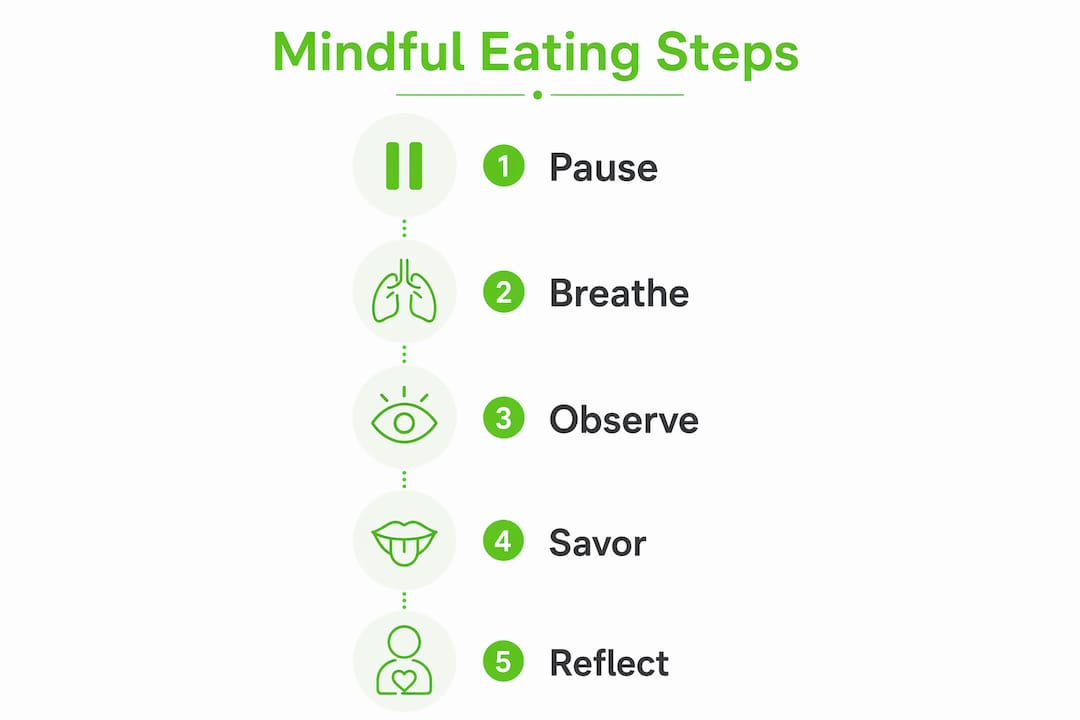
The most widespread misunderstanding is that mindful eating simply means eating slowly. It is far more than that. Eating slowly without internal awareness is just slow eating. Mindful eating requires you to assess your internal state before and during meals, distinguishing genuine hunger from emotional urges.
Several other misconceptions hold people back:
- It requires perfection. Mindful eating is not about being present at every bite of every meal. It is about noticing when you have drifted into autopilot and choosing to return to awareness. That deliberate pause is the practice itself.
- It is a diet. Mindful eating carries no food rules, banned ingredients, or calorie targets. Health Canada recognises it as an awareness-based practice focused entirely on the how and why of eating.
- Results come quickly. Like any skill, mindful eating takes weeks of consistent practice before it feels natural. Expecting instant results leads to frustration and abandonment.
- Lapses mean failure. Judging yourself harshly after eating mindlessly is counterproductive to building the skill. Self-compassion is not optional. It is a core part of the practice.
Starting small protects you from burnout. Taking three intentional breaths before a single meal each day is more effective than attempting full mindfulness at every sitting. Build the habit at one meal before expanding it.
How does mindful eating improve everyday life?
The practical benefits of mindful eating show up quickly once the habit takes hold. The table below maps the most common improvements to the specific mechanism behind each one.

| Benefit | Mechanism |
|---|---|
| Improved digestion | Slower chewing and reduced stress during meals supports the digestive process |
| Reduced emotional eating | Prefrontal regulation interrupts stress-driven food urges before they become actions |
| Greater meal satisfaction | Full sensory attention increases the brain’s reward response from smaller portions |
| Healthier food choices | Awareness of how foods make you feel naturally steers you towards nourishing options |
| Better hunger awareness | Regular use of hunger cues recalibrates your body’s appetite signals over time |
Eating without distractions directly improves both satisfaction and portion control. When you are fully present at a meal, you notice flavour, texture, and fullness more acutely. That heightened awareness means you need less food to feel genuinely satisfied.
Mindful eating also improves digestion by encouraging slower chewing and a calmer eating environment. Digestion begins in the mouth, and thorough chewing reduces the workload on the stomach and intestines. People who practise mindful eating consistently report fewer episodes of bloating and discomfort after meals.
The connection to healthier food choices is perhaps the most underappreciated benefit. When you pay attention to how a meal makes you feel in the hour after eating, you naturally gather data about which foods support your energy and which ones drain it. That feedback loop, built through mindful grocery shopping and deliberate meal choices, gradually shifts your preferences without willpower or restriction.
Key takeaways
Mindful eating is a neurologically grounded behavioural practice that shifts eating from automatic and emotional to deliberate and hunger-led, producing lasting improvements in digestion, satisfaction, and food choices.
| Point | Details |
|---|---|
| Definition | Mindful eating is awareness-based, not rule-based. It focuses on how and why you eat, not what you eat. |
| Brain mechanism | It dampens reward-driven eating by strengthening prefrontal regulation over impulsive food responses. |
| Core practice | Eat without screens, pace meals to 20 minutes, and use hunger cues rather than external portion rules. |
| Common barrier | Expecting perfection or quick results leads to abandonment. Start with one mindful meal per day. |
| Self-compassion | Lapses are part of the process. Returning to awareness without judgment is the skill itself. |
Mindful eating takes longer than one meal to learn
I have spoken with many people who tried mindful eating for a week, felt nothing had changed, and concluded it did not work for them. That is the wrong timeframe entirely. Mindful eating is closer to learning a musical instrument than following a recipe. The first few weeks feel awkward and effortful. You forget to put your fork down. You eat half a bowl of pasta before you remember to check in with your hunger. That is completely normal.
The insight that changed my own approach was this: the moment you notice you have been eating on autopilot is not a failure. It is the practice. That recognition, that brief pause where you think “I have been eating without thinking,” is exactly what mindful eating trains you to do. The more often you catch it, the shorter the gap between autopilot and awareness becomes.
The other thing worth saying plainly is that self-compassion is not a soft add-on. It is structurally necessary. Guilt and self-criticism activate the same stress pathways that drive emotional eating in the first place. If you berate yourself for eating a bag of crisps mindlessly, you are more likely to reach for another one, not less. Kindness towards yourself is not indulgence. It is the mechanism that keeps the practice alive.
Start with one meal. Not every meal. One. Sit down, put your phone away, and check in with your hunger before you eat. Do that for two weeks before you add anything else. Small, consistent steps build the neural pathways that make mindful eating feel natural rather than forced.
— Arjit
Naturessoulshop and the food that supports mindful eating
Mindful eating works best when the food on your plate is worth paying attention to. Clean, organic ingredients with genuine flavour and nutritional depth give your senses something real to engage with.

Naturessoulshop stocks a full range of organic and natural foods across fresh produce, dry grocery, dairy, vegan and gluten-free options, and home care. Every product is chosen for clean ingredients and transparent sourcing, which makes it easier to build meals you can eat with full awareness. If you are ready to pair your mindful eating practice with food that genuinely supports it, Naturessoulshop is a practical place to start. You can also explore fresh organic produce to bring more whole, unprocessed ingredients into your daily meals.
FAQ
What is the simplest definition of mindful eating?
Mindful eating is the practice of paying full attention to the experience of eating, including hunger cues, flavour, and fullness, without judgment or dietary rules.
Is mindful eating the same as eating slowly?
No. Eating slowly is one technique within mindful eating, but the practice also requires assessing your internal state to distinguish genuine hunger from emotional or habitual urges.
How long does it take to see benefits from mindful eating?
Most people notice improvements in meal satisfaction and emotional eating within two to four weeks of consistent daily practice, starting with one mindful meal per day.
Can mindful eating help with weight management?
Mindful eating reduces emotional and binge eating by strengthening prefrontal regulation over food impulses. This naturally supports healthier portion awareness without calorie counting or restriction.
Do I need to change what I eat to practise mindful eating?
No. Mindful eating focuses on how and why you eat, not on eliminating specific foods. Over time, awareness of how foods make you feel tends to guide you towards more nourishing choices naturally.


