


TL;DR:
- Most adults using parabens within legal limits face no confirmed health risks.
- Reducing the total number of leave-on products is the most effective way to lower exposure.
Parabens are a family of synthetic preservative chemicals used in cosmetics, toiletries, some medicines and certain processed foods to prevent the growth of bacteria, yeast and mould. For most UK consumers, products formulated within current regulatory limits are considered safe by scientific committees. That said, aggregate exposure from using many products simultaneously is the metric that matters, and a small group of people, particularly infants under six months old, those with known skin sensitivities, and parents applying products to the nappy area, have good reason to be more cautious.
Quick verdict for UK consumers:
- Most adults using products within authorised limits face no demonstrated health risk.
- Propyl- and butylparaben carry stricter combined-use limits because of greater endocrine activity in some studies.
- Infants under six months and children under three should avoid paraben-containing products in the nappy area.
- People with contact dermatitis or known paraben sensitivity should check labels carefully.
- Reducing the total number of leave-on products you use is the single most practical step to lower aggregate exposure.
Table of Contents
- What are parabens, exactly, and why do they work?
- Which everyday products commonly contain parabens?
- How to spot parabens on an ingredient list
- Why manufacturers still use parabens
- What does the evidence say about health effects?
- How are parabens regulated in the UK?
- How parabens enter and leave the body
- Parabens in the environment
- Aggregate exposure and the paraben-free trade-off
- Practical steps to reduce paraben exposure
- Key takeaways
- A perspective worth considering
- Sources and further reading
What are parabens, exactly, and why do they work?
Parabens are esters of p-hydroxybenzoic acid, a naturally occurring compound found in some fruits and vegetables. The ester group attached to the benzene ring is what gives each paraben its name and its slightly different properties: a methyl ester becomes methylparaben, a butyl ester becomes butylparaben, and so on. That structural variation also affects how well each type penetrates skin and how active it is in the body.
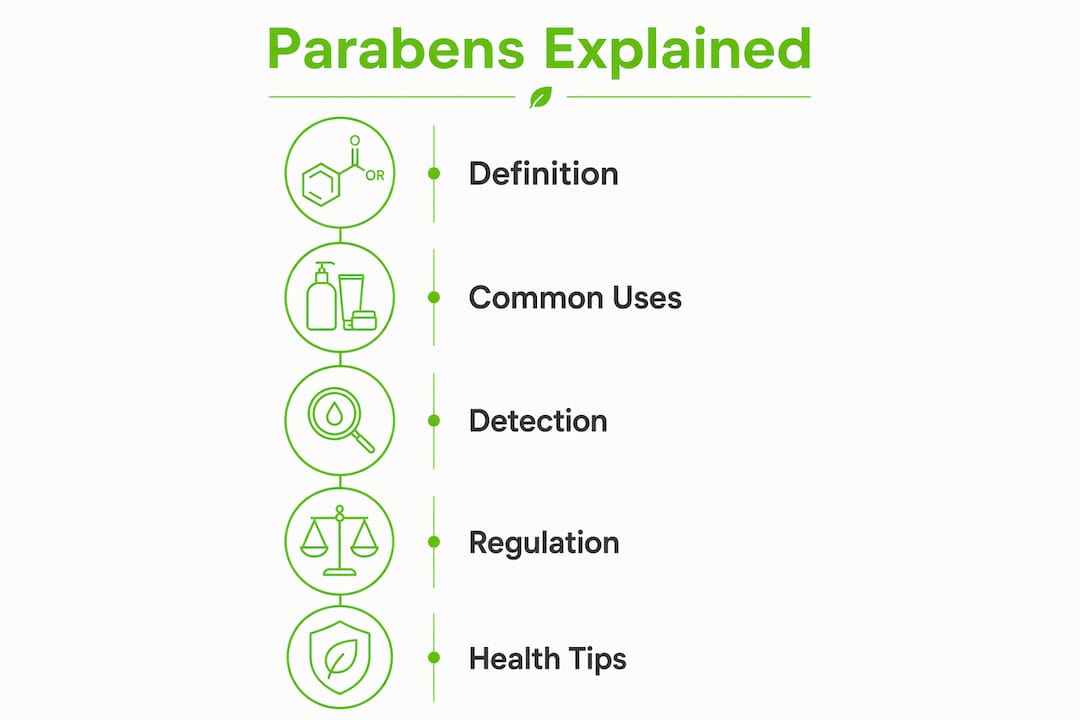
Their antimicrobial power comes from disrupting microbial cell membranes and inhibiting enzyme activity, which stops bacteria, yeast and mould from multiplying. They work across a wide pH range, which is why formulators favour them over many alternatives. Concentrations in finished products are typically well below 1%, with UK/EU regulatory limits permitting methylparaben and ethylparaben up to 0.4% each, and propyl- and butylparaben capped at 0.14% combined.
Which everyday products commonly contain parabens?
Parabens turn up in a surprisingly wide range of products, which is precisely why aggregate exposure matters more than any single item.
- Leave-on cosmetics: moisturisers, body lotions, face creams, sunscreens, foundations
- Rinse-off products: shampoos, conditioners, shower gels, face washes
- Colour cosmetics: mascaras, lipsticks, eyeshadow palettes
- Personal care: deodorants, shaving gels, hair styling products
- Pharmaceuticals: some topical creams, oral medicines and injectable preparations
- Processed foods: certain jams, sauces and baked goods (methylparaben and ethylparaben are approved food additives in some markets)
The frequency and number of products you use each day matters. Someone who applies a moisturiser, a sunscreen, a shampoo and a conditioner daily is accumulating exposure from four separate sources, even if each product individually sits within its permitted limit.
Pro Tip: When reviewing your routine, prioritise swapping leave-on products first. Rinse-off products like shampoo are washed away quickly, so your skin absorbs far less compared with a moisturiser that stays on all day.
How to spot parabens on an ingredient list
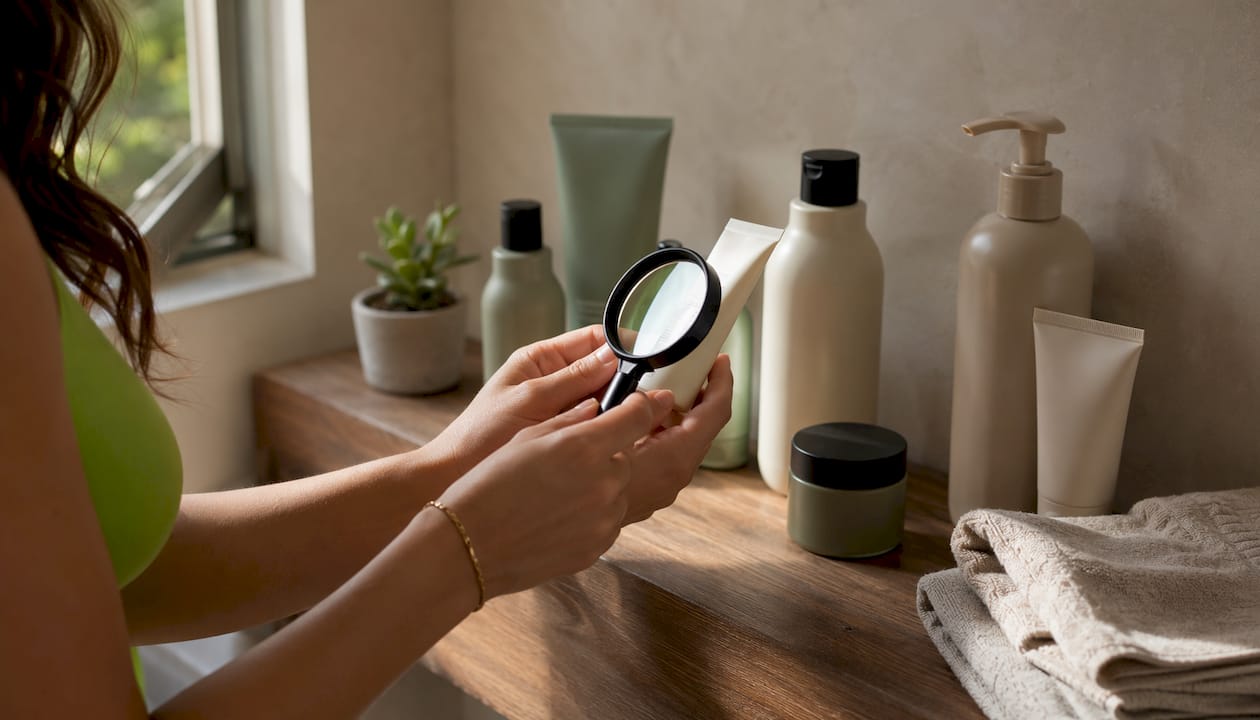
Parabens appear on INCI (International Nomenclature of Cosmetic Ingredients) lists under several names. Knowing them makes label-reading straightforward.
Common paraben names to look for:
- Methylparaben (also listed as methyl 4-hydroxybenzoate)
- Ethylparaben (ethyl 4-hydroxybenzoate)
- Propylparaben (propyl 4-hydroxybenzoate)
- Butylparaben (butyl 4-hydroxybenzoate)
- Isopropylparaben and isobutylparaben
- Benzylparaben
The “4-hydroxybenzoate” suffix is the one that catches people out. A product listing “methyl 4-hydroxybenzoate” contains methylparaben; the chemistry is identical, just named by IUPAC convention rather than the common trade name. On a long ingredient list, parabens typically appear towards the end, since they are used at low concentrations, but they can appear anywhere depending on formulation order.
Why manufacturers still use parabens
The short answer is that parabens do the job reliably and cheaply. They cover a broad spectrum of microbes, remain stable across a wide temperature and pH range, and have a safety record stretching back more than 70 years of widespread use. For a manufacturer, that combination is hard to beat.
The less obvious point is that removing parabens creates a real formulation challenge. Replacing them typically requires revalidating preservative efficacy with an alternative system, which may demand different pH conditions, shorter shelf life or even cold-chain storage. Paraben-free labelling does not inherently mean safer; substitute preservatives often have smaller evidence bases and, in some cases, a higher risk of causing skin reactions. A product with inadequate preservation can harbour dangerous microbial contamination, which is a more immediate health risk than trace paraben exposure for most people.
What does the evidence say about health effects?
This is where the nuance matters most. The main concern is weak oestrogenic activity: parabens can bind to oestrogen receptors, though with far lower potency than endogenous oestrogen. Laboratory studies and some observational research have reported associations with endocrine disruption, reproductive effects and, in a small number of studies, possible links to breast cancer. Scientific reviews are careful to note that causality for typical consumer exposures remains unresolved, and that much of the concerning data comes from animal studies or cell-culture experiments rather than controlled human trials.
What the main concerns look like in practice:
- Oestrogenic activity: Parabens bind oestrogen receptors, but at potencies estimated to be thousands of times weaker than oestradiol.
- Cancer links: Some studies have detected parabens in breast tissue, but detection does not establish causation. Regulatory bodies have not concluded that authorised cosmetic use causes cancer.
- Reproductive effects: Animal studies at high doses show effects; human data at typical exposure levels remains inconclusive.
- Skin sensitisation: Contact allergic reactions do occur, particularly with propylparaben and butylparaben, though rates are relatively low in the general population.
- Vulnerable groups: Infants under six months have immature enzyme systems, meaning parabens may clear more slowly from their bodies.
Key finding: Systematic reviews calculate that typical consumer exposures generally fall within safety margins when regulatory limits are respected, but simultaneous use of many products can raise aggregate systemic dose to levels that warrant attention.
Advocacy groups such as Breast Cancer Prevention Partners highlight biomonitoring findings that detect parabens in urine and raise questions about cumulative effects, particularly for people with high product use. Their position is more cautious than the regulatory consensus, and it is worth understanding both perspectives rather than dismissing either.
This article is general information, not medical advice. If you have specific health concerns about ingredient exposure, consult a qualified healthcare professional or dermatologist.
How are parabens regulated in the UK?
The UK’s cosmetics framework is built on retained EU law, specifically Regulation (EC) No 1223/2009, which continues to apply following Brexit. The SCCS (Scientific Committee on Consumer Safety) has evaluated parabens multiple times, and its opinions form the basis of the permitted concentration limits that apply in the UK.
Current authorised limits (applicable in the UK):
| Paraben | Maximum concentration (single use) | Combined-use limit | Special restrictions |
|---|---|---|---|
| Methylparaben | 0.4% | — | None for adults |
| Ethylparaben | 0.4% | — | None for adults |
| Propylparaben | — | 0.14% (combined with butylparaben) | Not permitted in nappy-area products for children under 3 |
| Butylparaben | — | 0.14% (combined with propylparaben) | Not permitted in nappy-area products for children under 3 |
The stricter rules for propyl- and butylparaben reflect their higher lipophilicity and greater endocrine activity in some studies. The SCCS used conservative assumptions in its risk assessment, including high dermal absorption rates and high consumer use frequencies, to derive these margins of safety.
Practical points for UK shoppers:
- Products sold legally in the UK must comply with these limits.
- The MHRA oversees cosmetics safety enforcement in Great Britain.
- Reputable brands reformulate when limits change; checking for recent reformulations on trusted retailer sites is straightforward.
- The regulatory framework continues to evolve as new evidence emerges.
How parabens enter and leave the body
Understanding the route of exposure helps put the risk in context. Parabens reach the body primarily through three pathways: dermal absorption from leave-on products, ingestion from food or hand-to-mouth contact, and inhalation from sprays or aerosols.
Routes and factors that affect uptake:
- Dermal absorption is the dominant route for cosmetic exposure. Formulation matters significantly: volatile solvents such as ethanol increase skin penetration compared with water-based bases, and longer alkyl chain parabens (propyl, butyl) penetrate more readily than shorter ones (methyl, ethyl).
- Ingestion is relevant for lip products and food sources.
- Inhalation is a minor route except for spray products used in enclosed spaces.
Once absorbed, parabens are rapidly hydrolysed by esterases in the skin and bloodstream, converted to p-hydroxybenzoic acid, and then conjugated and excreted in urine. This fast clearance is one reason regulators consider them manageable at authorised levels. Biomonitoring studies consistently detect paraben metabolites in urine across general populations, confirming widespread exposure, but the presence of metabolites in urine is not itself evidence of harm. What matters is the systemic dose relative to the safety margin.
The picture changes for newborns and infants under six months: UDP-glucuronosyltransferase enzymes, which help clear parabens, are not fully developed until around six months of age, meaning parabens may persist longer in very young children.
Parabens in the environment
When you rinse off a shampoo or wash your face, parabens enter the wastewater system. Conventional wastewater treatment removes a proportion, but not all, and parabens have been detected in surface water and sediments in studies across Europe and beyond. Methylparaben and ethylparaben degrade relatively quickly in the environment; propyl- and butylparaben are more persistent.
The ecological concern centres on aquatic organisms. Some studies report endocrine-disrupting effects in fish at environmentally relevant concentrations, though the evidence base remains incomplete and the picture varies by species and exposure level. The uncertainty is genuine rather than manufactured: researchers are still working out which concentrations cause harm in real-world conditions versus controlled laboratory settings.
For consumers, the practical implication is modest but real. Choosing products with responsible formulations, avoiding unnecessary product waste, and disposing of old cosmetics correctly (not pouring them down the drain in bulk) all reduce the load entering waterways. For a broader look at how synthetic preservatives interact with food and the environment, the Naturessoulshop guide on natural food preservatives covers the trade-offs in useful detail.
Aggregate exposure and the paraben-free trade-off
The most important insight from recent research is also the least intuitive: the question is not whether a single product contains parabens, but how much total paraben exposure you accumulate across your whole routine. Regulators derive safety margins by modelling aggregate systemic exposure dose across multiple simultaneous product uses, not by evaluating one product in isolation.
What the evidence shows:
- Typical exposures from products used within authorised limits generally fall within safety margins.
- Heavy product users, particularly those applying multiple leave-on cosmetics daily, may approach the upper end of modelled exposure ranges.
- Paraben-free alternatives are not automatically safer; substitute preservatives may have less safety data and can raise microbial risk if the formulation is not properly validated.
- Some consumers switching to “natural” preservatives encounter higher rates of skin reactions from ingredients such as essential oils or benzyl alcohol.
Pro Tip: Rather than chasing every “paraben-free” claim on a label, reduce the total number of leave-on products in your daily routine. That single change does more to lower aggregate exposure than swapping every product for a paraben-free version, many of which use less-studied alternatives.
For those curious about the broader picture of preservative-free eating, the FITTASTE overview of preservative-free convenience meals explains the formulation trade-offs in the food sector, which mirror many of the same challenges seen in cosmetics.
Practical steps to reduce paraben exposure
Reducing exposure does not require throwing out your entire bathroom cabinet. A few targeted changes make a meaningful difference.

Step 1: Audit your leave-on products first. Moisturisers, body lotions and sunscreens stay on skin for hours. These contribute far more to systemic dose than rinse-off products. If you want to reduce exposure, start here.
Step 2: Read the INCI list. Look for any name ending in “-paraben” or containing “4-hydroxybenzoate.” If propyl- or butylparaben appear and you are buying for a child under three, choose a different product.
Step 3: Simplify your routine. Fewer products mean lower aggregate exposure, regardless of which preservative system each one uses. A three-product morning routine carries less cumulative load than a ten-product one.
Step 4: Store products correctly. Heat and light degrade preservative systems faster, which can lead to microbial growth. Keep products away from direct sunlight and do not use products past their period-after-opening symbol.
Do not attempt to remove preservatives from a product yourself or dilute a product to “reduce” paraben concentration. Both approaches compromise the preservative system and create genuine microbial risk.
If you experience persistent redness, itching or contact dermatitis after using a product, see a dermatologist. Patch testing can identify whether parabens or another ingredient are responsible. For those interested in whether preservatives are bad for you more broadly, Naturessoulshop’s guide covers the wider picture.
Key takeaways
Parabens are well-studied preservatives that are considered safe at authorised concentrations for most adults, but aggregate exposure and vulnerable groups deserve specific attention.
| Point | Details |
|---|---|
| Regulatory position | UK/EU limits permit methylparaben and ethylparaben up to 0.4% each; propyl- and butylparaben are capped at 0.14% combined. |
| Infants and nappy area | Propyl- and butylparaben are not permitted in nappy-area products for children under three. |
| Aggregate exposure | Total systemic dose across all products used simultaneously is the metric regulators assess, not any single product. |
| Paraben-free trade-offs | Paraben-free alternatives may use less-studied preservatives or carry higher microbial risk if poorly formulated. |
| Most effective action | Reduce the number of leave-on products in your daily routine to lower aggregate exposure meaningfully. |
A perspective worth considering
The paraben debate has a peculiar quality: the science is genuinely uncertain in places, yet the marketing has settled on a confident answer. “Paraben-free” has become shorthand for “safer,” and that framing has stuck even though the evidence does not fully support it.
What strikes me about the regulatory picture is how conservative the risk assessments actually are. The SCCS does not assume average use; it models high-end consumers applying multiple products simultaneously, using generous absorption estimates. When even that conservative model returns acceptable margins of safety for methylparaben and ethylparaben, that is a meaningful finding. The stricter limits on propyl- and butylparaben reflect genuine uncertainty, not confirmed harm, and the nappy-area restriction for under-threes reflects the sensible precautionary logic of protecting immature metabolic systems.
The more interesting question is what happens when the whole industry pivots to alternatives. Phenoxyethanol, sodium benzoate, benzyl alcohol, essential oil blends: these are not inherently safer, they are simply newer to widespread cosmetic use at scale. The evidence base for parabens, built over decades, is actually one of their underappreciated advantages. Consumers who switch to “clean” formulations in pursuit of lower risk sometimes end up with products that are harder to preserve, more prone to contamination, or more likely to cause sensitisation reactions.
None of this means parabens are beyond scrutiny. The endocrine-activity question is real, the cumulative exposure question is real, and the gaps in human data are real. But the right response to genuine uncertainty is proportionate action: reduce aggregate exposure where you can, pay attention to vulnerable groups, and read labels. It is not to assume the worst and replace every studied preservative with an unstudied one.
At Naturessoulshop, the approach to ingredients starts from exactly this kind of evidence-led thinking. The organic skincare and clean-ingredient products stocked on the site are selected with formulation transparency in mind, and the broader Naturessoulshop range reflects a commitment to clean ingredients across food, skincare and home care.
Sources and further reading
The following primary sources and reviews underpin this article. Regulatory opinions carry more weight than single studies; a single observational study reporting an association is not the same as a safety conclusion.
- FDA: Parabens in cosmetics — accessible overview of the FDA’s current position and the state of the evidence.
- SCCS Opinion on parabens (EC) — the primary scientific committee opinion underpinning EU and UK concentration limits.
- SCCS Opinion on Butylparaben — detailed evaluation of butylparaben’s metabolism, endocrine activity and revised concentration limits.
- PubMed: Safety review of parabens in cosmetics — peer-reviewed systematic review of biomonitoring data and safety margins.
- ScienceDirect: Parabens — benefits and potential health risks — recent review covering endocrine effects, reproductive concerns and environmental data.
- WebMD: What to know about parabens — consumer-facing summary of common paraben types and label guidance.
- Breast Cancer Prevention Partners: Parabens — advocacy perspective on biomonitoring findings and cumulative exposure concerns.
- The Conversation: Why are products advertised as paraben-free? — expert commentary on formulation trade-offs and the limits of “paraben-free” claims.
How to read these sources: A regulatory opinion from the SCCS or FDA reflects a synthesis of available evidence and carries more weight than any individual study. When a single paper reports a concerning association, check whether that finding has been replicated and whether the doses used reflect real consumer exposure.


