


TL;DR:
- Reading product labels accurately involves anchoring all nutritional information to the stated serving size for correct interpretation.
- Understanding % Daily Values helps identify nutrients to limit or encourage, based on a standard 2,000-calorie diet for quick assessment.
- Inspecting ingredient lists in order reveals the product’s true composition, while allergen statements ensure safety for allergy management.
Reading product labels is the skill of interpreting serving sizes, nutrient contents, ingredients, and allergen warnings to make healthier food choices. Known formally as nutrition label literacy, this practice gives you direct control over what enters your body. The Nutrition Facts panel, ingredient list, and allergen statements are your primary tools, and understanding them separates genuinely healthy products from cleverly marketed ones. Labels differ across the UK, US, Canada, and Australia, but the core principles of how to read food labels remain consistent. This guide walks you through every component, clearly and practically.
How to read product labels: start with serving size
Serving size and servings per container anchor every single nutritional value on a label. Every calorie count, every gram of fat, every milligram of sodium you see refers to that stated serving, not the entire packet. This is the most misunderstood element of understanding food labels, and getting it wrong skews every other calculation you make.

What serving size actually tells you
Serving size is the manufacturer’s defined portion, expressed in grams, millilitres, or household measures such as “1 cup” or “3 biscuits.” Servings per container tells you how many of those portions exist in the whole product. A 500 ml bottle of juice labelled as “2 servings” means every number on the panel applies to 250 ml, not the full bottle. Drink the whole bottle and you double every value, including calories and added sugars.
Nutrition experts stress starting with serving size to accurately gauge calorie and nutrient intake, precisely because the rest of the label is meaningless without this anchor. A packet of crisps showing 150 calories per serving sounds reasonable until you notice it contains 2.5 servings. That single bag now delivers 375 calories.
Common misconceptions worth knowing:
- Serving sizes are not recommendations for how much to eat. They are standardised reference amounts set by regulators.
- Serving sizes vary between brands for the same product category, which makes direct comparisons tricky unless you use per 100 g data.
- “Low calorie” claims on the front of a pack are always relative to the stated serving size, which may be unrealistically small.
- Children’s products often use adult serving sizes, so actual intake for a child may represent a larger proportion of their daily needs.
Pro Tip: Before reading anything else on a label, locate the serving size and multiply all values by the number of servings you actually plan to consume. This single habit transforms how you interpret every label.
What do % daily values mean on a nutrition label?
The Percent Daily Value (%DV) is a quick reference showing how much of a nutrient one serving contributes to a standard 2,000-calorie daily diet. %DV categorises nutrients as low at 5% or less and high at 20% or more, giving you an instant signal without requiring any maths.
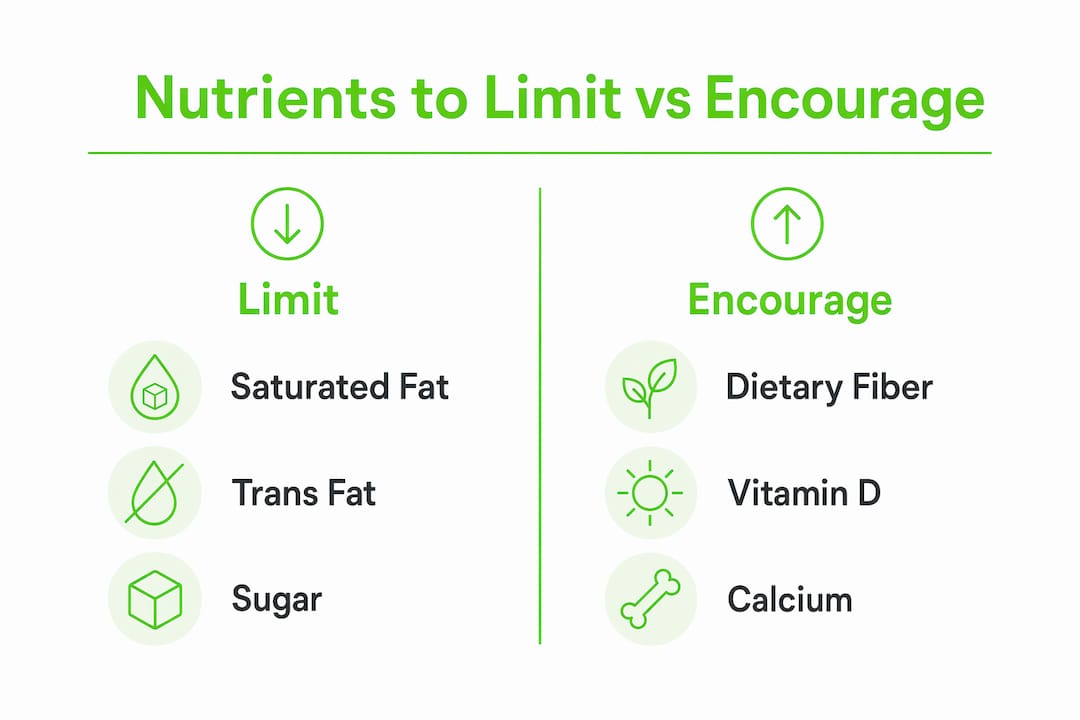
Nutrients to limit versus nutrients to encourage
Not all nutrients deserve the same attention. The table below separates them clearly:
| Nutrients to limit | Nutrients to encourage |
|---|---|
| Saturated fat | Dietary fibre |
| Trans fat | Vitamin D |
| Sodium | Calcium |
| Added sugars | Iron |
| Cholesterol | Potassium |
For nutrients to limit, a low %DV (5% or under) is the target. For nutrients to encourage, a high %DV (20% or above) is desirable. This framework makes reading nutrition labels far faster once you internalise it.
One area that trips people up is fat. Consumers often focus incorrectly on total fat rather than saturated and trans fats, which carry distinct health implications. Total fat includes unsaturated fats from sources like nuts and olive oil, which are beneficial. Saturated fat and trans fat are the figures that warrant scrutiny.
Trans fat deserves particular attention. A label showing “0 g trans fat” may still contain up to 0.5 g per serving due to rounding rules on labels. If partially hydrogenated oils appear anywhere in the ingredient list, trans fat is present. Eat multiple servings and that hidden amount accumulates meaningfully.
%DV is a useful guide, but actual individual nutrient needs vary by age, gender, activity level, and health goals. A person managing hypertension will prioritise sodium %DV far more carefully than a healthy teenager. Use %DV as a starting point, then adjust your personal thresholds accordingly. Checking hidden sugars in food is especially worthwhile, as added sugars appear under multiple names and can push %DV higher than the label initially suggests.
Pro Tip: When comparing two similar products, look at the per 100 g column rather than the per-serving column. Serving sizes differ between brands, but per 100 g data puts everything on an equal footing.
How are ingredients listed on a food label?
Ingredients are listed in descending order by weight, meaning the first ingredient is the most abundant by mass. This single rule reveals more about a product’s true composition than any front-of-pack claim. A cereal listing sugar as its second ingredient after whole grain oats contains more sugar than any other component except oats.
Identifying the first three to five ingredients gives you the product’s nutritional backbone. If those are whole foods, the product is likely what it claims to be. If refined flour, sugar, or palm oil dominate the top positions, the product’s health credentials weaken regardless of what the front label says. Reading ingredient lists this way connects directly to understanding natural ingredients and separating genuine whole-food products from processed alternatives.
Allergen labelling and cross-contamination
Allergen statements often appear separately from the ingredient list, introduced with the word “Contains,” and they supplement rather than replace the full ingredient list. Consumers must check both the allergen statement and the ingredient list to manage allergy risk properly.
Key points for allergy-aware label reading:
- The 14 major allergens regulated in the UK include milk, eggs, gluten-containing cereals, peanuts, tree nuts, fish, shellfish, sesame, soya, celery, mustard, lupin, molluscs, and sulphur dioxide.
- Allergens must be emphasised in the ingredient list, typically in bold or a contrasting typeface, making them easier to spot.
- Ingredient lists are crucial for allergy management, and “may contain” statements signal cross-contamination risk during manufacturing, not a guaranteed presence.
- Canada requires allergen information both within the ingredient list and in a separate “Contains” statement, a dual approach that reduces the chance of a missed allergen.
- “May contain” carries no legal threshold in most countries, so individuals with severe allergies should treat it as a genuine warning.
For families managing multiple food allergies, the common food allergies guide from Naturessoulshop provides a practical breakdown of how to recognise allergen statements across different product formats.
How to compare labels and avoid common mistakes
A three-step workflow used by experienced label readers covers serving size anchoring, %DV assessment against personal limits, and ingredient examination for a quick but thorough evaluation. This sequence prevents the most common errors and works on any product in any category.
Follow this process at the supermarket:
- Check serving size first. Confirm how many servings are in the pack and decide how many you will realistically consume. Adjust all values accordingly.
- Scan %DV for your priority nutrients. If you are managing sodium intake, go straight to sodium %DV. If you are increasing fibre, check that figure. You do not need to read every line every time.
- Review the ingredient list. Confirm the first three ingredients align with what the product claims to be. Check for any allergens or additives you want to avoid.
- Use per 100 g for cross-brand comparisons. Per 100 g data standardises nutritional values so you can compare a supermarket own-brand with a premium product on equal terms.
- Verify front-of-pack claims. Front labels are designed for quick comparison but can be misleading if not checked against the full nutrition panel. A “reduced fat” claim means less fat than the original version, not necessarily a low-fat product overall.
The most common mistakes in understanding product labels are trusting “0 g trans fat” without checking for partially hydrogenated oils, ignoring serving size when comparing products, and assuming “natural” or “organic” on the front means the product is nutritionally sound. Food labelling is influenced by regulation and marketing, meaning labels can highlight positive traits while downplaying negatives. Consumer education is the only reliable counter to this.
Pro Tip: Photograph labels of products you buy regularly and compare them side by side at home. You will spot differences in sodium or sugar content that are invisible when you are standing in a busy aisle.
Key takeaways
Reading product labels accurately requires anchoring all nutritional data to the stated serving size, using %DV as a quick nutrient guide, and verifying ingredient order and allergen statements before purchasing.
| Point | Details |
|---|---|
| Serving size anchors everything | Multiply all label values by the number of servings you actually consume. |
| Use %DV as a quick filter | 5% or less is low; 20% or more is high for any nutrient on the panel. |
| Ingredients reveal true composition | The first three ingredients by weight define what a product actually is. |
| Check allergens in two places | Read both the ingredient list and the separate “Contains” statement for full safety. |
| Per 100 g enables fair comparison | Use the per 100 g column to compare products across brands on equal terms. |
What I have learned from years of reading labels
I have spent a long time working with organic and natural food products at Naturessoulshop, and the single most consistent observation I have made is this: most people read labels from the wrong end. They start with the front of the pack, get reassured by words like “natural” or “high protein,” and never open the nutrition panel at all.
The serving size confusion is real and it is not accidental. Manufacturers are not obligated to make serving sizes reflect how people actually eat. A single-serve bag of trail mix listing 180 calories per serving with 1.5 servings per container is a deliberate friction point. Most people eat the bag. That is 270 calories, not 180.
What I find genuinely useful is developing a short personal checklist based on your own health priorities. If you are managing blood pressure, sodium is your first column. If you are watching weight, calories and added sugars matter most. If you have a child with a nut allergy, the allergen statement is your first stop, every single time. Generic label reading is less effective than personalised label reading.
The other thing worth saying plainly: label reading is a skill, and skills improve with repetition. The first time you decode a nutrition panel it takes two minutes. After a few weeks of practice, it takes ten seconds. International formats like the NHS traffic light system in the UK or the Health Star Rating in Australia add another layer, but the underlying logic of serving size, nutrients, and ingredients transfers across all of them. Check food labelling in India for an example of how regional regulations shape label formats while keeping the same core structure.
Do not let the complexity intimidate you. Every label is answering the same three questions: how much is a serving, what nutrients does it contain, and what is it actually made of. Once you see labels through that lens, they stop being confusing and start being genuinely useful.
— Arjit
Make label reading work for you with Naturessoulshop
Understanding food labels is only half the equation. The other half is choosing products where the label tells a clean, honest story from the very first ingredient. At Naturessoulshop, every product in the range, from organic dry groceries and dairy to vegan snacks and skin care, is selected for ingredient transparency and clean formulation. You will not find partially hydrogenated oils buried in the middle of an ingredient list or misleading serving sizes designed to obscure calorie counts. Browse the health product range to find items that align directly with what you have learned here, including options like vegan, gluten-free crackers where every label claim is backed by the ingredient list.
FAQ
What is the first thing to check on a food label?
Check the serving size before anything else. All calorie and nutrient values on the label refer to that stated portion, so knowing how many servings you will consume is the foundation of accurate label reading.
How do I know if a nutrient level is high or low?
Use the % Daily Value as your guide. A %DV of 5% or less means the nutrient is low in that product; 20% or more means it is high, based on a standard 2,000-calorie daily diet.
Can “0 g trans fat” on a label mean trans fat is present?
Yes. Labels can show “0 g trans fat” if the amount per serving is below 0.5 g due to rounding rules. If partially hydrogenated oils appear in the ingredient list, trans fat is present and will accumulate across multiple servings.
Why should I check both the ingredient list and the allergen statement?
Allergen statements and ingredient lists serve different purposes. The ingredient list names every component by weight, while the “Contains” statement highlights major allergens separately. Checking both reduces the risk of missing a hidden allergen.
What is the best way to compare two similar products?
Use the per 100 g column rather than the per-serving figures. Serving sizes differ between brands, so per 100 g data provides a standardised basis for fair nutritional comparison across products.


