


TL;DR:
- In 2025, consumers demand measurable proof and proof-based wellness practices, prioritizing data-driven outcomes.
- They adopt structured, phased routines using wearables, environmental adjustments, and transparent brands to build lasting health habits.
Wellness trends in 2025 are defined by one shift: consumers now demand proof, not promises. Seventy per cent of global consumers actively manage their health, and 55% spend over £80 a month on nutrition and self-care. That is not casual interest. It signals a population treating personal health as a managed system, not a passive aspiration. The top wellness movements of 2025 span technology-enabled self-tracking, sleep redesign, functional nutrition, conscious buying, and prevention-first frameworks. Each one rewards people who measure, adjust, and integrate rather than those who simply add another supplement to the shelf.
What are the biggest wellness trends in 2025?
Wellness has become the architecture of modern living, not a product category you browse on a Saturday afternoon. Consumers in 2025 act as CEOs of their own health, tracking, testing, and personalising in real time. The 2025 holistic health trends that matter most share three characteristics: they are measurable, they integrate across life systems, and they deliver visible impact rather than vague claims.
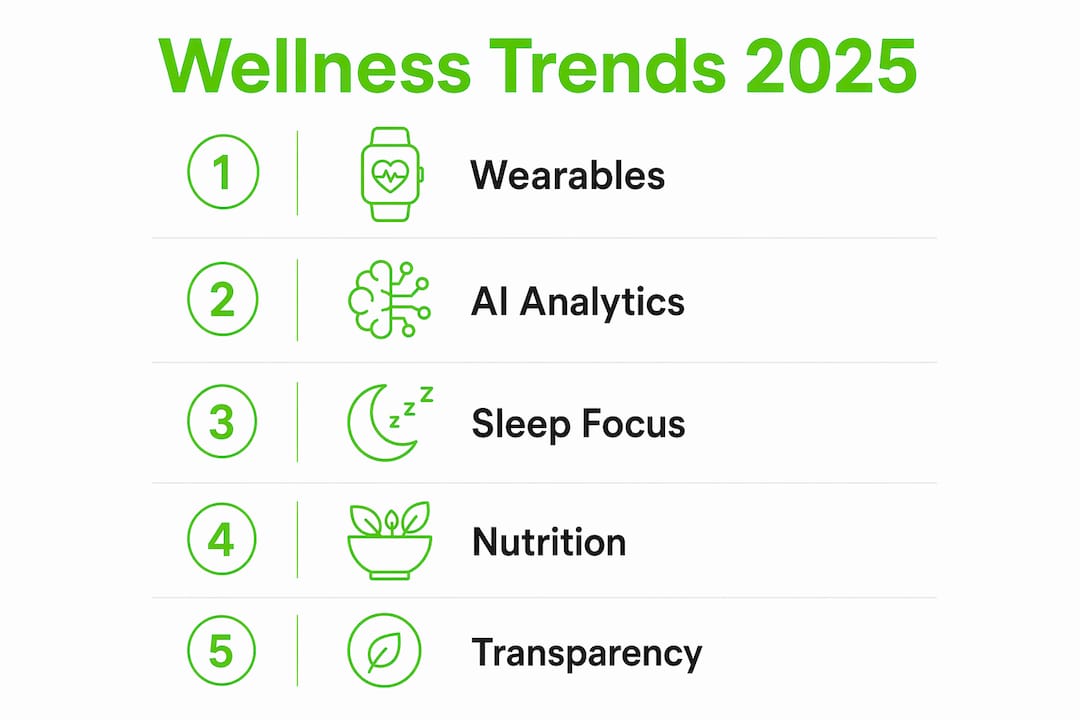
The health trends forecast for 2025 covers five distinct pillars. Technology and wearables are reshaping how people read and respond to their own bodies. Sleep is being redesigned around circadian science rather than gadget obsession. Nutrition and supplementation are converging into a single, functional daily routine. Conscious consumerism is forcing brands to prove their ethics and effectiveness. And public health frameworks are giving individuals a structured model for lasting behaviour change. Each pillar connects to the others, which is precisely what makes 2025 different from previous years.
How are wearables and AI changing personal health in 2025?
Thirty-six per cent of US adults now use health wearables, and those users are twice as likely to change their nutrition behaviour based on device feedback. That is a direct, measurable link between data and daily decisions. Devices like Oura Ring, Whoop, and Apple Watch now surface sleep scores, heart rate variability, blood oxygen, and recovery readiness before you have had your morning coffee.

The practical impact is significant. Wearable users report eating more protein and vegetables and consuming less sugar, not because of a diet plan, but because their device showed them the downstream effect on recovery and energy. This is what emerging wellness strategies look like in practice: a feedback loop between behaviour and outcome, running continuously in the background of daily life.
Key metrics that wearable users track and act on in 2025:
- Heart rate variability (HRV): a drop signals stress or poor recovery, prompting rest or lighter training
- Sleep staging: light, deep, and REM breakdowns guide bedtime routines and supplement timing
- Blood glucose trends: continuous glucose monitors (CGMs) show how specific meals affect energy and mood
- Resting heart rate: a rising trend over several days often precedes illness, allowing early intervention
- Readiness scores: composite daily scores from Oura and Whoop guide training intensity decisions
AI layers on top of this data to surface patterns a human would miss. Apps like Ultrahuman and Lumen now offer personalised dietary recommendations based on metabolic data, not generic population averages. Consumers require literacy in tracking data and deciding when to adjust or escalate care. The technology is only as useful as the person interpreting it.
Pro Tip: Start with one metric, not five. Tracking HRV for four weeks before adding sleep staging gives you a baseline that makes subsequent data far more meaningful.
Is ‘sleepmaxxing’ still relevant, or has sleep wellness moved on?
Sleep wellness is the most misunderstood pillar of the 2025 health trends forecast. The “sleepmaxxing” wave of 2023 and 2024, which involved stacking mouth tape, weighted blankets, red light panels, and sleep trackers simultaneously, has given way to something more considered. Sustainable, restorative sleep is now preferred over aggressive optimisation, and the science supports this shift.
The new approach to sleep in 2025 follows a cleaner logic:
- Circadian lighting alignment: replacing overhead white light after 7pm with warm, low-lux sources to support natural melatonin production
- Sleep by design: treating the bedroom as a single-purpose environment, removing screens, lowering temperature to 17 to 19 degrees Celsius, and using blackout solutions
- Home diagnostics: devices like the Withings Sleep Analyser provide clinical-grade sleep data without requiring a wearable on the wrist
- Sleep tourism: a growing sector where hotels and retreat centres offer structured, immersive sleep programmes combining environment design, nutrition, and coaching
Over-optimising sleep with gadgets causes fatigue in itself. The paradox is real: obsessing over a sleep score raises cortisol, which worsens sleep. The 2025 approach is to set up the environment correctly, track occasionally rather than nightly, and trust the system. For recovery optimisation to work, sleep must be the foundation, not an afterthought.
How are nutrition and supplements converging in 2025?
The boundary between food, supplements, and beauty products is dissolving. Wellness product categories are converging, with functional ingredients like protein, fibre, adaptogens, and collagen now expected across daily formats rather than confined to a capsule or powder.
| Format | Functional ingredients now common | Wellness benefit claimed |
|---|---|---|
| Everyday food and drink | Protein, fibre, omega-3, probiotics | Satiety, gut health, cardiovascular support |
| Supplements | Adaptogens, magnesium, vitamin D3 | Stress resilience, sleep, immunity |
| Skin care | Collagen, hyaluronic acid, niacinamide | Skin barrier, hydration, anti-ageing |
| Functional beverages | Ashwagandha, lion’s mane, L-theanine | Focus, calm, clean energy |
Wearable feedback is now directly influencing supplement timing and dietary composition. A CGM reading that shows a blood glucose spike after breakfast leads a user to swap refined carbohydrates for oats with added protein. That is nutrition personalisation at a granular level that was not accessible to most people five years ago.
The other force reshaping nutrition in 2025 is the rise of anti-obesity medications like semaglutide (Ozempic, Wegovy). Their widespread use is changing how people think about appetite, portion size, and the role of food in emotional regulation. Brands selling plant-based supplements and functional foods are responding by emphasising nutrient density over calorie volume, because users on these medications eat less but need more nutritional value per bite.
Key shifts in consumer nutrition behaviour in 2025:
- Protein targets are rising, with many adults aiming for 1.6 to 2.2 grams per kilogram of body weight
- Fibre is being treated as a primary health lever, not a secondary concern
- Adaptogens like ashwagandha and rhodiola are moving from niche health shops into mainstream supermarkets
- Superfoods for longevity such as moringa, spirulina, and turmeric are appearing in everyday cooking rather than specialist supplements
Why are consumers demanding more transparency from wellness brands?
Seventy per cent of consumers say eco-friendly, ethical sourcing is important in wellness products, and 71% are willing to pay more for those attributes. This is not a niche preference. It is a mainstream purchasing criterion that brands can no longer treat as optional. Eighty-two per cent of consumers want clearer labels, and 25% cite a lack of trust as the reason they have not made healthier choices.
Trust is now the gatekeeper of wellness adoption. Transparency alone no longer persuades. Consumers validate claims through third-party testing results, peer reviews, and their own tracked outcomes. A brand that says its magnesium supplement improves sleep must be prepared for a customer who checks their Oura Ring data and expects to see the result.
What this means practically for anyone choosing wellness products:
- Look for products with third-party certifications such as Soil Association Organic, NSF Certified, or Informed Sport
- Prioritise brands that publish ingredient sourcing information, not just ingredient lists
- Check food labelling for additive-free, non-GMO, and allergen transparency before buying
- Treat affordability as a signal worth investigating. A very cheap “organic” product often has a compromised supply chain
Cost remains a real barrier. The health trends forecast for 2025 shows that value wellness, meaning products that deliver genuine outcomes at accessible price points, is the fastest-growing segment within conscious consumerism. Brands that can prove effectiveness without charging a premium will capture the largest share of this market.
How can you build a structured wellness routine using public health frameworks?
The US wellness economy reached $2.1 trillion with public health and prevention growing at 8.8% annually. That growth reflects a broader shift: individuals are adopting the same phased, evidence-based frameworks that public health bodies use, and applying them to personal routines. The WHO’s obesity acceleration plan uses a four-phase model that maps directly onto how individuals can structure their own wellness journey.
- Set a specific goal: not “eat better” but “consume 30 grams of fibre daily for 60 days and track energy levels”
- Plan the implementation: identify which meals, products, and habits will deliver the goal, and remove friction from the environment
- Execute and track: use a wearable, a food diary app like Cronometer, or a simple weekly check-in to record progress
- Adjust based on data: if the outcome is not appearing after four weeks, change one variable at a time rather than overhauling everything
Phased public health frameworks improve continuous personal health outcomes precisely because they separate goal-setting from execution and execution from evaluation. Most people fail at wellness not because they lack motivation but because they conflate all three stages and lose clarity when results are slow.
Pro Tip: Apply the one-variable rule when adjusting your routine. Change your sleep time or your protein intake, but not both in the same week. This is how you identify what is actually working.
Building healthy habits naturally within this phased structure is more durable than any single-product fix. The goal is a system that runs with minimal willpower, not a heroic daily effort.
Key takeaways
The defining feature of wellness trends in 2025 is that measurement, integration, and proof have replaced aspiration as the primary drivers of personal health decisions.
| Point | Details |
|---|---|
| Data drives behaviour change | Wearable users are twice as likely to adjust nutrition based on device feedback. |
| Sleep needs design, not obsession | Circadian alignment and environment control outperform gadget stacking for restorative rest. |
| Nutrition and supplements are converging | Functional ingredients are now expected across food, drinks, and skin care, not just capsules. |
| Trust is the purchase gatekeeper | 70% of consumers require ethical sourcing and transparent proof before buying wellness products. |
| Phased frameworks outperform ad-hoc habits | Structured goal-setting, tracking, and adjustment cycles produce more consistent wellness outcomes. |
Why I think most people are approaching 2025 wellness backwards
Most people I speak with start with the product and work backwards to the problem. They buy a magnesium supplement because they read it helps sleep, without first measuring whether magnesium is actually the gap in their routine. This is the wrong order of operations, and it is expensive.
The future wellness practices that will actually stick are built on measurement first. Spend two weeks tracking your sleep, energy, and food intake before buying anything. You will almost certainly discover that the issue is not a missing supplement but a structural habit: inconsistent sleep timing, insufficient protein, or chronic under-hydration. These are free to fix.
I am also cautious about complexity fatigue. The wellness industry profits from adding layers, and there is always a new device, protocol, or ingredient to try. The people I have seen make the most consistent progress are those who build integrated routines around three or four non-negotiables and ignore the rest. Simplicity is not a compromise. It is the strategy.
The one area where I think spending is genuinely justified is product quality. Choosing organic, ethically sourced food and supplements over cheaper alternatives with synthetic additives is not a luxury. It is the foundation of a wellness system that actually works.
— Arjit
Start your 2025 wellness journey with Naturessoulshop
Naturessoulshop stocks organic, ethically sourced products across every category that the 2025 wellness trends point towards: functional foods, clean supplements, vegan and gluten-free options, and natural skin care with transparent ingredient lists. Every product on the Naturessoulshop store is selected for clean ingredients and verifiable sourcing, which means you are not guessing about what is in your routine. Whether you are building a nutrition protocol around whole foods, exploring organic skin care that matches your values, or looking for supplements that deliver measurable results, Naturessoulshop is built for exactly this moment in wellness.
FAQ
What are the top wellness trends in 2025?
The top wellness movements in 2025 centre on personalised health tracking via wearables, sustainable sleep design, functional nutrition convergence, conscious consumerism, and phased prevention frameworks. Each trend prioritises measurable outcomes over generic health claims.
How do wearables influence wellness behaviour?
Adults who use health wearables are twice as likely to change their nutrition based on device feedback, with over half reporting increased protein and vegetable intake. The data creates a direct feedback loop between daily choices and tracked health outcomes.
Is sleep optimisation still a major wellness focus?
Sleep remains central to 2025 holistic health trends, but the focus has shifted from complex gadget stacking to circadian-aligned, environment-first approaches. Sustainable rest, supported by consistent sleep timing and low-lux evening lighting, is now preferred over aggressive optimisation.
Why does transparency matter so much in wellness products now?
Consumers measure wellness by effectiveness and impact, not by ingredient lists alone. Twenty-five per cent of consumers cite lack of trust as the reason they have not made healthier choices, making third-party verification and honest sourcing non-negotiable for credible brands.
How can I build a structured wellness routine in 2025?
Follow a four-phase approach: set a specific, measurable goal; plan the habits and products needed; track progress weekly; and adjust one variable at a time based on results. This mirrors the evidence-based frameworks used in public health and produces more consistent outcomes than ad-hoc habit changes.


