


TL;DR:
- “Natural” on labels lacks a formal FDA definition and can include heavily processed ingredients.
- Natural ingredients originate from sources like plants or animals but may still undergo complex processing.
- Organic certification requires strict standards, unlike the loose implications of the “natural” label.
The word ‘natural’ is everywhere on product labels, yet most of us have never stopped to question what it actually means in law. Shockingly, food labels marked ‘natural’ carry no formal regulatory definition and offer no guarantee of health benefits. That gap between marketing promise and nutritional reality leaves health-conscious shoppers at a disadvantage. In this article, we cut through the noise and explain what ‘natural’ truly means, how natural ingredients are sourced and processed, how they compare with organic and synthetic alternatives, and how you can read clean labels with genuine confidence.
Table of Contents
- What does ‘natural’ really mean on ingredient labels?
- How natural ingredients are sourced and processed
- Comparing natural, organic, and synthetic ingredients
- Unlocking health benefits and reading clean labels wisely
- Why most consumers misunderstand ‘natural’ and clean labels
- Discover truly natural and organic options at Nature’s Soul Shop
- Frequently asked questions
Key Takeaways
| Point | Details |
|---|---|
| ‘Natural’ lacks strict regulation | The term ‘natural’ on labels is ambiguous, often unregulated and should not be blindly trusted for health claims. |
| Organic is more robust | Organic products are certified, regularly inspected, and typically deliver greater benefits than natural-labelled alternatives. |
| Source and processing matter | Natural ingredients may be plant, animal, or fermentation-based and their real benefit depends on minimal processing and transparent sourcing. |
| ‘Clean-label’ pitfalls | Clean-label or ‘natural’ products can still contain hidden additives, making ingredient list scrutiny vital for health-conscious shoppers. |
| Smart shopping is key | Use ingredient awareness and certification checks for truly healthy choices, not just marketing claims. |
What does ‘natural’ really mean on ingredient labels?
Walk down any supermarket aisle and count how many products shout ‘natural’ at you. It is a lot. Yet despite how frequently the claim appears, the FDA has not formally defined ‘natural’; current guidance only states that nothing artificial or synthetic has been added. That is the entire standard. No minimum nutritional threshold. No requirement that ingredients be grown without pesticides. No ban on highly refined components, provided they originate from a natural source.
This matters enormously for you as a shopper because the label can legally appear on products that are heavily processed, high in sugar, or nutritionally unremarkable. What you see is not always what you get.
To make things more complex, the FDA is considering a formal definition as bioengineering and novel processing techniques challenge older assumptions about what ‘natural’ even means. Cell-cultured proteins, enzyme-modified starches, and fermentation-derived compounds all sit in an awkward grey area under the current loose policy.
Here is a quick summary of the key distinctions worth knowing:
- ‘Natural’: No formal regulatory definition; means nothing artificial or synthetic added, but does not restrict heavy processing or pesticide use.
- ‘Organic’: Strictly regulated, certifiable, and backed by third-party inspections. Understanding the difference between natural and organic is the first step towards smarter shopping.
- ‘Clean label’: An industry term (not a legal one) suggesting simple, recognisable ingredients with minimal additives.
- ‘Minimally processed’: Describes foods that retain close-to-original nutritional integrity, unlike refined or ultra-processed variants.
‘Natural’ is a marketing category, not a safety or nutritional standard. Reading it on a label tells you surprisingly little about what is actually inside the packet.
For shoppers committed to clean eating, this ambiguity is frustrating. Knowing how minimally processed foods differ from ‘natural’ ones helps you use both terms together as a meaningful filter rather than trusting either one in isolation.
How natural ingredients are sourced and processed
Natural ingredients must originate from a natural source. That sounds obvious, yet the reality is layered. Natural flavours and ingredients come from plant, animal, or fermentation sources and are processed using methods such as extraction, roasting, or distillation. The source is natural; the journey from source to bottle or packet can be surprisingly complex.
Here is how natural ingredients typically move from field to finished product:
- Sourcing: Ingredients are harvested from plants (herbs, fruits, vegetables), derived from animals (dairy, eggs, gelatine), or produced through microbial fermentation (certain vitamins, acids, and flavour compounds).
- Primary processing: Raw materials are cleaned, dried, roasted, pressed, or fermented. At this stage, most ingredients still resemble their original form.
- Extraction: Flavours and active compounds are isolated using solvents, steam distillation, or cold pressing. This is where ‘natural’ starts to drift from ‘whole food’.
- Concentration or standardisation: Extracts may be concentrated or blended to ensure consistent flavour or potency in the final product.
- Formulation: Ingredients are combined with carriers, stabilisers, or emulsifiers, some of which may themselves be ‘natural’ by definition but far from simple.
The critical insight here is the gap between minimally processed and technically natural. A vanilla flavour extracted from a vanilla pod using ethanol solvent is classified as natural. So is a strawberry flavour derived from a fermented wood compound. Neither is synthetic, but neither is the same as biting into actual fruit.

Pro Tip: When scanning labels, look specifically for phrases like ‘minimally processed’ and ‘no artificial ingredients’ rather than relying on ‘natural’ alone. And always check the full ingredient list for preservatives to avoid that can slip in even under a natural claim.
Understanding this sourcing-to-shelf journey helps you ask better questions and make genuinely informed choices rather than responding to front-of-pack marketing.
Comparing natural, organic, and synthetic ingredients
Now that the sourcing picture is clearer, it is worth placing natural ingredients side by side with organic and synthetic alternatives so you can see exactly what each label promises and what it does not.
| Attribute | Natural | Organic | Synthetic |
|---|---|---|---|
| Regulatory definition | No formal definition | Strictly defined and certified | Formally classified |
| Pesticide use | Not restricted | Natural pesticides only, minimised | Varies widely |
| Processing level | Can be heavily processed | Generally less refined | Often highly engineered |
| Third-party certification | Not required | Required (95%+ organic content) | Not applicable |
| Nutritional guarantee | None | None (but cleaner inputs) | None |
| Common label claims | ‘Natural flavours’, ‘natural colours’ | ‘Certified organic’, ‘USDA organic’ | Listed by chemical name |
Organic products must contain at least 95% organic ingredients, must use only approved natural pesticides and herbicides, and are subject to regular third-party inspections. That is a substantively higher bar than anything the word ‘natural’ demands.
This difference is not academic. Studies consistently show that organic produce carries lower pesticide residues and, in some categories, higher antioxidant levels. Synthetic additives, by contrast, are rigorously safety-tested but can trigger sensitivities in some individuals, particularly artificial preservatives and colourings.
What should you watch for beyond the table above?
- ‘Natural’ does not mean organic, low in pesticides, or nutritious. It is a sourcing descriptor, not a quality guarantee.
- Organic certification requires traceable supply chains, something that conventional versus organic comparisons consistently highlight as a key differentiator.
- Synthetic does not automatically mean harmful. Some synthetics, like ascorbic acid (vitamin C), are identical at a molecular level to their natural counterparts. Context and dose always matter.
If you are ready to go deeper, our certified organic guide explains exactly what certification involves and why it is the most reliable signal of genuine ingredient quality.
Unlocking health benefits and reading clean labels wisely
So what does all of this mean for your health, and how do you actually shop more wisely? Let us get practical.
Natural ingredients in genuinely organic, minimally processed products do carry meaningful benefits. Less exposure to synthetic pesticides. Fewer artificial preservatives. Greater ingredient transparency. These are real advantages, particularly when maintained across a long-term dietary pattern rather than a single purchase.
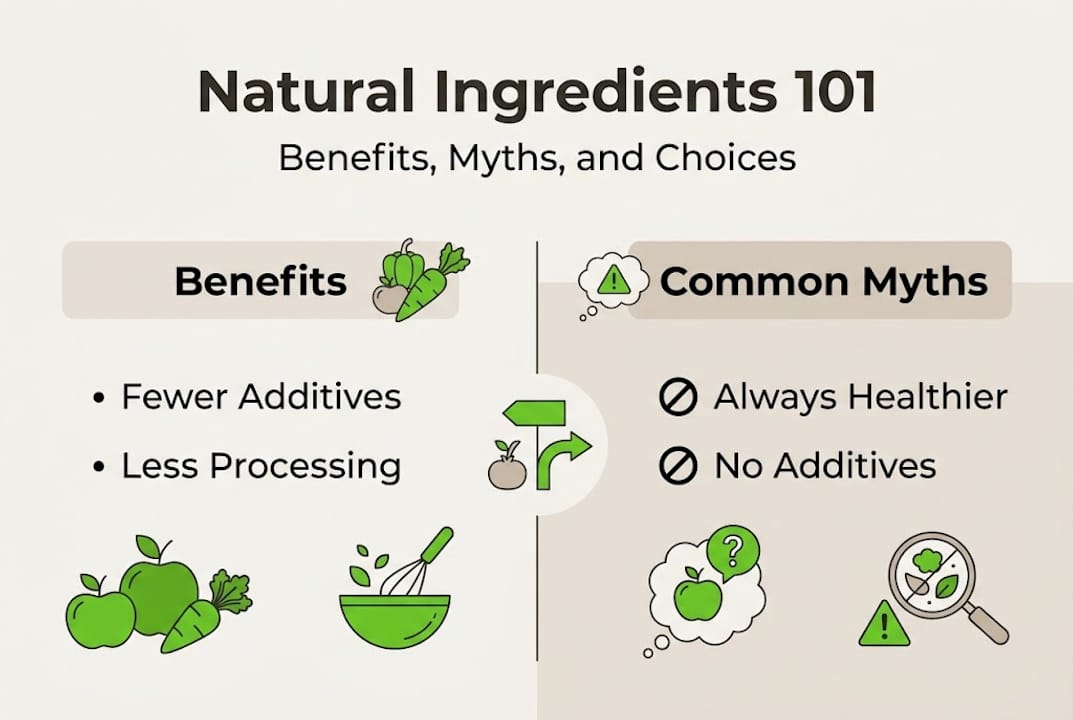
However, the natural label does not guarantee health benefits, better animal welfare, lower pesticide levels, or superior nutrition. A ‘naturally flavoured’ fizzy drink is still a fizzy drink. A ‘natural’ biscuit made with organic cane sugar is still high in sugar. The ingredient source is only part of the story.
Here is a practical health-claims reference for clean-label shopping:
| Claim | What it means | What it does not mean |
|---|---|---|
| ‘Natural flavours’ | Flavour from a natural source | Simple, whole-food ingredient |
| ‘No artificial preservatives’ | No synthetic preservatives added | No preservatives of any kind |
| ‘Organic’ | Certified to 95%+ organic standard | Automatically nutritionally superior |
| ‘Clean label’ | Minimal, recognisable ingredients | A legal or regulated standard |
| ‘Free from additives’ | No listed additives | No processing aids or carriers |
Pro Tip: Before buying, check whether the product distinguishes between natural and artificial flavours and whether it discloses its processing methods. Brands that volunteer this information tend to have nothing to hide.
Beyond labels, here are the most important filters to apply as a health-conscious shopper:
- Ingredient list length: Fewer ingredients generally indicates less processing.
- Recognisability: If you cannot pronounce or picture an ingredient, research it before assuming it is harmless.
- Certification logos: Look for certified organic, vegan, or gluten-free marks, not just marketing claims.
- Preservative check: Even products labelled natural may include natural food preservatives worth understanding before consuming regularly.
Why most consumers misunderstand ‘natural’ and clean labels
Here is an uncomfortable truth: the ‘natural’ label has always been designed to work on instinct, not intellect. It bypasses critical thinking and speaks directly to a feeling, that something called natural must be good for you. That emotional shortcut is exactly why brands invest heavily in the claim while regulators continue debating its definition.
Shoppers who read only the front of the pack are, in effect, reading the brand’s best marketing pitch. The back of the pack, the ingredient list, the allergen information, the processing disclosures, that is where the real story lives.
We have seen, across every category we work in, that the most health-literate consumers are not the ones who avoid all synthetic ingredients. They are the ones who ask why an ingredient appears, how it was processed, and what certification backs the claim. That combination of curiosity and scepticism is far more protective than any label promise.
Shifting from superficial label reading to genuine ingredient literacy takes practice. Starting with minimally processed foods as a baseline is a practical first step that builds confidence before you tackle more complex claims.
Discover truly natural and organic options at Nature’s Soul Shop
Now that you understand what ‘natural’ really means and how to read labels with clarity, the next step is finding products that genuinely live up to those standards.
At Nature’s Soul Shop, every product in our health collection is selected for ingredient transparency, minimal processing, and authentic sourcing across fruits, vegetables, dairy, meats, dry grocery, vegan, gluten-free, home care, and skin care. If you are looking for a satisfying, genuinely clean snack, our jowar-based gluten-free snacks are a brilliant place to start. Browse the full range at Nature’s Soul Shop and shop with the confidence that comes from knowing exactly what is in your basket.
Frequently asked questions
Does ‘natural’ mean a product is healthier?
No. ‘Natural’ simply indicates that no artificial or synthetic ingredients have been added, but it offers no guarantee of health benefits, lower pesticide levels, or superior nutritional value.
How can I tell if a product using ‘natural’ ingredients contains additives?
Check the full ingredient list for phrases like ‘no artificial ingredients’ and ‘minimally processed’, and look beyond front-of-pack claims to identify hidden processing aids or additives.
What is the difference between organic and natural ingredients?
Organic ingredients are formally regulated and require third-party certification, including at least 95% organic content and adherence to approved farming practices, whilst ‘natural’ carries no equivalent legal definition or scrutiny.
Are natural flavours always plant-based?
No. Natural flavours can be derived from plant, animal, or fermentation sources, meaning they may not be suitable for vegans or vegetarians without further verification on the label.


