


Probiotics genuinely matter for specific, well-evidenced uses, but they are not a universal health fix. The clearest benefits sit in gut-related conditions: reducing antibiotic-associated diarrhoea, shortening some bouts of acute infectious diarrhoea in children, and modest symptom relief in irritable bowel syndrome. For healthy adults, a fibre-rich diet and fermented foods are usually the smarter starting point. If you are immunocompromised, seriously ill, or caring for a premature infant, speak to a clinician before taking any probiotic product.
- Who benefits most: people taking antibiotics, those managing IBS, and some with ulcerative colitis (as an adjunct to medication).
- Safety note: probiotics can cause serious infections in immunocompromised individuals and preterm infants; consult a clinician if you fall into a high-risk group.
- Food-first action: add yogurt, kefir, or fermented vegetables to your diet before reaching for a supplement.
Pro Tip: If you do try a supplement, look for the full strain name on the label (genus, species, and strain designation), not just “Lactobacillus” or “Bifidobacterium.” Generic labels tell you almost nothing about clinical effect.
Table of Contents
- What are probiotics, and what strains should you know?
- How do probiotics actually work in your gut?
- What does the clinical evidence actually support?
- Are probiotics safe, and who should be cautious?
- Why strain name and CFU count matter more than the price tag
- Probiotic foods vs supplements: which should you choose?
- How to choose a probiotic in the UK: a practical checklist
- What research keeps getting wrong about probiotics
- Key takeaways
- A considered view on where probiotics actually fit
- Useful sources and further reading
What are probiotics, and what strains should you know?
Probiotics are live microorganisms that, when consumed in adequate amounts, confer a health benefit on the host. That definition comes from the International Scientific Association for Probiotics and Prebiotics (ISAPP) and is echoed by the NIH Office of Dietary Supplements. Both bacteria and yeasts qualify, and they are found in fermented foods as well as in dietary supplements.
The naming convention matters more than most labels suggest. Every probiotic has three levels of identity:
- Genus: the broad family (e.g. Lactobacillus, Bifidobacterium, Saccharomyces)
- Species: the next level down (e.g. rhamnosus, longum, boulardii)
- Strain: the specific identifier that links a product to clinical trial evidence (e.g. Lactobacillus rhamnosus GG, often abbreviated as LGG)
The strain is what actually matters. Two products both labelled “Lactobacillus rhamnosus” may behave entirely differently in the gut if they carry different strain designations. LGG, for instance, has a substantial body of trial evidence behind it for antibiotic-associated diarrhoea; a generic L. rhamnosus product without a strain ID does not inherit that evidence.
Not every product sold as a probiotic has proven benefits. The label “probiotic” carries no regulatory guarantee of efficacy in the UK, which is why strain-level scrutiny is the only reliable filter a consumer has.

How do probiotics actually work in your gut?
Probiotics act through several distinct mechanisms: they compete with pathogens for space and nutrients, produce beneficial metabolites, modulate immune signalling, and reinforce the gut’s physical barrier. According to the NIH ODS health professional fact sheet, these effects are strain- and dose-specific, which is why a probiotic that works for one condition may have no effect on another.
Here is what each mechanism means in practice:
- Colonisation resistance: beneficial microbes occupy adhesion sites in the gut lining, physically crowding out harmful bacteria before they can establish.
- Short-chain fatty acid (SCFA) production: certain bacteria ferment dietary fibre into SCFAs such as butyrate, which feeds colonocytes (the cells lining the colon) and helps regulate inflammation.
- Immune modulation: probiotics can interact with gut-associated lymphoid tissue, influencing cytokine production and the balance between pro- and anti-inflammatory signals.
- Gut barrier reinforcement: some strains stimulate the production of tight-junction proteins that seal gaps between intestinal cells, reducing permeability.
- Bile salt and enzymatic activity: certain species modify bile acids and produce enzymes that affect nutrient absorption and pathogen survival.
Some of these mechanisms are broadly shared across genera; others are species-specific or even strain-specific. Barrier reinforcement and vitamin synthesis, for example, can vary at the species level, while immune modulation effects differ considerably between strains. This is precisely why translating a trial result from one product to another with a different strain designation is scientifically unreliable.
Mechanism snapshot: SCFA production supports gut barrier integrity and reduces local inflammation. Colonisation resistance limits pathogen growth. Immune modulation shapes the inflammatory response. All three depend on which strain you are taking and at what dose.
What does the clinical evidence actually support?
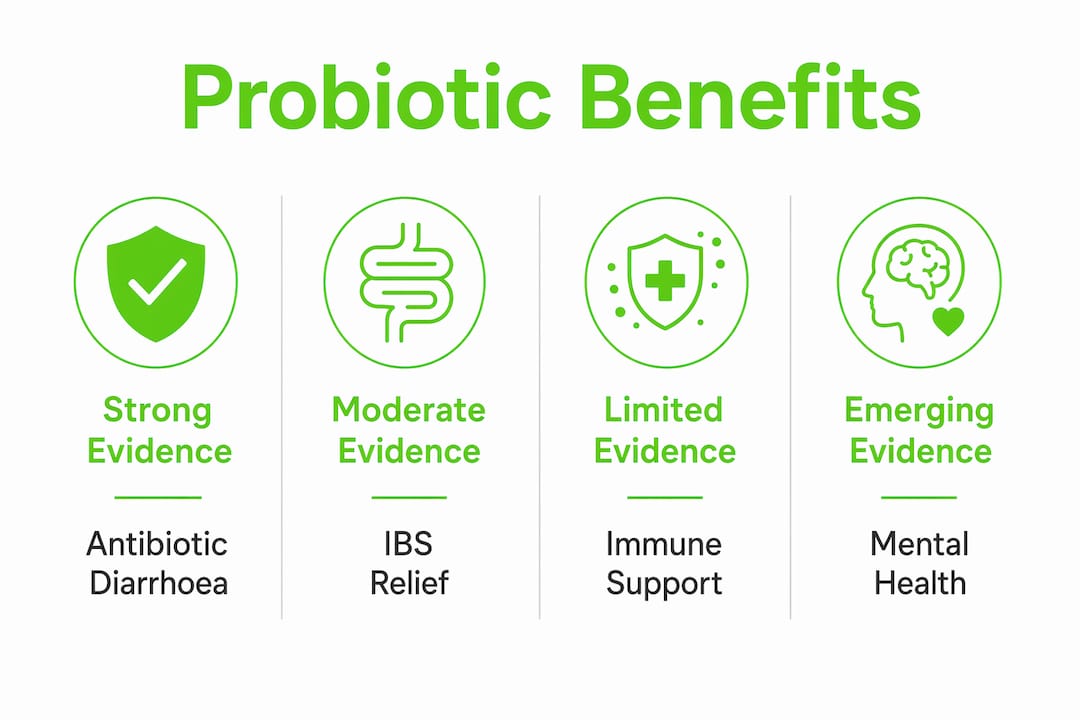
The honest one-sentence summary: probiotics have clear, reproducible benefits for a handful of gut conditions, mixed or limited evidence for several others, and no meaningful support for broad claims about immunity, weight loss, or general mental health.
| Condition | Evidence strength | Notes |
|---|---|---|
| Antibiotic-associated diarrhoea | Strong | Meta-analyses support LGG and Saccharomyces boulardii; start promptly alongside the antibiotic course |
| Paediatric acute infectious diarrhoea | Moderate | Some strains may shorten episodes by approximately one day; not all trials agree |
| NEC and sepsis in preterm infants | Moderate (with caveats) | Reduced risk in several studies but strain combinations varied; FDA has raised safety concerns |
| IBS symptom relief | Moderate | Meta-analyses report modest improvement; effect depends on strain and duration |
| Ulcerative colitis (adjunct) | Limited–moderate | May slightly reduce symptom severity alongside medication; no benefit shown for Crohn’s disease |
| Traveller’s diarrhoea | Limited | Some strain-specific evidence; inconsistent across trials |
| Vaginal health (BV, thrush) | Limited | Oral and vaginal Lactobacillus strains show promise; evidence base is small |
| Cholesterol reduction | Mixed | Small reductions in total and LDL cholesterol in some trials; other studies show no effect |
| Weight management | Weak | Some trials show minor reductions; others show no effect or slight increase |
| General immunity “boosting” | Insufficient | No agreed definition of immune “boosting”; broad claims are not supported |
| Mental health (gut-brain axis) | Preliminary | Interesting mechanistic hypotheses; clinical evidence is early-stage and inconsistent |
A few points worth emphasising. Antibiotic-associated diarrhoea is the strongest use case, and the benefit is most pronounced when a probiotic is started promptly alongside the antibiotic course. For IBS, the evidence is real but modest, and the effect varies considerably by strain and by which symptom is being targeted. The preterm infant data is genuinely promising but requires clinical oversight because the same vulnerable population that might benefit also carries the highest risk of harm.

Are probiotics safe, and who should be cautious?
For healthy adults, probiotics are generally safe. The most common effects are transient and mild: gas, bloating, and loose stools in the first few days as the gut adjusts. These typically resolve without intervention.
The picture changes for certain groups. Serious adverse events, including bacterial and fungal infections, have been documented in:
- Immunocompromised individuals (people on immunosuppressants, those with HIV/AIDS, or undergoing chemotherapy)
- Critically ill or hospitalised patients
- Preterm and very-low-birth-weight infants, where the FDA has raised specific safety concerns
- People with central venous catheters, where there is a theoretical risk of translocation
Beyond these high-risk groups, a few practical safety points apply to everyone:
- Stop taking a probiotic and seek medical advice if you develop a fever, worsening diarrhoea, or any sign of systemic infection.
- Check expiry dates. A product past its use-by date may contain far fewer viable organisms than the label states.
- Store products as directed. Some require refrigeration; others are shelf-stable. Ignoring storage instructions can render a product ineffective before you open it.
- Probiotic supplements are not medicines in the UK. They are regulated as foods or food supplements, which means they are not subject to the same pre-market safety and efficacy requirements as licensed medicines.
Pro Tip: If you are on immunosuppressant medication or have recently had surgery, do not start a probiotic supplement without checking with your GP or specialist first. The risk is low in absolute terms, but it is real and avoidable.
Why strain name and CFU count matter more than the price tag
The single most important thing to understand about probiotic supplements is this: the strain determines the effect, and the dose determines whether that effect is achievable. A higher CFU count does not automatically mean a better product.
Reading a probiotic label
When you pick up a supplement, look for:
- Full strain designation: genus + species + strain code (e.g. Lactobacillus rhamnosus GG). A product listing only genus and species gives you no way to verify clinical evidence.
- CFU guarantee: the label should state CFUs “at end of shelf-life,” not “at time of manufacture.” Viable organisms decline over time, so a product guaranteeing 10 billion CFUs at manufacture may deliver far fewer by the time you take it.
- Storage instructions: clearly stated and realistic for your household.
- Expiry date: check it before purchase, not after.
Typical CFU ranges and trial durations
NIH ODS consumer guidance notes that common label amounts include 1 × 10⁹ (1 billion) and 1 × 10¹⁰ (10 billion) CFUs per serving, but higher counts alone do not predict greater benefit. What matters is whether that dose was used in the trials supporting the named strain.
| Condition | Typical CFU range used in trials | Typical trial duration |
|---|---|---|
| Antibiotic-associated diarrhoea | 1 × 10⁹ – 1 × 10¹⁰ | Duration of antibiotic course + 1–2 weeks |
| IBS symptom management | 1 × 10⁸ – 1 × 10¹⁰ | 2–8 weeks |
| Paediatric acute diarrhoea | 1 × 10⁸ – 1 × 10¹⁰ | 5–7 days |
| Vaginal health | Varies by route | 4–8 weeks |
Clinicians typically trial a strain-matched probiotic for 2–8 weeks to assess benefit. If there is no improvement within that window, continuing the same product is unlikely to help.
Probiotic foods vs supplements: which should you choose?
Food first. For most healthy people, fermented foods are the better starting point because they deliver live microorganisms alongside a matrix of nutrients, and they support a broader dietary pattern that feeds the whole microbiome.
Common probiotic foods include:
- Yogurt (live cultures; check the label for “live and active cultures”)
- Kefir (higher microbial diversity than most yogurts)
- Fermented vegetables such as sauerkraut and kimchi (unpasteurised versions only; heat kills the cultures)
- Miso and tempeh (fermented soy products)
- Some aged cheeses (contain live cultures, though counts vary)
The limitation of food sources is strain variability. Unlike a labelled supplement, a pot of yogurt does not tell you which strains it contains or at what count. That is fine for general dietary support, but it means food alone is unlikely to deliver the strain-specific, dose-specific effects seen in clinical trials for conditions like antibiotic-associated diarrhoea.
Prebiotics are the other half of the equation. These are non-digestible fibres, found in foods like garlic, onions, chicory, leeks, and bananas, that feed your resident beneficial bacteria. Harvard’s Nutrition Source makes the point clearly: a fibre-rich diet is often more sustainable for microbiome health than relying on supplements. Synbiotics, which combine probiotics and prebiotics in one product, aim to address both sides, though the evidence for synbiotic supplements specifically is still limited.
One practical pitfall: many processed foods are now marketed with “prebiotic” or “added fibre” claims, often involving inulin or chicory root extract added in small amounts. These are not equivalent to a genuinely fibre-rich diet. For a practical breakdown of prebiotic vs probiotic foods and how they interact, Naturessoulshop’s guide covers the distinction clearly.
If you are lactose intolerant or following a plant-based diet, fermented options still exist. Naturessoulshop’s guide to non-dairy probiotic foods covers practical alternatives including water kefir, coconut yogurt, and fermented vegetables.
How to choose a probiotic in the UK: a practical checklist
Start with the short answer: a good probiotic has a documented strain, a CFU guarantee to end of shelf-life, clear storage instructions, and realistic claims tied to a specific condition. Everything else is marketing.
- Confirm the full strain designation. If the label says only “Lactobacillus acidophilus” with no strain code, put it back. You cannot verify clinical evidence without the strain identifier.
- Check the CFU guarantee. Look for “guaranteed at end of shelf-life,” not “at manufacture.” Cleveland Clinic guidance highlights this as one of the most reliable quality signals on a label.
- Read the storage instructions before you buy. A refrigerated product that has been sitting on a warm shelf is already compromised.
- Look for third-party testing or certification. In the UK, independent quality seals (such as those from Informed Sport or NSF International) indicate that the product has been tested for label accuracy and contaminants.
- Match the strain to your specific condition. A strain with evidence for antibiotic-associated diarrhoea is not automatically useful for IBS. Check whether the named strain has published trials for your intended use.
- Be sceptical of broad claims. Phrases like “supports immunity,” “boosts gut health,” or “total wellness” are not condition-specific and are not regulated claims in the UK food supplement market.
- Buy from reputable UK retailers. Pharmacy chains, registered health food retailers, and established online stores with clear supply chains are safer bets than unverified marketplace sellers.
- Ask a pharmacist. UK pharmacists can advise on strain selection, interactions with medications, and whether a supplement is appropriate for your situation.
Red flags to avoid: products with no strain designation, no expiry date, no storage guidance, or claims that sound like medicine (“treats,” “cures,” “clinically proven” without a cited trial for the named strain).
For readers interested in making probiotic foods at home, Naturessoulshop’s fermented vegetables guide is a practical starting point.
What research keeps getting wrong about probiotics
The single most important insight from the current evidence base is this: a universally “healthy” microbiome has not been defined. Microbiomes vary enormously between individuals, which means a probiotic that shifts one person’s gut composition may have no measurable effect on another’s. Harvard’s Nutrition Source makes this point explicitly, and it has a direct practical implication: targeted use for a specific condition is more defensible than routine supplementation for general wellness.
Several widespread misconceptions are worth addressing directly:
- “Probiotics colonise your gut permanently.” They do not. Most probiotic strains are transient; they pass through the digestive tract and their effects cease when you stop taking them. Sustained benefit usually requires continued intake or, better, dietary changes that support your resident microbiome.
- “More CFUs means more benefit.” The NIH ODS is clear that higher CFU counts alone do not predict greater health benefit. Dose matters only in relation to what was used in the trial for that specific strain.
- “All probiotics are the same.” This is the most consequential misconception. Strain specificity is not a technicality; it is the entire basis of the evidence.
- “The research is settled.” Much of it is not. Many studies are small, heterogeneous, and funded by supplement manufacturers, which NCCIH notes contributes to a literature where cautious, condition-specific clinical approaches are more appropriate than blanket endorsement.
“Because many studies are small, heterogeneous and industry-sponsored, clinicians frequently adopt a cautious, condition-specific approach rather than endorsing routine supplementation for healthy adults. The supplement industry’s funding of research has contributed to a proliferation of low-quality or conflicted studies making broad claims.” — NCCIH / Harvard Nutrition Source (independent expert consensus)
In the UK, probiotic supplements are regulated as food supplements under the Food Supplements (England) Regulations 2003, not as medicines. Manufacturers are not required to prove efficacy before sale. Third-party testing is voluntary. This regulatory gap is precisely why label literacy and strain-specific evidence matter so much for UK consumers.
A practitioner-level insight worth noting: matching a strain to an indication is only half the equation. The prebiotic substrate matters too. A probiotic strain introduced into a gut with very low dietary fibre has limited fuel for fermentation and may produce fewer SCFAs than the same strain in a fibre-rich environment. Increasing dietary fibre alongside any probiotic use is not optional advice; it is mechanistically relevant. Naturessoulshop’s prebiotic foods list is a practical place to start.
For a broader evidence-based overview of the role of probiotics in digestion, Mybestpharmacy.net’s guide covers the digestion angle in useful detail.
Key takeaways
Probiotics have clear, strain-specific benefits for gut conditions like antibiotic-associated diarrhoea and IBS, but they are not a general wellness supplement, and food-first remains the most evidence-supported approach for healthy adults.
| Point | Details |
|---|---|
| Strain specificity is non-negotiable | Always check for genus, species, and strain code on the label; generic names carry no trial evidence. |
| Strongest evidence is gut-focused | Antibiotic-associated diarrhoea and IBS have the most consistent clinical support; broad immunity claims do not. |
| High-risk groups need clinical advice | Immunocompromised individuals, critically ill patients, and preterm infants should consult a clinician before use. |
| Food and fibre come first | A fibre-rich diet feeding resident microbes is more sustainable than supplement reliance for most healthy people. |
| UK regulation is limited | Probiotic supplements are food supplements in the UK; third-party testing is the only independent quality check available. |
A considered view on where probiotics actually fit
The gap between what probiotics are marketed as and what the evidence supports is wider than most people realise. The gut-health category has become one of the most commercially exploited areas of the supplement market, and the noise makes it genuinely hard to find the signal.
What the evidence actually supports is narrower and more useful than the marketing suggests: a specific strain, at an adequate dose, for a defined condition, for a defined period. That is not a disappointing conclusion. It is a precise one. Antibiotic-associated diarrhoea is common, uncomfortable, and often preventable with the right strain started promptly. IBS affects a significant proportion of the UK population and has limited pharmaceutical options. These are real problems with real, if modest, probiotic solutions.
The food-first message is not a consolation prize. Fermented foods and dietary fibre genuinely support a more diverse and resilient microbiome over time, in ways that no supplement has yet matched in long-term trials. The two approaches are not in competition; they are complementary, with supplements filling a targeted role when food alone is insufficient.
At Naturessoulshop, the ethos is clean ingredients and evidence-informed choices. If you are looking for probiotic-friendly foods, fermented dairy, or supplement options, the health category is a good place to start, and the Naturessoulshop store carries a range of products that support a food-first approach to gut health.
Useful sources and further reading
The following sources were used in preparing this article. All are freely accessible and represent independent, non-commercial guidance.
- NIH Office of Dietary Supplements — Probiotics Consumer Fact Sheet: Plain-language overview of what probiotics are, CFU labelling, and condition-specific evidence summaries. A reliable first reference for UK readers.
- NIH ODS — Probiotics Health Professional Fact Sheet: More detailed coverage of mechanisms, strain specificity, and clinical evidence; useful for readers who want the full scientific context.
- NCCIH — Probiotics: Usefulness and Safety: Covers safety evidence, high-risk populations, and the limitations of current research, including industry funding concerns.
- Harvard T.H. Chan School of Public Health — The Nutrition Source: Probiotics: Independent academic commentary on prebiotics, fibre, and the limits of supplement evidence; particularly useful on the food-first argument.
- NHS — Probiotics: UK-specific guidance on when probiotics may help and when to seek clinical advice. The most relevant starting point for UK readers.
- Cleveland Clinic — Probiotics: Practical guidance on label reading, CFU guarantees, and quality signals; useful for supplement selection.
- PMC/NIH — A Gastroenterologist’s Guide to Probiotics: Peer-reviewed review covering IBS, cholesterol, and evidence quality; a useful clinical perspective.
- PMC/NIH — Health Benefits of Probiotics: A Review: Broader peer-reviewed review of probiotic health effects across multiple conditions.
A note on UK regulation: In the UK, probiotic supplements are governed by the Food Supplements (England) Regulations 2003 and overseen by the Food Standards Agency (FSA). They are not licensed medicines and are not required to demonstrate efficacy before sale. For clinical guidance on whether a probiotic is appropriate for your specific situation, speak to your GP or a registered dietitian.
This article provides general health information only and is not a substitute for professional medical advice. Always consult a qualified clinician for guidance on your individual circumstances.


