


TL;DR:
- Workplace wellness strategies focus on simple microbreaks, stress management, and proper nutrition to enhance health and productivity. Leadership support and embedding health habits into daily workflows are essential for sustainable success. Building a wellness culture requires small, consistent actions and peer support to normalize healthy behaviors.
Workplace wellness tips are actionable strategies that improve physical health, reduce stress, and sustain productivity during work hours. Organisations that embed these practices consistently see measurable gains: whole-person health approaches integrating physical, mental, and financial well-being reduce medical claims, pharmacy expenses, and behavioural health costs. The Stanford Centre on Stress and Health confirms that focused breathing and meditation increase lifespan by an average of 18 months compared with control groups. These are not peripheral perks. They are evidence-backed employee health strategies that affect the bottom line and the people behind it.
What are the best workplace wellness tips for daily use?
The most effective workplace wellness tips share one quality: they fit inside the workday without requiring extra time or equipment. A 4-minute daily desk routine covering a 60-second posture reset, a 2-minute seated hip opener, and a 1-minute neck mobility sequence reduces spinal pressure and fatigue without leaving your chair. That matters because most office workers sit for six or more hours a day, and prolonged sitting compresses the lumbar spine and tightens the hip flexors. Small, repeatable movements counteract that damage before it compounds.
Quick physical exercises and microbreaks
Physical microbreaks are the fastest entry point into better office wellness. The routine below takes four minutes and requires no equipment.
- Posture reset (60 seconds): Sit tall, draw your shoulder blades together, and hold for five seconds. Repeat six times. This reactivates the postural muscles that slump after long periods of screen work.
- Seated hip opener (2 minutes): Cross your right ankle over your left knee, sit upright, and lean forward gently. Hold for 30 seconds per side, repeating twice. This releases the hip flexors that tighten during prolonged sitting.
- Neck mobility (1 minute): Slowly tilt your ear toward your shoulder, hold for ten seconds, then switch sides. Follow with three slow chin-to-chest drops. This reduces tension headaches linked to forward-head posture.
Microbreaks work best when they are scheduled rather than spontaneous. Calendaring micro-steps that fit naturally into the workday increases participation and improves wellbeing. Set a recurring reminder every 90 minutes and treat it as a non-negotiable meeting with your body.
Pro Tip: Pair your microbreak with a glass of water. Hydration and movement together reset both your circulation and your concentration in under five minutes.

How can stress management techniques improve mental wellness at work?
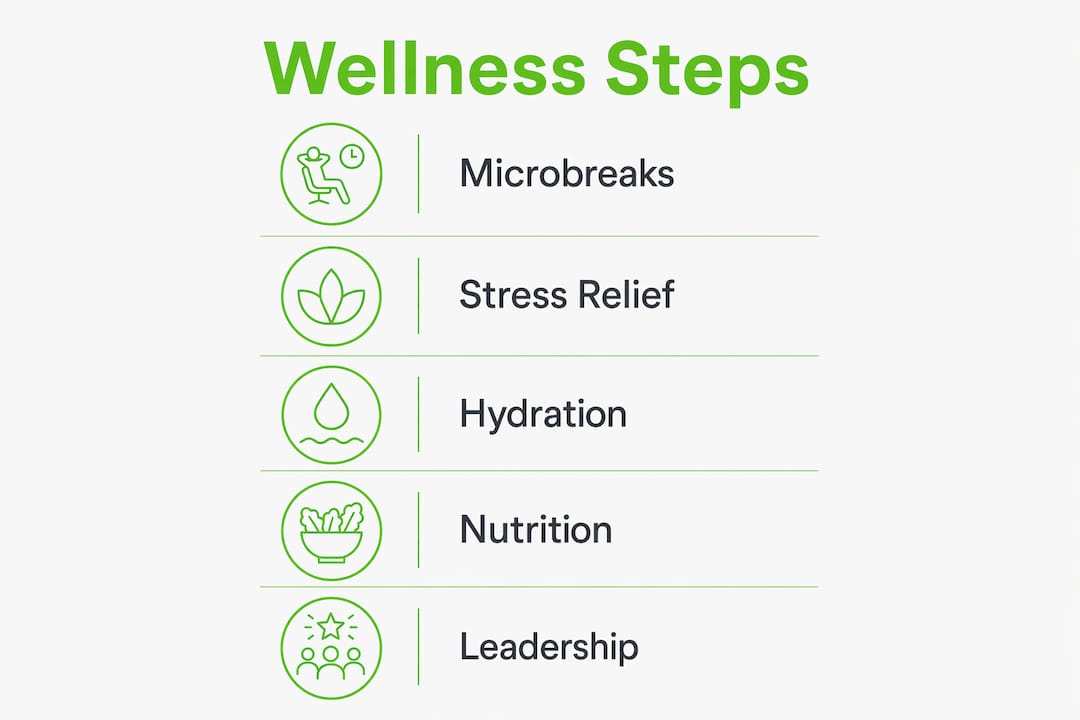
Stress management techniques are the most under-used tool in any employee health strategy. Most people suppress stress to appear professional. That approach backfires. Recognising stress as a data point helps employees identify the root cause of a workplace problem rather than masking its symptoms. The stress response is your nervous system flagging that something needs attention. Ignoring it does not resolve the underlying issue.
Dr David Spiegel at Stanford’s Centre on Stress and Health explains why physical techniques work so well:
“Physical stress reduction techniques give the brain a sense of agency, directly counteracting the feelings of helplessness that make work stress so damaging. When you control your breath, you signal to your nervous system that you are not powerless.”
That mechanism is why focused breathing outperforms distraction as a coping tool. Breathing exercises activate the parasympathetic nervous system within 60–90 seconds. That is faster than any app notification or motivational podcast. Meditation builds on this by training the prefrontal cortex to regulate emotional responses over time, which improves decision-making and reduces reactive behaviour in high-pressure meetings.
Social support amplifies these benefits. Peer group participation buffers the negative effects of stress and contributes to longer survival even in individuals facing serious illness. In a workplace context, this means that a culture of psychological safety, where colleagues can speak honestly about pressure, produces measurable health outcomes. Stress management is not a solo practice.
Pro Tip: Schedule a 5-minute breathing session at 2PM, the hour when cortisol naturally dips and concentration falters. Three slow inhales through the nose, each held for four seconds, followed by a long exhale, will reset your focus without caffeine.
What role do nutrition and hydration play in workplace wellness?
Nutrition is the foundation that every other healthy work habit rests on. Combining protein and fibre at meals stabilises blood sugar, sustains energy, and supports the focus needed for other wellness behaviours. Without that foundation, even the best stress management techniques lose their effectiveness because a blood sugar crash overrides any mental discipline you have built.
The practical challenge is that most office environments make poor nutrition the path of least resistance. Vending machines, biscuit tins, and catered meetings filled with refined carbohydrates are the default. Changing that default requires deliberate choices.
Nutrition habits that sustain energy through the day
| Habit | Why it works | Easy implementation |
|---|---|---|
| Protein at breakfast | Slows glucose absorption, reduces mid-morning energy dip | Eggs, Greek yoghurt, or nut butter on wholegrain toast |
| Visible healthy snacks | Proximity drives choice; healthy options get eaten when they are within reach | Keep nuts, seeds, or fruit on the desk rather than in a bag |
| Hydration before hunger | Thirst is often mistaken for hunger, leading to unnecessary snacking | Drink 250ml of water before reaching for a snack |
| Fibre-rich lunch | Slows digestion and prevents the post-lunch slump | Legumes, vegetables, and wholegrains as the base of any meal |
For employees who want practical meal ideas, gluten-free work lunches offer balanced options that travel well and avoid the refined carbohydrates that cause afternoon fatigue. Desk snacks matter equally. Keeping nutritious snack options visible and accessible removes the friction that leads to poor choices under pressure.
Hydration deserves its own emphasis. Even mild dehydration, defined as a fluid loss of 1–2% of body weight, impairs short-term memory and concentration. A 500ml bottle on the desk, refilled twice before lunch, is a simple standard that most employees can meet without disrupting their workflow.
How can leaders create a workplace culture that sustains wellness?
Workplace leaders are the single biggest variable in whether wellness programmes succeed or fail. Isolated wellness programmes fail when they are not supported by leadership commitment, job autonomy, and coworker encouragement. A lunchtime yoga class offered by an organisation whose managers routinely schedule 7AM calls sends a contradictory message. Employees read behaviour, not policy documents.
The McKinsey Health Institute recommends a two-layer approach: combine quick-win initiatives with structural change. Here is how that looks in practice:
- Embed wellness into workflow. Digital nudges such as hourly break reminders and calendar blocks for lunch increase participation without requiring willpower. Wellness that requires extra effort from already-stretched employees rarely sticks.
- Give employees autonomy over their schedules. Flexible start times and the ability to take a 15-minute walk at midday are low-cost interventions with high returns. Job autonomy is a systemic enabler of wellness, not a perk.
- Train managers to model healthy behaviour. A manager who takes lunch away from their desk and leaves on time signals that recovery is acceptable. That signal travels faster than any company-wide email.
- Introduce health PTO. Dedicated time off for preventive appointments, mental health days, and recovery removes the guilt that stops employees from using standard leave for health purposes.
- Combine physical and social activities. Walking meetings, team stretching sessions, and group challenges combine movement with connection, addressing both physical and mental health in one intervention.
The UnitedHealthcare whole-person model reinforces this. Preventive screenings and early stress management that target chronic conditions produce cost savings for organisations. That means the business case for creating a healthy workplace is not just ethical. It is financial.
Key takeaways
Effective workplace wellness combines physical microbreaks, stress management techniques, sound nutrition, and leadership-driven culture to produce lasting improvements in health and productivity.
| Point | Details |
|---|---|
| Microbreaks reduce physical strain | A 4-minute desk routine covering posture, hips, and neck cuts spinal pressure and fatigue daily. |
| Stress is data, not weakness | Recognising stress as a signal helps identify root causes rather than suppressing symptoms. |
| Nutrition underpins all other habits | Protein and fibre at meals stabilise energy and support focus throughout the workday. |
| Leaders drive culture | Wellness programmes fail without leadership modelling, job autonomy, and coworker support. |
| Embed habits into workflow | Digital nudges and scheduled breaks increase participation far more than stand-alone programmes. |
What I have learned from watching wellness programmes succeed and fail
I have spent years watching organisations launch wellness initiatives with genuine enthusiasm, only to see participation collapse within three months. The pattern is almost always the same. The programme sits beside the work rather than inside it. Employees are asked to add wellness to an already full schedule, and when pressure rises, wellness is the first thing dropped.
The organisations that get this right treat wellness as part of how work gets done, not as a reward for finishing it. That shift is smaller than it sounds but harder than it looks. It requires leaders to protect lunch breaks with the same firmness they protect client meetings. It requires HR teams to measure participation in wellness behaviours with the same rigour they apply to performance metrics.
The other thing I have noticed is that peer support does more than any app or programme. When a colleague says “I’m taking a walk, want to join?” the social pull is stronger than any reminder notification. Building that culture starts with one or two people modelling the behaviour publicly. Leadership is the obvious place to start, but it does not have to be. Anyone can be the person who normalises taking a proper break.
Start with one habit. Make it small enough that you cannot fail. A single 4-minute desk routine, done every day for three weeks, builds the identity of someone who takes their health seriously at work. That identity is what sustains every other change that follows.
— Arjit
Naturessoulshop: fuel your wellness from the inside out
Good workplace wellness starts with what you put into your body. Naturessoulshop stocks a wide range of organic food and wellness products built around clean, natural ingredients, from fresh produce and dry grocery staples to vegan and gluten-free snacks that travel well to the office.
Whether you are building a better desk snack routine or looking for supplements to support your daily energy, Naturessoulshop’s health product range covers everything from skin care to nutrition, all sourced with clean ingredients and no unnecessary additives. Browse the full range and find the products that fit your workday.
FAQ
What are the most effective workplace wellness tips for employees?
The most effective tips combine physical microbreaks, focused breathing, and consistent nutrition habits. A 4-minute desk routine, a midday breathing session, and protein-rich meals address the three biggest drivers of workplace fatigue.
How do stress management techniques help mental health in the workplace?
Focused breathing and meditation reverse the physiological stress response and give the brain a sense of agency. Stanford research shows these techniques increase lifespan by an average of 18 months compared with those who do not practise them.
What nutrition habits best support energy and focus at work?
Combining protein and fibre at every meal stabilises blood sugar and prevents energy dips. Keeping healthy snacks visible on the desk and drinking water before reaching for food are the two simplest changes with the fastest results.
Why do wellness programmes for employees often fail?
Programmes fail when they sit outside the normal workflow and require extra effort from already-stretched employees. McKinsey research confirms that wellness succeeds only when supported by leadership commitment, job autonomy, and coworker encouragement.
How can leaders promote work-life balance without large budgets?
Leaders can model healthy behaviour by taking lunch away from their desks, protecting team members’ non-working hours, and introducing flexible start times. These cost nothing and signal that recovery is a professional value, not a weakness.


