


TL;DR:
- Phytonutrients are bioactive plant compounds that influence human health without being essential nutrients. Eating a diverse, colorful array of whole plant foods ensures broad phytonutrient intake, which supports oxidative balance, inflammation reduction, and cardiovascular health. Relying on whole foods rather than supplements is crucial, as phytochemicals work synergistically within the food matrix, and their levels vary based on plant varieties and preparation.
Phytonutrients are plant-derived bioactive compounds that influence human physiology without being classified as essential nutrients like vitamins or minerals. Scientists also call them phytochemicals, and the two terms are used interchangeably across research literature. These compounds give plants their colour, flavour, and natural defences against pests and disease. When you eat those plants, the compounds enter your body and interact with biological systems in ways that epidemiological studies consistently link to lower rates of chronic disease. Understanding what phytonutrients are, where to find them, and how they work gives you a practical framework for making food choices that go well beyond basic nutrition.
What are phytonutrients? Types and key characteristics
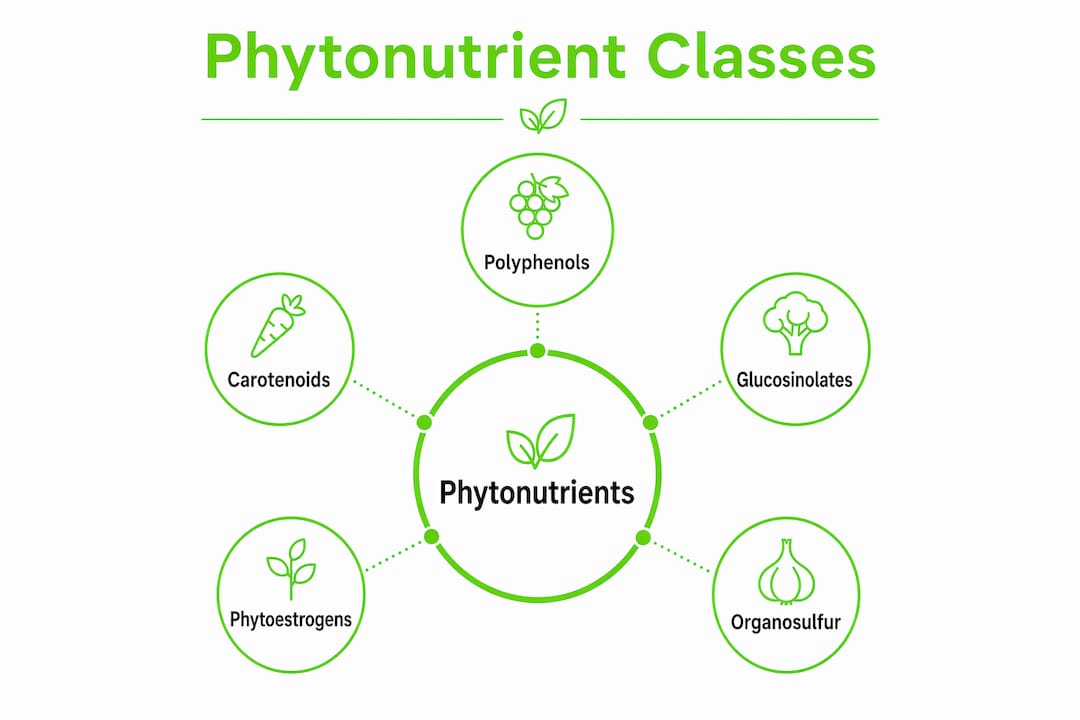
Between 50,000 and 130,000 distinct phytochemicals have been identified from plants. That number alone signals how much biological diversity exists in the food on your plate. A 2025 comprehensive review groups dietary phytonutrients into five principal families, each with distinct chemical structures and biological activities.

Polyphenols are the largest and most studied group. They include flavonoids found in berries, apples, and green tea, as well as phenolic acids present in coffee and whole grains. Polyphenols are the compounds responsible for the deep reds in blueberries and the bitterness in dark chocolate.
Carotenoids are fat-soluble pigments that produce the orange, red, and yellow colours in carrots, tomatoes, and sweet peppers. Beta-carotene converts to vitamin A in the body. Lycopene, found in cooked tomatoes, is associated with cardiovascular and prostate health.
Glucosinolates are sulphur-containing compounds concentrated in cruciferous vegetables such as broccoli, kale, Brussels sprouts, and cabbage. When these vegetables are chopped or chewed, glucosinolates break down into biologically active forms including isothiocyanates and indoles.
Phytoestrogens, particularly isoflavones found in soya beans and lentils, have a structural similarity to oestrogen and can interact weakly with oestrogen receptors in human tissue.
Organosulfur compounds are the defining chemistry of garlic, onions, leeks, and chives. Allicin, produced when garlic is crushed, is the most recognised member of this group.
| Phytonutrient class | Primary food sources | Key biological activity |
|---|---|---|
| Polyphenols (flavonoids) | Berries, green tea, dark chocolate | Antioxidant, anti-inflammatory |
| Carotenoids | Carrots, tomatoes, sweet peppers | Antioxidant, precursor to vitamin A |
| Glucosinolates | Broccoli, kale, cabbage | Cellular defence, detoxification support |
| Phytoestrogens | Soya beans, lentils, flaxseed | Hormonal modulation |
| Organosulfur compounds | Garlic, onions, leeks | Antimicrobial, cardiovascular support |
How do phytonutrients work in the human body?
Phytonutrients act through several overlapping biological pathways rather than a single mechanism. This is one reason why isolated supplements rarely replicate the effects of whole foods. The three most documented mechanisms are antioxidant activity, anti-inflammatory signalling, and cardiovascular support.
Neutralising oxidative stress
Polyphenols scavenge reactive oxygen species and support the body’s own antioxidant enzyme systems, including superoxide dismutase and glutathione peroxidase. Reactive oxygen species are unstable molecules produced during normal metabolism and amplified by pollution, stress, and processed food. Left unchecked, they damage cell membranes, proteins, and DNA. Phytonutrients reduce this burden both directly, by neutralising free radicals, and indirectly, by upregulating the enzymes your body uses to do the same job. The practical implication is that a diet rich in polyphenols reduces the cumulative oxidative load on your cells over time.
Pro Tip: Cooking tomatoes in olive oil significantly increases lycopene bioavailability because lycopene is fat-soluble. A simple tomato sauce made with extra-virgin olive oil delivers more lycopene than a raw tomato salad.
Anti-inflammatory effects
Chronic low-grade inflammation underlies conditions including type 2 diabetes, cardiovascular disease, and certain cancers. Polyphenols reduce inflammatory markers such as C-reactive protein and interleukin-6 by modulating signalling pathways including NF-kB, a key regulator of the inflammatory response. Curcumin from turmeric and quercetin from onions and apples are two of the most studied compounds in this context. The evidence base for individual phytonutrients varies widely, and many compounds are still under active scientific investigation. What the research does support consistently is that dietary patterns high in diverse plant foods correlate with lower inflammatory markers across populations.
Cardiovascular and metabolic support
Phytoestrogens and flavonoids support blood vessel relaxation by promoting nitric oxide production in the endothelium, the inner lining of blood vessels. Organosulfur compounds from garlic have demonstrated modest blood pressure and cholesterol effects in clinical trials. You can read more about how antioxidants support cardiovascular health and the specific pathways involved. These effects are modest when examined in isolation but become clinically meaningful when they operate together across a varied plant-rich diet over years.
What are the best dietary sources of phytonutrients?
Fruits, vegetables, whole grains, legumes, nuts, seeds, herbs, tea, coffee, cocoa, and extra-virgin olive oil supply the majority of dietary phytonutrients in a typical diet. The key principle is that different plant families provide entirely different compound profiles. Eating only spinach and apples, however consistently, will not give you the glucosinolates from broccoli or the organosulfur compounds from garlic.
Eating a variety of coloured fruits and vegetables is the most practical strategy for ensuring broad phytonutrient coverage. The concept is sometimes called “eating the rainbow,” and it has a genuine scientific basis. Each colour group signals a different class of compounds.
- Red and pink foods (tomatoes, watermelon, pink grapefruit): lycopene and anthocyanins
- Orange and yellow foods (carrots, sweet potatoes, mangoes): beta-carotene, zeaxanthin, and hesperidin
- Green foods (broccoli, spinach, kale, green tea): glucosinolates, lutein, and catechins
- Blue and purple foods (blueberries, red cabbage, aubergine): anthocyanins and resveratrol
- White and brown foods (garlic, onions, mushrooms, wholegrains): allicin, quercetin, and beta-glucans
The organic fruit nutrition in organically grown produce may also offer higher phytonutrient concentrations, as some studies suggest plants grown without synthetic pesticides produce more of their own defensive compounds. This is not a universal finding, but it is a reasonable consideration when choosing between conventional and organic options.
Pro Tip: Ginger is a concentrated source of gingerols and shogaols, two phytonutrients with well-documented anti-inflammatory properties. Adding fresh ginger to smoothies, stir-fries, or herbal teas is one of the simplest ways to broaden your phytonutrient intake without overhauling your diet.
Herbs and spices deserve particular attention because they deliver high phytonutrient concentrations in small quantities. Turmeric, rosemary, oregano, and cinnamon are among the most potent sources per gram of any food. A daily habit of cooking with fresh herbs adds meaningful phytonutrient diversity without requiring any significant change to your meal structure.
Challenges in measuring phytonutrient intake
Phytonutrient content varies considerably depending on plant variety, growing conditions, maturity at harvest, storage time, and cooking method. A broccoli floret grown in mineral-rich soil and eaten the same day it is harvested contains a fundamentally different glucosinolate profile from one that has spent five days in a cold chain. This variability makes it genuinely difficult to establish precise intake recommendations, which is why no official daily reference values exist for most phytonutrients.
Analytical measurement adds another layer of complexity. Lipophilic and phenolic compounds require different extraction methods, meaning that the reported phytonutrient content in a food database may not reflect what is actually present in the specific item you are eating. Researchers use techniques including high-performance liquid chromatography and mass spectrometry to quantify individual compounds, but these methods are not standardised across laboratories.
| Challenge | Practical implication |
|---|---|
| Cultivar and growing conditions | Phytonutrient levels differ between varieties of the same vegetable |
| Processing and cooking | Heat, water, and time degrade or transform many compounds |
| Analytical method variability | Food database values are estimates, not precise measurements |
| Bioavailability differences | Absorption varies by individual gut microbiome and food matrix |
The supplement question follows directly from these challenges. Purified phytonutrient supplements cannot replicate whole food benefits because phytochemicals act synergistically within the food matrix. A resveratrol capsule delivers one isolated compound. A handful of blueberries delivers hundreds of interacting polyphenols alongside fibre, vitamins, and minerals that influence how those compounds are absorbed and used. The importance of phytonutrients for health is therefore best realised through food, not through a pill that attempts to bottle a single extract.
Key takeaways
Phytonutrients deliver their greatest health benefits through diverse whole food intake, not through isolated supplements or single-food strategies.
| Point | Details |
|---|---|
| Definition and classification | Phytonutrients are bioactive plant compounds, not essential nutrients, yet they measurably influence human health. |
| Five principal families | Polyphenols, carotenoids, glucosinolates, phytoestrogens, and organosulfur compounds each act through distinct pathways. |
| Eat the rainbow | Colour diversity in your diet is the most reliable way to cover the full spectrum of phytonutrient classes. |
| Whole foods over supplements | Synergistic interactions within food matrices cannot be replicated by isolated phytonutrient capsules. |
| Measurement is imprecise | Phytonutrient levels vary by variety, growing conditions, and cooking, so no universal daily targets exist. |
Why I think most people are approaching phytonutrients backwards
Most people I speak with about phytonutrients are looking for the one compound that will make the difference. They read about lycopene and start buying tomato supplements. They hear about resveratrol and reach for a capsule. I understand the appeal. It is far easier to take a pill than to restructure your diet.
But the research does not support that approach, and I think the framing of phytonutrients as individual heroes misses the point entirely. What the epidemiological data actually shows is that populations eating diverse, plant-heavy diets have lower chronic disease rates. Not populations taking high-dose polyphenol supplements.
The more useful mental model is to think of your diet as an ecosystem. A single species does not make an ecosystem healthy. Diversity does. When you add a new vegetable to your weekly shop, you are not just adding one phytonutrient. You are adding dozens of compounds that interact with each other and with the compounds already in your diet. That complexity is the mechanism.
I also think people underestimate herbs and spices. Gram for gram, oregano contains more antioxidant polyphenols than blueberries. Turmeric’s curcumin content is well documented. These are not exotic superfoods. They are ingredients most kitchens already have. The gap between a phytonutrient-poor diet and a rich one is often just a matter of cooking habits rather than an expensive overhaul of your grocery list.
The emerging research on fermented plant foods is also worth watching. Fermentation transforms phytonutrient profiles and can increase bioavailability of certain compounds. This is an area where the science is still developing, but the direction is promising.
— Arjit
Build a phytonutrient-rich diet with Naturessoulshop
Knowing which foods to eat is one thing. Finding them in genuinely clean, organic form is another.

Naturessoulshop stocks a full range of organic foods and groceries sourced with clean ingredients across every category, from fresh fruits and vegetables to dry grocery, legumes, nuts, seeds, and herbs. Every product category is chosen with the same principle in mind: real food, minimal processing, and ingredients you can recognise. If you want to put the “eating the rainbow” principle into practice with produce that has not been stripped of its phytonutrient content through long supply chains, the fresh produce range at Naturessoulshop is a practical starting point. Browse the full health product range to find options that support your specific wellness goals.
FAQ
What are phytonutrients in simple terms?
Phytonutrients are natural compounds found in plants that support human health by acting as antioxidants, reducing inflammation, and interacting with cellular processes. They are not classified as essential nutrients but are consistently linked to lower chronic disease risk in population studies.
Are phytonutrients the same as vitamins?
No. Vitamins are essential nutrients your body cannot produce in sufficient quantities and must obtain from food to survive. Phytonutrients are bioactive plant compounds that influence health but are not required to prevent deficiency diseases.
Which foods are highest in phytonutrients?
Berries, dark leafy greens, cruciferous vegetables, garlic, onions, green tea, extra-virgin olive oil, and legumes are among the richest sources. Herbs and spices such as turmeric, oregano, and rosemary deliver exceptionally high concentrations per gram.
Do phytonutrient supplements work as well as whole foods?
The evidence says no. Purified supplements cannot replicate the synergistic effects of whole foods, where hundreds of compounds interact within a complex food matrix to influence absorption and biological activity.
How many phytonutrients exist?
Researchers have identified between 50,000 and 130,000 distinct phytochemicals from plants, though only a fraction have been studied in detail for their effects on human health.


