


TL;DR:
- Family meals are linked to better nutrition, emotional wellbeing, and stronger family communication. Regular shared meals promote healthy eating habits, teach appetite regulation, and foster trust between parents and children. Most families can start small by establishing routine, distraction-free meals and gradually build a sustainable, positive tradition.
Family meals are defined as shared eating occasions where parents and children sit together, and research consistently links them to better nutrition, stronger communication, and reduced risk behaviours in young people. The importance of family meals extends well beyond the food on the table. Johns Hopkins Medicine, Tufts University, and the American Academy of Pediatrics (AAP) have each produced findings showing that regular shared meals shape children’s physical health, emotional wellbeing, and long-term relationship with food. For parents and caregivers looking to make a meaningful difference at home, the dinner table is one of the most evidence-backed places to start.
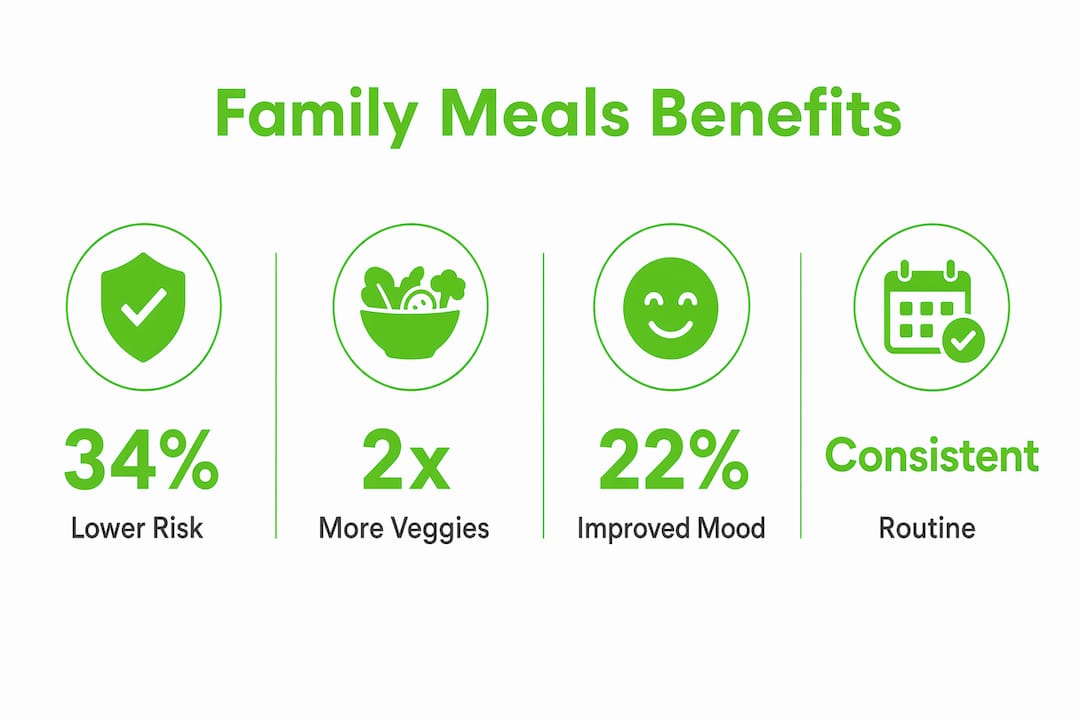
How do family meals improve nutritional health?
Regular family meals produce measurable improvements in what children and adults actually eat. Research from Johns Hopkins shows that family meals increase intake of calcium-rich foods, fruits, vegetables, fibre, folate, and vitamins A, C, E, and B6. That list matters because these are precisely the nutrients most children fall short on when left to snack independently or eat fast food.

Home-cooked meals served at the table give parents direct control over ingredients, portion sizes, and cooking methods. A plate of roasted vegetables with lean protein prepared at home bears little resemblance nutritionally to a takeaway meal, even when both appear similar in size. The benefits of home-cooked meals are well documented, and family mealtimes are the most natural setting in which to deliver them consistently.
The AAP reinforces this point by recommending that regular meal and snack times with healthy foods support healthy weight in children. The mechanism is straightforward: predictable eating schedules reduce grazing on processed snacks and help children recognise genuine hunger and fullness cues. Parents who set consistent mealtimes are, in effect, teaching appetite regulation without a single formal lesson.
Shared meals also create a low-pressure space for nutritional education. When a child watches a parent choose a leafy salad or ask about where a vegetable comes from, that modelling sticks. Children who grow up at a table where food is discussed, prepared together, and enjoyed are more likely to carry those habits into adulthood.
Pro Tip: Involve children aged five and over in washing, tearing, or plating food before the meal. Johns Hopkins notes that children involved in preparation show greater engagement with meals and are more willing to try new foods.
What is the impact of family meals on communication and emotional wellbeing?
The social function of shared meals rivals their nutritional value. A study published in Scientific Reports drawing on Gallup data from 142 countries found that meal sharing predicts wellbeing at a level comparable to income or employment status. People who regularly eat with others report higher happiness and lower stress, pain, and sadness. That finding applies to family meals as much as any other shared eating context.
For adolescents specifically, the stakes are higher. Tufts University research found that higher-quality family dinners are linked to a 22–34% lower prevalence of substance use among young people with low to moderate childhood adversity. The protective effect does not come from the food itself. It comes from parent-child communication and monitoring that naturally occur when families sit together regularly.
“The relationship-building function of family meals outweighs the food or timing details in preventing adolescent substance use.” — Tufts University research, 2026
This reframes how parents should think about the dinner table. The goal is not a perfectly balanced plate. The goal is a conversation. Asking a teenager about their day, listening without interrupting, and sharing something from your own day builds the kind of trust that makes young people less likely to seek risky outlets elsewhere.
The broader benefits of regular family dinners for emotional health include:
- Reduced feelings of loneliness and social isolation in both children and adults
- Stronger parent-child bonds built through consistent, low-stakes interaction
- Improved language development in younger children through conversation exposure
- A predictable daily ritual that provides psychological security and routine
- Reduced stress for parents who use mealtimes as a deliberate pause in a busy day
Research from the University of Florida IFAS Extension consolidates these findings, confirming that family eating routines reduce risky adolescent behaviours and improve family connectedness across a range of household types.
Are family meals effective for every family?
Family meals deliver strong benefits for most households, but the evidence is not uniform. Tufts research is explicit that family meals offer limited protection for adolescents facing severe adversity. Roughly 20% of young people with high levels of adversity need trauma-informed mental health support alongside shared meals to achieve positive outcomes. A family dinner alone cannot substitute for professional intervention when a child is dealing with abuse, bereavement, or serious mental health challenges.
The quality of the meal interaction matters as much as its frequency. Tufts findings confirm that meal enjoyment and distraction-free settings drive stronger behavioural outcomes than simply being in the same room. A meal eaten in silence while everyone scrolls a phone provides almost none of the relational benefits described above.
Families can adapt shared meals to suit their circumstances without losing the core benefit. Here are practical adjustments for common situations:
- Single-parent households: One shared meal per day, even breakfast, delivers meaningful connection. The number of adults present matters less than the consistency of the routine.
- Shift workers and irregular schedules: A weekend brunch or a Sunday dinner can anchor the week. Frequency does not need to be daily to be effective.
- Blended families: Neutral, enjoyable meals without high-stakes conversations help new family units build comfort gradually. Start with lighter topics and build over time.
- Children with sensory or dietary needs: Adapt the menu rather than the occasion. The shared table remains valuable even when individual plates look different.
Pro Tip: If mealtimes have historically been tense in your household, start with a short, low-expectation format. A 15-minute breakfast together three times a week builds the habit without pressure. Increase duration as comfort grows.
How can parents build a regular family meal routine?
Starting a consistent family meal routine does not require a complete household overhaul. Johns Hopkins recommends starting with 1–2 shared meals per week and building gradually. That advice matters because perfectionism is the most common reason families abandon the effort entirely. One good meal a week beats seven stressful ones.
Practical healthy family meal planning reduces the daily decision fatigue that derails good intentions. Spending 20 minutes on a Sunday mapping out three or four dinners for the week means you are not standing in front of an empty fridge at 6pm deciding between toast and a takeaway. Batch-cooking grains, washing vegetables in advance, and keeping a stocked pantry of clean-ingredient staples cuts active cooking time significantly.
The following habits consistently support sustainable family meal routines:
- Set a fixed time. Even an approximate window (between 6pm and 7pm) creates an expectation children can plan around.
- Keep phones off the table. This single change improves conversation quality more than any other adjustment.
- Rotate meal choices. Let each family member choose one dinner per week. Children who choose the meal are far more likely to eat it.
- Prepare together. Assign age-appropriate tasks. A five-year-old can wash salad leaves. A twelve-year-old can stir a sauce. Preparation builds ownership.
- Accept imperfection. A simple pasta dish eaten together beats an elaborate meal eaten alone.
| Challenge | Practical Solution |
|---|---|
| Busy weekday schedules | Batch-cook on Sundays; use 20-minute one-pot recipes on weekdays |
| Picky eaters | Serve one accepted food alongside new items; avoid short-order cooking |
| Screen distractions | Establish a no-phone rule before sitting down, not during |
| Irregular work hours | Anchor one weekend meal as the non-negotiable family gathering |
| Low cooking confidence | Use simple, clean-ingredient recipes with five or fewer components |
For families wanting to go further, building a balanced meal naturally using whole, organic ingredients removes much of the nutritional guesswork. When the ingredients are good, the meal does not need to be complicated.
Key takeaways
Regular family meals deliver their greatest benefits through consistent, distraction-free interaction, not through perfect food or rigid scheduling.
| Point | Details |
|---|---|
| Nutrition improves with shared meals | Family meals increase intake of fruits, vegetables, fibre, and key vitamins compared to fast food or solo eating. |
| Communication drives the real benefit | Tufts research links meal quality and parent-child dialogue to a 22–34% reduction in adolescent substance use. |
| Meal quality matters more than frequency | Distraction-free, enjoyable mealtimes produce stronger outcomes than frequent but disengaged ones. |
| Start small and build gradually | Johns Hopkins advises beginning with 1–2 shared meals per week to build a sustainable, low-stress habit. |
| Some families need additional support | Adolescents facing severe adversity benefit from trauma-informed care alongside regular family meals. |
Why i think most families are overthinking this
Most parents I speak with assume that family meals require a proper home-cooked spread, a set table, and everyone present at the same time. That expectation is the single biggest barrier to actually doing it. The research does not support that standard. What the evidence consistently shows is that presence and conversation are the active ingredients, not the food.
I have seen families transform their relationships with something as simple as a shared breakfast three mornings a week. No elaborate cooking. No formal setting. Just cereal, fruit, and ten minutes of genuine conversation before the school run. The children in those households show up differently. They are more communicative, more settled, and more willing to raise problems with their parents.
The other thing I would push back on is the idea that family meals are primarily a childhood intervention. The Scientific Reports Gallup data from 142 countries shows that adults who eat with others report meaningfully higher wellbeing. This is not just about raising better children. It is about building a household where everyone feels less alone.
My honest recommendation: stop waiting for the right conditions. Start with one meal this week. Keep phones off the table. Ask one genuine question. That is the whole formula.
— Arjit
How Naturessoulshop supports healthier family meals
Naturessoulshop stocks the kind of clean-ingredient staples that make healthy family meal planning genuinely straightforward. From fresh organic produce to vegan and gluten-free dry grocery options, every product is chosen to remove the compromise between convenience and nutrition.

Whether you are building a weekly meal plan from scratch or simply restocking your pantry with better ingredients, Naturessoulshop’s organic grocery range covers everything from fresh fruit and vegetables to dairy, meat, and home care essentials. For families prioritising whole, natural ingredients at the table, the fresh organic produce section is a strong starting point. Good meals begin with good ingredients, and Naturessoulshop makes sourcing them simple.
FAQ
Why are family meals important for children’s health?
Family meals are linked to higher intake of fruits, vegetables, fibre, and key vitamins, according to Johns Hopkins Medicine. The AAP also confirms that regular mealtimes support healthy weight by establishing consistent eating cues.
How often should families eat together to see benefits?
Research from Johns Hopkins suggests starting with 1–2 shared meals per week and building from there. Consistency matters more than daily frequency, particularly for families with demanding schedules.
Do family meals reduce the risk of substance use in teenagers?
Tufts University research found that higher-quality family dinners are associated with a 22–34% lower prevalence of substance use in adolescents with low to moderate adversity. The protective effect is driven by parent-child communication, not the meal itself.
What makes a family meal high quality?
Tufts research identifies three factors: minimising distractions (particularly screens), encouraging open conversation, and creating an enjoyable atmosphere. A relaxed, phone-free table delivers more benefit than a nutritionally perfect meal eaten in silence.
Can family meals help adults as well as children?
A Scientific Reports study using Gallup data from 142 countries found that adults who regularly share meals report higher happiness and lower stress. The wellbeing benefit of meal sharing is comparable in scale to the effect of income or employment status.


