


TL;DR:
- Organic foods in India have lower pesticide residues and may improve long-term health.
- Organic farming enhances soil health and increases nutritious phytochemicals in crops.
- Switching to organic staples can positively impact family wellness and environmental sustainability.
Many Indians are starting to question whether organic products are simply a premium marketing ploy or something worth the investment. The science, thankfully, is clear. Organic foods consistently show lower pesticide residues than their conventional counterparts, and a growing body of research links long-term organic consumption to measurable improvements in health. This article cuts through the noise to explain why organic choices are not a passing fad, but a genuinely powerful long-term investment in your family’s health and in the planet’s future, especially within the Indian context where pesticide use remains a serious concern.
Table of Contents
- Why organic is more than a trend: The science explained
- Nutrient power: Long-term health improvements from organic choices
- Soil, health, and sustainability: The organic connection
- Real-life impact in India: Organic diets and community wellness
- The uncomfortable truth most miss about organic living in India
- Discover organic options for lasting wellness
- Frequently asked questions
Key Takeaways
| Point | Details |
|---|---|
| Lower pesticide exposure | Organic foods help Indian families avoid high-risk chemical residues. |
| Greater nutrient density | Organic and regenerative foods give a measurable boost in vitamins and antioxidants. |
| Soil health impact | Healthy soils in organic farming produce more nutritious food and protect ecosystems. |
| Measurable community benefits | Indian government programmes show real health gains from switching to organic diets. |
Why organic is more than a trend: The science explained
India is one of the world’s largest consumers of synthetic pesticides, and the effects on our food supply are not trivial. When researchers examined vegetables sold across Indian markets, they found a stark contrast: organic samples showed no synthetic residues, while many conventional samples exceeded permissible safety limits. That is not a small difference. That is a difference that accumulates over a lifetime.
Understanding the organic vs conventional differences helps put this in perspective. Organic farming bans the use of synthetic pesticides and fertilisers, relying instead on natural inputs and ecological balance. This means the food that reaches your plate carries significantly fewer chemical residues, and the farmland itself remains healthier across generations.
Here is what the science consistently confirms about long-term organic consumption:
- Reduced pesticide exposure: Choosing organic foods reduces dietary exposure to pesticides across all age groups, including children who are especially vulnerable.
- Lower risk of chronic illness: Chronic low-level pesticide exposure is associated with neurological, hormonal, and developmental problems over time.
- Healthier gut and immunity: Fewer synthetic chemicals means less disruption to your gut microbiome, which regulates everything from digestion to immunity.
- Safer for children: Children consuming organic diets show measurably lower levels of pesticide metabolites in urine studies conducted globally.
“The real issue is not whether organic costs more today. It is whether the cost of not choosing organic accumulates in ways we cannot easily see or price.”
The benefits of organic fruit alone make a compelling case. Fruits are among the most pesticide-laden foods in conventional supply chains. When those same fruits are grown organically, the difference in chemical load is dramatic and the taste, often noticeably better.
It is also worth noting that organic certification in India is regulated under the National Programme for Organic Production (NPOP), giving consumers a reliable framework to verify genuinely organic products. Science is not supporting a lifestyle trend here. It is confirming a smarter, safer way to eat.
Nutrient power: Long-term health improvements from organic choices
Beyond reducing toxins, the true strength of organic produce lies in its nutritional profile. Research published in a major antioxidants journal found that organic and regenerative farming increases vitamin C, zinc, and polyphenol levels in crops, while simultaneously lowering nitrate and pesticide concentrations. This is not a marginal difference. It represents a meaningful shift in what your body receives with every meal.

The reason comes down to how plants grow. When crops are not propped up by synthetic fertilisers, they respond by producing more of their own protective compounds, including antioxidants and micronutrients. These very compounds are the ones that protect your cells, regulate inflammation, and reduce your risk of chronic disease.
An Indian study tracking farming communities found improvements in dietary diversity, glycaemia, kidney function, and child growth among those eating organic produce. These are not abstract lab results. These are measurable health changes in real Indian families.
Nutrient comparison: Organic vs conventional produce
| Nutrient | Organic produce | Conventional produce |
|---|---|---|
| Vitamin C | Higher | Lower |
| Zinc | Higher | Lower |
| Polyphenols/antioxidants | Higher | Lower |
| Nitrates | Lower | Higher |
| Synthetic pesticide residue | Negligible | Present |
The nutritional value of organic foods is particularly relevant for Indian diets, which are already rich in plant-based foods. If the vegetables, pulses, and fruits you already eat are also organically grown, the nutrient gains compound over time.
Pro Tip: Prioritise organic for foods you eat daily, such as dal, spinach, tomatoes, and bananas. These are the foods where consistent nutrient gains and reduced pesticide exposure make the biggest difference to your long-term health.
The importance of micronutrients cannot be overstated, especially in a country where micronutrient deficiencies, including zinc and vitamin C shortfalls, affect a significant proportion of the population. Organic food is not a supplement. It is food that genuinely nourishes more, with less of what harms.
Soil, health, and sustainability: The organic connection
Nutrients and health benefits originate in the soil, so how do organic methods enhance this? Soil is not just dirt. It is a living ecosystem containing billions of microorganisms that determine how well plants absorb nutrients, resist disease, and produce the phytochemicals (plant compounds) that benefit human health.
Research shows that the healthy soil microbiome in regenerative organic systems actively boosts plant defences and phytochemical content, which in turn delivers anti-inflammatory and antioxidant effects to the people who eat those plants. This is the soil-to-cell connection that industrial farming simply cannot replicate.
Organic vs conventional farming: Soil and food impact
| Factor | Organic/regenerative farming | Conventional farming |
|---|---|---|
| Soil microbiome diversity | Rich and active | Depleted over time |
| Phytochemical content in food | Higher | Lower |
| Carbon sequestration | Positive | Minimal |
| Biodiversity support | Strong | Weak |
| Long-term soil fertility | Improving | Declining |
The regenerative agriculture guide explains how practices like composting, crop rotation, and avoiding synthetic inputs work together to build soil health over years, not just seasons. This is a long game, and the returns are substantial.
Pro Tip: When buying vegetables, look for produce from farms that use composting and intercropping. These practices signal healthier soil and, by extension, more nutritious food on your table.
The environmental impact of food choices matters too. Organic farming reduces chemical runoff into rivers and groundwater, protects pollinators like bees, and helps sequester carbon in the soil. When you choose organic, you are not just making a personal health decision. You are participating in a much larger system of care.
Real-life impact in India: Organic diets and community wellness
Theory is important, but real results come from seeing change on the ground in Indian families. Andhra Pradesh’s Community-managed Natural Farming programme (APCNF) is one of the world’s largest organic farming initiatives and is now the subject of rigorous scientific study. The BLOOM randomised controlled trial is specifically designed to track health outcomes as farmers and families shift to natural farming practices.
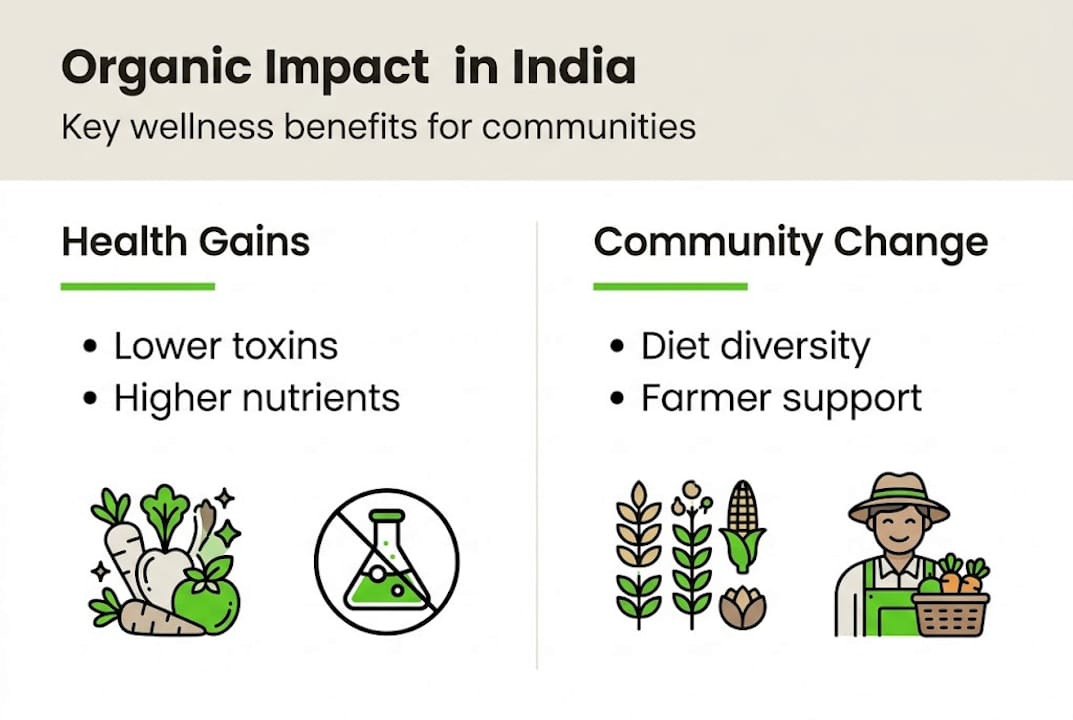
APCNF’s Indian trials are tracking lower pesticide levels in participants’ bodies, improved dietary variety, and better overall well-being across millions of people in Andhra Pradesh alone. The scale of this is remarkable and the early results are encouraging.
Here is how Indian families can begin applying these insights practically:
- Start with staples: Switch your most-consumed vegetables and grains to organic first. Dal, rice, and leafy greens are a strong starting point.
- Use the switching to organic guide to make the shift gradual and affordable, category by category.
- Cook at home more often: The benefits of home-cooked meals are amplified when the ingredients are clean and organic.
- Support local organic vendors: Farmers’ markets and community-supported agriculture (CSA) boxes often offer fresh organic produce at fair prices.
- Track how you feel: Many families report improved digestion, better energy, and fewer seasonal illnesses within weeks of switching.
Did you know? APCNF now supports over 6 million farmers across Andhra Pradesh, making it a global model for large-scale natural farming with direct public health benefits.
Pro Tip: If budget is a concern, prioritise organic for the “dirty dozen” of Indian produce, including spinach, tomatoes, okra, and grapes, where pesticide loads tend to be highest in conventional farming.
The uncomfortable truth most miss about organic living in India
Most guides frame the challenge of going organic as a cost problem. We disagree. The real barrier is the absence of reliable information and trustworthy access points. Many Indian consumers want to make better choices but simply do not know what to trust or where to start.
Perfection is not the goal. Consistency is. A family that switches just three staples to organic and maintains that habit for a year will accumulate far greater health benefits than one that goes entirely organic for a month and gives up. Small, sustained changes are where the real wins live.
Urban consumers benefit from growing availability through online platforms and curated wellness stores. Rural consumers, interestingly, are often closer to the source and can access naturally farmed produce with less effort than they realise. The real organic fruit benefits are not reserved for the wealthy. They are available to anyone who knows where to look and commits to looking consistently. The most honest advice we can offer: start somewhere, stay with it, and build your knowledge as you go.
Discover organic options for lasting wellness
Ready to put these organic benefits into your daily routine? We understand that knowing the science is only half the journey. The other half is finding products you can actually trust.
At Nature’s Soul Shop, we have curated organic and natural products across every category you need, from clean grocery staples to skin care with honest ingredients. Try our organic red lentil pasta, made entirely from masoor dal with no wheat or rice, or pick up a bar of our handcrafted neem and lemon soap for skin care that is as clean as your food. Every product on our shelves is chosen to make your organic journey easier, tastier, and genuinely worthwhile.
Frequently asked questions
Is organic food really safer for long-term health in India?
Yes. Organic produce in India contains significantly fewer pesticide residues than conventional options, reducing the chronic exposure risk that accumulates over years of daily consumption.
What long-term diseases can organic foods help prevent?
Organic and regenerative farming produces foods richer in antioxidants and micronutrients, and regenerative farming increases antioxidants that research links to lower risks of cardiovascular disease, diabetes, and other chronic conditions.
Are there Indian studies proving the benefits of organic food?
Yes. APCNF’s Indian trials and the BLOOM randomised controlled trial are actively measuring reduced body pesticide levels and improved health markers among Indian families eating organically.
Is organic food more nutritious than conventional options?
Many studies confirm that organic farming increases nutrient density, with organic crops typically containing more vitamin C, zinc, and antioxidants than conventionally grown equivalents due to soil health and farming practice differences.
Recommended
- Organic Certification in India: Your Guide to Healthy Choices – naturessoulshop
- Organic diet for kids: A parent’s guide to healthy eating – naturessoulshop
- Seasonal organic produce for wellness in Delhi NCR – naturessoulshop
- Affordable organic foods guide: eat healthy in India on a budget – naturessoulshop


