


Certified Naturally Grown suits most direct-market small farms selling face to face at markets or through CSAs, while USDA Organic is the one you need if you plan to use the word “organic” on a retail shelf or ship to wholesale buyers. CNG runs on trust and peer inspection with fees typically under US$200; USDA Organic involves federal paperwork and accredited third-party audits that cost significantly more. The checklist further down tells you exactly which one matches your sales channel.
TL;DR:
- Farms selling mainly at farmers markets or CSA stands typically benefit more from CNG’s low-cost, peer-based inspection and local trust rather than USDA Organic certification.
- USDA Organic certification involves a detailed five-step process, including land transition requirements and annual inspections, which can cost from several hundred to thousands of dollars.
- Farms with sales over $5,000 annually are legally required to hold USDA Organic certification to label products as organic, while smaller farms can reference organic practices without formal certification.
- USDA Organic provides access to supermarkets, distributors, and export markets, whereas CNG is accepted primarily at local markets and by farmers committed to community trust.
- Both standards prohibit synthetic pesticides and fertilizers, but USDA-certified farms offer more consistent environmental and compliance documentation suitable for large-scale trading.
Table of Contents
- Certified naturally grown vs organic: the head-to-head comparison
- How the organic certification process actually works step by step
- What certification actually costs and when you legally need one
- Where each certification actually gets you as a farmer
- A quick checklist for choosing between the two
- How Naturessoulshop verifies certification before it reaches your basket
- Where the two standards actually agree
- Environmental impact: same intentions, different accountability
- Real farms, two different paths
- What certification does to your price and your shelf space
- Labelling rules and what you can legally say
- Why shoppers trust each label differently
- Who should actually pick which label
- Community trust and formal paperwork aren’t rivals
- Shop certified, transparently sourced products with Naturessoulshop
- Where to check the details yourself
- Sources
Certified naturally grown vs organic: the head-to-head comparison
The two labels solve different problems, and that shows up the moment you look at who signs off on them. USDA Organic answers to the federal government through the National Organic Program (NOP); Certified Naturally Grown answers to a non-profit built by farmers, for farmers. Neither is fake. They just serve different markets.
- Oversight: USDA Organic sits under a federal agency with accredited certifying agents; CNG is governed by a non-profit board and relies on farmer peer review rather than government accreditation.
- Inspection model: USDA Organic uses trained, paid, third-party inspectors who check an operation’s compliance in detail, including soil records, buffer zones, and sometimes residue testing. CNG uses other farmers in the network, visiting each other’s land under a participatory guarantee system (PGS) and publishing the results.
- Cost: CNG membership typically costs under $200 a year, while USDA certification costs vary widely from several hundred to several thousand dollars depending on farm size and certifier.
- Market access: USDA Organic is recognised by supermarkets, distributors, and export buyers; CNG is recognised by farmers markets, CSA members, and local restaurants who know the network, but rarely by national chains.
- Scope: USDA Organic covers everything from raw produce to processed goods, livestock, and even hydroponic operations under specific rules. CNG focuses mainly on produce, and separately on livestock and apiary programmes, with a narrower reach into processed food.
If your buyer is a regional grocery chain, the oversight gap matters more than the cost gap. If your buyer is someone who shops your stall every Saturday, the reverse is often true, because they can ask you questions CNG’s transparency model already answers.
How the organic certification process actually works step by step
USDA’s National Organic Program follows a fixed five-step sequence, and it does not shortcut for small operations. The process runs through these stages:
- Write an Organic System Plan (OSP) detailing inputs, practices, and how you’ll prevent contamination.
- Implement the plan for at least one full growing season before certification, and note that land transitioning from conventional use needs a 36-month clean period first.
- Undergo an on-site inspection by an accredited certifying agent, who reviews records, walks the fields, and may pull samples.
- Certifier review of the inspection report against NOP standards.
- Certification decision, followed by annual renewal with fresh paperwork and another inspection.
That 36-month transition rule catches a lot of new farmers off guard: land sprayed with conventional inputs cannot carry the organic label until three years have passed, no exceptions for good intentions.
CNG works differently. You submit a profile describing your practices, a fellow farmer visits your land for a peer inspection, and you sign an annual pledge affirming compliance with published standards. Inspection summaries go up publicly on the CNG directory, so anyone can check what an inspector found. There’s no accreditation layer above the inspector, which is exactly what keeps costs down, but it’s also why some wholesale buyers won’t accept it as a substitute for USDA Organic.
What certification actually costs and when you legally need one
Money is usually the deciding factor for small operations, so it’s worth being blunt about the numbers. CNG membership typically costs less than $200 annually, covering the peer network and directory listing. USDA Organic certification varies far more widely, since it includes an application fee, an annual inspection fee, and certifier administrative charges that scale with your acreage and revenue.
- CNG: typically less than $200 annually, relatively flat regardless of farm size.
- USDA Organic: costs vary widely from several hundred to several thousand dollars a year, depending on operation size and certifier.
- Some state programmes offer partial fee reimbursement for USDA certification, so you should check with your local extension office about available assistance.
Here’s the rule that trips people up: any farm grossing more than $5,000 a year in agricultural sales must hold USDA certification to legally call its products “organic”. Below that threshold, you can use organic practices and even say so in conversation, but you cannot print “organic” on a label or sign without the certification behind it. Our guide to USDA organic requirements covers the exemption in more detail if you’re near that line.
Where each certification actually gets you as a farmer
Market access is the real test of naturally grown benefits versus organic status, and it comes down to who’s buying.
- CNG is widely accepted at farmers markets, by CSA members, and by roadside stands where the buyer already trusts the local network.
- USDA Organic is what supermarkets, food service distributors, and export buyers expect, because it’s the only label with legal weight behind the word “organic.”
- Roughly 8% of CNG members also hold USDA Organic certification, often because they sell direct at markets but also supply a wholesale account that requires the federal label.
- CNG works best as a complementary or interim label for farms whose growth plans eventually include retail distribution, rather than a permanent substitute for USDA status.
Pro Tip: Ask a vendor whether their certificate or inspection summary is public. CNG farms post theirs online by name; USDA-certified farms can show you a certificate number you can verify with their certifying agent. A vendor who can’t produce either is worth a second question.
A quick checklist for choosing between the two
Work through this in order rather than jumping straight to cost, because your sales channel decides everything else.
- Check your revenue. Under $5,000 in annual sales, you’re exempt from mandatory certification either way, though CNG still adds credibility.
- Check your buyers. Selling direct to consumers who know you personally leans CNG; selling to a distributor, grocery chain, or exporter requires USDA Organic.
- Check your paperwork tolerance. USDA demands an OSP, annual renewal, and inspection records; CNG asks for a profile and a pledge.
- Check your budget for fees. Under $200 a year fits CNG; a few hundred to a few thousand fits USDA, depending on your size.
- Watch for red flags. Any vendor who claims to be “organic” without showing a certificate number, or who calls their farm “naturally grown” while implying it’s government-regulated, is misrepresenting the label.
Pro Tip: If you’re a consumer rather than a farmer, ask to see the CNG directory listing or the USDA certificate before taking a “certified” claim at face value. Both are searchable online in seconds.
How Naturessoulshop verifies certification before it reaches your basket
The online store sources organic and natural products across fruit, vegetables, dairy, dry grocery, and skincare, and requests documentation from suppliers before listing products, including certificate numbers, inspection dates, and certifying body details where applicable. That means a shopper browsing the site isn’t relying on a label alone but on paperwork Naturessoulshop has already checked. For readers who want the fuller picture of what suppliers go through, our guide on which organic certification to require from suppliers walks through the documentation gap between formal and peer-based schemes.

Where the two standards actually agree
It’s worth being fair to both labels here, because the overlap is bigger than the marketing suggests. Both USDA Organic and CNG prohibit synthetic pesticides and fertilisers, ban genetically modified seed and inputs, and require practices that build soil health, such as composting, cover cropping, and crop rotation. Neither label allows sewage sludge as fertiliser. Neither allows irradiation of the finished product.
Where they diverge is enforcement, not principle. USDA backs its rules with paid inspectors trained to NOP standards and the legal authority to fine or decertify a farm that lies on its Organic System Plan. CNG backs the same underlying principles with a promise: a neighbouring farmer visits, looks at your fields, and posts what they found. If a CNG farmer is cutting corners, the check comes from community reputation rather than federal enforcement, and that’s a genuinely different kind of accountability, not a weaker set of standards.
This is why so many people describe naturally grown food as organic in every meaningful respect except the paperwork. The soil health practices, the synthetic ban, and the GMO prohibition are close to identical on paper. What’s missing from CNG is the audit trail a distributor’s legal team wants to see before they’ll put a “organic” sticker on a pallet.
Environmental impact: same intentions, different accountability
Both certifications push toward the same environmental outcomes: less synthetic runoff, healthier soil biology, and no GMO contamination of seed stock. Where they differ is how consistently those outcomes get measured across a large network.
USDA’s inspection regime includes buffer zone checks and, in some cases, residue sampling, giving a more standardised environmental record across thousands of certified operations nationwide. That consistency matters at scale. It’s also expensive to maintain, which is part of why certification costs climb with farm size.
CNG’s environmental case rests on something harder to quantify but arguably just as real: farmers inspecting farmers tend to notice details an outside auditor might miss, because they know what healthy soil looks like on land similar to their own. A peer inspector who farms three miles away recognises overgrazed pasture or nutrient-starved beds faster than someone flying in for a scheduled audit. The trade-off is that CNG doesn’t produce the kind of aggregated environmental data that USDA’s federal reporting structure generates, so its impact is harder to benchmark nationally even where the on-the-ground practice is sound.
Neither approach is inherently greener. USDA offers measurable rigour; CNG offers local nuance. A shopper who cares about verified soil practices on a specific plot of land might trust a CNG peer report more than a distant federal number, and that’s a reasonable position to hold.

Real farms, two different paths
Picture two vegetable growers with similar acreage and similar practices, differing mainly in where they sell. One sells almost entirely through a Saturday farmers market and a 40-member CSA. She joined CNG, paid a modest annual fee, hosted a peer inspection from a farmer two towns over, and had her listing live within weeks. Her customers already trust her face to face; the CNG badge on her stand sign is a bonus, not the reason they buy.
The other grower supplies a regional grocery chain and, more recently, started shipping preserves to a distributor. He needed USDA Organic from day one, because no retail buyer at that scale would stock a product without it. He spent a full growing season documenting his Organic System Plan, sat through an on-site inspection that checked buffer zones between his fields and a neighbouring conventional farm, and now renews annually with fresh paperwork every year.
Both are legitimately committed to organic principles. The difference is entirely about where the product goes after it leaves the farm gate, which is the clearest illustration of the difference between organic and naturally grown that you’ll find outside a spreadsheet.
What certification does to your price and your shelf space
Certification fees are only part of the cost story. USDA Organic status often lets a farm command a price premium in retail settings, because distributors and grocery buyers use the label as a proxy for quality and reduce their own due diligence accordingly. That premium has to cover not just the certification fee itself, but the extra recordkeeping time, the annual inspection day, and the administrative overhead of renewing every year.
CNG rarely commands the same retail premium, because it isn’t stocked by the retailers who pay one. What it does instead is protect a farmer’s price at the market stall by giving repeat customers a reason to keep paying full price rather than shopping around. That’s a different kind of return: not a wholesale markup, but customer retention in a direct-sales relationship.
Market access beyond the fee itself often decides the real cost comparison. A grower who could sell into a regional chain but lacks USDA Organic status isn’t just missing a label, they’re missing the entire sales channel. A grower who never intended to sell wholesale loses nothing by skipping USDA and keeping the savings.
Labelling rules and what you can legally say
The word “organic” is legally restricted the moment a farm’s gross agricultural sales pass $5,000 a year. Above that line, only USDA-certified operations can print “organic” on packaging, signage, or invoices. CNG farms cannot use the word “organic” on their labels regardless of sales volume, because CNG is not a USDA-recognised certifying body. They use “naturally grown” instead, and the CNG standards are explicit that members should not imply government organic status.
This distinction catches new farmers out constantly. A CNG member advertising “certified organic” produce, even informally on a hand-painted sign, is making a claim the label doesn’t support. The safer, accurate phrase is “Certified Naturally Grown” or simply “grown using organic methods, not certified,” which keeps the marketing honest without borrowing a term that belongs to a different certification scheme entirely.
Why shoppers trust each label differently
Consumer recognition tilts heavily toward USDA Organic, largely because its green-and-white seal has appeared on supermarket shelves for over two decades. Shoppers see it as a government guarantee, even though the actual inspection is carried out by a private accredited agent, not a federal employee.
CNG trust works on a different mechanism entirely: proximity. A shopper who has spoken to the farmer, seen the fields, or read the public inspection summary online tends to trust CNG just as much, sometimes more, because the verification feels personal rather than bureaucratic. That trust doesn’t transfer well to a shopper who’s never met the farmer, which is exactly why CNG struggles in supermarket settings and thrives at a market stall.
Neither label is inherently more trustworthy on the science. Research examining organic food claims broadly finds limited conclusive evidence that organic produce is nutritionally superior to conventional food, so much of the buying decision comes down to values around synthetic inputs and environmental practice rather than hard nutritional data. For a deeper look at how quality standards get communicated to shoppers, this explainer on food quality standards is a useful outside reference.
Who should actually pick which label
Direct-market farms selling at markets, through CSAs, or from a farm stand almost always fit CNG better. The fees are lower, the paperwork is lighter, and the customers doing the buying are already close enough to verify trust themselves.
Farms selling wholesale, into grocery retail, or exporting need USDA Organic, full stop, because the federal standard is what national and institutional buyers require before they’ll put a product on a shelf or in a contract. There’s no workaround here: a distributor’s compliance team won’t accept a peer-reviewed label in place of an accredited one.
The farms that carry both, still a minority at around 8% of CNG’s membership, tend to be growing past their original direct-sales model. They keep CNG for the community relationships that built their customer base, and they add USDA Organic once a wholesale account or grocery buyer asks for it. That layering is deliberate, not indecision. It reflects a farm outgrowing one sales channel while keeping the other alive.
Community trust and formal paperwork aren’t rivals
Both models solve real problems, and pitting them against each other misses the point. Peer inspection works because farmers know what to look for on land like their own, and public transparency lets a stranger check the record without a government badge involved. Formal accreditation works because it scales to a level trust alone cannot: no distributor can personally visit every farm in a supply chain, so they lean on a federal standard instead.
The honest answer is that both can be right for the same farm at different stages of growth. Use the checklist above to work out which sales channel you’re building for today, then revisit the choice as that channel changes.
— Arjit
Shop certified, transparently sourced products with Naturessoulshop
The store gives shoppers a shortcut past the label-checking altogether: products listed include certification and sourcing details on their pages, helping customers verify claims such as “organic” or “naturally grown”.
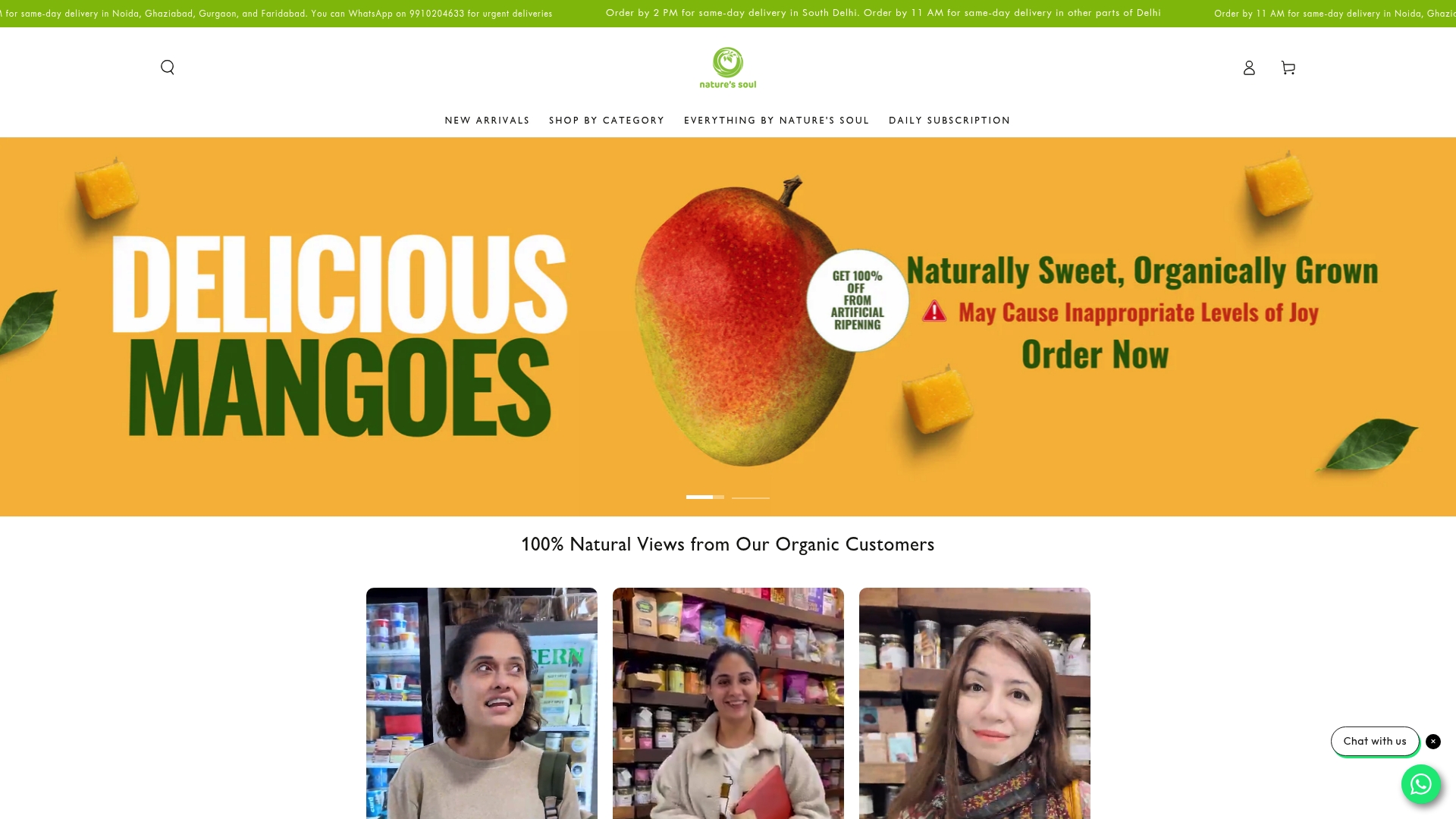
Browse organic fruit, vegetables, dairy, and pantry staples on Nature’s Soul Fresh, or explore skincare and wellness ranges like the Patchouli Lavender Cream from SOS Organics and the health category for supplements and everyday wellness picks. If you’re a supplier or a curious shopper wanting to understand what documentation stands behind a claim, our certified organic explainer breaks down verification in plain terms. Certification needs differ by product and market, but every listing on Naturessoulshop states its sourcing standard clearly, so start browsing and check the product page before you add anything to your basket.
Where to check the details yourself
- USDA NOP: becoming certified — the official five-step process, forms, and inspection expectations.
- Certified Naturally Grown standards and directory — peer inspection model, published standards, and member listings.
- Cornell Small Farms Program organic certification guide — cost breakdowns and practical advice for small operations.
- North Carolina organic commodities production guide — the $5,000 sales threshold and state-level labelling rules.
Sources
- North Carolina organic commodities production guide — chapter 12: organic certification
- Organic certification — Cornell Small Farms Program
- Becoming certified — USDA Agricultural Marketing Service (National Organic Program)
- Certified Organic and Certified Naturally Grown: What’s the difference, and why it matters — Certified Naturally Grown


