


Buying local food gives you fresher produce with more retained nutrients, keeps a larger share of your money circulating in your own community, and cuts transport emissions on short-haul perishables. The trade-off isn’t perfect everywhere, but choosing seasonal, locally sourced items where you can is one of the simplest upgrades to your food shopping. The evidence for each of these benefits, and how to act on them follow below.
TL;DR:
- Buying local produce ensures fresher, more nutrient-rich food, especially for delicate items like leafy greens and berries, which degrade quickly after harvest.
- Local food has a smaller environmental footprint primarily when short-haul perishables are involved, as local production often uses less packaging and refrigeration.
- Money spent at local farms or markets remains more within the community, supporting regional jobs, farms, and food diversity over time.
- Shorter supply chains allow consumers to directly ask farmers about their practices, though some small producers lack formal certifications despite potentially low chemical use.
- Accessing local food is easiest through farmers markets, CSAs, farm shops, regional grocery sections, or online stores that specify farm names and harvest locations.
Table of Contents
- Why buy local food for freshness and nutrition?
- Does buying local actually help the environment?
- How does buying local strengthen the local economy?
- What does seasonal, local eating actually change about your food?
- Is local food actually safer to buy?
- Where can you actually buy local food?
- Nature’s Soul Shop’s take on sourcing local produce
- Where to buy local, organic produce online
- Sources
Why buy local food for freshness and nutrition?
Nutrient loss starts the moment produce leaves the ground or the branch. Vitamin C, in particular, degrades quickly after harvest, and the longer a fruit or vegetable spends in transit and cold storage, the more nutrients it may lose before it reaches your plate. Local produce sold at farmers markets is often picked within 24 hours of sale, which leaves far less time for that decline to happen.
There’s a second, less obvious mechanism at play: distance itself changes how food is grown. Crops destined for long hauls are frequently bred or treated for shelf stability rather than flavour, and some are picked underripe, then gassed or chemically ripened en route. Local growers selling direct to nearby customers don’t need to solve that logistics problem, so they can pick at peak ripeness and skip a layer of post-harvest treatment altogether.
A national consumer study found:
- 82% of shoppers cite freshness as their main reason for choosing local food
- 75% cite support for the local economy
- 58% cite wanting to know where their food comes from
Freshness by the numbers: Freshness beats price, brand, and convenience as the top reason people seek out local food, according to USDA Economic Research Service data — a signal that taste and nutrition are what actually drives the decision, not sentiment alone.
None of this means every non-local item is nutritionally inferior. Frozen vegetables are usually blanched and frozen within hours of picking, which can lock in nutrients as effectively as a quick trip from a nearby farm, and tinned tomatoes or beans hold up perfectly well nutritionally. The real advantage of buying local shows up most clearly with delicate items such as leafy greens, berries, and soft fruit, where freshness and flavour degrade fastest.
Does buying local actually help the environment?
Sometimes, but not for the reason most people assume. “Food miles,” the distance a product travels before reaching you, are a much smaller piece of its environmental footprint than how it was farmed, processed, and packaged. A tomato grown in a heated greenhouse ten miles away can carry a larger carbon footprint than one shipped from a sun-drenched region a thousand miles further out. Transport is one input in a full life-cycle assessment, not the whole equation, and production method frequently outweighs distance travelled.
Where local buying does reliably cut emissions is with short-haul perishables: items that would otherwise be refrigerated, air-freighted, or driven long distances precisely because they spoil fast. Soft fruit, salad leaves, and fresh herbs fall into this category. A comparative study of conventional versus local supply chains found that transport savings are real but uneven, and depend heavily on what’s being compared and how it was grown at each end.
Local buying also carries co-benefits that don’t show up in a simple emissions tally:
- Less packaging, since food travelling a short distance needs less protective wrapping
- More support for smaller-scale, often more agroecologically diverse farms
- Fewer cold-chain links, each of which uses energy to maintain temperature
- Reduced food waste in transit, since shorter journeys mean fewer spoilage losses
Pro Tip: Look at what’s grown in season near you before assuming “local” beats “imported” on environmental grounds. An out-of-season local greenhouse tomato can lose to a field-grown one shipped from a warmer region, so pairing local with seasonal is where the real environmental win sits.
For a wider view of how sourcing decisions ripple through emissions and supply chains, this explainer on local sourcing covers the trade-offs food businesses weigh when deciding what to stock.
How does buying local strengthen the local economy?
Money spent at a local farm or independent grocer doesn’t leave town the way it does at a national chain. A meaningful share gets re-spent locally, on wages, on supplies from other local businesses, on services, creating a repeat cycle that a purchase at a large chain generally doesn’t. This is the “local multiplier” effect, and it’s well documented in research on local food systems.
Direct-to-consumer routes change the maths for farmers too. Selling through a farmers market, a Community Supported Agriculture (CSA) box, or a food hub cuts out several layers of distributor and retailer margin. A grower who sells a punnet of strawberries at market keeps far more of that final price than one selling wholesale into a supermarket supply chain, where the retail markup, distribution costs, and broker fees all take a cut before the farm sees a penny.
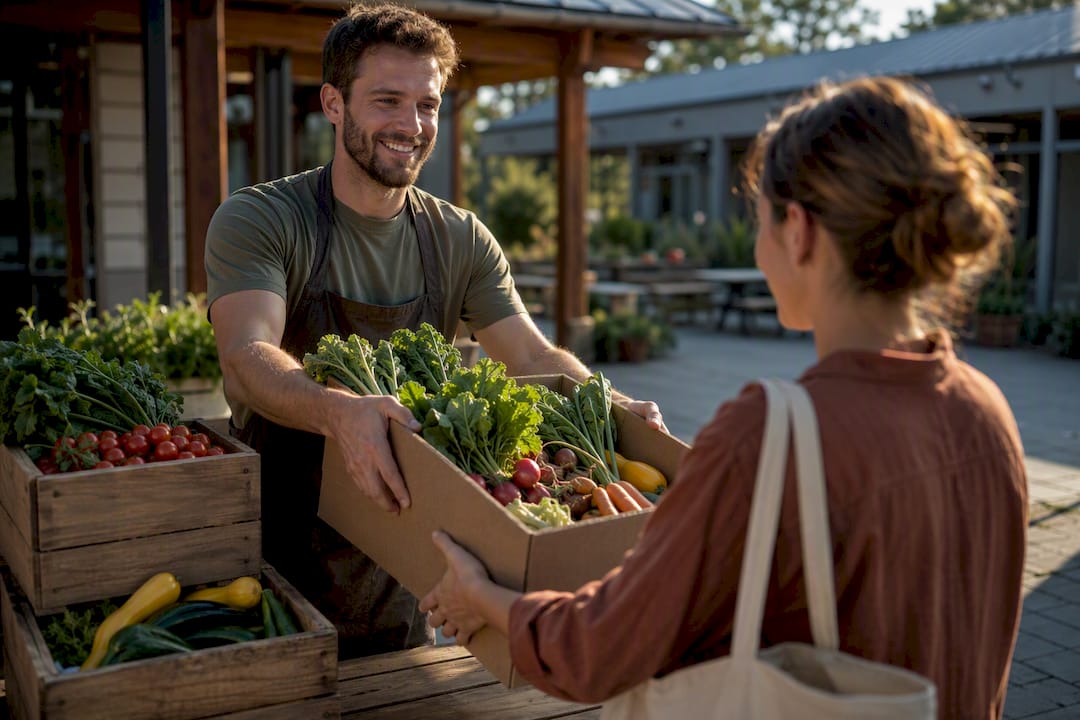
Buying direct also builds a feedback loop: consistent local demand lets farmers respond to what customers actually want, whether that’s low-packaging options or specific growing methods, in a way a distant supplier chain never registers.
The knock-on effects extend beyond farm income:
- Local food jobs, from growing to packing to market stalls, stay in the region
- Working farmland stays in production rather than being sold for development
- Regional food traditions and varieties survive because there’s still a market for them
Supporting local farmers with your weekly shop is one of the more direct ways an individual purchase can shape what a local economy looks like in five or ten years.
What does seasonal, local eating actually change about your food?
Eating with the seasons means your plate changes throughout the year almost by default: asparagus and rhubarb in spring, tomatoes and stone fruit in summer, squash and root vegetables in autumn. That rotation isn’t a limitation. It’s what forces variety into a diet that would otherwise default to the same handful of supermarket staples year-round.
Local growers, freed from the need to breed for shipping durability, tend to grow differently:
- Heirloom and speciality varieties selected for flavour, not shelf life
- Crops chosen for local climate and soil rather than universal transport tolerance
- Wider genetic diversity across a region’s farms, which supports resilience against pests and disease
Smaller farms in particular often carry a far wider range of specialty cultivars than a commercial grower supplying a national chain, simply because flavour and adaptation to the local growing season matter more to them than uniformity. That diversity is also a quiet form of biodiversity protection, keeping older varieties in cultivation instead of letting them disappear in favour of a handful of shipping-friendly types.
Is local food actually safer to buy?
Shorter supply chains mean fewer hands touch your food between farm and plate, and fewer points where contamination can occur. Every additional processing, packing, or storage step in a long industrial chain is another opportunity for something to go wrong, which is part of why food safety guidance emphasises minimising handling wherever practical.
Proximity also gives you something a supermarket aisle rarely offers: the ability to ask. You can ask a grower directly how they manage pests, how animals are raised, or how produce is washed and stored, and shorter chains genuinely support that transparency in a way distant, multi-layered supply chains usually don’t.
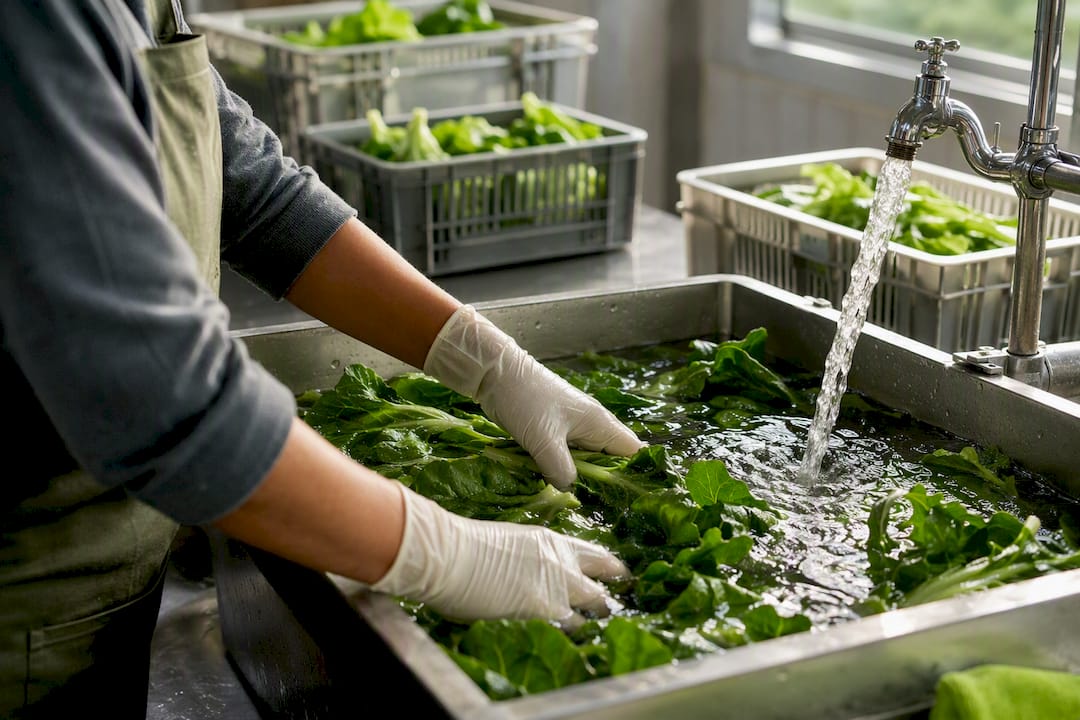
That said, small producers often lack formal third-party certification simply because the audit process is expensive and geared towards larger operations. A farm without an organic label isn’t necessarily using more chemicals; it may just have decided the paperwork isn’t worth it for a market stall.
Worth asking before you buy:
- How and when was this harvested?
- What pest or weed control methods do you use?
- Are animals pasture-raised, and how much space do they have?
- Do you hold any certifications, and can I see them?
Pro Tip: Ask the same two or three questions every time you visit a stall. Growers remember regular customers, and consistent questions tend to get more detailed, more honest answers over time than a one-off enquiry.
Where can you actually buy local food?
Finding local food is easier than most people expect once you know where to look:
- Farmers markets. Search for a weekly market near you. Most towns and cities run at least one.
- CSAs (Community Supported Agriculture). Pay a season upfront and collect a weekly box; this gives farmers guaranteed income and you guaranteed variety.
- Farm shops and food hubs. Many farms sell direct from the gate or via regional food hubs that aggregate several producers.
- Local sections of supermarkets. Increasingly common, though check the label for the actual growing region rather than just a “locally sourced” sticker.
- Local delivery services. Online grocers that source directly from regional growers and deliver within a defined area.
To verify what you’re actually buying, check the label or listing for a named farm or producer, not just a country or region, and look for a clear statement of where and when it was grown. A step-by-step guide to finding local produce walks through what to look for both at markets and when ordering online.
On budget: buying everything local and organic at once is rarely realistic, so start with the items where freshness matters most (leafy greens, berries, herbs) and mix those with pantry staples sourced however is most affordable. Buying in season is also simply cheaper, since produce at peak local supply costs less than the same item grown out of season elsewhere and shipped in.
Nature’s Soul Shop’s take on sourcing local produce
Working directly with growers changes how you think about a delivery box. It stops being a logistics exercise and becomes a relationship where you know who grew what, and roughly how it got to your door.
Naturessoulshop built its sourcing around that relationship, favouring shorter chains and seasonal availability over year-round uniformity wherever the region allows it. A carton of tomatoes in season looks and tastes different from one grown out of season under artificial conditions, and that difference is the whole point of buying local in the first place.
The practical lesson for readers: don’t just look for a “local” label, ask what’s actually in season and where it came from. That single habit, applied consistently, delivers most of the benefits this article has covered.
— Arjit
Where to buy local, organic produce online
There are other ways to get local food, a Saturday market run, a CSA box, a farm shop visit, and each has its place. A local online store offers seasonal, organically grown produce alongside meats, dairy, dry groceries, and vegan and gluten-free options, delivered directly to your door within a defined local area.
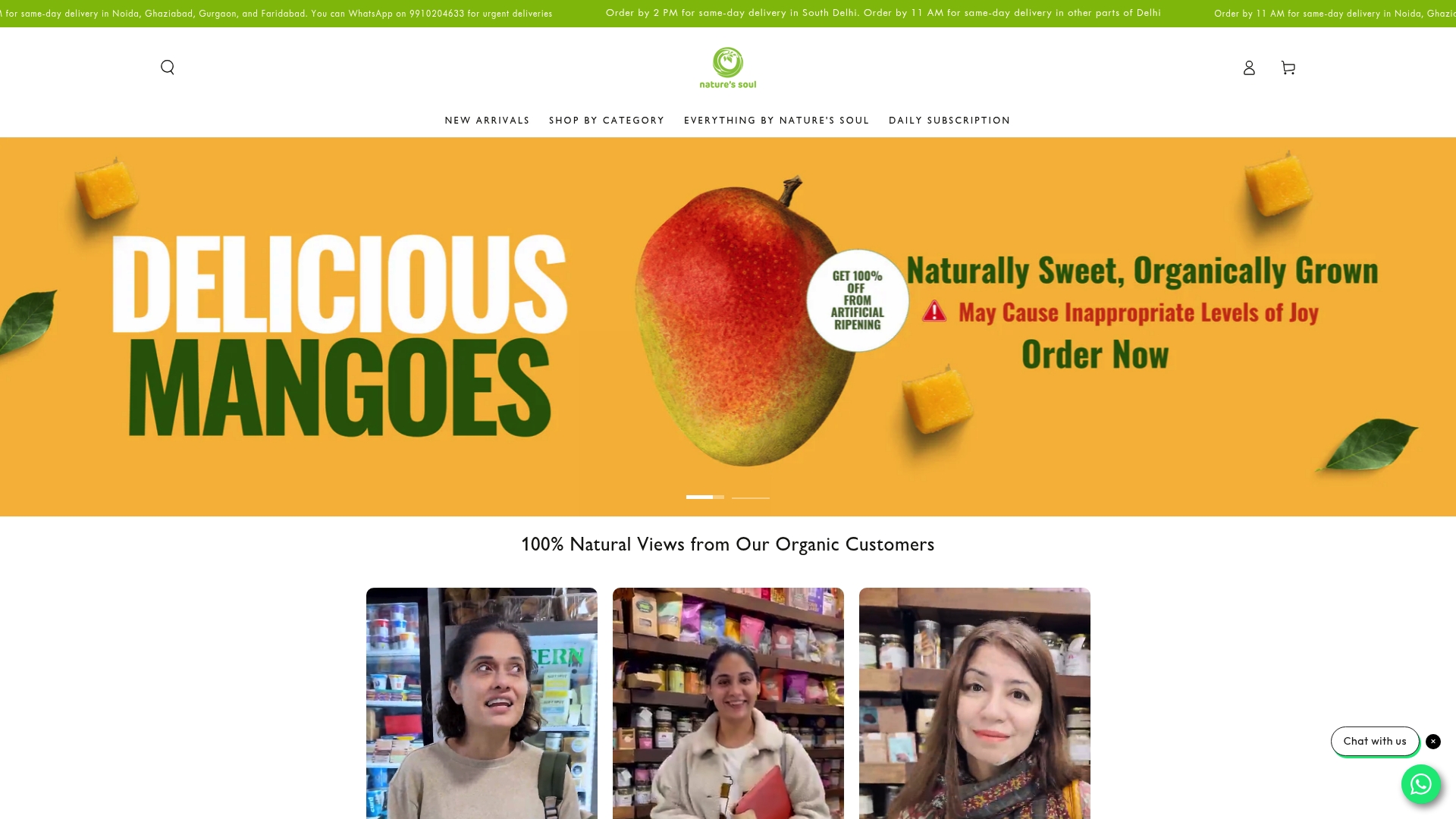
The Nature’s Soul Fresh range is built around seasonal produce boxes, the same principle behind CSAs, but ordered on your schedule rather than a fixed weekly pickup. Before you order, check the listing details on each product page for sourcing information, and look at the health category if you’re rounding out a local, whole-food diet with complementary wellness products.
If freshness, transparency, and supporting a shorter supply chain matter to you, the next step is straightforward: browse the current seasonal selection at Nature’s Soul Shop and place an order for same-day delivery within the serviceable area.
Sources
- The local food movement — definitions, benefits and resources (Utah State University Extension)
- Why buy local? factsheet (University of Vermont)


