


Switching to an organic diet reliably lowers pesticide exposure, measured directly through biomarkers in urine and blood. Nutrient differences exist too, though they’re modest: slightly more polyphenols, slightly more omega-3s in some dairy. Population studies hint at benefits around allergies, weight and pregnancy outcomes, but confounding factors mean none of that is proven cause and effect yet.
TL;DR:
- Switching to an organic diet significantly reduces pesticide exposure within days, but it does not guarantee the reversal of long-term cumulative exposure.
- Organic foods provide modest increases in polyphenols and omega-3s, but nutrient gains vary by crop and are less substantial than marketing suggests.
- Population studies suggest associations between organic consumption and lower obesity, allergy rates, and pregnancy complications, though causation remains unproven.
- Organic farming reduces antibiotic use in livestock, lowers farmworker pesticide exposure, and may decrease heavy metal residues like cadmium, but these benefits are region-dependent.
- Prioritize buying organic for high-residue produce, during pregnancy or early childhood, and use seasonal or frozen options to maximize benefits on a limited budget.
Table of Contents
- The evidence behind the benefits of organic farming on human health
- How organic food lowers your pesticide exposure
- Do organic foods have more nutrients than conventional ones?
- What population studies say about allergies, weight and pregnancy
- Antibiotics, contaminants and the health case beyond nutrients
- How to prioritise organic food on a real budget
- Where Naturessoulshop’s own guides fit into this picture
- Soil health, the food chain and where the benefit actually starts
- Beyond pesticides: heavy metals and other residues
- What long-term studies say about chronic disease risk
- Can choosing organic food improve your wellbeing beyond nutrition?
- An editorial take on the organic health debate
- The verdict on organic farming and your health
- Sources
The evidence behind the benefits of organic farming on human health
The strongest evidence sits in a small pile, not a mountain. Short intervention trials that switch people onto organic diets and measure pesticide metabolites in their urine produce the most reliable results, because they track a direct biological change rather than a lifestyle guess. Systematic reviews, including a widely cited comprehensive review published in Environmental Health, pull together dozens of these studies and consistently land on the same conclusion: organic consumption lowers pesticide exposure and antibiotic-resistance pressure from livestock, but the data on chronic disease outcomes stays thin.
Large cohort studies add weight without adding certainty. Research tracking regular organic consumers over years, including French cohort work summarised in observational research on organic consumption and health outcomes, finds associations with lower obesity risk. Association is not causation, and cohort designs cannot rule out the possibility that people who buy organic also exercise more, smoke less, or simply eat more vegetables overall.
What the evidence base actually supports right now:
- Biomarker trials: strong, repeatable evidence for reduced pesticide exposure
- Systematic reviews: consistent but cautious conclusions on nutrient and antibiotic differences
- Large cohorts: suggestive associations with obesity and pregnancy outcomes, not proof of causation
- Long-term randomised controlled trials on disease outcomes: still missing from the picture
How organic food lowers your pesticide exposure
This is where the science is least ambiguous. Clinical trials that put participants on an organic diet for just a few days show measurable, often rapid, drops in urinary pesticide metabolites, a pattern confirmed by clinical trials tracking pesticide biomarkers after dietary switches. The body clears these compounds quickly once the dietary source is removed, which is exactly why the biomarker changes show up within days rather than months.
Pro Tip: Biomarker drops this fast tell you the exposure pathway is real and controllable, not that switching diets alone will reverse years of cumulative exposure.
Organophosphates are the pesticide class drawing the most attention, largely because prenatal exposure has been linked to changes in child neurodevelopment in the same Environmental Health review cited above. That’s the reason public health guidance, including a Mayo Clinic overview of organic food’s benefits and limits, singles out pregnancy and early childhood as the life stages where reducing exposure carries the clearest logic.
What switching actually buys you, and what it doesn’t:
- Immediate, measurable reduction in pesticide metabolite levels
- No guaranteed reversal of long-term accumulated exposure
- No blanket protection against all environmental contaminants, only the pesticide-residue pathway
Do organic foods have more nutrients than conventional ones?
Yes, but the gap is smaller than marketing copy suggests. Nutritional analyses collected in food composition research comparing organic and conventional produce report modestly higher polyphenol concentrations in organic fruit and vegetables, and higher omega-3 fatty acid content in some organic dairy. Flavonoids and phenolic acids are the compounds that show up most consistently, though the actual size of the difference depends heavily on which crop and which study you’re reading.
Mineral content tells a messier story. Iron and magnesium sometimes read higher in organic produce, but the pattern isn’t consistent across studies, a caveat also raised by the 2024 review in an analysis of organic food’s nutritional value and health impact. Soil quality, crop variety and harvest timing swing nutrient levels by an amount comparable to the farming system itself, according to analysis on variability in food composition.
What this means for how you eat:
- Expect a modest polyphenol and omega-3 boost from organic choices, not a dramatic one
- Don’t expect consistent mineral gains across every organic product
- Overall diet quality (more vegetables, less processed food) still outweighs the organic-versus-conventional gap on its own
What population studies say about allergies, weight and pregnancy
Cohort data offers some of the most talked-about findings in this field, and also some of the easiest to misread. The Koala birth cohort found lower eczema rates among children in households consuming more organic dairy and vegetables. France’s Nutrinet-Santé cohort has linked frequent organic consumption with lower cardiometabolic risk, including lower rates of overweight and obesity, a pattern echoed in cohort evidence on organic consumption and health outcomes. Some studies have also reported lower rates of pre-eclampsia among organic consumers during pregnancy.
None of this proves organic food itself causes the improvement. People who buy organic tend to differ from those who don’t in ways researchers call confounding, meaning higher income, more exercise, better overall diet quality, and fewer smokers in the sample. The Environmental Health review notes this directly: residual confounding from healthier lifestyles among organic shoppers plausibly explains at least part of the effect researchers observe.
Reverse causation is also on the table. It’s plausible that people who already eat healthier diets and exercise more simply gravitate towards organic shopping, rather than organic food making them healthier. Settling this would require randomised controlled trials running over years, tracking real disease outcomes rather than biomarkers or self-reported habits. That kind of trial hasn’t been done yet, and may never be feasible at scale.
Antibiotics, contaminants and the health case beyond nutrients
Some of the strongest arguments for organic farming have nothing to do with nutrient content. Organic livestock standards restrict prophylactic antibiotic use and require withdrawal periods before slaughter, which reduces one of the structural drivers of antimicrobial resistance across the food system, as detailed in the Environmental Health review.
Farmworkers and rural communities also carry a lower burden of occupational pesticide exposure under organic systems, a benefit that never shows up in a nutrition label but matters for public health downstream. Some analyses report lower cadmium levels in organic crops, tied to differences in fertiliser use, though this varies by region and soil type.
Pro Tip: If you’re weighing up organic versus conventional purely on nutrition, you’re missing half the picture. Antibiotic stewardship and farmworker exposure are health benefits too, just ones that never make it onto a label.
- Lower antibiotic pressure in organic livestock, a measurable public-health lever against resistance
- Reduced occupational pesticide exposure for farmworkers and surrounding communities
- Some reported reductions in cadmium and other contaminants, though evidence varies by region
How to prioritise organic food on a real budget
You don’t need to buy everything organic to get most of the benefit. Focus your spending where residue levels run highest and where the biology matters most.
- Prioritise pregnancy and early childhood. This is the life stage where pesticide exposure carries the clearest developmental relevance.
- Buy organic for high-residue produce first. Soft-skinned fruits and leafy vegetables typically carry more residue than produce you peel.
- Buy conventional where the residue gap is smaller. Thick-skinned fruit and vegetables you peel anyway don’t need the organic premium.
- Shop seasonally and consider frozen organic produce. Seasonal buying and frozen options usually cost less without sacrificing nutrient content, a point echoed in seasonal produce nutrition guidance.
- Don’t treat “organic” as a health halo on processed snacks. An organic biscuit is still a biscuit; whole foods do the real work.
Pro Tip: A public health approach to a limited budget means spending on the items and life stages with the highest exposure, not converting your entire trolley overnight.
Where Naturessoulshop’s own guides fit into this picture
An online wellness retailer has built out its own evidence-based reading on this topic for exactly this reason: shoppers deserve more than a marketing claim on a label. The guide on the real benefits of organic fruit nutrition goes deeper into which nutrient differences actually hold up, and the step-by-step guide to switching to organic walks through a practical, budget-aware transition rather than an all-or-nothing overhaul.
For readers acting on the pregnancy and allergy points raised above, guidance on introducing new foods and managing allergy risk in infants is worth a read alongside this article.
An online wellness retailer’s product range covers categories that include organic fruit, vegetables and dairy alternatives, pantry staples and gluten-free, vegan options, as well as skincare and home care products formulated with cleaner ingredient lists.
Soil health, the food chain and where the benefit actually starts
Nutrient content in your food starts underground, not on the supermarket shelf. Organic farming standards prohibit synthetic fertilisers and most synthetic pesticides, which changes how soil microbial communities function over time. Healthier, more biologically active soil tends to support better nutrient cycling, meaning plants have more consistent access to minerals and trace compounds as they grow.
This is one reason nutrient differences between organic and conventional produce are inconsistent from study to study: soil condition varies enormously between farms regardless of certification status. A well-managed conventional farm with good soil stewardship can sometimes outperform a poorly managed organic one on nutrient density. Certification tells you about inputs and practices, not automatically about outcome.
The food-chain argument for soil health is more structural than nutritional. Reduced synthetic pesticide and fertiliser runoff means less contamination reaching waterways and, eventually, drinking water supplies in agricultural regions. Soil that retains organic matter also supports more diverse microbial life, which some researchers link to broader ecosystem resilience, including the insect populations that pollinate the crops we eat.

None of this is a direct, individual health guarantee. It’s a slower, systemic benefit that plays out at the level of ecosystems and food systems rather than a single meal. If you’re choosing organic partly because of soil health, you’re making an environmental and long-term food-security choice as much as a personal-nutrition one, and that distinction is worth holding onto when you’re weighing the premium at checkout.
Beyond pesticides: heavy metals and other residues
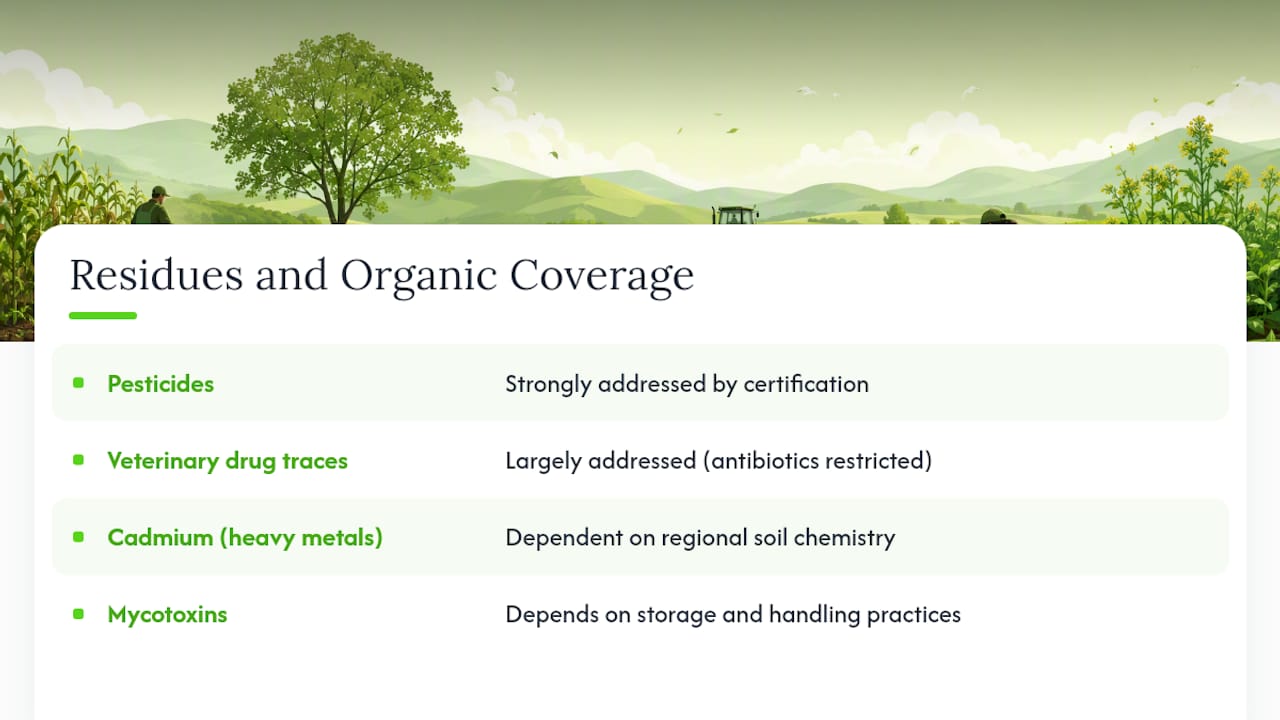
Pesticide residue dominates the organic-versus-conventional conversation, but it isn’t the only chemical difference between the two systems. Heavy metals like cadmium enter crops largely through fertiliser use and soil composition, not spraying, which makes this a genuinely separate question from pesticide exposure.
Some studies report lower cadmium levels in organic crops, a pattern tied to restrictions on certain synthetic fertilisers rich in the mineral. The effect isn’t universal. Cadmium uptake depends heavily on regional soil chemistry, so a crop grown organically in one region can still carry more cadmium than a conventionally grown crop from soil with naturally lower background levels elsewhere. Farming method interacts with geography here rather than overriding it.
Other residues worth knowing about include veterinary drug traces in animal products and mycotoxins, natural toxins produced by fungi that can affect both organic and conventional grain if storage conditions are poor. Neither farming system has an automatic advantage on mycotoxins. Storage and handling practices matter more than certification status.
The practical takeaway is that “chemical residue” covers a wider category than pesticide spray alone, and organic certification addresses some of that category strongly (pesticides, antibiotics) while leaving other parts (regional heavy metal background levels, storage-related toxins) largely untouched. Anyone buying organic specifically to avoid heavy metals should treat it as a partial measure, not a complete one, and pay attention to where their food is actually grown.
What long-term studies say about chronic disease risk
Long-term epidemiological data on organic consumption and chronic disease is the thinnest part of this whole picture, and it’s worth being honest about that. Most of what exists comes from cohort studies that track self-reported eating habits over years, not randomised trials that control for confounding variables directly.
The French Nutrinet-Santé cohort remains the most frequently cited example, linking higher organic food consumption with reduced cardiometabolic risk markers, including lower rates of overweight and obesity. Cancer risk has also been examined in cohort data, with some studies reporting lower incidence among frequent organic consumers, though the effect sizes vary and the studies can’t separate the influence of an organic diet from the broader healthier lifestyle patterns that tend to accompany it.
That confounding problem doesn’t go away with a bigger sample size. Cohort studies, however large, are observational by design. They can flag a pattern worth investigating; they cannot prove that organic food itself, rather than the vegetables, exercise habits or income bracket that come along with buying it, drives the outcome. Genuinely settling the chronic disease question would need decades-long randomised controlled trials that assign people to organic versus conventional diets and follow real disease incidence, a study design that’s expensive, logistically difficult and essentially unprecedented at the scale needed for statistical power.
Until that evidence arrives, the honest position is that organic consumption correlates with better chronic disease markers in the population data available. Correlation, in this case, is doing a lot of the heavy lifting on its own.
Can choosing organic food improve your wellbeing beyond nutrition?
There’s a psychological dimension to this that rarely makes it into scientific reviews, but it shows up consistently in how people describe their own experience. Choosing organic food often comes with a sense of agency, a feeling that you’re making a deliberate decision about what enters your body and your household, rather than defaulting to whatever’s cheapest or most convenient.
That sense of control has a plausible link to stress reduction, even without a specific trial measuring it directly. Feeling like you have some influence over your environmental exposure, particularly around pregnancy or a child’s early years, can ease a specific kind of background anxiety that health-conscious people often describe, even if it’s never been formally quantified in a peer-reviewed trial.
There’s also a social layer. Organic and farmers’ market shopping tends to build more direct relationships with food sources and, in some communities, a stronger sense of connection to local producers and seasonal eating rhythms. That’s harder to measure than a pesticide biomarker, but it’s not nothing. Wellbeing research more broadly recognises that a sense of purpose and control over daily choices contributes to overall life satisfaction, and food choices are one of the most frequent, tangible decisions most people make every single day.
None of this replaces the biomarker and cohort evidence covered earlier. It sits alongside it, as a real but harder-to-measure part of why organic choices matter to the people who make them.
An editorial take on the organic health debate
The gap between what gets said about organic food and what the evidence actually supports is wider than most people assume, and it runs in both directions. Sceptics dismiss the entire category as marketing, which ignores genuinely solid biomarker trial data on pesticide reduction. Enthusiasts treat every organic label as a health guarantee, which ignores how thin the long-term disease evidence still is.
The conventional advice, buy everything organic if you can afford it, isn’t wrong exactly, but it misses the point of where the evidence is strongest. Pregnancy, early childhood and high-residue produce are where the biology makes the clearest case. Spending the same budget on organic biscuits or processed snacks buys you almost nothing beyond the same biscuit with a different label.
What I’d prioritise, based on everything the research actually shows: soil-grown produce with high residue potential, dairy and meat where antibiotic stewardship matters, and life stages where exposure has the most developmental weight. Everything else is a reasonable preference, not a proven health intervention. That distinction should guide where your money goes long before any marketing claim does.
— Arjit
The verdict on organic farming and your health
Pesticide exposure drops reliably when you switch to organic. Nutrient differences are real but modest, and population-level benefits around weight, allergies and pregnancy remain suggestive rather than proven. Prioritise organic where residue and life stage matter most, and lean on Naturessoulshop for both the evidence guides and the actual groceries.
This article is general information, not a substitute for advice from a qualified doctor. Consult a qualified healthcare professional about your own circumstances before acting on anything here.
Sources
- Clinical trials showing reduced pesticide biomarkers after switching to organic diets (PubMed entry)
- Human health implications of organic food and organic agriculture: a comprehensive review (Environmental Health, 2017)


