


For lower environmental impacts per hectare, organic farming generally performs better. For maximum food output per hectare, conventional farming yields more. That single trade-off sits at the heart of almost every debate about which system is “better” — and the honest answer is that neither wins across every metric.
The core trade-offs, in brief:
- Yields: Organic systems produce 19–25% less on average than conventional, though the gap narrows sharply for some crops and widens for others.
- Biodiversity and soil health: Organic management consistently increases species abundance and soil carbon per hectare, but per-kilogram comparisons can flip the result for greenhouse gas emissions.
- Prices and profits: Organic price premiums often offset lower yields for farmers, but they push food costs higher for consumers and raise access and equity concerns.
The rest of this guide unpacks each of those trade-offs with evidence from peer-reviewed meta-analyses, long-term trials, and UK-relevant context — so you can judge the claims yourself rather than rely on marketing copy.
Key takeaways
| Point | Details |
|---|---|
| Yield gap is real but variable | Organic yields average 19–25% lower, with cereals at the larger end and legumes at the smaller end. |
| Environmental benefits are per-hectare | Biodiversity and soil carbon gains are consistent, but GHG advantages often reverse when measured per kilogram of food. |
| Nitrogen leaching is management-sensitive | Organic can reduce N leaching on average, but poor timing of green manure incorporation can produce the opposite result. |
| Profitability often holds up | Price premiums typically offset lower yields, but only when farmers have access to premium market channels. |
| Diet change amplifies impact | Reducing ruminant meat consumption delivers larger land-use and emissions benefits than switching farming system alone. |
Table of Contents
- How do organic and conventional farming compare across key outcomes?
- What do “organic” and “conventional” actually mean in the UK?
- What does the evidence say about organic yields?
- How does each system affect biodiversity, soil, water, and climate?
- Does organic food reduce your pesticide exposure?
- What are the economics for farmers and consumers?
- Can organic farming scale to feed the UK?
- What does the research actually prove, and where is it uncertain?
- What can consumers, farmers, and policymakers do right now?
- A perspective on reading the evidence honestly
- Sources
How do organic and conventional farming compare across key outcomes?
| Dimension | Organic farming | Conventional farming | Context notes |
|---|---|---|---|
| Yields (per hectare) | 19–25% lower on average | Higher | Gap varies by crop |
| Biodiversity | Higher abundance and richness | Lower in most studies | Effect strongest in simple arable landscapes |
| Soil carbon | Generally higher | Lower under continuous tillage | Temporal scale matters; gains take years |
| Nitrogen leaching | Often lower, but variable | Often higher | Management-sensitive; timing of ploughing is critical |
| GHG emissions per hectare | Often lower | Often higher | Reverses per kg of product due to yield gap |
| GHG emissions per kg product | Often higher | Often lower | LCA functional unit is decisive |
| Farmer profitability | Often comparable or better | Higher gross output | Premiums and lower input costs offset yield loss |
| Consumer prices | Around 20% premium typical | Lower | Raises equity and access concerns |
| Food security / land use | Needs more land for same output | More land-efficient | Depends on diet change and waste reduction |
| Pesticide residues on food | Lower synthetic residues | Higher synthetic residues | Organic is not pesticide-free |
| Occupational pesticide exposure | Lower for synthetic chemicals | Higher | Approved natural pesticides still used in organic |
Typical yield gap: Meta-analyses report a mean organic–conventional yield gap of 19–25%, but this figure masks enormous variation by crop, region, and management intensity. Treat it as a starting point, not a fixed rule.
What do “organic” and “conventional” actually mean in the UK?
The word “organic” has a legal definition in the UK. After Brexit, the UK retained the EU organic regulation framework under domestic law, administered by the Department for Environment, Food and Rural Affairs (DEFRA) and enforced through approved certification bodies including the Soil Association, Organic Farmers and Growers (OF&G), and the Biodynamic Association. A product can only be labelled organic if the farm or processor holds a valid certificate from one of these bodies and submits to annual inspection.
What certification actually prohibits is specific and extensive. Synthetic fertilisers, synthetic pesticides, and genetically modified organisms (GMOs) are all banned. So are growth regulators, routine antibiotic use in livestock, and most synthetic food additives in processed organic products. Buffer zones between organic fields and neighbouring conventional land are required to reduce spray-drift contamination, and strict commingling rules govern how organic and non-organic produce is handled and stored.
Organic farming is a system-level approach, not simply a swap of one input for another. Its core practices include:
- Planned multi-year crop rotations to break pest and disease cycles
- Cover crops and green manures to fix nitrogen and protect soil structure
- Compost and farmyard manure to build soil organic matter
- Biological controls (predatory insects, trap crops, pheromone traps) instead of synthetic pesticides
- Mechanical weeding rather than herbicides
Conventional farming, by contrast, is not a single system. It spans everything from high-input arable operations using synthetic nitrogen fertilisers and multiple pesticide applications, to lower-input mixed farms that already adopt some conservation practices such as minimum tillage or integrated pest management (IPM). The word “conventional” in research papers usually means the mainstream comparison system in a given country or trial, which can vary considerably.
Pro Tip: When assessing a product’s environmental credentials, look beyond the word “organic” on the label. Check which certification body issued the certificate — the Soil Association’s standards are among the most stringent in the UK — and whether the producer uses direct-sale or short-supply-chain routes, which reduce post-farm environmental costs.
What does the evidence say about organic yields?
The yield gap is real, well-documented, and context-dependent. A landmark review published in Science Advances found that organic yields are typically 19–25% lower than conventional, drawing on numerous meta-analyses. But that headline figure conceals a wide distribution.
Sources: Science Advances meta-analysis review; Frontiers in Sustainable Food Systems global meta-analysis.
A global meta-analysis in Frontiers in Sustainable Food Systems added an important nuance: organic systems not only yield less on average, they show greater yield variability from year to year. That variability matters for farm business planning and for food supply stability. The same analysis found that profitability was often comparable or better under organic, largely because price premiums compensated for lower volumes.
Yield stability under stress is a separate question. Higher soil organic matter in organic systems can improve water-holding capacity, which may buffer yields during drought. Evidence here is promising but not yet conclusive at scale. Long-term lysimeter trials, including a 32-year experiment reported in Frontiers in Agronomy, found organic dry matter yields at around 64.7% of the best management practice conventional comparator — a larger gap than the global average, illustrating how specific management conditions can push outcomes well outside the typical range.
For UK arable systems, where wheat and barley dominate, the yield gap is likely towards the larger end of the range. That has direct implications for land use if organic production were to scale significantly.
How does each system affect biodiversity, soil, water, and climate?
Biodiversity
The evidence here is among the most consistent in the whole debate. The global meta-analysis in Frontiers in Sustainable Food Systems found organic farms reliably support higher species abundance and richness across taxa including plants, insects, birds, and soil organisms. The effect is strongest in intensively farmed arable landscapes, where the contrast with conventional management is sharpest. In already-diverse mixed or pastoral landscapes, the biodiversity uplift from organic certification is smaller.
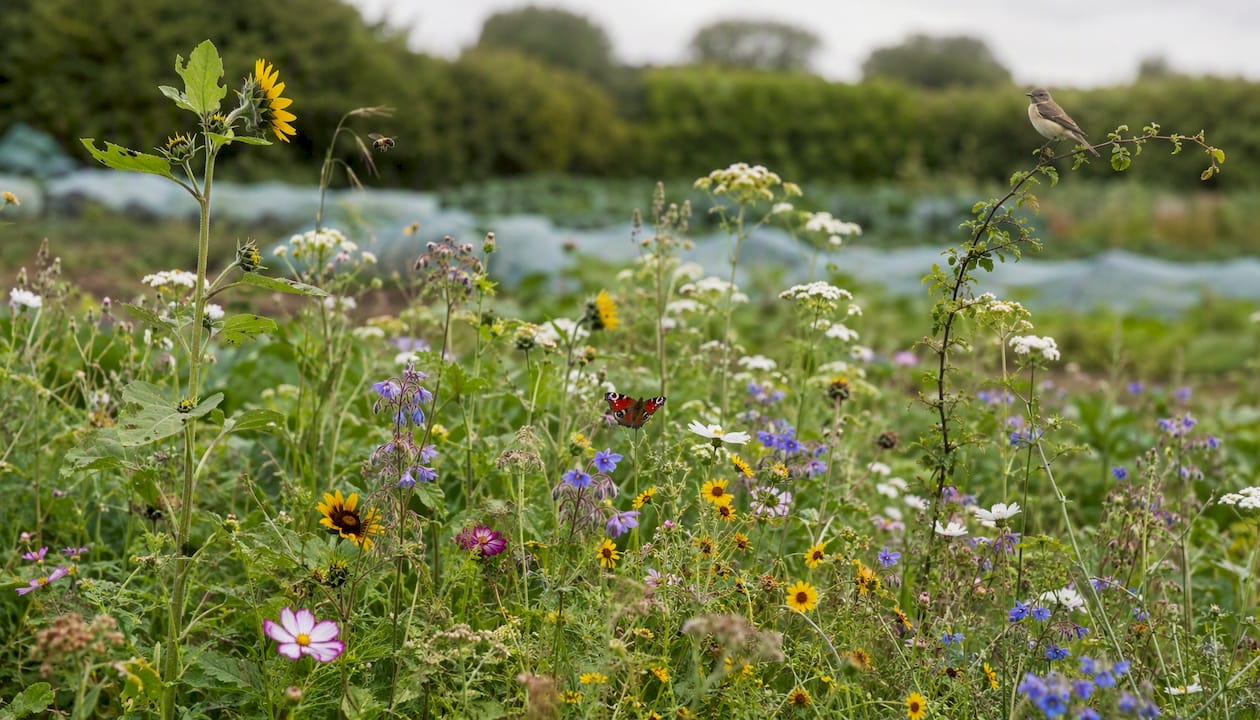
Certification standards are part of the reason organic systems deliver consistent biodiversity benefits. Prohibiting synthetic pesticides removes a major pressure on non-target species, and the structural diversity of organic rotations creates more varied habitats than monoculture-dominated conventional systems.
Soil health and carbon
Organic management generally builds soil organic matter faster than conventional tillage-based systems, partly because compost and manure applications add carbon directly, and partly because diverse rotations with cover crops reduce bare-soil periods. Higher soil organic matter improves structure, water retention, and long-term fertility. For a deeper look at why soil organic matter, the mechanisms are worth understanding in their own right.
The carbon sequestration benefit is real but should not be overstated. Gains accumulate slowly, are reversible if management changes, and depend heavily on baseline soil conditions and rotation design.
Water quality and nitrogen leaching
This is where the picture gets complicated. Many organic practices reduce nitrate leaching: lower nitrogen inputs, longer rotations, and cover crops all help. A meta-analysis cited in the long-term lysimeter study reported median nitrate leaching reductions for organic systems, though results vary considerably. But the same lysimeter trial found that one organic treatment produced higher annual nitrogen loads in seepage (26.1 kg ha⁻¹) compared to the best management practice conventional system (20.5 kg ha⁻¹), because the timing of legume ploughing released nitrogen at the wrong point in the season.
The lesson is that organic does not automatically mean lower nitrogen losses. Optimised management, particularly the timing of green manure incorporation and catch-crop establishment, is what determines the outcome.
Greenhouse gas emissions
Life-cycle comparisons are highly sensitive to the functional unit chosen. Per hectare, organic systems often emit less greenhouse gas because they use no synthetic nitrogen fertiliser (whose production is energy-intensive) and support higher soil carbon. Per kilogram of product, the picture often reverses: because conventional systems produce more per hectare, their emissions are spread across more units of food, giving a lower carbon footprint per kilogram in many crop categories.
Neither metric is “correct” — they answer different questions. Per-hectare figures matter for landscape-level climate policy; per-kilogram figures matter for the carbon footprint of a specific food product.
Pro Tip: When reading environmental claims about organic food, check whether the figure cited is per hectare or per kilogram. A claim that “organic farming emits less carbon” may be true per hectare and false per kilogram for the same crop. Always ask which functional unit the comparison uses.
Does organic food reduce your pesticide exposure?
Organic certification does reduce exposure to synthetic pesticide residues, both for consumers and for farm workers. Studies consistently find lower synthetic pesticide residues on organic produce compared to conventional. For farm workers, the occupational exposure reduction is particularly significant: conventional arable farming involves repeated applications of herbicides, fungicides, and insecticides, each carrying some level of exposure risk.
The key caveat, though, is one that marketing rarely mentions: organic is not pesticide-free. UK organic standards permit a range of naturally derived substances including copper-based fungicides, sulphur, pyrethrin, and various plant-derived compounds. Biological controls such as predatory mites, nematodes, and pheromone-based traps are also widely used. Buffer zones and commingling rules reduce but cannot eliminate the risk of spray drift from neighbouring conventional fields.
Key points on pesticide exposure:
- Synthetic pesticide residues on organic produce are substantially lower than on conventional produce in most monitoring surveys.
- Approved natural pesticides used in organic systems are not without environmental or health effects; copper, for instance, accumulates in soil with repeated use.
- Occupational exposure for organic farm workers to synthetic chemicals is lower, though physical labour intensity is often higher.
- The UK’s Expert Committee on Pesticide Residues in Food (PRiF) monitors residue levels in both organic and conventional produce annually.
On nutrition, the evidence is more limited. For a fuller look at nutritional differences in organic foods, the picture is nuanced: effect sizes are generally small and the clinical significance for most consumers is uncertain.
A large-scale European monitoring programme found that synthetic pesticide residues were detected in around 44% of conventional produce samples but in a substantially lower proportion of organic samples, though residues above legal limits were rare in both categories.
What are the economics for farmers and consumers?
Organic farming costs more to run, but not always in the ways people expect. Synthetic fertiliser and pesticide bills are lower or eliminated. What rises is labour: mechanical weeding, manual pest scouting, and the management complexity of diverse rotations all demand more time per hectare. Transition costs are also significant. The UK organic conversion period is typically two years, during which a farm must follow organic standards but cannot yet sell produce at organic prices. DEFRA and the Countryside Stewardship scheme offer some conversion support payments, but they do not fully bridge the income gap for most farms.
Once certified, price premiums are the main economic lever. The global meta-analysis found that profitability was often comparable or better under organic precisely because premiums compensated for the yield loss. But premiums depend on market access, and not all organic farmers can reach premium channels.
For consumers, the price gap is real and raises equity concerns. Organic food in UK supermarkets typically costs more than its conventional equivalent, which means lower-income households face a higher barrier to accessing organic produce. Local sourcing and direct-sale models, including box schemes and farmers’ markets, can narrow that gap. Understanding what local sourcing means in practice helps explain why proximity to the farm often matters as much as the certification label.
Key economic decision points for farmers considering conversion:
- Model cash flow through the two-year conversion period before committing.
- Identify premium market routes (direct sales, box schemes, wholesale organic buyers) before converting, not after.
- Factor in labour costs honestly: organic systems are more management-intensive, not just input-substituted.
- Consider partial conversion of the most suitable fields first, rather than whole-farm conversion in one step.
Pro Tip: UK farmers considering organic conversion should contact the Organic Research Centre (ORC) or the Soil Association’s farming team before starting. Both offer free or low-cost advisory services and can connect you with farmers who have already made the transition in similar cropping systems.
Can organic farming scale to feed the UK?
This is the question that makes the organic debate genuinely difficult. If the UK converted all its farmland to organic production, the yield gap would require either importing more food, bringing more land into production, or reducing per-capita food consumption. None of those options is straightforward.
The land-use implication is the sharpest concern. That additional land would need to come from somewhere. The most likely sources (semi-natural habitats, woodland, wetlands) are precisely the ecosystems that provide the biodiversity and carbon sequestration benefits that make organic attractive in the first place.
The picture changes significantly if diet shifts alongside farming system change:
- Reducing meat consumption, particularly beef and dairy, releases large areas of grassland and feed-crop land.
- Cutting food waste (currently around one-third of all food produced globally is wasted) reduces the total production requirement.
- Integrating organic practices into conventional systems, rather than requiring full certification, could deliver many of the environmental benefits at a smaller yield cost.
The UK produces roughly 60% of its own food by value. A large-scale shift to organic production without accompanying diet change would likely increase import dependency, shifting environmental costs rather than eliminating them.
Scenarios that combine reduced meat consumption, lower food waste, and targeted adoption of organic practices in the most environmentally sensitive areas are more plausible than whole-system conversion. The environmental impact of food choices extends well beyond the farming method to include what is grown, how much is wasted, and how far it travels.
What does the research actually prove, and where is it uncertain?
The strongest evidence in this debate comes from two types of study: global meta-analyses that pool results across many trials, and long-term field experiments that track outcomes over decades. Both have limitations worth understanding.
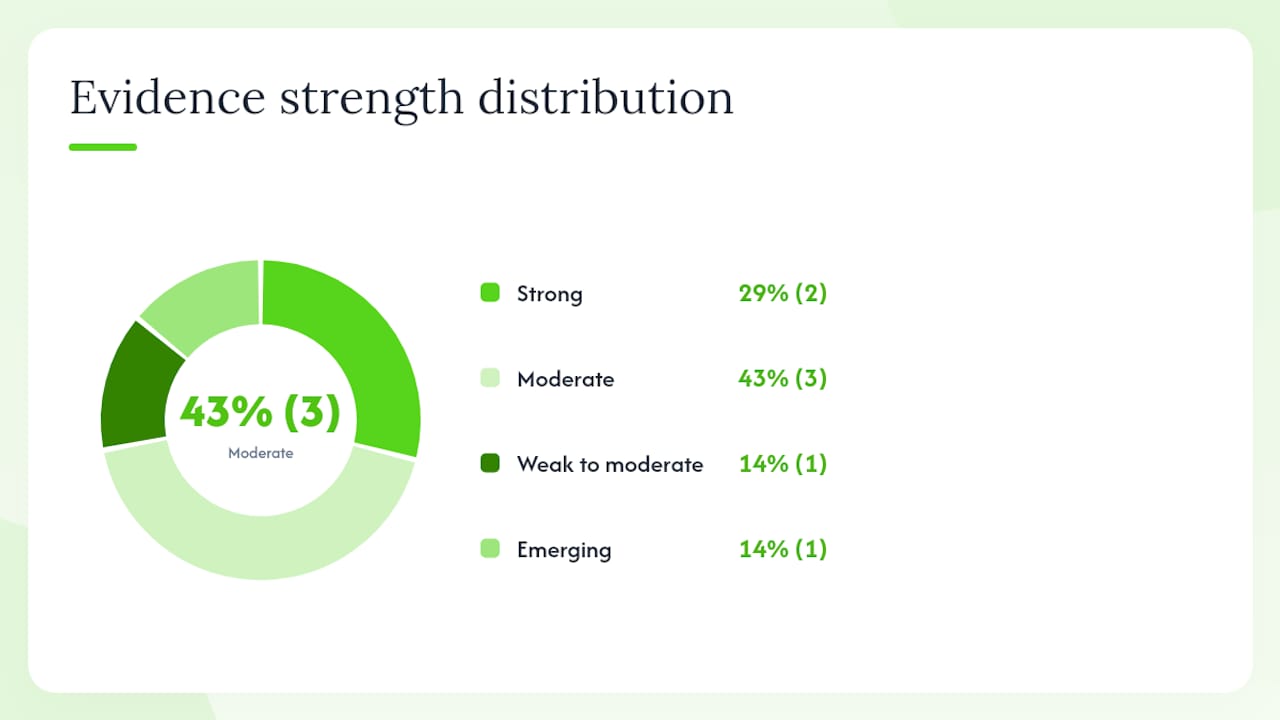
| Outcome | Evidence strength | Key caveat |
|---|---|---|
| Organic yields lower on average | Strong (multiple meta-analyses) | High heterogeneity; crop and management specific |
| Organic biodiversity benefits | Strong | Effect size varies with landscape context |
| Soil carbon gains under organic | Moderate | Slow accumulation; reversible; baseline-dependent |
| N leaching lower under organic | Moderate | Management-sensitive; some trials show opposite |
| GHG per ha lower under organic | Moderate | Reverses per kg in most crop categories |
| Nutritional differences | Weak to moderate | Small effect sizes; clinical significance unclear |
| Long-term yield stability | Emerging | Drought resilience promising but not yet conclusive |
The Science Advances review is the most cited synthesis for yield comparisons and is worth reading for its treatment of context dependence. The long-term lysimeter study provides rare multi-decade experimental data on nitrogen dynamics. The Our World in Data analysis offers the clearest lay summary of why blanket statements about organic being “better for the environment” are misleading.
Common methodological problems across the literature include: geographical bias towards high-income countries (most trials are in Europe and North America); heterogeneity in what counts as “conventional” in the comparison arm; short trial durations that miss long-term soil transitions; and the functional unit problem in life-cycle assessments, where per-hectare and per-kilogram metrics give systematically different conclusions.
For UK policy, the research gaps that matter most are: long-term UK-specific trials across major crop types; evidence on hybrid systems that adopt organic practices without full certification; and economic modelling of transition pathways that account for diet change and waste reduction.
The single most important methodological point for general readers: always ask whether an environmental comparison is reported per hectare or per kilogram of food produced. The answer changes the conclusion for greenhouse gas emissions in most crop categories.
What can consumers, farmers, and policymakers do right now?
For consumers
- Choose certified organic produce for the food categories where pesticide residue reduction matters most to you, such as soft fruits and leafy vegetables, which tend to carry higher residue loads in conventional production.
- Reduce meat consumption, particularly beef: the land-use and emissions impact of diet change exceeds the impact of switching from conventional to organic within the same food category.
- Buy from local, direct-sale sources where possible. Short supply chains reduce post-farm environmental costs and often support smaller farms that use lower-input methods even without full organic certification.
- Check certification body standards. The Soil Association’s standards are among the most demanding in the UK; other bodies certify to the legal minimum.
For farmers
- Adopt organic practices incrementally: cover crops, longer rotations, and reduced synthetic nitrogen inputs deliver environmental benefits without requiring full conversion.
- If considering full conversion, model the economics of the transition period carefully and secure premium market routes before committing.
- Use the sustainable agriculture practices framework to identify which system-level changes give the best return on environmental investment for your specific farm type.
- Engage with long-term trial networks and farmer knowledge-exchange groups; the Organic Research Centre and NIAB both run UK-relevant programmes.
For policymakers
- Target agri-environment payments at the practices with the strongest evidence base (cover crops, diverse rotations, reduced synthetic nitrogen near watercourses) rather than at certification status alone.
- Fund long-term UK-specific trials to fill the evidence gaps that currently make it hard to give confident advice for British cropping systems.
- Address market structure failures that prevent organic price premiums from reaching smaller farms and that limit consumer access to affordable organic produce.
Pro Tip: For UK policymakers and supply-chain buyers, the most cost-effective intervention is likely not full organic conversion subsidies but targeted payments for specific high-impact practices — reduced nitrogen near sensitive water bodies, diverse rotations in arable systems, and permanent cover on erosion-prone land. The evidence base for these practices is stronger and the yield cost is lower than whole-system conversion.
For a broader view of how food system sustainability works in practice, the 2026 food services sustainability guide covers procurement and operational dimensions that complement farm-level choices.
A perspective on reading the evidence honestly
The organic farming debate attracts more motivated reasoning than almost any other topic in food and agriculture. Advocates overstate the environmental benefits; critics overstate the yield costs. Both sides tend to pick the functional unit that flatters their position.
What the evidence actually supports is more nuanced and, frankly, more useful. Organic systems reliably deliver biodiversity and soil carbon benefits per hectare. They reliably yield less. Whether that trade-off is worth making depends on what you are trying to achieve, at what scale, and in what landscape. A small mixed farm in a biodiversity-sensitive area of the UK is a very different case from a large arable operation in East Anglia where food output per hectare is the dominant concern.
The thing that gets underweighted in most coverage is the role of diet. The single largest lever available to UK consumers who care about land use and emissions is not switching from conventional to organic food — it is reducing consumption of ruminant meat and dairy. That shift releases more land, reduces more emissions, and costs less than any farming system change. Organic farming matters, but it matters most when it is part of a broader food system shift, not a substitute for one.
At Naturessoulshop, the evidence shapes which products are stocked and how they are described. The brand’s commitment to clean ingredients and certified organic sourcing reflects a genuine reading of the biodiversity and pesticide-exposure evidence, not a marketing position. But the honest version of that commitment acknowledges the yield trade-offs and the importance of context.
Sources
The sources below represent the strongest evidence base for the claims in this guide. Each is peer-reviewed or produced by a recognised research or policy institution.
- Many shades of gray—The context-dependent performance of organic agriculture | Science Advances
- Frontiers | Organic Farming Provides Reliable Environmental Benefits but Increases Variability in Crop Yields: A Global Meta-Analysis
- Is organic agriculture better for the environment? | Our World in Data
- Training manual for ORGANIC AGRICULTURE
- Nature
- Organic farming practices | Rodale Institute
Most important source for general readers: The Science Advances meta-analytic review (“Many shades of gray”) is the single best starting point for understanding yield comparisons, because it explicitly models how context changes the outcome rather than reporting a single average.
For more on the environmental impact of organic food choices and how they connect to broader sustainability goals, Naturessoulshop’s resource library covers the evidence from a consumer perspective. If you are ready to put the evidence into practice, Nature’s Soul Shop stocks certified organic produce, dry grocery, dairy, and home care products sourced to the standards discussed throughout this guide.


