


No, non-GMO foods are not inherently healthier than their approved genetically modified counterparts. The World Health Organization, the FDA and the National Academies of Sciences, Engineering and Medicine (NASEM) have each reviewed the evidence and found no consistent difference in nutrition or safety between the two. Where genuine health risk exists, it usually traces back to farming practices, not the genetic trait itself.
TL;DR:
- Regulatory reviews and chemical analyses consistently show no significant nutritional or safety differences between GMO and non-GMO foods.
- Concerns about pesticides like glyphosate depend more on farming practices and exposure levels than on GMO status itself.
- Genetic modifications that improve nutrition, such as golden rice or altered oils, are evaluated individually and can offer health benefits.
- Labels like non-GMO, organic, and bioengineered serve different purposes, with organic standards banning GMOs and restricting pesticides, while non-GMO is a voluntary certification.
- Focusing on overall diet quality and fresh, minimally processed foods has a far greater impact on health than selecting foods based solely on GMO labels.
Table of Contents
- Are non-GMO foods healthier? What the evidence actually says
- Pesticides, herbicides and farming systems: why non-GMO can still matter
- When genetic engineering makes food more nutritious
- Non-GMO vs organic vs bioengineered labelling: what you’re actually buying
- What actually matters most when you shop
- Why the non-GMO debate misses the point
- Shop verified organic and non-GMO groceries with Nature’s Soul Shop
- Sources
Are non-GMO foods healthier? What the evidence actually says
The short version: regulators keep looking for a health gap between GMO and non-GMO foods, and they keep not finding one worth worrying about. That’s not a dodge. It’s the conclusion of three separate reviewing bodies working from different data sets.
The FDA states plainly that GMO foods currently sold have passed safety assessments and don’t present unusual risks, with routine allergenicity and compositional testing built into approval. The WHO takes the same line internationally, evaluating GM foods case by case and finding no acute health risk in what’s already on shelves. NASEM went further, digging through the original research behind decades of GM crop approvals, and concluded that foods from genetically engineered crops aren’t more likely to cause harm than their conventional equivalents.
There’s an honest caveat buried in that NASEM review, though. Detecting a small, slow-building health effect across a whole population is genuinely hard. Chronic disease has dozens of contributing factors, and isolating “GMO consumption” as a variable is close to impossible with observational data. That’s a limitation of population science generally, not evidence that something is being hidden.
The weight of evidence rests on three main pillars:
- Regulatory reviews — pre-market safety assessments covering toxicity, allergenicity and nutritional equivalence.
- Epidemiological data — population-level comparisons of disease rates in regions with high versus low GMO consumption.
- Compositional analyses — direct chemical comparison of GM and non-GM crop varieties, which typically fall within natural variation.
Across all three, the pattern holds: no demonstrated gap in cancer rates, allergies, or chronic disease tied to GMO consumption specifically.
Pesticides, herbicides and farming systems: why non-GMO can still matter
Here’s where the “non-GMO is better” instinct isn’t wrong so much as pointed at the wrong target. The genetic trait itself rarely causes harm. What surrounds it, the farming system built around that trait, sometimes does.
Herbicide-tolerant crops let farmers spray glyphosate liberally without killing the crop, and some regions have seen herbicide use rise as a result, even while insect-resistant Bt varieties cut insecticide use elsewhere. It’s a mixed picture, trait by trait.
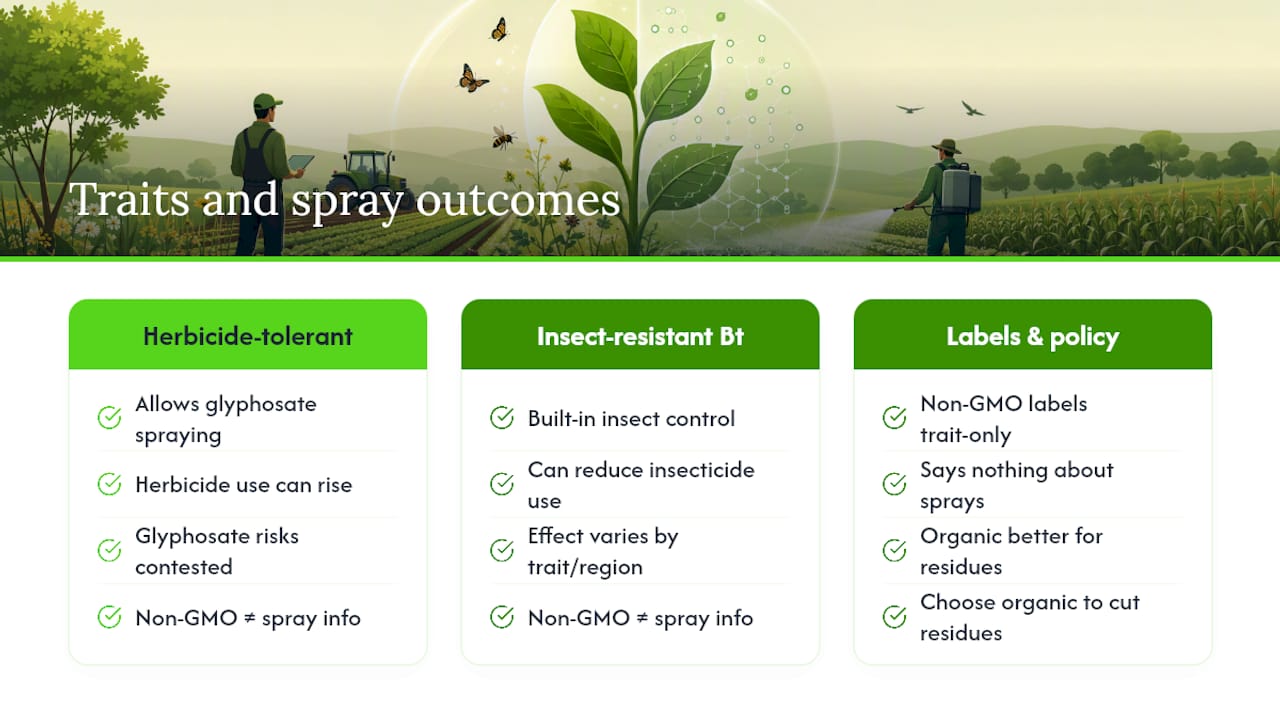
Glyphosate itself carries the more contested evidence. A widely cited review found a 41% relative-risk increase for non-Hodgkin lymphoma among people with high glyphosate exposure, though other reviews interpret the same data more cautiously, and real-world exposure levels vary hugely by occupation and region.
If pesticide residue is your actual concern, and for many shoppers it is, organic certification is the stronger lever to pull, not a “non-GMO” label. Non-GMO says nothing about spray regimes. You can read more on glyphosate exposure risks if this is the part that worries you most.
When genetic engineering makes food more nutritious
Genetic modification isn’t a single thing with one health direction. It’s a toolkit, and some applications specifically boost nutrition rather than risk it.
Golden rice is the standard example: engineered to produce beta-carotene, it was developed to fight vitamin A deficiency in populations where rice is a dietary staple and where deficiency causes preventable blindness. Modified soybean oil profiles are another, altering fat composition to reduce trans fats in processed food.
These benefits are trait-specific. They don’t generalise to “GMOs are good for you” any more than a single risky trait generalises to “GMOs are bad for you.” Each modification goes through its own safety and nutritional evaluation before approval, which is exactly why blanket statements in either direction tend to oversimplify the science.
- Golden rice: engineered for vitamin A content, aimed at deficiency-related blindness prevention.
- Modified oil crops: altered fat profiles to reduce trans fat in food supply.
- Case-by-case regulation: each nutrient-enhanced trait is assessed individually, not approved as a category.
Non-GMO vs organic vs bioengineered labelling: what you’re actually buying
Supermarket labels promise different things, and mixing them up leads to wasted money or false reassurance.
- Non-GMO Project Verified is a private, voluntary certification. It confirms a product avoids genetically engineered ingredients and nothing more. It says nothing about pesticide use.
- Mandatory bioengineered labelling is the newer, legally required disclosure that a product contains detectable genetically engineered material. It’s a transparency label, not a safety rating.
- USDA Organic (or equivalent organic standards elsewhere) prohibits GMOs entirely and also restricts synthetic pesticide and fertiliser use, alongside rules on soil management and animal welfare.
The practical distinction: organic and non-GMO standards differ in scope, and organic covers considerably more ground. If avoiding synthetic pesticide residue is your priority, reach for organic. If avoiding genetic engineering specifically is the goal, either label works, but they’re answering different questions.
What actually matters most when you shop
Chasing a single label misses the bigger picture. Diet quality overwhelmingly comes down to how whole and minimally processed your food is, how varied your intake is, and how much of your plate is fresh produce versus packaged product. That’s a bigger lever than GMO status by a wide margin, a point the WHO itself makes when it frames dietary pattern as the priority over any single ingredient flag.
That said, some situations justify tighter precaution. Pregnancy, infant feeding, and any context involving high cumulative pesticide exposure are reasonable moments to lean organic rather than relying on price or convenience.
A workable shopping checklist, informed by food quality standards,:
- Prioritise fresh produce and animal products for organic certification first. That’s where pesticide residue and hormone exposure concentrate.
- Reserve strict non-GMO sourcing for packaged goods where engineered ingredients (soy, corn, canola derivatives) are common fillers.
- Treat processing level as your first filter, engineered or not, ultra-processed food carries its own separate risks.
Pro Tip: If you can only afford organic on a handful of items, spend it on the produce you eat with the skin on, and on dairy and meat. Buying non-GMO packaged snacks while ignoring produce sourcing gets the priorities backwards.
Why the non-GMO debate misses the point
The conventional advice on this topic treats “non-GMO” as a proxy for “healthier,” and that’s the part I’d push back on hardest. It’s a category error. Genetic engineering is a technique, not a health outcome, and lumping golden rice in with herbicide-tolerant soy under one banner obscures more than it reveals.
Where the real signal sits is in farming systems and processing, not gene-splicing. If you’re worried about glyphosate, buy organic. If you’re worried about ultra-processed ingredients, read the ingredient list, not the GMO badge. Most shoppers I’d wager have never separated those two concerns, and retailers haven’t exactly rushed to clarify it for them.
What should come first, before any label chasing, is dietary pattern: more whole food, less packaged filler, and a bit of scepticism towards labels sold as shortcuts for judgement you’d otherwise have to exercise yourself.
— Arjit
Shop verified organic and non-GMO groceries with Nature’s Soul Shop
Nature’s Soul Shop gives you a direct route to genuinely certified organic and non-GMO groceries without picking through supermarket labelling yourself. Every category, fresh produce, dairy, dry grocery, vegan and gluten-free lines, goes through supply chain verification before it reaches you, with same-day delivery across Delhi NCR.
If pesticide exposure is your main concern, start with the fresh organic produce range, since that’s where residue avoidance matters most according to the evidence above. Browsing the wider health category is a good next step for supplements and wellness staples alongside your grocery order. Visit Nature’s Soul Shop to place your order today.
This article is general information, not a substitute for advice from a qualified doctor. Consult a qualified healthcare professional about your own circumstances before acting on anything here.
Sources
Nature’s Soul Shop applies supply chain checks and recognised certifications before a product lands on a shelf. That doesn’t mean every claim is beyond scrutiny, it means sourcing decisions follow the same evidence hierarchy this article has walked through: farming system first, ingredient engineering second.
For readers who want to go deeper:
- Understanding GMOs (FDA resource)
- Food, genetically modified (WHO Q&A)
- Genetically engineered crops: safety, risks and public concerns — National Academies (NCBI)
- Roundup and non‑Hodgkin’s lymphoma (Medical News Today summary)


