


Regulatory bodies including the FDA and WHO consider currently marketed GMO foods as safe to eat as their conventional counterparts, based on decades of compositional and safety review. Choosing non-GMO or organic instead is usually driven by environmental concerns, pesticide exposure, or personal values rather than proven nutritional gaps. Naturessoulshop stocks both non-GMO and organic ranges for shoppers who want that choice without the guesswork.
TL;DR:
- Most GMO crops like corn, soy, and canola are used mainly in processed foods, making GMO content widespread in packaged products.
- Bioengineered labels only confirm detectable genetic modification, but refined ingredients like sugar and oils may be GMO-derived without disclosure.
- The scientific consensus affirms that approved GMO foods are as safe to eat as their conventional counterparts, with gaps mainly in ecological and long-term monitoring.
- Non-GMO and organic certifications differ: organic prohibits genetic engineering entirely, while Non-GMO projects verify ingredients through testing, but labels are not foolproof.
- Cost premiums for non-GMO or organic foods can range from 10% to 75%, so consumers should weigh scientific evidence, personal values, and budget priorities carefully.
Table of Contents
- GMO and non-GMO foods: what the labels actually mean
- What does the evidence say about GMO food safety?
- Which foods actually contain GMO ingredients?
- How do you read GMO and organic food labels?
- Should you choose non-GMO or organic, and what will it cost you?
- Practical shopping tips for avoiding GMOs
- How are GMOs regulated and approved around the world?
- Why do people disagree so much about GMOs?
- Can GMOs help solve food security and sustainability challenges?
- Author’s perspective: reconciling evidence, cost and values
- Shop non-GMO and organic without the label guesswork
- Sources
GMO and non-GMO foods: what the labels actually mean
Packaging language around GMOs and non-GMO foods gets muddled fast, so start with clean definitions.
A GMO (genetically modified organism) has had its DNA altered in a laboratory, often to resist pests, tolerate herbicides, or survive drought. Bioengineered is the newer, narrower legal term used in the United States under the National Bioengineered Food Disclosure Standard (NBFDS), covering foods where modified genetic material can be detected in the final product. Non-GMO simply means an ingredient wasn’t produced through genetic engineering, whether or not it carries formal certification. USDA organic goes further: it’s a farming and processing standard that prohibits genetic engineering entirely, alongside rules on synthetic pesticides and fertilisers.
The terminology gets more confusing with newer techniques like gene editing (CRISPR), which alters existing DNA rather than inserting foreign genes and sits in a regulatory grey zone in several markets.
Some practical gaps worth knowing before you shop:
- Refined oils and sugars often lose detectable modified DNA during processing, so they can be exempt from bioengineered disclosure even when sourced from GMO crops.
- Meat, poultry, and egg products are generally exempt from NBFDS labelling, even if the animals were fed GMO grain.
- Restaurant and food-service meals aren’t covered by federal disclosure rules at all.
What does the evidence say about GMO food safety?
The scientific consensus is more settled than the public debate suggests. MedlinePlus reports that major regulatory and scientific bodies, including the FDA and WHO, have reviewed GMOs for decades and found currently marketed GMO foods as safe to consume as their conventional equivalents, without evidence of long-term harm.
The consensus figure: decades of regulatory review across multiple countries have not produced evidence linking approved GMO foods to health harm in humans.
That doesn’t mean the science is closed. Here’s what regulators actually test, and where the limits sit:
- Compositional analysis compares nutrients, toxins, and allergens in a GMO crop against its conventional counterpart, looking for unexpected changes.
- Allergenicity screening checks whether a new protein resembles known allergens closely enough to trigger a reaction.
- Feeding studies on animals assess short-term and sometimes longer-term health markers, though these trials rarely run for a lifetime or across multiple generations.
The gaps that remain are less about human health and more about ecology and monitoring. Cross-pollination between GMO and non-GMO crops, herbicide-resistant “superweeds,” and the long-term effects of newer gene-editing techniques are all areas where researchers say more data would help, according to a National Academies review of GE crop safety. Feeding trials and compositional checks are good at catching obvious toxicity or allergen risk. They’re less equipped to detect subtle, cumulative, or ecosystem-level effects that only show up after years of widespread cultivation. That distinction matters if you’re trying to separate “no evidence of harm” from “definitively proven harmless” — they’re not quite the same claim, even if the practical difference for your dinner plate is small.
Which foods actually contain GMO ingredients?
Most people picture GMOs as fresh produce, but the reality is that processed foods carry far more genetically engineered content than the fruit and veg aisle.
The FDA lists the crops grown from genetically engineered seed in the United States: corn, soybean, canola, sugar beet, alfalfa, papaya, summer squash, potato, and a bioengineered variety of salmon. Over 90% of US corn and soy acreage is planted with genetically engineered seed, which matters because those two crops feed directly into thousands of processed products.
Here’s where that shows up on a supermarket shelf:
- Corn becomes high-fructose corn syrup, corn starch, corn syrup solids, and maltodextrin, found in soft drinks, sauces, and baked goods.
- Soy becomes soy protein isolate, soy lecithin, and vegetable oil blends used in everything from protein bars to margarine.
- Canola and sugar beet feed into cooking oils and refined sugar, often with no trace of modified DNA left after processing.
- Alfalfa mostly enters the food chain indirectly, as feed for dairy cattle.
A cereal bar, a bottle of salad dressing, and a packet of biscuits can all contain GMO-derived ingredients without a single obvious GMO crop listed on the front of the pack.
How do you read GMO and organic food labels?
Three separate labelling systems cover this ground, and they don’t mean the same thing.
The NBFDS bioengineered disclosure is the US federal standard. It requires a disclosure, usually a small “Bioengineered” text or symbol, only when modified genetic material is detectable in the finished product. According to a Virginia Tech factsheet on bioengineered labelling, refined ingredients where DNA breaks down during processing, along with small manufacturers and certain meat and dairy products, are exempt. That means the absence of a bioengineered label doesn’t guarantee an ingredient is GMO-free.
Non-GMO Project verification is voluntary and generally considered the more rigorous route. It requires testing of major high-risk ingredients and documented supply-chain controls for inputs that can’t be tested directly, according to the Non-GMO Project. That butterfly seal signals ongoing verification, not a one-off check.
USDA organic certification prohibits genetic engineering outright as part of a broader process standard, per USDA guidance. It doesn’t require routine GMO testing, though, so trace contamination via cross-pollination is technically possible even on certified organic land.
- Bioengineered label present → confirms GMO content, but its absence doesn’t confirm the opposite.
- Non-GMO Project butterfly → tested verification for high-risk ingredients.
- USDA organic seal → GMOs prohibited by process, plus no synthetic pesticides.
- Products can, and often do, carry both organic and Non-GMO Project seals.
Pro Tip: If avoiding GMOs matters to you specifically, look for both the organic seal and the Non-GMO Project butterfly together. One covers farming process, the other covers testing. Together they close most of the gaps either leaves open.
Should you choose non-GMO or organic, and what will it cost you?
Three things should drive this decision: what the evidence actually shows, what you personally prioritise, and what your budget can absorb.
On evidence, the honest answer is that there’s no demonstrated nutritional advantage to non-GMO or organic over conventional GMO-containing foods, though organic produce tends to carry fewer pesticide residues on average, according to National Geographic’s breakdown of food labels. On values, plenty of shoppers choose non-GMO or organic for environmental or ethical reasons that have nothing to do with personal health outcomes, and that’s a legitimate basis for a purchase.
On cost, expect to pay more. Reported premiums for non-GMO or organic products range from roughly 10% to nearly 75% above conventional equivalents, per USDA data, with the widest gaps typically on fresh produce and the smallest on shelf-stable pantry goods.
A quick checklist before you fill the trolley:
- Decide which of the three drivers, health, values, or budget, matters most for this particular purchase.
- Prioritise organic or non-GMO spending on foods you eat whole and often, where any pesticide residue reduction has the most relevance.
- Accept smaller premiums on processed staples, where the ingredient is heavily refined anyway.
- Check for both organic and Non-GMO Project seals if avoiding GMOs specifically is the goal.
Practical shopping tips for avoiding GMOs
A few habits do most of the work here. Buy whole foods over processed ones, since refined ingredients are exactly where GMO content hides behind exemptions. Read ingredient lists rather than front-of-pack claims. Look specifically for Non-GMO Project Verified or USDA organic seals rather than assuming an absent bioengineered label means an absent GMO.
Naturessoulshop’s own guides on what non-GMO foods actually mean and how to identify organic products go deeper on spotting reliable seals while shopping.
How are GMOs regulated and approved around the world?
Approval processes for GMOs vary sharply by country, and that variation is often the biggest source of consumer confusion.
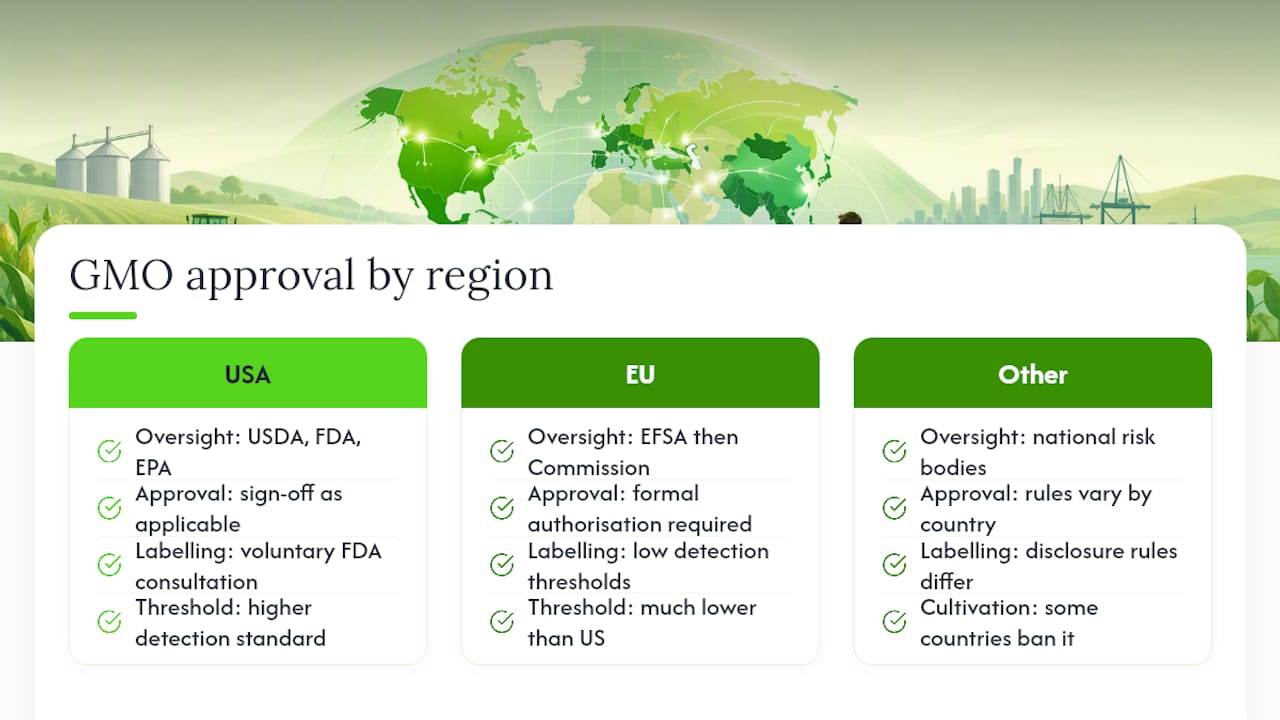
In the United States, three agencies share oversight: the USDA evaluates environmental and agricultural risk, the FDA assesses food safety through voluntary consultation, and the EPA regulates GMOs engineered to produce pesticides. A crop typically needs sign-off from whichever agencies apply to its specific traits before commercial planting.
The European Union runs a stricter, more centralised system. GMOs need approval from the European Food Safety Authority and then formal authorisation from the European Commission before sale, and EU rules require labelling at much lower detection thresholds than the US bioengineered standard. This is part of why so many products sold in Europe carry no GMO content at all, cultivation and import approvals move slowly and face significant public resistance.
Elsewhere, the picture fragments further. Countries including Japan, Australia, and Canada have their own risk assessment bodies with varying thresholds and disclosure rules, while some nations effectively ban GMO cultivation outright even where imports of GMO-derived ingredients are permitted. Newer gene-editing techniques complicate this picture further, since several regulators are still deciding whether CRISPR-edited crops count as “genetically modified” under existing law at all, or fall into a separate, lighter-touch category.
For a global shopper, the practical takeaway is that a product legal and unlabelled in one country might require disclosure, or be barred outright, in another.
Why do people disagree so much about GMOs?
The GMO debate rarely stays confined to safety data, because much of the disagreement is ethical and economic rather than scientific.
Patent control is a recurring flashpoint. A handful of agricultural biotechnology companies hold patents on major GMO seed lines, which critics argue concentrates control over the food supply and limits farmers’ ability to save and replant seed year over year. Supporters counter that patent protection is what funds the research pipeline in the first place.
Corporate concentration in agriculture feeds a related worry: that GMO adoption favours large industrial farms with the capital to license patented seed and buy the associated herbicides, over smallholders working tighter margins. There’s also a transparency argument, that consumers deserve to know what’s in their food regardless of whether regulators consider it safe, which is part of why labelling fights have been so protracted and politically charged.
Public perception surveys consistently show a gap between scientific consensus and consumer sentiment. A meaningful share of shoppers remain wary of GMOs even where regulators have approved them, often citing a general discomfort with unfamiliar technology rather than a specific documented risk. That gap isn’t irrational. It reflects legitimate questions about who controls the food system and whether “safe to eat” fully addresses everything people care about when they choose what to buy.
Can GMOs help solve food security and sustainability challenges?
Global food security is where GMO advocates make their strongest case, and it’s worth taking seriously.
Drought-tolerant and pest-resistant GMO crop varieties have allowed cultivation in regions with poor soil or unreliable rainfall, potentially raising yields where conventional varieties would fail more often. Reduced pesticide spraying on certain pest-resistant crop varieties, such as some GMO cotton and corn lines, can also lower input costs and chemical exposure for farmers working smaller plots.
But the sustainability picture isn’t uniformly positive. Herbicide-tolerant GMO crops have, in some regions, driven heavier use of specific herbicides over time as weeds develop resistance, a trend agronomists watch closely because it can undercut the very efficiency gains GMOs are meant to deliver. Monoculture farming, whether GMO or conventional, also raises separate biodiversity concerns that genetic modification alone doesn’t solve.
The realistic framing is that GMOs are one tool among several, alongside improved conventional breeding, better irrigation infrastructure, and reduced food waste, in addressing global nutrition gaps. Genetic engineering isn’t a silver bullet, and treating it as either the sole solution or the sole villain in the food security conversation oversimplifies a genuinely complicated agricultural picture.

Author’s perspective: reconciling evidence, cost and values
The safety data on GMOs is more settled than most headlines suggest, and I think that gets lost in translation. But settled safety data doesn’t make the non-GMO or organic choice irrational. If pesticide exposure, supply-chain transparency, or supporting smaller-scale farming matter to you, that’s a legitimate basis for spending more, evidence gaps or not. The mistake is assuming you must justify a values-based purchase with a health claim the data doesn’t fully support.
— Arjit
Shop non-GMO and organic without the label guesswork
Reading NBFDS disclosures, hunting for the Non-GMO Project butterfly, and cross-checking organic seals is a lot to do on every supermarket trip. Naturessoulshop does that filtering upfront, stocking fresh produce, pantry staples, and gluten-free lines that are already vetted against organic and non-GMO standards, so you’re not squinting at ingredient lists in the aisle.
The Nature’s Soul Fresh range covers perishables where the organic pesticide-reduction argument matters most, while the wider Naturessoulshop store carries pantry and specialty items across the same clean-ingredient standard. Browse the current range and check what’s in stock for delivery in your area today.
Sources
For readers who want to go straight to primary sources: MedlinePlus covers the safety consensus in plain language, the FDA’s GMO crops page lists approved crops, USDA’s Organic 101 explains organic rules, and the Virginia Tech factsheet unpacks bioengineered labelling exemptions in detail. For a broader look at food quality standards beyond GMOs, Wild Foodz’s guide to smarter dining is a useful industry perspective.
- MedlinePlus: GMO overview
- FDA: GMO crops, animal food, and beyond
- USDA: Organic 101 — Can GMOs be used in organic products?
- Virginia Tech factsheet: GMO, bioengineered labelling, and non‑GMO food


