


Adaptogens are a category of herbs and fungi, including ashwagandha, rhodiola, and Panax ginseng, traditionally used to help the body handle physical or mental stress without causing harm at normal doses. Human trial evidence is genuinely encouraging for a handful of these plants, particularly ashwagandha and rhodiola, but still limited overall. Speak to a doctor or pharmacist before adding one to a routine that includes prescription medicines.
TL;DR:
- Only ashwagandha and rhodiola have substantial human trial data supporting their effects on stress and fatigue.
- Adaptogens primarily modulate the hypothalamic-pituitary-adrenal axis and induce protective proteins, but most evidence is from animal studies.
- Most marketed adaptogens lack rigorous clinical trials, and effects can vary widely between different standardised extracts.
- Safety is generally good at normal doses, but caution is needed for pregnant people, those with autoimmune or thyroid conditions, and individuals on certain medications.
- Standardised products with clear extract content and third-party testing offer more reliable effects than unstandardised powders or vague labels.
Table of Contents
- What does “adaptogen” actually mean, and where did the term come from?
- How do adaptogens work in the body?
- The eight adaptogens you’ll actually encounter, and how strong the evidence is
- What benefits does the research actually support?
- Is it safe to take adaptogens, and what should you watch for?
- Forms, dosing, and how long before you notice anything
- How Naturessoulshop selects and presents adaptogen products
- Beyond cortisol: antioxidant and anti-inflammatory pathways
- Where the evidence leaves us
- Sources
What does “adaptogen” actually mean, and where did the term come from?
The word has a precise, if old-fashioned, scientific definition. Soviet pharmacologist Nikolai Lazarev coined “adaptogen” in the 1940s while researching substances that helped soldiers and factory workers withstand physical strain, and Soviet researchers later formalised three criteria a substance had to meet to earn the label. It had to be non-toxic at normal doses, help the body cope with a broad range of stressors, and support a return to homeostasis rather than push a single organ system in one direction.
That third criterion is the one most modern supplements fail to demonstrate convincingly. Plenty of herbs affect stress hormones, but “normalising” a whole system is a much harder claim to prove than “reduces cortisol in a lab test.”
This is why some scientists and regulators treat the category with caution. “Adaptogen” was never an approved pharmacological classification anywhere; it’s a working concept borrowed from mid-century Soviet pharmacology, not a term with regulatory teeth. Cleveland Clinic and similar clinical resources use it descriptively, while the FDA treats health claims attached to it the same way it treats any unproven drug claim.
How do adaptogens work in the body?
Most research points to the hypothalamic-pituitary-adrenal (HPA) axis, the feedback loop that governs cortisol release when you’re under pressure. Adaptogens appear to blunt an exaggerated cortisol spike and help it settle back down faster once the stressor passes, rather than suppressing the stress response outright.
A second mechanism, hormesis, describes how a small, controlled dose of a mild stressor can prime the body’s own defence systems, similar to how a light workout stimulates muscle adaptation without causing damage. Adaptogens seem to trigger this same low-grade priming effect, partly by inducing heat-shock proteins that help cells manage stress at a molecular level.
The third idea, pleiotropy, is the observation that a single adaptogenic compound rarely acts on just one target. Ginsenosides in ginseng and withanolides in ashwagandha interact with several receptor systems and signalling pathways at once, which may explain why the same plant gets credited with effects on mood, energy, and immune markers.
Reviews of the molecular literature describe adaptogens as agents that modulate the HPA axis, induce protective heat-shock proteins, and act through several molecular pathways simultaneously, while cautioning that much of this mechanistic detail comes from animal and cell studies rather than robust human trials.
That gap between laboratory mechanism and confirmed human outcome is the single most important thing to hold onto while reading any adaptogen claim.
The eight adaptogens you’ll actually encounter, and how strong the evidence is
Not every plant sold as an adaptogen has the same weight of research behind it. Some have real randomised trials; others rest mostly on tradition and preclinical data.
- Ashwagandha (Withania somnifera): the best-studied of the group, with human trials suggesting reductions in perceived stress and cortisol levels in some study populations.
- Rhodiola rosea: NCCIH’s evidence summary describes limited but promising human data for fatigue and stress-related mental performance.
- Panax ginseng: long used for energy and endurance; supports HPA modulation in preclinical work, with more mixed human data on performance.
- Eleutherococcus (eleuthero): historically grouped with ginseng for stamina and resilience under physical strain, again with more animal than clinical data.
- Schisandra chinensis: traditional liver-protective and anti-fatigue herb; human evidence remains sparse.
- Holy basil (tulsi): commonly used for mood and metabolic support; mostly preclinical and small human studies.
- Reishi (Ganoderma spp.): studied mainly for immune modulation and sleep quality rather than stress specifically.
- Cordyceps: researched for stamina and oxygen utilisation, largely in athletic and preclinical contexts.
Ashwagandha and rhodiola currently sit closest to having reproducible human-trial data. The rest range from “some supportive small studies” to “mostly traditional use plus lab research,” which matters when weighing how much confidence to place in a bold label claim.
What benefits does the research actually support?
Stress and fatigue reduction have the strongest, though still modest, evidence base. Several trials on ashwagandha report measurable drops in self-reported stress scores and cortisol over eight to twelve weeks, and rhodiola trials show comparable improvements in perceived fatigue during demanding periods.
The honest caveat is that most of these trials are small, often fewer than 100 participants, run for a matter of weeks, and use different extracts at different doses. That heterogeneity makes it hard to say “ashwagandha does X” with the same confidence you’d apply to a well-established pharmaceutical, because two products labelled ashwagandha may not behave identically.
A realistic framing: adaptogens look like a plausible adjunct for people managing everyday stress or mild fatigue, sitting alongside sleep, exercise, and diet rather than replacing any of them. They are not a substitute for treating diagnosed anxiety disorders, chronic fatigue conditions, or clinical depression, and no current evidence supports using them that way. Where the research is most convincing is in modest, incremental improvement, not dramatic transformation.
Is it safe to take adaptogens, and what should you watch for?
Most adaptogens are well tolerated at typical doses, but “well tolerated” isn’t the same as “risk free for everyone.” Readers should be aware of potential risks and consult resources on red light therapy contraindications when considering new treatments. Mild digestive upset, headache, or drowsiness are the most commonly reported issues.
Certain groups need particular caution:
- Pregnant or breastfeeding people, since safety data is largely absent.
- Anyone with autoimmune conditions, because some adaptogens may stimulate immune activity.
- People with thyroid disorders, as ashwagandha in particular can affect thyroid hormone levels.
- Anyone on blood pressure medication, blood thinners, or immunosuppressants.
Clinicians specifically flag interactions with medicines affecting immune function, thyroid hormone, or blood pressure, which is exactly the group that should talk to a doctor before starting any adaptogen, not just check a label. On the regulatory side, the FDA has sent warning letters to supplement companies for making disease-treatment claims tied to adaptogenic ingredients, stating that some such products may legally count as unapproved new drugs. That enforcement pattern is a useful reminder that adaptogens are sold as supplements, not medicines, in most markets, and label claims should be read with that distinction in mind.
Pro Tip: Stop taking any adaptogen supplement at least two weeks before scheduled surgery, since several of them can affect blood clotting or blood pressure in ways that matter under anaesthesia.
Forms, dosing, and how long before you notice anything
Adaptogens turn up as loose powders, standardised capsules, tinctures, teas, and increasingly as ingredients in functional foods and drinks. Standardisation is the detail that separates a reliable product from a gamble: extracts specifying exact withanolide content (ashwagandha) or ginsenoside content (ginseng) give far more predictable effects than unstandardised bulk powders, where active-compound levels can swing widely between batches.

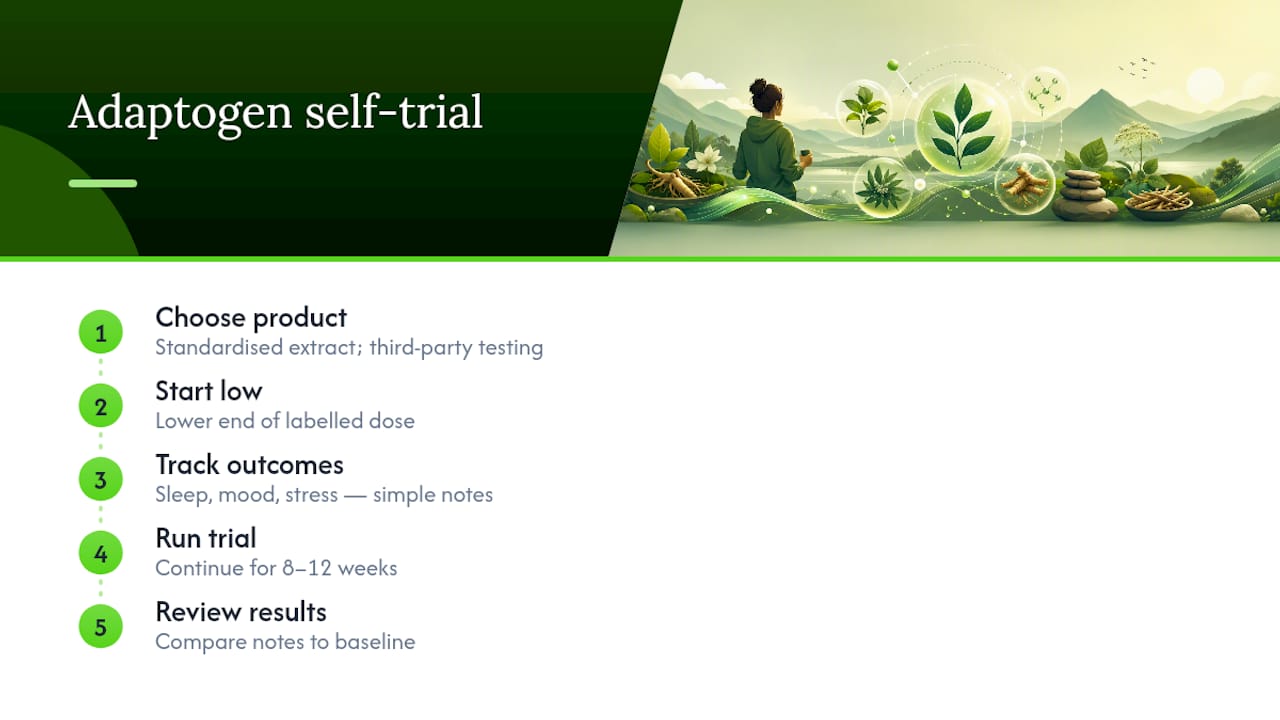
Most clinical trials run for eight to twelve weeks before measuring outcomes, which is a reasonable benchmark for your own trial period too. Start at the lower end of a labelled dose, keep a simple note of sleep, mood, or stress levels, and favour products that state their standardisation percentage and carry third-party testing.
How Naturessoulshop selects and presents adaptogen products
Naturessoulshop stocks adaptogens as part of a broader organic and wellness range, and the same sourcing standards apply across the catalogue: clean ingredients, clear labelling, and vegan or gluten-free formulations where relevant.
- Ashwagandha capsules from Organic India, formulated for stress relief and vitality.
- Reishi powder aimed at calm and restful sleep, vegan and dairy-free.
- Cordyceps militaris for stamina and immunity support, free from soy and peanut allergens.
- Instant mushroom coffee blending functional mushrooms with Suntheanine for everyday use.
When choosing between products, look for stated serving sizes, standardised extract percentages, and allergen-free credentials rather than a bare “adaptogen” label with no supporting detail.
Beyond cortisol: antioxidant and anti-inflammatory pathways
Stress hormone regulation isn’t the only mechanism worth understanding. Chronic stress drives up oxidative damage and low-grade inflammation throughout the body, and several adaptogens appear to counter both processes independently of their effect on the HPA axis.
Compounds in ashwagandha, reishi, and schisandra have shown antioxidant activity in laboratory studies, meaning they help neutralise the reactive molecules that accumulate during prolonged physical or psychological strain. Reducing this oxidative load may partly explain why some people report steadier energy and mood, separate from any direct hormonal effect.
Anti-inflammatory activity follows a similar pattern. Preclinical work on ginseng and reishi points to modulation of inflammatory signalling molecules, the kind that rise during illness, poor sleep, or sustained stress. If an adaptogen dampens that inflammatory signalling even modestly, it could contribute to the sense of resilience users report, quite apart from any cortisol change.
This is also part of why adaptogens differ from stimulants or classic nootropics. A stimulant works fast and directly on alertness, often followed by a crash. Adaptogens are not designed to deliver a jolt; the aim is a steadier baseline over weeks, built through multiple slow-acting pathways rather than one sharp lever. That distinction matters when setting expectations: someone hoping for an immediate energy hit from ashwagandha is likely to be disappointed, while someone tracking stress resilience over two months has a fairer test of what the herb can plausibly do.
Where the evidence leaves us
The gap between what adaptogen marketing promises and what the trial data supports is real, but it doesn’t mean the category is empty. Ashwagandha and rhodiola have earned their reputation with actual human trials, however modest in size. Most of the rest, cordyceps, schisandra, holy basil, are still riding on centuries of traditional use plus laboratory mechanism studies, which is a different, weaker kind of evidence than a randomised trial, even when it’s genuinely suggestive.
Where I think the conventional advice goes wrong is treating “adaptogen” as a single stamp of quality. It isn’t. It’s a working hypothesis about how a plant behaves, and the strength of that hypothesis varies enormously from one herb to the next. The reader’s real job isn’t choosing “an adaptogen”; it’s choosing a specific, standardised extract of a specific plant with at least some human data behind it, and then giving it the eight to twelve weeks a proper trial would use before judging it.
Prioritise the label over the marketing story. A standardised withanolide percentage tells you more than any claim about “ancient Ayurvedic wisdom” ever will.
— Arjit
Sources
- What are adaptogens and should you be taking them? — UCLA Health
- Warning letters — Lone Star Botanicals, FDA
- System-level, molecular and cellular mechanisms of selected plant adaptogens — PMC
- System-level, molecular and cellular mechanisms of selected plant adaptogens — MDPI Nutrients
- Ashwagandha — Office of Dietary Supplements (NIH)


