


For fresh, organic and seasonal produce delivered without the supermarket queue, Naturessoulshop offers a practical fruit veg box delivery built around curated ranges and flexible subscriptions. It suits households that want reliable freshness without committing to rigid terms.
Two reasons it works for most households:
- Boxes rotate with the seasons, so you get organic options at their best rather than forced-ripened imports.
- Subscriptions flex around you: change frequency, swap items, or pause when you’re away.
Pro Tip: If you’re new to box delivery, start with a medium mixed box rather than fruit-only or veg-only, as it gives a realistic read on portion sizes and usage before committing to a bigger order. It gives you a realistic read on portion sizes and how much you actually use before you commit to a bigger, pricier order.
Key Takeaways
Choosing a fruit veg box delivery service comes down to matching box size and customisation to household need, checking subscription flexibility before price, and verifying organic and seasonal claims rather than assuming them.
| Point | Details |
|---|---|
| Match size to household | Start with a medium mixed box unless you know your household’s weekly consumption already. |
| Prioritise flexibility over certification | A provider with easy pause and skip options beats a rigid organic-only subscription for most households. |
| Verify claims, don’t assume them | Ask which body certifies “organic” and how far “local” produce actually travels. |
| Check reviews for patterns, not stars | Read one and two-star Trustpilot reviews to spot recurring delivery or service issues. |
| Naturessoulshop for organic, seasonal boxes | Offers curated organic ranges with flexible subscriptions and a typical first-order discount for new customers. |
Table of Contents
- What are the different fruit veg box delivery sizes and types?
- How do subscription frequency and delivery flexibility work?
- How much does fruit veg box delivery typically cost?
- What do “organic,” “local” and “seasonal” actually mean?
- How do you choose the right box for your household?
- How Naturessoulshop supports organic, seasonal box delivery
- What should you expect from customer service?
- What payment methods and billing options are typical?
- Does the provider have a good reputation?
- What special offers and trial options are available?
- What matters more than a neutral vendor list
- Getting started with your first Naturessoulshop box
- Sources
What are the different fruit veg box delivery sizes and types?
Every provider splits its range into a handful of core categories, and knowing which one matches your kitchen habits saves you money and food waste. The three broad types are fruit-only, vegetable-only and mixed boxes, and most services then layer size options on top.
- Fruit boxes typically hold apples, bananas, citrus and whatever’s in season, aimed at snacking and breakfast use rather than cooking.
- Vegetable boxes focus on cooking staples: roots, greens, alliums and salad items, usually built around what a household needs for evening meals across a week.
- Mixed boxes blend both, usually in a ratio weighted towards vegetables since most households cook more veg than they eat raw fruit.
Size labels vary by provider, but the pattern is consistent enough to plan around:
- A small box generally suits one or two people who cook a few times a week and want to top up rather than replace a full shop.
- A medium box fits two to three people or a family that eats a good amount of fresh produce but still shops elsewhere for other groceries.
- A large box is built for four-plus people, or for households doing serious batch cooking and freezing.
Where providers really differ is customisation. Some run fully curated boxes, meaning you get whatever the grower has that week with no input from you, which is where the “wonky veg” and rescued-produce schemes tend to sit. Others let you build your own from an online list, swap out items you dislike, or add extras like eggs, bread or dairy to the same delivery. BBC Good Food’s testing of veg box providers found this curation-versus-customisation split is the single biggest factor separating one service from another, more so than price or box size. If you’ve got a picky household or specific dietary needs, prioritise a provider that allows swaps. If you enjoy being surprised and want to expand what you cook, a curated box does more of the thinking for you.
How do subscription frequency and delivery flexibility work?
Most fruit veg box delivery services run on a weekly or fortnightly cycle, and nearly all let you adjust that rhythm once you’re signed up. Weekly suits households eating through produce quickly; fortnightly works better if you’ve got freezer space or a smaller household that can’t finish a box before it wilts.
Flexibility is where the real differences show up between providers:
- Skipping a delivery is standard practice, usually done through an online account a few days before your next scheduled drop.
- Pausing for holidays is typically free and can often run for several weeks without cancelling the subscription outright.
- Switching frequency (weekly to fortnightly, or the reverse) usually takes effect from your next order rather than immediately.
- Cancelling generally requires notice, commonly a cut-off point a day or two before your next charge, so leaving it to the last minute can mean paying for one more box than you intended.
Payment is almost always automated, with a card charged a set number of days before each delivery and an email reminder giving you a window to make changes.
Delivery day itself tends to follow a fixed schedule tied to your postcode or delivery zone, though some services offer a choice of days if you’re in a well-covered area, as explained in our partner’s guide to fresh food delivery logistics. Safe-drop is now the default rather than the exception: insulated packaging or a cool box left at the door means you don’t need to be home, though produce still needs bringing in reasonably promptly in warm weather. Our guide to ensuring optimal freshness in home-delivered produce covers what to do if a box sits on the doorstep longer than planned, which matters more in summer than winter. If you’re renting or often out during the day, check a provider’s safe-drop policy before signing up rather than after your first soggy delivery.
How much does fruit veg box delivery typically cost?
Price bands cluster fairly predictably across the market once you look past the marketing. Entry-level small boxes tend to start in the region of what you’d pay for a modest supermarket fruit and veg shop, while large or premium organic boxes can run considerably higher once you factor in delivery.
A useful yardstick: rescued or “wonky” produce schemes are consistently cheaper than curated organic boxes because the produce would otherwise go to waste. Oddbox’s model shows how accepting variable, imperfect-looking contents can bring the entry price down, though you trade predictability for the saving.
When comparing providers, watch for these cost factors:
- Delivery fees, which some services fold into the box price and others charge separately, especially below a minimum order value.
- First-order discounts, common across the market as an incentive to trial a box before committing to a recurring subscription.
- Organic certification and named-grower provenance, both of which typically add a premium over conventional produce.
- Packaging costs, since compostable or returnable packaging sometimes carries a small surcharge over standard cardboard.
The most honest comparison isn’t the sticker price on the box. It’s cost per portion once you divide the total by what you’ll realistically eat, since a cheap box full of items your household won’t touch is worse value than a pricier one matched to your actual habits.
What do “organic,” “local” and “seasonal” actually mean?
These three words get used loosely across the industry, and it pays to know what each one is actually promising before you pay extra for it. “Organic” should mean certified production without synthetic pesticides or fertilisers, and a legitimate provider will name their certifying body rather than just printing the word on a box. “Local” is far less regulated. It can mean produce grown within a defined radius, or it can simply mean the packing depot is nearby while the produce itself travelled a long way to get there.
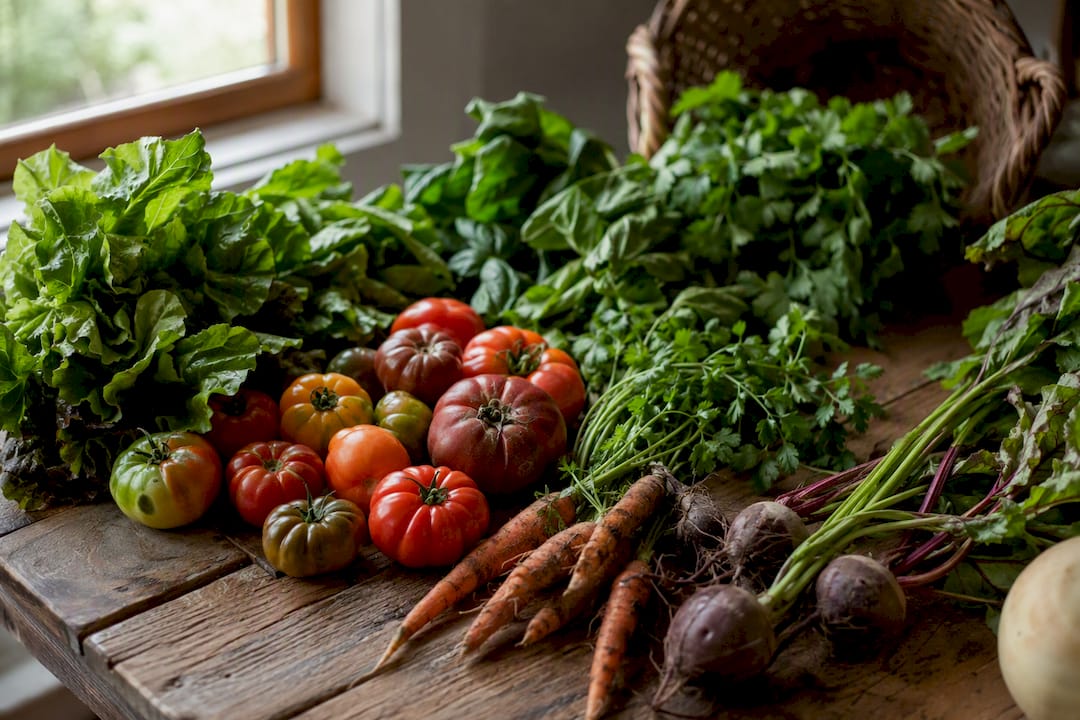
“Seasonal” is the most reliable of the three because it’s dictated by growing conditions rather than marketing choice. A genuinely seasonal box changes noticeably through the year: heavy on brassicas and roots in winter, salad and stone fruit in summer.
Rescued-produce and wonky-veg schemes add another layer worth understanding. These reduce food waste by taking cosmetically imperfect or surplus produce that supermarkets reject, which is a genuine sustainability win, but it means less predictable contents week to week.
- Ask directly which certifying body backs any “organic” claim.
- Ask how far produce typically travels before it reaches the packing depot.
- Ask what happens to packaging: is it returnable, compostable or standard cardboard.
Pro Tip: Don’t assume “seasonal” and “local” are the same claim. A box can be genuinely seasonal while sourcing globally, and genuinely local while including plenty of imported staples like bananas and citrus.
How do you choose the right box for your household?
Work through this in order rather than picking on price alone, since the cheapest box that goes half-eaten in the fridge isn’t actually a good deal.
- Estimate consumption first. Track roughly how much fresh produce your household gets through in a normal week before choosing a size.
- Flag dietary needs. If you need gluten-free or vegan add-ons alongside your box, check whether the provider offers them or whether you’ll need a second source.
- Decide how much flexibility you need. A household with unpredictable weeks abroad or a variable work pattern should weight pause and skip options heavily.
- Set a realistic budget, including delivery fees, and compare against cost per portion rather than the headline price.
- Rank sustainability priorities if provenance, packaging and food waste matter to your decision, since providers vary enormously here.
Watch for red flags before you commit: vague cancellation terms buried in small print, no named growers or certifying bodies, and a Trustpilot page dominated by complaints about missed deliveries rather than praise.
Pro Tip: Read a provider’s most recent one and two-star reviews before the five-star ones. They tell you far more about how a company handles problems than glowing testimonials ever will.
How Naturessoulshop supports organic, seasonal box delivery
Naturessoulshop built its produce range around clean, organic sourcing rather than treating fruit and veg as a side category bolted onto a wider grocery offer. The focus stays on curated ranges where provenance is clear and seasonal rotation is the default, not an add-on.
This article is written by Arjit, drawing on Naturessoulshop’s ongoing work across organic and natural product categories, from fresh produce through to dairy, dry grocery and skincare.
For readers who want more operational detail before subscribing, two resources go deeper:
- Fresh fruit and veg home delivery: your UK guide covers box types and subscription basics in more depth.
- Fresh organic produce delivered to your door explains certification and sourcing standards.
What should you expect from customer service?
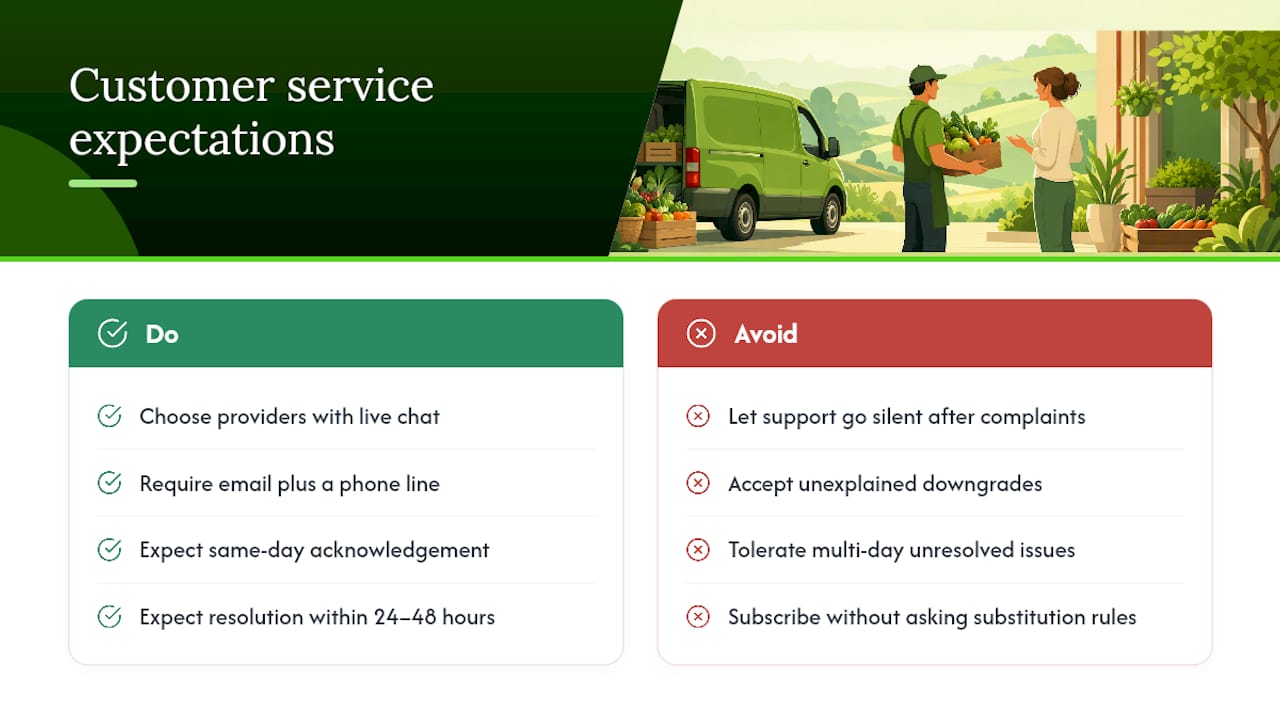
Response speed and how a provider handles mistakes matter more long-term than any single box’s contents, because problems with fresh produce need fixing fast, not in three days. A wilted lettuce or a missing item is a minor annoyance if it’s replaced or credited quickly; it becomes a reason to cancel if support goes quiet.
Look for a provider offering multiple contact routes: live chat for urgent delivery issues, email for less time-sensitive queries, and ideally a phone line for anything requiring a real conversation. Response time benchmarks worth expecting are same-day acknowledgement and resolution within 24 to 48 hours for straightforward complaints like a damaged box or a missed delivery slot.
Substitution policy is a quieter but equally important test of service quality. When an item is out of stock, a good provider swaps it for something of comparable value and tells you clearly what changed and why, rather than silently downgrading your box. Ask a provider directly, before subscribing, what their substitution policy looks like and how quickly they typically resolve delivery problems. Their answer, and how promptly they give it, tells you most of what you need to know.
What payment methods and billing options are typical?
Card payment dominates the market, with most providers accepting standard debit and credit cards through a secure checkout, and many now supporting digital wallets like Apple Pay or Google Pay for faster repeat checkout. Recurring billing is the default model: your card is charged automatically ahead of each scheduled delivery, generally a set number of days beforehand so you’ve got time to skip or pause if needed.
Some providers also offer:
- Prepaid credit or gift options, useful if you’re buying a subscription for someone else or want to budget in a lump sum rather than a recurring charge.
- Itemised billing, showing exactly what’s in each box and its cost, which matters if you’ve added extras like bread or dairy alongside your fruit and veg.
- Automatic price adjustment notices, since seasonal availability can shift box pricing slightly, and a transparent provider tells you before charging rather than after.
Check whether a provider bills you the moment you sign up or only ahead of your first delivery. This affects how quickly you can test a service without committing your card to weeks of charges you haven’t confirmed you want. It’s a small detail that trips up more new customers than it should.
Does the provider have a good reputation?
Independent review platforms are the most reliable check available before you hand over card details, because company-run testimonials only ever show the good outcomes. Trustpilot pages for box providers consistently surface the same recurring themes: delivery reliability, box quality on arrival, and how quickly customer service responds when something goes wrong.
Treat a five-star average with some caution if the review count is small; a handful of enthusiastic early customers isn’t the same signal as thousands of reviews sustained over years. Read the one and two-star reviews specifically. A pattern of complaints about missed deliveries or unresponsive support tells you more than the overall star rating does on its own.
Beyond national review platforms, local directories offer a different kind of reputation check. Bristol Food Network’s veg box scheme listing documents community and social-enterprise providers, which often carry strong local reputations built on word of mouth rather than online reviews. If a provider in your area is community-run or a social enterprise, that local trust can matter as much as a national star rating.
What special offers and trial options are available?
Nearly every fruit veg box delivery service runs some kind of introductory offer, typically a discount on your first box or a reduced delivery fee for new customers. These exist because providers know the biggest barrier to subscribing is uncertainty about box contents and quality, and a lower-risk first order removes that hesitation.
Trial periods work slightly differently to discounts. Rather than a price cut, some providers let you order a single box with no subscription commitment, so you can judge quality and portion sizes before signing up to a recurring delivery. This is worth doing even if a discount is on offer elsewhere, since a cheap first box that doesn’t suit your household is still a wasted trial.
Referral schemes are common too, giving existing customers a credit or discount for bringing in a new subscriber, which can be a useful way to offset ongoing costs if friends or family are also interested. Seasonal promotions, particularly around January health pushes or ahead of major holidays, tend to offer the deepest discounts of the year. If you’re not in a hurry to start, waiting for one of these windows can meaningfully lower your first few months’ cost.
What matters more than a neutral vendor list
Most guides to this topic read like spreadsheets: box size here, price there, a tick if they do organic. That misses the actual decision most households are making, which isn’t “which provider is objectively best” but “which provider fits how we actually eat and how much unpredictability we can tolerate.”
The conventional advice undersells flexibility and oversells organic certification as the deciding factor. Certification matters, but a rigid subscription that penalises you for going on holiday will cost you more in wasted, rotten produce than the difference between organic and conventional ever will. Prioritise a provider that lets you pause and skip without friction before you prioritise a badge on the box.
Seasonal, wonky and rescued-produce models deserve more credit than they get in mainstream comparisons. They ask a little more of you, since you can’t plan a recipe around contents you don’t yet know. In exchange, you get genuinely fresher food and a smaller environmental footprint. That trade is worth making for most households, not just the ecologically minded ones.
Getting started with your first Naturessoulshop box
If you’ve read this far, you already know what matters: freshness, genuine seasonal and organic sourcing, and a subscription that bends around your life rather than the other way round. That’s the gap Naturessoulshop fills, with curated organic ranges built for households that want reliability without a rigid contract.
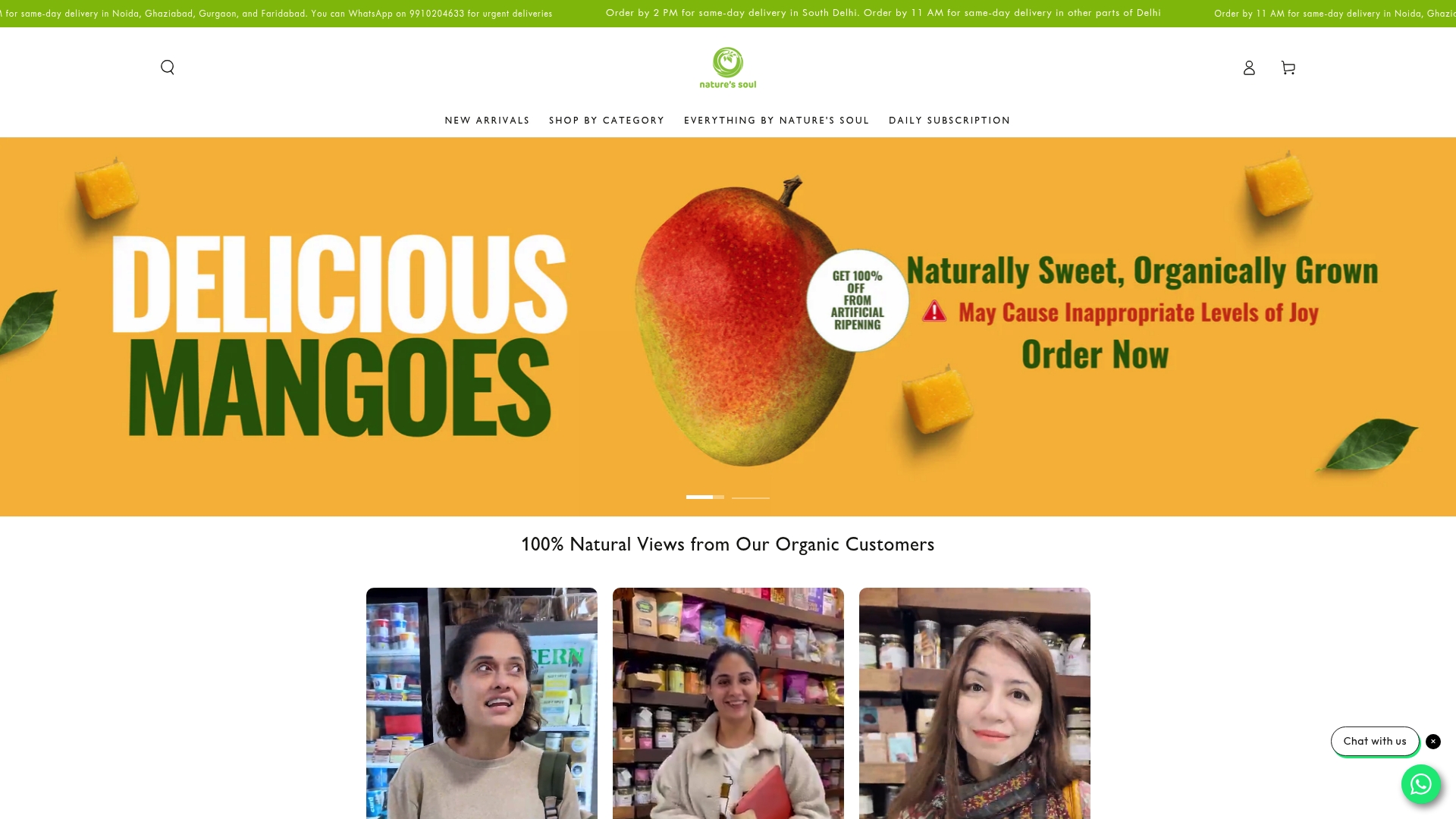
Start by matching box size to household size: a small box for one or two people easing in, a medium box for a family that cooks most nights, a large box if you’re batch-cooking or feeding a bigger household. From there, the process is straightforward. Head to Naturessoulshop, choose your produce box, set your delivery frequency, and add your address details at checkout. If you’ve got dietary needs beyond fresh produce, the health category covers curated wellness-focused ranges you can add to the same order.
Delivery coverage and help are both handled directly through the site, with support available if you need to adjust an order before it’s dispatched. New customers typically find a first-order offer applied automatically at checkout, making it a low-risk way to test whether a Naturessoulshop box fits your kitchen before committing to a longer run of deliveries.
Sources
- 8 of the best veg boxes for 2026, from wonky veg to organic
- Veg box schemes – Bristol Food Network
- Uk
- Oddbox | Good Food Doing Good, Delivered to Your Door


