


TL;DR:
- Eating seasonally preserves nutrients like vitamin C and folate that degrade quickly after harvest, enhancing health benefits.
- It also promotes dietary diversity, lowers costs during peak seasons, and reduces environmental impact by favoring locally grown, field-produced foods.
Most people assume that “fresh” simply means recently purchased, regardless of when or where something was grown. That assumption quietly costs you nutrients with every meal. The benefits of seasonal eating go well beyond taste. Research shows that water-soluble vitamins like vitamin C and folate begin degrading within days of harvest, meaning produce that has travelled long distances or sat in cold storage can arrive nutritionally depleted. Eating with the seasons shortens that gap, and the advantages extend to your wallet, your community, and the planet.
Table of Contents
- Key takeaways
- Benefits of seasonal eating: the nutrient case
- Dietary diversity across the year
- Environmental and economic advantages
- How to eat seasonally in practice
- My honest take on seasonal eating
- Explore seasonal eating with Naturessoulshop
- FAQ
Key takeaways
| Point | Details |
|---|---|
| Nutrient retention is time-sensitive | Vitamin C and folate in leafy greens can drop dramatically within days of harvest, so seasonal produce with a shorter journey retains more. |
| Dietary variety improves with the seasons | Rotating food choices around harvest cycles naturally increases micronutrient diversity throughout the year. |
| Sustainability is more complex than “local = green” | Field-grown seasonal crops typically carry a lower carbon footprint than heated greenhouse alternatives, even when shipped from abroad. |
| Seasonal produce tends to cost less | Higher supply during peak season lowers prices, making healthy eating more affordable without extra effort. |
| Frozen can complement fresh | High-quality frozen produce, blanched at peak ripeness, is a smart off-season strategy to maintain year-round nutrition. |
Benefits of seasonal eating: the nutrient case
Here is something most nutrition articles skip over. The moment a vegetable is harvested, it begins losing nutrients. The speed of that loss depends on the vegetable, storage temperature, light exposure, and time. For leafy greens, the decline is swift and measurable.
Spinach is a useful example. Vitamin C losses of 15-55% can occur within the first seven to fourteen days of refrigerated storage, and folate losses can reach as high as 77% after just eight days at typical cold-chain temperatures. That is not a trivial difference. If you are eating spinach specifically for its folate content, produce that has spent ten days in transit and storage may deliver a fraction of what you expect.
Folate degrades faster when produce is exposed to light, and even cold storage only slows the process rather than stopping it. Seasonal produce, sourced locally and sold at high-turnover markets, typically has a shorter time-to-plate. That shorter window is where the real nutritional advantage sits.
Key factors that affect nutrient retention in fresh produce:
- Time since harvest. The single biggest variable for water-soluble vitamins.
- Storage temperature. Colder slows degradation but does not halt it.
- Light exposure. Chlorophyll and vitamin C both break down faster in light.
- Cooking method. Boiling leaches water-soluble vitamins into the water; steaming or stir-frying preserves more.
Pro Tip: When buying leafy greens, check for firm, upright leaves with no yellowing. Wilting is a visible sign that nutrient loss is already well underway.
Advanced research into nano-packaging shows that treated kale retains higher ascorbic acid for up to forty days refrigerated, which underlines how much storage handling matters. Until such technology is standard, your best option remains buying produce that has not spent long in the supply chain.
Dietary diversity across the year
Eating seasonally is, at its core, a rotation strategy. When you follow the harvest calendar rather than buying the same ten items year-round, your diet shifts with the seasons. Spring brings peas, asparagus, and new-season greens. Summer offers tomatoes, courgettes, and stone fruits. Autumn delivers root vegetables, squash, and brassicas. Winter leans on citrus, stored roots, and hardy greens.
That rotation matters nutritionally. A study tracking women and children in rural Ethiopia found that dietary diversity rose meaningfully during harvest season, with the proportion of women meeting minimum dietary diversity increasing from 16.8% to 25.0%, and children from 11.8% to 23.3%. These are significant shifts driven largely by seasonal food availability.
Seasonal eating improves dietary diversity and micronutrient intake, but alone does not eliminate deficiencies. Combining it with broader nutrition strategies gives the best results.
The honest caveat is that seasonal eating is not a complete solution on its own. If your local growing season is short or your access to variety is limited, you will still face gaps. The recommendation from nutrition researchers is to treat seasonal eating as a foundation and layer in other strategies, including fortified foods, preserved produce, and targeted supplementation where needed. Checking India’s seasonal produce calendar is a practical starting point for understanding what is genuinely in season in your region.
Environmental and economic advantages
The sustainability case for eating seasonally is real, but it is also frequently misunderstood. The popular shorthand of “local is always greener” does not hold up under scrutiny.
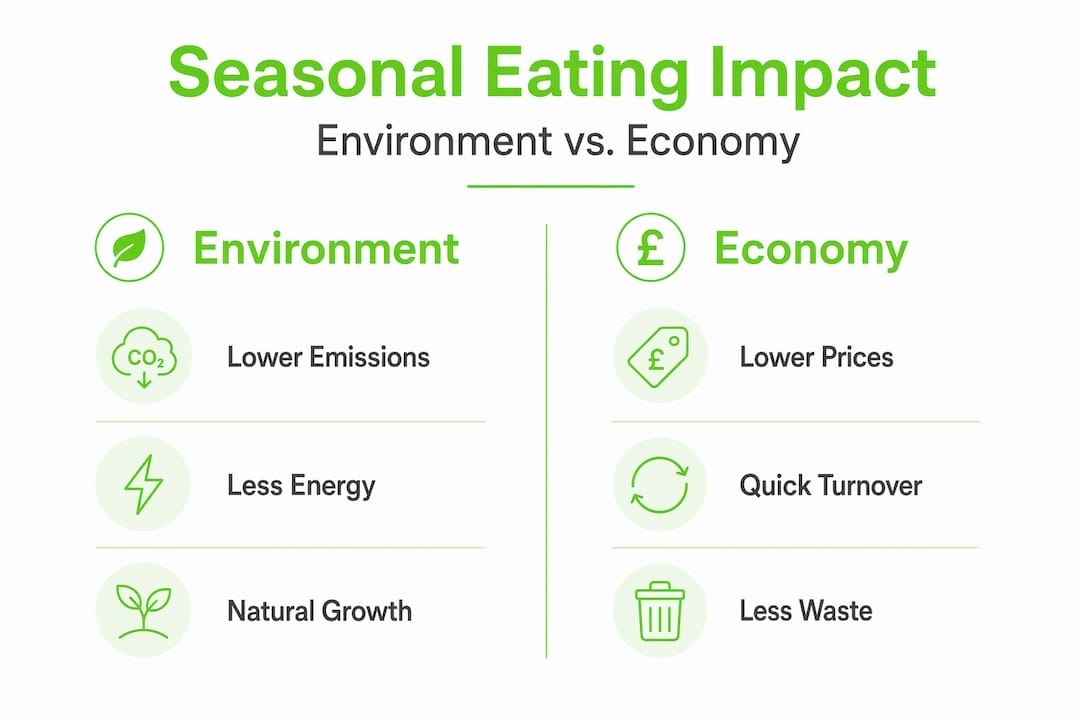
Transport accounts for roughly 11% of food’s carbon emissions, while production methods account for around 83%. That means how food is grown matters far more than how far it travels. A tomato grown in a heated greenhouse in the UK during winter can carry a significantly higher carbon footprint than a tomato field-grown in Spain and shipped north. The energy required to maintain artificial growing conditions often outweighs the emissions saved by keeping the food local.
| Scenario | Environmental impact |
|---|---|
| Field-grown seasonal produce, local | Lowest. No artificial heat or light required. |
| Field-grown seasonal produce, imported | Low to moderate. Transport adds some emissions but production footprint is small. |
| Heated greenhouse, out of season, local | High. Energy for heating and lighting dominates the footprint. |
| Air-freighted produce, any origin | Very high. Air freight emissions are disproportionate to weight. |
The economic picture is more straightforward. USDA data confirm that fruit and vegetable prices drop during peak seasonal supply. When a crop is abundant, it costs less to grow, less to transport, and less to sell. Buying strawberries in June rather than December is not just a flavour decision. It is a financial one.
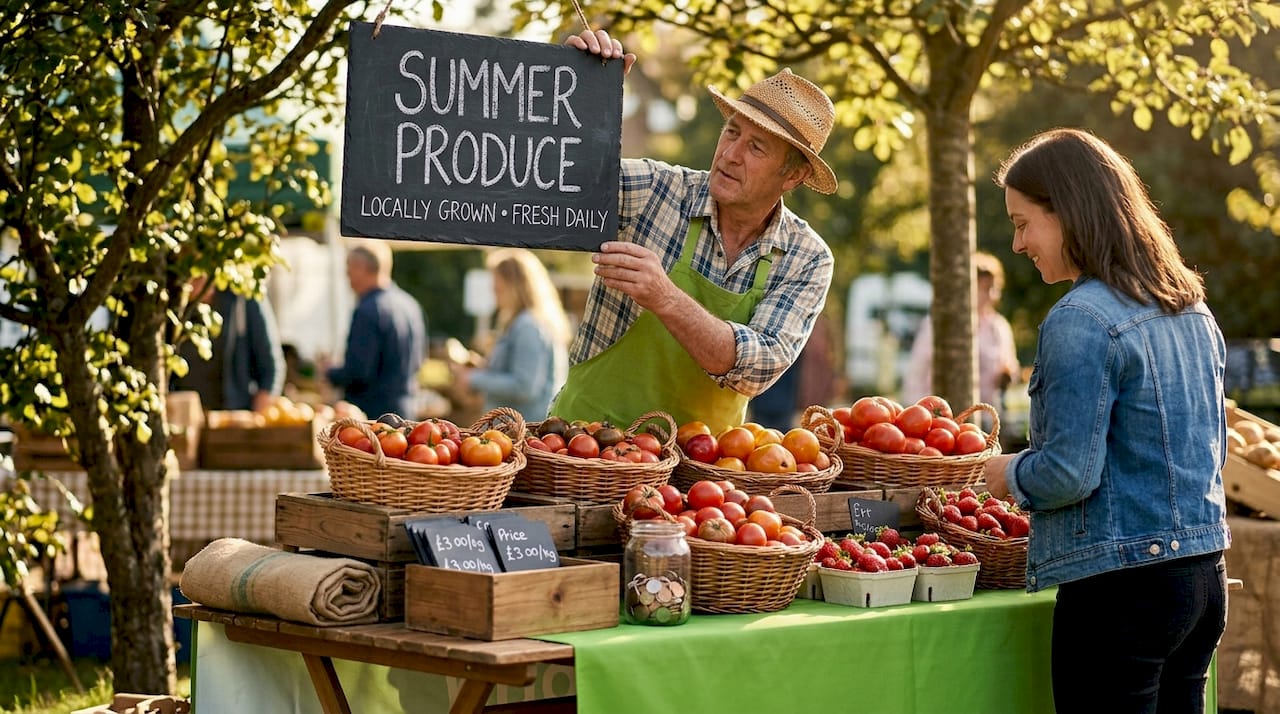
Seasonal abundance also tends to reduce food waste. When produce is cheap and plentiful, it moves quickly through the supply chain, spending less time in storage and less time sitting unsold on shelves. Varied seasonal consumption also reduces over-reliance on resource-intensive staples grown year-round under artificial conditions.
Pro Tip: If you want to reduce your food’s environmental impact meaningfully, focus first on avoiding air-freighted and heated-greenhouse produce rather than obsessing over food miles alone.
How to eat seasonally in practice
Knowing the theory is one thing. Making it work in a weekly shop is another. These steps make the transition straightforward.
-
Use a seasonal calendar. Find one specific to your region. What is in season in Delhi in October differs from what is in season in London. Naturessoulshop’s guide on finding local produce is a useful reference for sourcing fresh options close to home.
-
Shop at high-turnover vendors. Produce at busy markets and stores moves faster, meaning it is more likely to be recently harvested. Avoid buying leafy greens from displays that look sparse or wilted.
-
Check freshness indicators. Firm texture, vibrant colour, and no yellowing or soft spots are signs of recent harvest. These matter more than the label saying “fresh.”
-
Plan meals around what is available. Rather than deciding on a recipe first and then hunting for ingredients, browse what looks best and build the meal from there. This is how seasonal eating actually works in practice.
-
Use freezing to extend the season. Frozen blanched spinach retains more folate than refrigerated fresh spinach after seven or more days. Freezing produce at peak ripeness is not a compromise. For off-season nutrition, it is often the smarter choice. Pair this with guidance on storing produce correctly to get the most from what you buy.
-
Combine fresh and preserved strategically. Treat the season as the time to eat fresh and use the rest of the year to draw on high-quality frozen, fermented, or dried alternatives. This rotation approach maintains nutritional quality year-round without forcing you to compromise on taste or convenience.
My honest take on seasonal eating
I have been working in the organic food space long enough to have seen seasonal eating go from niche interest to mainstream talking point. And with that popularity has come a fair amount of oversimplification.
The part that frustrates me most is how people conflate “seasonal” with “nutritious” without thinking about what happened between harvest and their plate. I have seen beautifully labelled seasonal produce sitting in a shop for two weeks, wilting quietly. Buying it in November because it is technically a winter vegetable does not make it a nutritional win if it has been in cold storage since September.
What I have found actually works is treating seasonal eating as a timing strategy, not just a shopping category. Buy leafy greens frequently and in small quantities from vendors with high turnover. Freeze surplus at peak season. Do not assume that a seasonal label on packaging tells you anything useful about time since harvest.
The environmental complexity is also worth sitting with. I used to think local was always better. It is not. The carbon footprint of a heated polytunnel in February can be worse than a field in Morocco. That does not mean ignoring local food systems. It means being curious about how your food was actually grown, not just where.
What I find genuinely rewarding about eating with the seasons is the connection it creates. To the growing cycle, to the people who farm it, to the rhythms of the year. That is harder to quantify than vitamin C content, but it is real.
— Arjit
Explore seasonal eating with Naturessoulshop
If this article has made you want to put seasonal eating into practice, Naturessoulshop makes it easier to start. As an organic and natural food store, Naturessoulshop stocks fresh fruits and vegetables, dry grocery, dairy, and specialist health products, all sourced with clean ingredients in mind. Browse the fresh organic produce range to find what is currently in season, or explore the full online organic store for everything from seasonal vegetables to vegan and gluten-free pantry staples. For deeper reading, the Naturessoulshop blog covers sustainable grocery shopping and practical storage guides to help you get the most from every seasonal purchase.
FAQ
What are the main benefits of seasonal eating?
Seasonal eating benefits include higher nutrient retention in fresh produce, greater dietary diversity throughout the year, lower food costs during peak supply, and a reduced environmental footprint compared to out-of-season greenhouse or air-freighted alternatives.
Does seasonal produce really have more nutrients?
Yes, in many cases. Vitamin C and folate degrade rapidly after harvest, so produce with a shorter time-to-plate, typical of locally sourced seasonal food, tends to retain more of these water-soluble nutrients than produce that has spent days in transit and cold storage.
Is local food always more sustainable than imported seasonal produce?
Not always. Production methods matter more than food miles in most cases. Field-grown seasonal produce from abroad can have a lower carbon footprint than the same item grown locally in a heated greenhouse out of season.
Can frozen produce match the nutrition of fresh seasonal food?
Frozen produce blanched at peak ripeness can actually outperform refrigerated fresh produce that has been stored for over a week. Frozen spinach retains more folate than fresh spinach after seven or more days of refrigeration, making it a smart off-season choice.
How do I know what is truly in season where I live?
Use a region-specific seasonal produce calendar. What is in season varies significantly by climate and geography, so a calendar tailored to your area, such as Naturessoulshop’s India seasonal guide, gives far more accurate guidance than a generic list.
Recommended
- India’s seasonal produce calendar for healthier eating – naturessoulshop
- Top Benefits of Natural Products: 2025 Guide for a Healthier Life – naturessoulshop
- Seasonal eating guide 2026: 30% more nutrients for families – naturessoulshop
- Cooking with Seasonal Produce: Step-by-Step Guide – naturessoulshop


