


Organic apples do carry real advantages over conventional ones: several studies find measurably higher levels of protective plant compounds and lower pesticide residues, and organic orchards tend to support healthier soil and more biodiversity. None of this makes conventional apples unhealthy, but the differences are consistent enough to matter if you’re eating apples regularly and want the fullest nutritional return. The rest of this guide works through the actual evidence, nutrient by nutrient.
TL;DR:
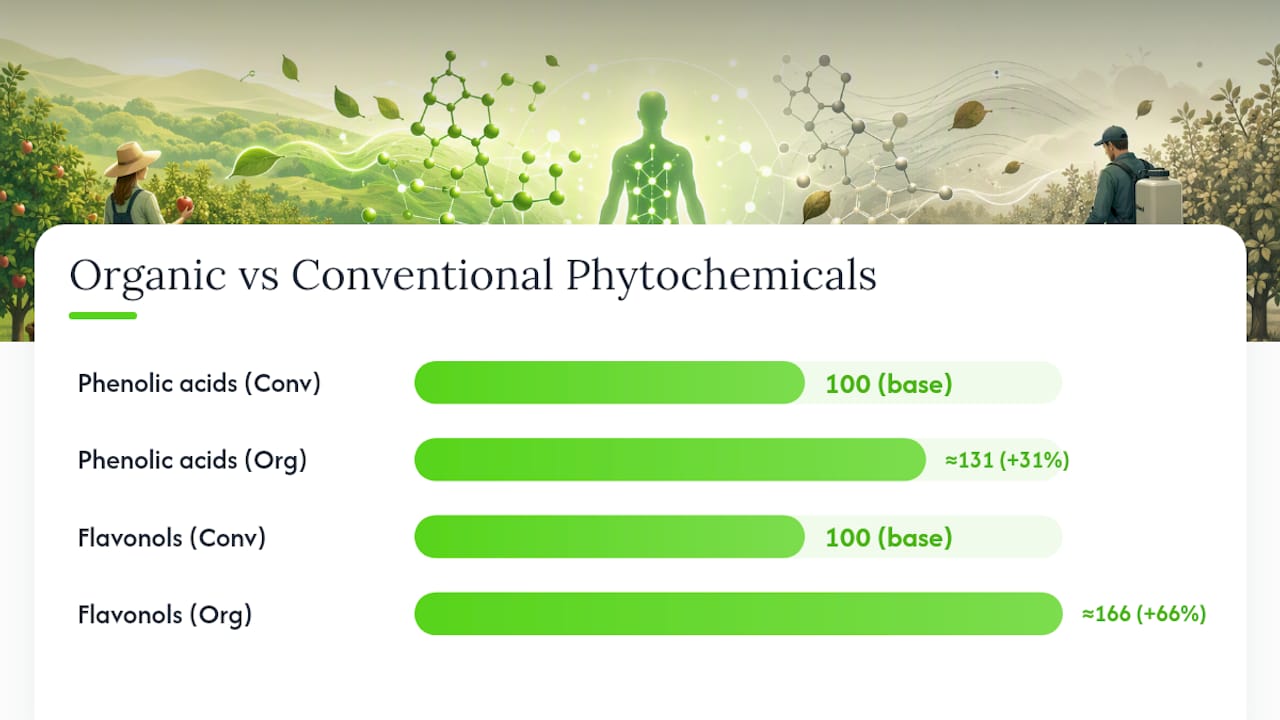
- Organic apples tend to have about 31% higher phenolic acid and 66% higher flavonol content than conventional apples due to plant stress responses.
- Whole, unpeeled apples provide significantly more phytochemicals and nutrients, especially in the skin, than peeled or processed apple products.
- Regular apple consumption is strongly linked to improved heart health and better blood sugar control, supported by cohort studies and gut microbiome research.
- Organic farming promotes greater soil biodiversity and reduces pesticide residue exposure, making it a better choice for frequent apple eaters prioritizing environmental and health considerations.
- Storing apples properly in cold conditions preserves vitamin C and flavonoids, which degrade over time with improper handling, affecting their health benefits.
Table of Contents
- Key health benefits of apples: what the evidence shows
- What’s in a medium apple, and why it counts
- Which plant compounds in apples actually do the work?
- What does the research say about apples and disease risk?
- Are organic apples really higher in nutrients than conventional ones?
- How does organic apple farming benefit the environment?
- How should you eat and store apples for maximum benefit?
- Who’s behind this guide, and why it’s worth trusting
- What the evidence actually tells you to prioritise
- Where to find genuinely organic apples and produce
- Sources
Key health benefits of apples: what the evidence shows
Apples earn their reputation as one of the most researched fruits in nutrition science, and the case for eating them daily holds up better than most food trends. Here’s what the evidence actually supports, ranked roughly by how solid the science is behind each claim.
- Heart health support. Apples are one of the richest fruit sources of soluble fibre, and the pectin in that fibre binds cholesterol in the gut before it can be absorbed. This is backed by strong epidemiological data linking regular apple consumption to lower cardiovascular risk, and it’s one of the better-supported claims in the phytochemical research on apples.
- Blood sugar control. The fibre and polyphenol combination slows glucose absorption after a meal, which blunts the insulin spike you’d get from a sugary snack of similar calorie count. Cohort studies show a consistent association here, though the mechanism is better proven in lab settings than in long-term human trials.
- Weight management. A medium apple is mostly water and fibre, so it fills you up for very few calories. This is a strong, well-replicated finding, though it’s more about apples displacing less healthy snacks than any special fat-burning property.
- Gut microbiome support. Pectin acts as a prebiotic, feeding beneficial gut bacteria and helping them produce short-chain fatty acids that support the gut lining. The evidence here is growing fast but still leans on smaller human trials and animal models rather than huge cohorts.
- Lower inflammation. Quercetin, one of the apple’s signature flavonoids, has demonstrated anti-inflammatory activity in cell studies and some human trials. The Harvard Nutrition Source treats this as a genuine mechanism rather than a marketing claim, though effect sizes in humans are modest.
- Possible cancer risk reduction. Laboratory research has shown apple phytochemicals inhibiting the proliferation of cancer cells, which is intriguing but a long way from proof that eating apples prevents cancer in people. Treat this one as promising rather than settled.
The pattern across all six benefits is the same: fibre and phytochemicals working together, not any single “miracle” nutrient. That matters when you get to the organic versus conventional question later, because it’s precisely those phytochemical levels that differ most between growing methods.
What’s in a medium apple, and why it counts
A medium apple, roughly 182 grams with the skin on, gives you about 95 calories, 4 grams of fibre, 8.4 milligrams of vitamin C, and 195 milligrams of potassium, according to figures commonly cited by outlets such as Cleveland Clinic.
Pro Tip: Roughly a third of an apple’s fibre and the majority of its quercetin sit in and just beneath the skin, so peeling it before eating throws away much of the point of choosing an apple in the first place.
The fibre itself splits into two types that do different jobs:
- Soluble fibre (pectin) dissolves into a gel in the gut, slows digestion, and binds cholesterol for excretion.
- Insoluble fibre adds bulk to stool and helps keep digestion moving, mostly concentrated in the skin and flesh near it.
Vitamin C matters here too, acting as a water-soluble antioxidant that helps protect cells from oxidative stress, while potassium supports healthy blood pressure by helping the body manage sodium balance. Both nutrients are more fragile than fibre.
Processing strips out most of the benefit. Clear apple juice loses nearly all its fibre and much of its vitamin C during filtering, and dried apples lose vitamin C through oxidation even though their fibre content stays largely intact. The Dietary Guidelines for Americans specifically recommend whole fruit over juice for exactly this reason. If you want the full nutritional package, whole and unpeeled is the only version that delivers it.
Which plant compounds in apples actually do the work?
Four phytochemicals do most of the heavy lifting in an apple, and each has a distinct job.
- Quercetin is a flavonoid concentrated heavily in the skin, and it acts on inflammatory pathways in the body while also showing antioxidant activity in cell studies.
- Catechin is the same compound family found in green tea, and it contributes antioxidant protection alongside modest support for blood vessel function.
- Chlorogenic acid appears to slow the rate at which the gut absorbs glucose, which lines up with the blood-sugar benefits apples show in cohort studies.
- Phloridzin is fairly unique to apples among common fruits, and early research suggests it may influence bone density and glucose metabolism, though human evidence is thinner here than for the other three.
The skin concentration point is worth repeating because it changes how you should actually eat the fruit: peeling an apple can remove a meaningful share of its quercetin and catechin content along with the fibre. A 2004 review in Nutrition Journal found this phytochemical density in apple skin is a major reason apples show stronger antioxidant activity than their vitamin C content alone would predict.
Growing method affects these compounds too. Comparative research has found that organic apples can carry higher concentrations of specific phenolic acids and flavonols than conventionally grown fruit, a point worth sitting with when you’re deciding which apples to buy, and one this guide returns to with the actual numbers shortly.
What does the research say about apples and disease risk?
Cohort studies give apples some of the strongest backing of any single fruit, particularly for cardiovascular disease and type 2 diabetes. The evidence for cancer prevention is much less settled, and it’s worth being honest about that gap rather than blurring it.
- Large cohort research, including data referenced in reviews of fruit intake and chronic disease risk, links higher apple consumption with meaningfully lower rates of type 2 diabetes, with some cohorts showing reduced risk among people eating an apple a day or more.
- Cardiovascular outcomes follow a similar pattern: populations with higher apple intake tend to show better lipid profiles and lower rates of heart disease, consistent with the cholesterol-binding action of pectin.
- Intervention trials, where researchers actually assign people to eat more apples and measure outcomes, show more mixed results. Sample sizes tend to be small and trial durations short, which makes it hard to separate a real effect from noise.
- Cancer evidence sits almost entirely in animal and cell-culture studies. Laboratory work has shown apple phytochemicals slowing the growth of cancer cells in controlled conditions, but that’s a very different thing from evidence that eating apples lowers cancer risk in real populations.
The gap between “apple compounds inhibit cancer cell growth in a petri dish” and “eating apples prevents cancer” is one of the most commonly blurred lines in nutrition reporting. The lab evidence is genuinely interesting. It just isn’t proof of a human outcome yet.
None of this undermines the case for eating apples regularly. It just means you should treat the cardiovascular and diabetes evidence as solid ground, and the cancer-prevention claims as an open, promising research direction rather than a settled fact.
Are organic apples really higher in nutrients than conventional ones?
Organic apples show up in more than one comparative study with noticeably higher levels of specific phytochemicals, and the gap isn’t trivial. A comparative study published in Applied Sciences found organic apples carrying roughly 31% higher phenolic acid content and around 66% higher flavonol content than conventionally grown fruit in some sample comparisons.
Why the difference exists: researchers link it to stress-response biology in plants. Crops grown without synthetic fertilisers and pesticides tend to produce more of their own natural defence compounds, many of which happen to be the same polyphenols responsible for the antioxidant and anti-inflammatory effects discussed earlier. Soil health plays into this too, since more microbially diverse soil appears to support stronger phytochemical production in the fruit grown in it, a pattern discussed in Rodale Institute’s research on organic apples.
Residue exposure is the other half of the picture:
- Conventionally grown apples routinely test among the higher end of pesticide residue in produce testing, largely because apples have thin skin and a texture that makes them attractive to pests.
- Organic certification standards prohibit most synthetic pesticides, which is reflected in consistently lower residue findings on organic apples across residue-monitoring studies.
- Lower residue exposure doesn’t guarantee a measurable personal health outcome for any one eater, but it does reduce a source of cumulative dietary exposure over years of regular consumption.
The honest framing here matters: a 66% increase in flavonol content sounds dramatic, but it’s a relative comparison between two apples, not a guarantee of a proportionally larger health effect in your body. Choosing organic is a reasonable, evidence-supported preference for anyone who eats apples often and wants to minimise pesticide exposure while modestly improving phytochemical intake, not a guaranteed transformation in health outcomes.
How does organic apple farming benefit the environment?
Organic orchards tend to leave a measurably lighter environmental footprint than conventional ones, mostly through what they don’t put into the soil. Skipping synthetic fertilisers and most pesticides changes the biology of the orchard floor in ways that ripple outward.
- Soil microbial diversity increases under organic management, since the absence of broad-spectrum pesticides lets a wider range of fungi and bacteria establish themselves in the root zone.
- Above-ground biodiversity benefits too, with organic orchards typically supporting more pollinator activity and a wider range of beneficial insects that would otherwise be suppressed by conventional spray regimes.
- Reduced chemical runoff protects nearby waterways and soil life beyond the orchard boundary, an effect conventional farming’s more targeted pest control doesn’t replicate.
- Soil health and fruit chemistry appear connected, with more biologically active soil linked to the same phenolic and flavonol increases in the fruit discussed in the organic versus conventional section above.
None of this comes free. Organic orchards often report lower yields per hectare than conventional operations, and they typically demand more intensive manual management to control pests and weeds without synthetic inputs. That trade-off is real, and it’s part of why organic produce tends to cost more. It’s not a reason to dismiss the environmental case, but it is a reason not to oversell organic farming as a costless upgrade with no trade-offs at all.
How should you eat and store apples for maximum benefit?
Getting the most out of an apple comes down to three habits: eating it whole, handling it properly before you do, and storing it in a way that doesn’t quietly strip out the nutrients you’re after.
- Eat the whole apple, skin included. Skip the peeler. As covered earlier, the skin holds a disproportionate share of the quercetin, catechin, and fibre, and removing it throws away much of the nutritional case for choosing an apple over a less fibrous snack.
- Choose whole fruit over juice. Even 100% apple juice with no added sugar loses nearly all its fibre in processing, and public health guidance consistently recommends whole fruit for this reason. Save juice for occasional use rather than treating it as equivalent to eating an apple.
- Wash under running water before eating. A simple rinse under running water, rubbing the surface as you go, removes the majority of surface residue and dirt without needing soap or produce washes.
- Aim for one to two apples a day as part of a varied diet, which lines up with typical serving guidance and keeps fruit sugar intake within sensible bounds given the fibre that comes attached to it.
- Store apples cold and away from other produce. Apples release ethylene gas that speeds ripening in nearby fruit and vegetables, and cold storage significantly slows the breakdown of vitamin C and flavonoid content over time. Naturessoulshop’s guide on how to store produce for maximum freshness covers the specifics of getting this right at home, and the natural food storage guide goes further into low-tech preservation methods that don’t rely on plastic or chemical treatments.
Postharvest handling isn’t a footnote here. Research on apple bioactives shows that storage conditions materially affect how much of the fruit’s beneficial compound content survives between harvest and your kitchen counter, which is exactly why sourcing and storage deserve as much attention as the apple you actually pick.
Who’s behind this guide, and why it’s worth trusting
This article was researched and written by Arjit for Naturessoulshop, drawing on peer-reviewed phytochemical analyses, cohort studies, and public dietary guidance rather than recycled listicle claims…
Naturessoulshop’s own writing on organic fruit nutrition and its organic versus conventional farming guide go deeper into the sourcing decisions behind the produce sold on the platform…
What the evidence actually tells you to prioritise
The conventional advice on apples stops at “eat one a day and you’re covered,” and that’s where most guides quietly leave the reader. It undersells two things: how much the skin and growing method genuinely change what you’re getting, and how much processing quietly erases the whole point of the fruit.
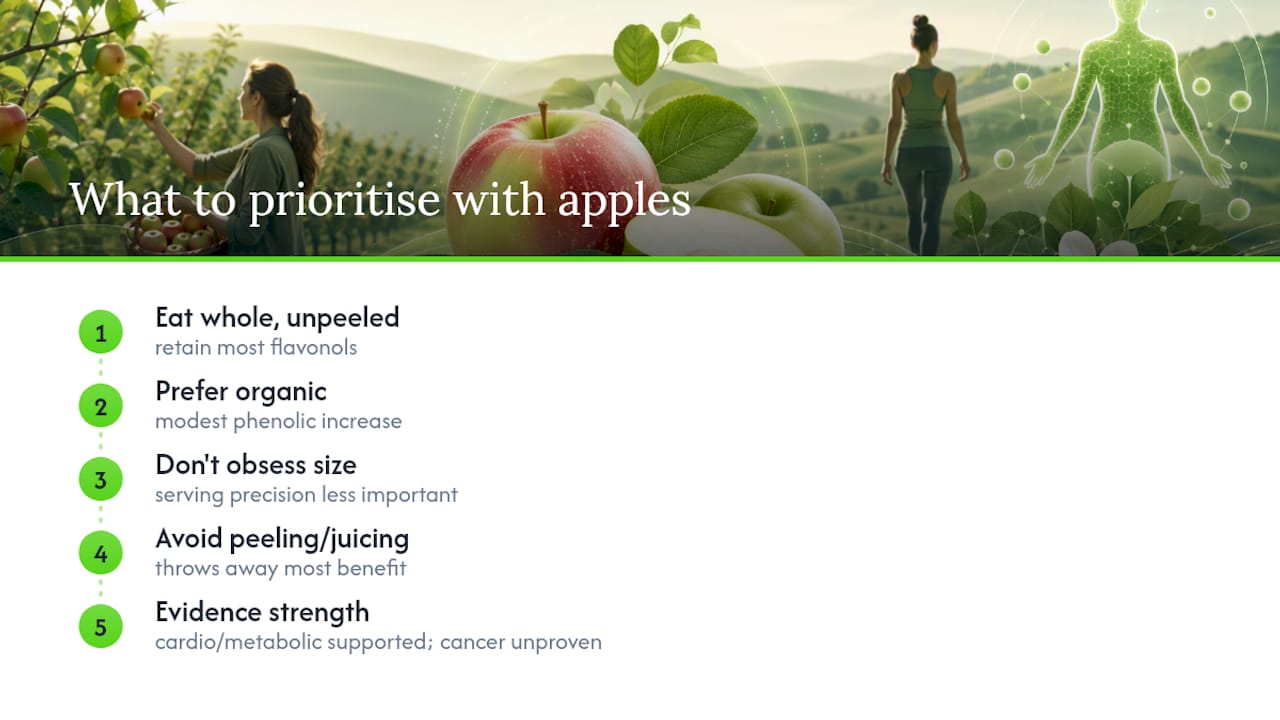
If I had to rank what matters, whole and unpeeled beats organic, and organic beats worrying about exact serving sizes. Peeling an apple or drinking its juice throws away more benefit than switching from conventional to organic ever adds back. That said, the organic phenolic increases documented in comparative studies are real enough that anyone eating apples several times a week should treat organic as the sensible default, not an indulgence.
Where I’d push back hardest on popular framing: cancer-prevention claims for apples get repeated far more confidently than the underlying lab-only evidence supports. Eat apples for the cardiovascular and metabolic benefits, which have real cohort backing. Treat anything beyond that as promising, not proven.
— Arjit
Where to find genuinely organic apples and produce
Naturessoulshop exists for exactly the reader who just read this far: someone who wants the phytochemical and residue advantages of organic produce without having to audit every apple’s growing history themselves. Sourcing organic fruit through a specialist grocer removes the guesswork that comes with unlabelled supermarket bins, where “organic” and conventional often sit side by side with no easy way to tell them apart at a glance.
A specialist grocer supplies organic fruit and groceries with same-day delivery in select regions, alongside dairy, vegan and gluten-free staples, and home and skincare products built on a clean-ingredient standard. If the postharvest handling points in this guide struck a chord, that same attention to freshness applies across the fresh produce range, where stock turnover is built around preserving nutrient quality rather than shelf-life alone. Browse the full Naturessoulshop store to see current organic fruit availability and place an order for delivery.
Sources
The claims in this guide draw on a small set of core references worth reading directly. The Harvard Nutrition Source apple profile covers general nutrient mechanisms; the 2004 phytochemical review remains a foundational summary of apple compounds and cancer/cardiovascular research; the MDPI organic versus conventional comparison supplies the phenolic and flavonol figures cited above; the postharvest handling review covers storage effects on bioactives; and the Dietary Guidelines for Americans anchor the whole-fruit-over-juice recommendation.
- Apples • The Nutrition Source
- Apple phytochemicals and their health benefits
- Comparative study: organic vs conventional apples (MDPI)
- Dietary Guidelines for Americans 2020-2025


