


TL;DR:
- Not all vegan foods are nutritionally equal; evaluate protein, micronutrients, fiber, and processing.
- Indian plant-based proteins like chickpeas, edamame, and pumpkin seeds are affordable and nutrient-rich.
- Focus on whole foods and local staples over processed imported products for sustainable and balanced vegan diets.
Switching to a vegan diet in India sounds straightforward until you actually stand in a grocery aisle, staring at dozens of products all claiming to be healthy, natural, and plant-based. The truth is, not every vegan option delivers genuine nourishment. With packaged plant-based meats, fortified milks, and trendy imported snacks flooding the market, it is easy to confuse variety with nutritional quality. This guide cuts through the noise. We will walk you through how to evaluate vegan alternatives properly, highlight the best protein-rich Indian foods, compare popular packaged options, and show you how to build truly balanced meals using what India already grows abundantly.
Table of Contents
- How to evaluate vegan alternatives for nutrition
- Top high-protein Indian vegan foods
- Plant-based milks and meats: benefits and trade-offs
- Choosing nutrient-complete, whole-food vegan options
- Why Indian vegan success depends on local whole foods, not just popular substitutes
- Discover organic vegan essentials for your Indian kitchen
- Frequently asked questions
Key Takeaways
| Point | Details |
|---|---|
| Prioritise whole foods | Unprocessed legumes, pulses, and millets are the most nutritious vegan choices in India. |
| Check for fortification | Packaged vegan milks and meats need vitamin B12 and iron fortification to ensure complete nutrition. |
| Mix for balance | Combine different plant foods for complete protein and micronutrient coverage. |
| Choose local and organic | Local organic produce offers better nutrition, sustainability, and affordability for vegan diets. |
How to evaluate vegan alternatives for nutrition
Not all vegan foods are created equal. A product can be 100% plant-based and still be nutritionally hollow, loaded with sodium, or stripped of fibre during processing. Before you pick anything off a shelf or add it to your weekly meal plan, it helps to have a clear framework.
Here are the six key criteria to assess any vegan alternative:
- Protein quality and completeness: Plants often lack one or more essential amino acids. Look for combinations or single sources like soy that offer a complete amino acid profile.
- Essential micronutrients: Vitamin B12, iron, and calcium are the three most commonly deficient nutrients in vegan diets. Check whether the product is naturally rich in these or fortified.
- Fibre content: A good vegan food should support gut health. Aim for options with at least 3 to 5 grams of fibre per serving.
- Sodium and sugar balance: Many packaged plant-based products use excess salt and sugar to improve flavour. Keep sodium under 400 mg per serving where possible.
- Ingredient sourcing: Locally grown and clean-label healthy foods are preferable to imported, heavily processed ingredients. Indian pulses and millets are both affordable and environmentally sound.
- Processing level: Whole-food plant-based diets consistently outperform ultra-processed alternatives in long-term health outcomes. The fewer the steps from field to plate, the better.
Processing level is particularly important in the Indian context. Unprocessed legumes are best for nutrition, cost, and sustainability in India, making a strong case for returning to basics rather than reaching for expensive mock meats.
“The best vegan choices are often the oldest ones. Chana, rajma, and moong have fed generations of Indians for good reason.”
Pro Tip: Always check for fortification on the label, especially for B12 and iron. If a product does not mention these, assume you will need to source them separately.
Understanding the nutritional contents of PBMAs (plant-based meat alternatives) also reveals how wide the gap can be between marketing claims and actual nutrient delivery. Use this framework every time you shop.
Top high-protein Indian vegan foods
India is genuinely fortunate when it comes to plant-based protein. The country’s agricultural diversity means that some of the world’s most protein-dense vegan foods are grown locally, are affordable, and have been part of Indian cooking for centuries.
Vegetable soybean and chickpea are top protein sources, with up to 34.9% and 23.6% protein respectively, making them two of the most powerful additions to any vegan meal plan.
Here is a quick comparison of major Indian high-protein vegan foods:
| Food | Protein per 100g | Key benefit |
|---|---|---|
| Vegetable soybean (edamame) | 25.7 to 34.9g | Complete amino acid profile |
| Chickpea (chana) | 22 to 25g | Versatile, widely available |
| Horse gram (kulthi) | 22 to 24g | Rich in iron and fibre |
| Green peas | 5 to 7g | Easy to add to any meal |
| Pumpkin seeds | 18 to 20g | High in zinc and magnesium |
| Flaxseed | 18g | Excellent omega-3 source |
Beyond protein numbers, here is what makes these foods stand out:
- Horse gram is one of India’s most underrated legumes. It has a higher protein density than most dals and is particularly popular in South India.
- Edamame (vegetable soybean) is now available fresh and frozen across major Indian cities and offers a complete protein that rivals many animal sources.
- Pumpkin seeds are easy to sprinkle on salads, porridges, or smoothies, making them one of the most practical protein boosters.
- Flaxseed doubles as an omega-3 source, which is especially valuable for vegans who do not consume fish.
Stocking up on these essential vegan pantry staples gives you a strong nutritional foundation without relying on expensive imports.
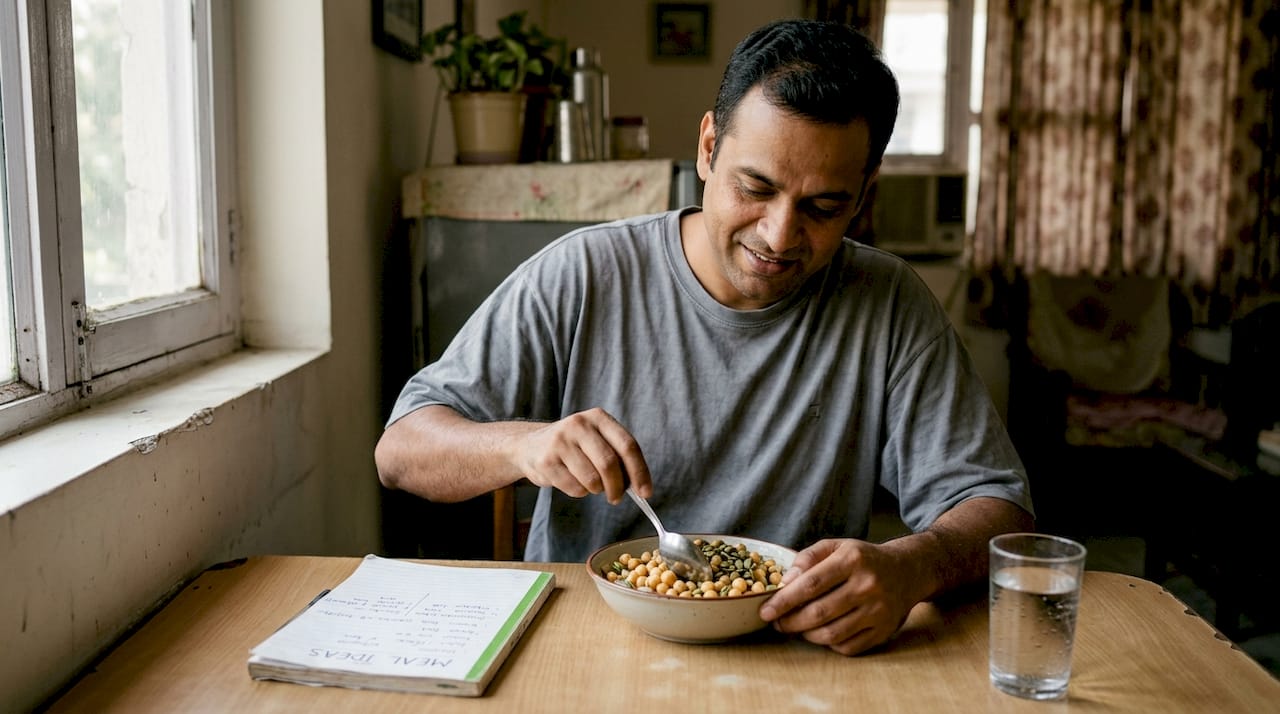
Pro Tip: Mix legumes with seeds at meals to balance amino acids naturally. A bowl of chana with a handful of pumpkin seeds covers far more nutritional ground than either food alone.
Plant-based milks and meats: benefits and trade-offs
Packaged vegan products have seen explosive growth in India. Soy milk, almond milk, oat milk, and burger-style plant-based meats are now available in most supermarkets and online stores. But popularity does not automatically mean nutritional superiority.
PBMAs in India generally have less protein and fat than animal meat, more fibre, sugar, and salt, and typically need fortification for B12 and iron. That is a significant set of trade-offs to be aware of before making them a daily staple.
Here is how common plant-based milks compare to dairy:
| Milk type | Protein per 100ml | Calcium | Notes |
|---|---|---|---|
| Cow’s milk | 3.4g | High (natural) | Reference point |
| Soy milk | 3.0 to 3.5g | Fortified | Closest to dairy in protein |
| Almond milk | 0.5 to 1.0g | Fortified | Low protein, low calories |
| Oat milk | 1.0 to 1.5g | Fortified | Higher carbohydrates |
| Rice milk | 0.3 to 0.5g | Fortified | Very low protein |
Soy milk is clearly the strongest dairy alternative from a protein standpoint. Almond and rice milks, while popular, are closer to flavoured water nutritionally unless heavily fortified.
For plant-based meats, most products only reach roughly 60% of the protein quality found in equivalent animal meat portions, and many carry surprisingly high sodium levels. If you are exploring Indian meat-alternative options, it is worth reading labels carefully rather than assuming all products are equivalent.
“Ultra-processed plant-based products may not be full nutrient equivalents. Pay close attention to fortification and ingredient lists before making them a regular part of your diet.”
It is also worth noting that some plant-based ingredients carry allergy considerations for vegans, particularly soy and tree nuts, which are common allergens. If you are experimenting with vegan desserts, check out some vegan dessert inspiration that uses whole ingredients rather than processed substitutes.
Choosing nutrient-complete, whole-food vegan options
Knowing what to avoid is only half the battle. The more empowering question is: how do you actually build meals that cover everything your body needs?
Prioritising local pulses, millets, and WFPB diets helps Indian vegans achieve balanced nutrition with minimal reliance on imports, and at a fraction of the cost of packaged alternatives.
Here are the signs that your vegan meal is nutritionally complete:
- Contains at least one legume or pulse as a protein source
- Includes a whole grain or millet for complex carbohydrates and B vitamins
- Has a variety of coloured vegetables for micronutrients and antioxidants
- Features a seed or nut component for healthy fats and minerals
- Is minimally processed with no added sugars or excessive sodium
Some of the easiest and most nutritious meal ideas include khichdi made with moong dal and bajra, millet salad with roasted chickpeas and seeds, and sprout bowls topped with sesame and lemon. These are not just traditional comfort foods. They are nutritionally sophisticated meals that tick nearly every box.
To transition towards a whole-food plant-based approach, follow these steps:
- Replace one processed vegan product per week with a whole-food equivalent.
- Build a base of three to four local pulses you enjoy and rotate them regularly.
- Introduce one millet (ragi, bajra, jowar) into your weekly meals.
- Add seeds to at least one meal per day for healthy fats and minerals.
- Review your B12 and iron levels every six months with a simple blood test.
For practical guidance, explore plant-based meal prep ideas that make weekly cooking simpler, and if you are avoiding gluten, there are excellent gluten-free vegan options that do not compromise on taste or nutrition.
Pro Tip: Always supplement B12 and, if your blood work suggests it, iron. No whole-food diet, however well designed, reliably provides adequate B12 for vegans.
Why Indian vegan success depends on local whole foods, not just popular substitutes
There is a tendency in urban India to equate going vegan with buying imported oat milk, expensive mock meats, and trendy protein powders. It is understandable. These products are well-marketed and feel modern. But they often deliver more packaging, more cost, and more nutritional uncertainty than the foods they claim to replace.
Whole-food plant-based diets in India carry a lower cost and environmental impact than processed or imported alternatives. That is not a minor footnote. It is the central argument for why Indian veganism should look inward, not outward.
India’s culinary heritage already contains the blueprint for excellent vegan nutrition. Rajma chawal, dal baati, pongal, and sprout salads are not just cultural staples. They are scientifically sound, nutritionally balanced meals that generations thrived on. The revival of millets, in particular, represents a genuine opportunity to improve both personal health and agricultural sustainability of plant-based eating across the country.
The smartest vegan diet in India is not the one with the most imported products. It is the one that uses what this land has always grown best.
Discover organic vegan essentials for your Indian kitchen
Building a nutritious vegan kitchen in India does not have to be complicated or expensive. The key is having the right staples on hand so that balanced, whole-food meals come together quickly and easily.
At Nature’s Soul, we have curated a range of organic, clean-ingredient vegan essentials sourced with care. From organic pulses, millets, and nuts to vegan snacks and bars that are free from artificial additives, everything is chosen to support a genuinely healthy plant-based lifestyle. You can also explore our fresh vegan kitchen staples for seasonal produce and pantry items delivered conveniently across India. Good nutrition starts with good ingredients, and we make finding them straightforward.
Frequently asked questions
Which Indian vegan foods have the most protein?
Vegetable soybean has 25.7 to 34.9% protein, chickpea 22 to 25%, and pumpkin seeds are also rich in protein, making these three of the top vegan protein sources available in India.
Are packaged plant-based meats and milks healthy?
PBMAs usually require fortification and can have higher salt and sugar than animal counterparts, so always check labels and prioritise products with added B12 and iron.
What nutrients do Indian vegans need to supplement?
Vitamin B12 and iron are the two key nutrients most vegans need to supplement, as Indian vegans need B12 supplementation and may also need iron depending on individual dietary intake.
How can I ensure my vegan meals are balanced?
WFPB diets with local pulses and millets help cover nutrition gaps; combine these with seeds and colourful vegetables and check protein, B12, iron, and calcium regularly.
Recommended
- Best Healthy Indian Snacks 2025: Tasty Options for Every Lifestyle – naturessoulshop
- Vegan Gluten Free Options in Delhi NCR 2025 Guide – naturessoulshop
- Vegan Pantry Staples: Essential Guide for Delhi NCR 2025 – naturessoulshop
- Healthy Vegan Dessert Recipes Loved in Delhi NCR – naturessoulshop
- Plant-based healing: 5 evidence-backed benefits in 2026


