


TL;DR:
- Living a minimalist lifestyle emphasizes intentional choices over owning fewer possessions. Research shows it enhances happiness by freeing time for meaningful activities and aligning with personal values. Ongoing discipline and a focus on purpose rather than decluttering events are essential for sustainable simplicity.
Most people assume living a minimalist lifestyle means owning fewer things. Clear the wardrobe, sell the sofa, done. But research published in 2026 tells a more interesting story. Minimalism has a 54% positive effect on happiness, and the mechanism is not possession count. It is intentional living, value-driven choices, and how you spend the time you free up. This guide covers the real philosophy, the psychological hurdles most people hit, and the practical steps that actually make simplicity stick.
Key takeaways
| Point | Details |
|---|---|
| Minimalism is intentional living | It goes beyond decluttering to making value-driven choices about time, energy, and possessions. |
| Research links it to happiness | A 2026 study found minimalist behaviour accounts for a 54% positive effect on happiness. |
| Decluttering is not enough | Without ongoing discipline and decision rules, clutter reliably returns after an initial clear-out. |
| Freed-up time is the real prize | Spending reclaimed hours on meaningful activities, not just owning less, drives genuine well-being. |
| Small steps create lasting habits | Scheduled sessions and 30-day challenges outperform sweeping overhauls for sustainable change. |
Living a minimalist lifestyle: what it really means
The word “minimalism” gets borrowed by interior designers, productivity coaches, and tech companies, but its philosophical roots go deeper. Voluntary simplicity is the more precise term used in academic literature. It describes a deliberate choice to reduce consumption, complexity, and distraction in favour of what genuinely matters to you.
This is not about aesthetics. A minimalist home does not need white walls or a single houseplant. What it does require is intentionality: owning things that serve a purpose, spending time in ways that align with your values, and resisting the cultural pressure to accumulate more as a proxy for success.
The research on why people adopt this lifestyle reveals something telling. Studies show that biospheric values (care for the environment) and altruistic values (concern for others) drive sustainable, happy minimalism. Egoistic motivation, such as minimising possessions to signal a certain identity, tends not to deliver the same well-being gains. The “why” shapes the outcome.
“Minimalism is not about having less for the sake of having less. It is about making room for what matters most.” This framing, consistent across both philosophy-based and research-backed accounts, is the most useful starting point for anyone considering the shift.
Here is what the evidence says distinguishes genuine minimalism from surface-level tidying:
- It addresses time, not just space. Anti-consumption lifestyles are primarily motivated by a desire for time freedom, not frugality.
- It is ongoing, not episodic. A clear-out feels satisfying, but it is a single event.
- It is personal. Your version of enough will differ from your neighbour’s, your colleague’s, or the influencer you follow.
- It connects to broader values, particularly around sustainability and meaningful relationships.
Misconceptions and psychological hurdles
One of the biggest reasons people struggle with simplicity is that they conflate two separate things. Decluttering is an event. Minimalism is a lifestyle. You can spend a weekend clearing your attic and feel terrific on Monday, then spend the next twelve months quietly re-accumulating. Without a decision infrastructure, a set of rules that govern what comes into your home and life, the default setting is always more.
There is also the emotional weight of the process itself. Decluttering can be genuinely stressful. Clinical psychologists note that sifting through possessions forces people to confront identity, memory, and loss. A values-based approach, asking “does this reflect who I want to be?” rather than “do I use this?”, reliably reduces that stress and produces more lasting decisions.
Another overlooked hurdle is the perception of busyness. Research in Scientific Reports found that perceived busyness shapes preferences toward simpler, smaller assortments to reduce decision effort. Ironically, the more overwhelmed you feel, the less mental bandwidth you have to make the good choices that would reduce that overwhelm.
Pro Tip: Before any decluttering session, write down three values that matter most to you right now. Use them as your filter. If an item or commitment does not serve at least one, it becomes much easier to let go.
Here is a practical sequence for working through the psychological challenges:
- Start with low-stakes areas. Bathroom cabinets and kitchen drawers carry less emotional charge than childhood memorabilia or a late parent’s belongings.
- Set a time limit. Thirty to forty-five minutes per session prevents decision fatigue from eroding your judgement.
- Create a “pause box” for anything you are unsure about. Review it after thirty days. Most of the time, you will not have missed the contents.
- Write down your decision rules. “One in, one out” or “I only buy something new when I have used up or given away the equivalent” are simple rules that prevent re-accumulation.
Practical tips for simplifying your home and life
The most effective minimalist living tips share one characteristic: they are small enough to sustain. Scheduling a one-hour decluttering session on a Saturday, or committing to a 30-day “no new purchases” challenge, works better than a weekend blitz that leaves you exhausted and vulnerable to rebound.
Beyond the physical environment, simplifying your life means auditing where your time and attention go. Digital clutter deserves the same scrutiny as physical clutter. The average person switches tasks dozens of times a day, and each switch carries a cognitive cost. Mono-tasking, committing to one activity at a time, is not a productivity hack. It is a form of mental minimalism.
Pro Tip: Apply the same “one in, one out” rule to commitments as you do to possessions. Before saying yes to a new obligation, identify what you will say no to in its place.
Here is a comparison of approaches that work versus those that tend to fail:
| Approach | What actually happens |
|---|---|
| Weekend blitz | Feels good initially; clutter returns within months without ongoing rules |
| Scheduled weekly sessions | Gradual, sustainable reduction with lower emotional fatigue |
| Buying a storage solution | Organises the excess rather than addressing the excess itself |
| 30-day no-buy challenge | Builds conscious consumption habits that often persist beyond the challenge |
| Deleting unused apps and subscriptions monthly | Reduces digital noise and recurring financial drains simultaneously |
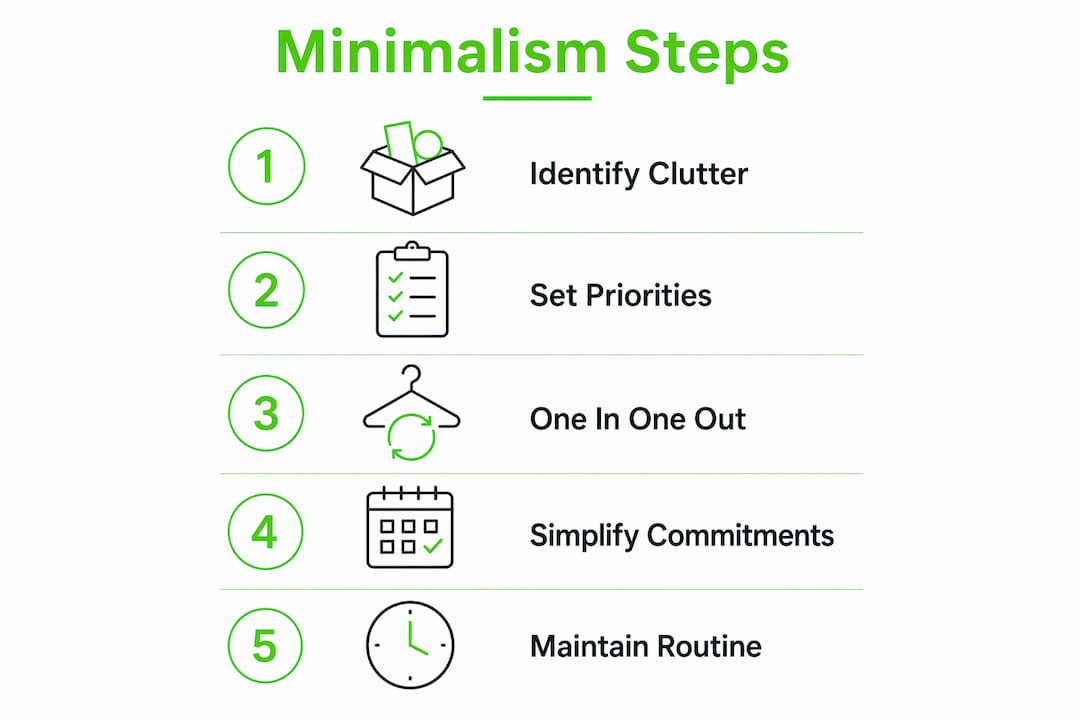
When simplifying your home, focus on duplicates first. Removing duplicate items and setting clear rules about future purchases is among the most consistently recommended steps from experienced minimalists, because duplicates accumulate invisibly and signal a deeper habit of “just in case” thinking.
The same principle applies to food and grocery shopping. Mindful grocery shopping naturally mirrors minimalist values: buying what you need, choosing quality over quantity, and reducing waste. The link between how you shop and how you live is closer than most people realise.
- Simplify your goals. Work on one significant change at a time rather than overhauling your entire life simultaneously.
- Plan how you will spend freed-up time. This is not trivial. Research shows that time spent meaningfully is the primary driver of well-being gains in minimalist lifestyles.
- Say no strategically. Every commitment you decline is an implicit choice to protect time for something that matters more.
- Practise zero waste shopping habits to bring minimalist values into your daily routines, not just your wardrobe.
Resilience, well-being, and sustainable living
The case for minimalism strengthened considerably during the COVID-19 pandemic. A survey of over 8,600 consumers conducted between 2020 and 2022 found that voluntary simplicity boosts resilience against crisis-driven stress. People who had already adopted simpler lifestyles before the pandemic showed markedly lower emotional distress during it.
The mechanism matters. The benefit came not from having fewer possessions per se, but from three specific traits that simple living tends to build: self-sufficiency, nonmaterial sources of fulfilment, and flexible problem-solving. These are psychological muscles. You develop them through ongoing practice, not a single decision.
“Voluntary simplicity helps mitigate crisis-driven stress better than forced restrictions, because it comes from an internal orientation rather than external pressure.” This distinction between chosen and imposed simplicity explains why minimalism adopted willingly feels freeing, while austerity forced on you feels devastating.
The environmental dimension is equally significant. Reduced consumption means fewer resources extracted, less waste generated, and a lower carbon footprint across the board. Choosing quality over quantity, repairing rather than replacing, and buying from producers who share your values are all expressions of the same philosophy.
Here is how the well-being benefits of minimalism break down across different life areas:
| Life area | Mechanism | Outcome |
|---|---|---|
| Mental health | Reduced decision fatigue and visual clutter | Lower baseline stress levels |
| Relationships | Less time on consumption; more time on people | Deeper, more attentive connections |
| Finances | Intentional spending and reduced impulse buying | Greater financial security over time |
| Environment | Mindful consumption and reduced waste | Lower personal environmental impact |
| Physical health | Cleaner spaces and reduced processed food consumption | Better sleep, diet, and energy |
A note of nuance: research also shows that high frugality can reduce time spent on meaningful activities if it becomes obsessive. Minimalism is not an ascetic competition. The goal is freedom, not deprivation.
My honest take on living with less
I have watched people approach minimalism as a one-off project and then quietly wonder why they feel no different six months later. The physical clear-out happened. The mental shift did not.
What I have learned is that the hardest part of this lifestyle is not getting rid of things. It is choosing what to do with the space and time you recover. Most people default to filling it again, whether with new purchases, new commitments, or new digital distractions. The real discipline is protecting that space long enough to discover what genuinely matters to you.
I have also noticed that the people who sustain minimalism long term are not the most frugal. They are the most intentional. There is a difference. Frugality alone, taken too far, can make you stingy with experiences and connections. Intentionality means spending generously on what matters and ruthlessly protecting against what does not.
My practical take: treat simplifying as a skill you practise weekly, not a destination you arrive at. Schedule a fifteen-minute review every Sunday. Ask what you bought, committed to, or consumed that week that did not serve your values. Then adjust. Over time, this habit compounds into a fundamentally different relationship with stuff, time, and your own attention.
— Arjit
Organic living starts with what you choose
Living with intention extends to what you put in your body and your home. That is where Naturessoulshop comes in.
At Naturessoulshop, every product is chosen with the same values that underpin minimalist living: clean ingredients, honest sourcing, and quality worth keeping. From organic fruits and vegetables to natural skin care and home care essentials, the range is built for people who want less noise and more substance in their daily routines. Choosing fewer, better products, whether organic dry grocery, vegan staples, or natural personal care, is one of the most direct ways to bring minimalist principles into everyday life. Explore the full range and start building a simpler, healthier home from the inside out.
FAQ
What is voluntary simplicity?
Voluntary simplicity is the academic term for a deliberate lifestyle choice to reduce consumption and complexity. It is the philosophy underpinning minimalism, focused on intentional living rather than just owning fewer possessions.
Does minimalism actually improve happiness?
Yes. A 2026 Springer Nature study found that minimalist behaviour has a 54% positive effect on happiness, with the biggest gains coming from spending freed-up time on meaningful activities rather than consumption.
How do I start decluttering without feeling overwhelmed?
Begin with low-stakes, low-emotion areas such as bathroom cabinets or kitchen drawers. Limit sessions to thirty to forty-five minutes and use your personal values as the filter for every decision. A values-based approach reduces stress and produces more lasting results.
Why does clutter always seem to come back?
Without clear decision rules about what enters your home and life, clutter returns by default. Minimalism requires ongoing discipline and recurring habits, not just a single clear-out event.
Can minimalism help during difficult times?
Research surveying over 8,600 people found that those who had adopted simpler lifestyles pre-crisis experienced significantly lower emotional stress during the COVID-19 pandemic, largely due to self-sufficiency and nonmaterial sources of fulfilment they had already built.


